Kirjojen hintavertailu – 12 859 826 kirjaa ja 27 kauppaa

Kirjailija

David Chandler

Kirjat ja teokset yhdessä paikassa: 63 kirjaa, julkaisuja vuosilta 1976–2026, suosituimpiin kuuluu Mermaid and the Monsters. Vertaile teosten hintoja ja tarkista saatavuus suomalaisista kirjakaupoista.

63 kirjaa

Kirjojen julkaisuvuodet: 1976–2026.

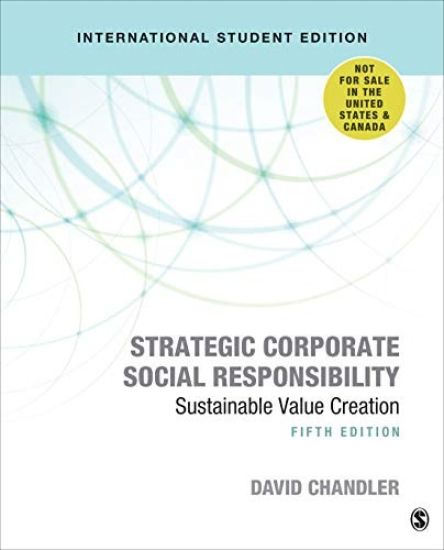
Strategic Corporate Social Responsibility - International Student Edition
Strategic Corporate Social Responsibility: Sustainable Value Creation, Fifth Edition, redefines corporate social responsibility (CSR) as being central to the value-creating purpose of the firm and provides a framework that firms can use to navigate the complex and dynamic business landscape. Based on a theory of empowered stakeholders, this bestselling text argues that the responsibility of a corporation is to create value, broadly defined. The primary challenge for managers today is to balance the competing interests of the firm’s stakeholders, understanding that what they expect today may not be what they will expect tomorrow. This tension is what makes CSR so demanding, but it is also what makes CSR integral to the firm’s strategy and day-to-day operations.

Jumble and the Lost Toys

Jumble and the Lost Toys

David Chandler

Independently Published
2019
pokkari
When Jumble wakes up, he finds himself in a strange house being looked after by a little old lady. She tells him that he had been found in the park and that the bump on his head had made him lose his memory. After he is fed and washed, he is introduced to other lost toys. That's where Jumble's adventures really begin. Jumble and the Lost Toys is the tale of a little lost bear looking for his way back home to his owner. The first of the 'Postal Bear Series', Jumble and the Lost Toys is a fully illustrated story written in seven chapters - perfect for a full week of bedtime reading, yet challenging enough for older children to read it themselves.
A History of Cambodia

A History of Cambodia

David Chandler

Routledge
2019
sidottu
In this clear and concise volume, author David Chandler provides a timely overview of Cambodia, a small but increasingly visible Southeast Asian nation. Praised by the Journal of Asian Studies as an ''original contribution, superior to any other existing work'', this acclaimed text has now been completely revised and updated to include material examining the early history of Cambodia, whose famous Angkorean ruins now attract more than one million tourists each year, the death of Pol Pot, and the revolution and final collapse of the Khmer Rouge. The fourth edition reflects recent research by major scholars as well as Chandler's long immersion in the subject and contains an entirely new section on the challenges facing Cambodia today, including an analysis of the current state of politics and sociology and the increasing pressures of globalization. This comprehensive overview of Cambodia will illuminate, for undergraduate students as well as general readers, the history and contemporary politics of a country long misunderstood.
100 Birds to See in Your Lifetime

100 Birds to See in Your Lifetime

David Chandler; Dominic Couzens; Nick Baker

Carlton Books Ltd
2019
sidottu
Part aspirational encyclopedia, part identification guide, 100 Birds to See in Your Lifetime provides detailed summary information and range maps, along with beautifully written profiles featuring unusual facts, anecdotes and its significance. Whilst many of the species would be on any bird enthusiast's wish list, the list has been fiercely debated by two renowned birding authors, using various criteria to arrive at a top 100. Some species are endangered and therefore a must to see and conserve; others are quite common but have a particular plumage or behaviour that makes them exceptional; and others have a legendary status amongst birdwatchers and the layman, such as the dancing Red-crowned Cranes and the spectacular Gyr Falcon.
Ontopolitics in the Anthropocene

Ontopolitics in the Anthropocene

David Chandler

Routledge
2018
sidottu
The Anthropocene captures more than a debate over how to address the problems of climate change and global warming. Increasingly, it is seen to signify the end of the modern condition itself and potentially to open up a new era of political possibilities. This is the first book to look at the new forms of governance emerging in the epoch of the Anthropocene. Forms of rule, which seek to govern without the handrails of modernist assumptions of ‘command and control’ from the top-down; taking on board new ontopolitical understandings of the need to govern on the grounds of non-linearity, complexity and entanglement. The book is divided into three parts, each focusing on a distinct mode or understanding of governance: Mapping, Sensing and Hacking. Mapping looks at attempts to govern through designing adaptive interventions into processes of interaction. Sensing considers ways of developing greater real time sensitivity to changes in relations, often deploying new technologies of Big Data and the Internet of Things. Hacking analyses the development of ways of ‘becoming with’, working to recomposition and reassemble relations in new and creative forms. This work will be of great interest to students and scholars of international politics, international security and international relations theory and those interested in critical theory and the way this is impacted by contemporary developments.
Ontopolitics in the Anthropocene

Ontopolitics in the Anthropocene

David Chandler

Routledge
2018
nidottu
The Anthropocene captures more than a debate over how to address the problems of climate change and global warming. Increasingly, it is seen to signify the end of the modern condition itself and potentially to open up a new era of political possibilities. This is the first book to look at the new forms of governance emerging in the epoch of the Anthropocene. Forms of rule, which seek to govern without the handrails of modernist assumptions of ‘command and control’ from the top-down; taking on board new ontopolitical understandings of the need to govern on the grounds of non-linearity, complexity and entanglement. The book is divided into three parts, each focusing on a distinct mode or understanding of governance: Mapping, Sensing and Hacking. Mapping looks at attempts to govern through designing adaptive interventions into processes of interaction. Sensing considers ways of developing greater real time sensitivity to changes in relations, often deploying new technologies of Big Data and the Internet of Things. Hacking analyses the development of ways of ‘becoming with’, working to recomposition and reassemble relations in new and creative forms. This work will be of great interest to students and scholars of international politics, international security and international relations theory and those interested in critical theory and the way this is impacted by contemporary developments.
Peacebuilding

Peacebuilding

David Chandler

Springer International Publishing AG
2017
nidottu
This book is the first to chart the rise and fall of peacebuilding. Charting its beginnings, as an ad-hoc extension of peacekeeping responsibilities, and formalisation, as a UN-supported international project of building liberal states. Twenty years later, the grounding policy assumptions of peacebuilding - that democracy, the rule of law and free markets were a universal solution to conflict-prone states and societies - have been revealed as naïve at best, and at worst, hubristic and Eurocentric. Here, Chandler traces the disillusionment with international peacebuilding, and the discursive shifts in the self-understanding of the peacebuilding project in policy and academic debate. He charts the transformation from peacebuilding as an international project based on universalist assumptions, to the understanding of peace as a necessarily indigenous process based on plural and non-linear understandings of difference. Is the end of peacebuilding necessarily a cause for celebration? Does this shift result in a realist resignation to the world as it appears? Is it necessary to “marry idealism with realism” – as E. H. Carr once argued - if we wish to keep open the possibilities for social change? This book seeks to answer these questions, making an invaluable reference both for students and practitioners of peacebuilding and for those interested in the broader shifts in the social and political grounding of policy-making today.
The Neoliberal Subject

The Neoliberal Subject

David Chandler; Julian Reid

Rowman Littlefield International
2016
sidottu
Political practices, agencies and institutions around the world promote the need for humans, individually and collectively, to develop capacities of resilience. We must accept and adapt to the ‘realities’ of an endemic condition of global insecurity and to the practice of so-called sustainable development. But in spite of claims that resilience make us more adept and capable, does the discourse of resilience undermine our ability to make our own decisions as to how we wish to live? This book draws out the theoretical assumptions behind the drive for resilience and its implications for issues of political subjectivity. It establishes a critical framework from which discourses of resilience can be understood and challenged in the fields of governance, security, development, and in political theory itself. Each part of the book includes a chapter by David Chandler and another by Julian Reid that build a passionate and provocative dialogue, individually distinct and offering contrasting perspectives on core issues. It concludes with an insightful interview with Gideon Baker. In place of resilience, the book argues that we need to revalorize an idea of the human subject as capable of acting on and transforming the world, rather than being cast in a permanent condition of enslavement to it.
The Neoliberal Subject

The Neoliberal Subject

David Chandler; Julian Reid

Rowman Littlefield International
2016
nidottu
Political practices, agencies and institutions around the world promote the need for humans, individually and collectively, to develop capacities of resilience. We must accept and adapt to the ‘realities’ of an endemic condition of global insecurity and to the practice of so-called sustainable development. But in spite of claims that resilience make us more adept and capable, does the discourse of resilience undermine our ability to make our own decisions as to how we wish to live? This book draws out the theoretical assumptions behind the drive for resilience and its implications for issues of political subjectivity. It establishes a critical framework from which discourses of resilience can be understood and challenged in the fields of governance, security, development, and in political theory itself. Each part of the book includes a chapter by David Chandler and another by Julian Reid that build a passionate and provocative dialogue, individually distinct and offering contrasting perspectives on core issues. It concludes with an insightful interview with Gideon Baker. In place of resilience, the book argues that we need to revalorize an idea of the human subject as capable of acting on and transforming the world, rather than being cast in a permanent condition of enslavement to it.
Resilience

Resilience

David Chandler

Routledge
2014
sidottu
Resilience has become a central concept in government policy understandings over the last decade. In our complex, global and interconnected world, resilience appears to be the policy ‘buzzword’ of choice, alleged to be the solution to a wide and ever-growing range of policy issues. This book analyses the key aspects of resilience-thinking and highlights how resilience impacts upon traditional conceptions of governance. This concise and accessible book investigates how resilience-thinking adds new insights into how politics (both domestically and internationally) is understood to work and how problems are perceived and addressed; from educational training in schools to global ethics and from responses to shock events and natural disasters to long-term international policies to promote peace and development. This book also raises searching questions about how resilience-thinking influences the types of knowledge and understanding we value and challenges traditional conceptions of social and political processes. It sets forward a new and clear conceptualisation of resilience, of use to students, academics and policy-makers, emphasising the links between the rise of resilience and awareness of the complex nature of problems and policy-making.
Resilience

Resilience

David Chandler

Routledge
2014
nidottu
Resilience has become a central concept in government policy understandings over the last decade. In our complex, global and interconnected world, resilience appears to be the policy ‘buzzword’ of choice, alleged to be the solution to a wide and ever-growing range of policy issues. This book analyses the key aspects of resilience-thinking and highlights how resilience impacts upon traditional conceptions of governance. This concise and accessible book investigates how resilience-thinking adds new insights into how politics (both domestically and internationally) is understood to work and how problems are perceived and addressed; from educational training in schools to global ethics and from responses to shock events and natural disasters to long-term international policies to promote peace and development. This book also raises searching questions about how resilience-thinking influences the types of knowledge and understanding we value and challenges traditional conceptions of social and political processes. It sets forward a new and clear conceptualisation of resilience, of use to students, academics and policy-makers, emphasising the links between the rise of resilience and awareness of the complex nature of problems and policy-making.
Biopesticides

Biopesticides

Alastair Bailey; David Chandler; Wyn Grant; Justin Greaves; Gillian Prince; Mark Tatchell

CABI Publishing
2012
nidottu
Biological controls that utilize natural predation, parasitism or other natural mechanisms, is an environmentally friendly alternative to chemical pesticides. Chemical pesticide methods are becoming less readily available due to increasing resistance problems and the prohibition of some substances. This book addresses the challenges of insufficient information and imperfectly understood regulatory processes in using biopesticides. It takes an interdisciplinary approach providing internationally comparative analyses on the registration of biopesticides and debates future biopesticide practices.
Honour Among Thieves

Honour Among Thieves

David Chandler

Harpercollins Publishers
2011
pokkari
Enter a world of darkness and danger, honour, daring and destiny in David Chandler�s magnificent epic trilogy: The Ancient Blades. One thief against the world�
RSPB First Book of Flowers

RSPB First Book of Flowers

Anita Ganeri; David Chandler

A C Black (Childrens books)
2011
nidottu

Halvin toimitettuna 15,90 €

Launching with four books looking at flowers, birds, mammals andminibeasts, each RSPB spotter's guide will comprise 35 common gardencreatures for beginner naturalists. Through beautifulfull-page illustration accompanied by key information about eachcreature, books are designed to encourage young children's interest inthe outside world and the wildlife around them. A spotter'schart for children to fill in, and links to Internet-based activitiesin each book, mean that children can extend the fun.
RSPB First Book Of Birds

RSPB First Book Of Birds

Anita Ganeri; David Chandler

A C Black (Childrens books)
2011
nidottu

Halvin toimitettuna 15,90 €

Learn all about identifying birds with this beautifully illustrated spotter's guide. With 35 British birds to learn about, the RSPB First Book of Birds is perfect for budding birdwatchers and naturalists. Through beautiful full-page illustration accompanied by key information about each creature, this book is designed to encourage young children's interest in the outside world and the wildlife around them. Includes a spotter's chart for children to fill in, key facts about each bird and accurate illustrations to make spotting birds easy. Part of a series of collectible spotter's guides published in partnership with the RSPB, the largest wildlife conservation charity in Europe. Other topics include: flowers, birds, mammals and minibeasts.