Kirjojen hintavertailu – 12 903 725 kirjaa ja 27 kauppaa

Kirjailija

David French

Kirjat ja teokset yhdessä paikassa: 43 kirjaa, julkaisuja vuosilta 1981–2025, suosituimpiin kuuluu Inorganic Geochemistry of Coal. Vertaile teosten hintoja ja tarkista saatavuus suomalaisista kirjakaupoista.

43 kirjaa

Kirjojen julkaisuvuodet: 1981–2025.

Inorganic Geochemistry of Coal

Inorganic Geochemistry of Coal

Shifeng Dai; Robert B. Finkelman; James C. Hower; David French; Ian T. Graham; Lei Zhao

Elsevier - Health Sciences Division
2023
nidottu
Inorganic Geochemistry of Coal explains how to determine the concentrations and modes of occurrence of elements in coal, how to diminish adverse effects of toxic elements on the environment and human health, which elements in coal could be industrially utilized, and which elements can be successfully used as indications for deciphering depositional environments and tectonic evolution. As coal use will remain at an all-time high for the next several decades, there is a critical need for understanding the properties of this fuel to ensure efficient use, encourage its economic by-product potential, and to help minimize its negative technological, environmental and health impacts.

For Valerie

For Valerie

David French

Gill
2025
nidottu

Halvin toimitettuna 30,90 €

In June 2019, Valerie French Kilroy was brutally murdered by her husband at their home near Westport, while her three young sons lay in bed. She was the third woman to lose her life at the hands of a partner in Ireland that year. For her brother David and the rest of her family it was the beginning of a battle against a system unprepared to protect the three innocent children whose father remains their legal guardian, despite being convicted of their mother’s murder. From the shock of hearing of his sister's death and the immediate aftermath to the multiple criminal trials before the guilty verdict was delivered, David provides a unique insight into some of the issues faced by victim’s families in the aftermath of fatal domestic violence. With every chapter, For Valerie confronts the darkest corners of grief, the love that endures beyond loss and the fierce determination of a family to preserve Valerie’s legacy. This is a tribute to her life, and a journey no reader will soon forget.
The Religion of American Greatness

The Religion of American Greatness

David French; Paul D. Miller

IVP Academic
2024
nidottu

Halvin toimitettuna 29,50 €

Long before it featured dramatically in the 2016 presidential election, Christian nationalism had sunk deep roots in the United States. From America's beginning, Christians have often merged their religious faith with national identity. But what is Christian nationalism? How is it different from patriotism? Is it an honest quirk, or something more threatening? Paul D. Miller, a Christian scholar, political theorist, veteran, and former White House staffer, provides a detailed portrait of--and case against--Christian nationalism. Building on his practical expertise not only in the archives and classroom but also in public service, Miller unravels this ideology's historical importance, its key tenets, and its political, cultural, and spiritual implications. Miller shows what's at stake if we misunderstand the relationship between Christianity and the American nation. Christian nationalism--the religion of American greatness--is an illiberal political theory, at odds with the genius of the American experiment, and could prove devastating to both church and state. Christians must relearn how to love our country without idolizing it and seek a healthier Christian political witness that respects our constitutional ideals and a biblical vision of justice.
Untrustworthy – The Knowledge Crisis Breaking Our Brains, Polluting Our Politics, and Corrupting Christian Community
Christianity Today 2023 Award of Merit (Politics & Public Life)Logos 2022 Book of the Year Award (Christianity in Culture)Which media outlets will help me be a responsible news consumer? How do I know what is true and whom I can trust? What can I do to combat all the misinformation and how it's impacting people I love? Many Americans are agonizing over questions such as these, feeling unsure and overwhelmed in today's chaotic information environment. American life and politics are suffering from a raging knowledge crisis, and the church is no exception. In Untrustworthy, Bonnie Kristian unpacks this crisis and explores ways to combat it in our own lives, families, and church communities. Drawing from her extensive experience in journalism and her training as a theologian, Kristian explores social media, political and digital culture, online paranoia, and the press itself. She explains factors that contribute to our confusion and helps Christians pay attention to how we consume content and think about truth. Finally, she provides specific ways to take action, empowering readers to avoid succumbing to or fueling the knowledge crisis.
The Religion of American Greatness – What's Wrong with Christian Nationalism
ECPA Top Shelf Award Winner Long before it featured dramatically in the 2016 presidential election, Christian nationalism had sunk deep roots in the United States. From America's beginning, Christians have often merged their religious faith with national identity. But what is Christian nationalism? How is it different from patriotism? Is it an honest quirk, or something more threatening? Paul D. Miller, a Christian scholar, political theorist, veteran, and former White House staffer, provides a detailed portrait of—and case against—Christian nationalism. Building on his practical expertise not only in the archives and classroom but also in public service, Miller unravels this ideology's historical importance, its key tenets, and its political, cultural, and spiritual implications. Miller shows what's at stake if we misunderstand the relationship between Christianity and the American nation. Christian nationalism—the religion of American greatness—is an illiberal political theory, at odds with the genius of the American experiment, and could prove devastating to both church and state. Christians must relearn how to love our country without idolizing it and seek a healthier Christian political witness that respects our constitutional ideals and a biblical vision of justice.
Deterrence, Coercion, and Appeasement

Deterrence, Coercion, and Appeasement

David French

Oxford University Press
2022
sidottu
Deterrence, Coercion, and Appeasement presents a compelling and original survey of British grand strategy in the inter-war period. Whereas most existing accounts privilege either diplomacy and foreign affairs, intelligence, or military affairs more narrowly, this study underlines the inexorable relationships between foreign policy, grand strategy, military force, intelligence, finance and not least, domestic politics and public opinion. Britain was the world's only global power in the inter-war period, and it confronted problems on a global scale. Policy-makers sought two goals: peace with security. They did so successfully in the 1920s, partly due to favourable circumstances that made their task relatively easy, and partly because they understood the strengths and limitations of British power and knew how to wield them. The situation deteriorated rapidly in the 1930s, however, as the international system became increasingly unfavourable to Britain. Policy-makers proved less adept than their predecessors at meeting these new challenges, partly because those challenges were more formidable, but also because they lacked the self-confidence of their predecessors, who had held high office during the most difficult years of the First World War and who lacked their understanding of how to wield the lever of international power. The study ends by providing a new and more sophisticated account of how and why Neville Chamberlain appeased the fascist powers in the late 1930s, and why Winston Churchill opposed him and eventually supplanted him in May 1940.
Divided We Fall

Divided We Fall

David French

St Martin's Press
2022
pokkari
Now in paperback: David French warns of the potential dangers to the country--and the world--if we don't summon the courage to reconcile our political differences. Two decades into the 21st Century, the U. S. is less united than at any time in our history since the Civil War. We are more diverse in our beliefs and culture than ever before. But red and blue states, secular and religious groups, liberal and conservative idealists, and Republican and Democratic representatives all have one thing in common: each believes their distinct cultures and liberties are being threatened by an escalating violent opposition. This polarized tribalism, espoused by the loudest, angriest fringe extremists on both the left and the right, dismisses dialogue as appeasement; if left unchecked, it could very well lead to secession. An engaging mix of cutting edge research and fair-minded analysis, Divided We Fall is an unblinking look at the true dimensions and dangers of this widening ideological gap, and what could happen if we don't take steps toward bridging it. French reveals chilling, plausible scenarios of how the United States could fracture into regions that will not only weaken the country but destabilize the world. But our future is not written in stone. By implementing James Madison's vision of pluralism--that all people have the right to form communities representing their personal values--we can prevent oppressive factions from seizing absolute power and instead maintain everyone's beliefs and identities across all fifty states. Reestablishing national unity will require the bravery to commit ourselves to embracing qualities of kindness, decency, and grace towards those we disagree with ideologically. French calls on all of us to demonstrate true tolerance so we can heal the American divide. If we want to remain united, we must learn to stand together again.
Heart Full of Soul

Heart Full of Soul

David French

McFarland Co Inc
2020
pokkari

Halvin toimitettuna 37,70 €

This is the first full-length biography of Keith Relf, frontman for the Yardbirds and one of the great tragic characters in rock history. Keith's moody vocals and harmonica helped to define the Yardbirds' sound on a string of innovative hit records in the 1960s that influenced garage rock, psychedelia, blues rock, hard rock and heavy metal. Numerous books have been written about the Yardbirds' famous guitarists--Eric Clapton, Jeff Beck and Jimmy Page--yet Keith has remained a mysterious and elusive figure since his death by electrocution at age 33. A deeply private person, prone to depression and poor health, Keith was ill-suited to the life of a rock star. In the years following the Yardbirds' breakup, as the band's guitarists became household names playing blues-based rock, Keith insisted on pursuing new musical paths, always searching for something new and trying to extend the Yardbirds' spirit of curiosity and innovation. By the time of his death in 1976, Keith was nearly forgotten and struggling physically, emotionally and financially. More than forty years after his tragic death, this important artist's story has finally been written and his contributions celebrated as more than just a footnote to the careers of his better-known bandmates.
The British Way in Warfare 1688 - 2000 (Routledge Revivals)
First published in 1990, this title examines British defence policy from 1688 onwards; the year in which Britain was successfully invaded for the final time, and which marked a generation of warfare that lasted until 1714, during which Britain came to be known as a major European power. David French considers the strategic alliances that formed and changed throughout the period, and tests his hypotheses in light of the varying paradigms of war, and British wartime and peacetime practices. The ways in which the needs of both the army and the navy have been balanced over time are analysed, with particular attention paid to how parliament allotted money and resources to each. Wars under discussion include the American War of Independence (1763-83), and the French Revolutionary and Napoleonic Wars. A detailed and critical title, this reissue will be of great value to history students studying Early Modern diplomacy, with a particular emphasis on the strategic development of British warfare and policy, and the place of Britain within the European power structure.
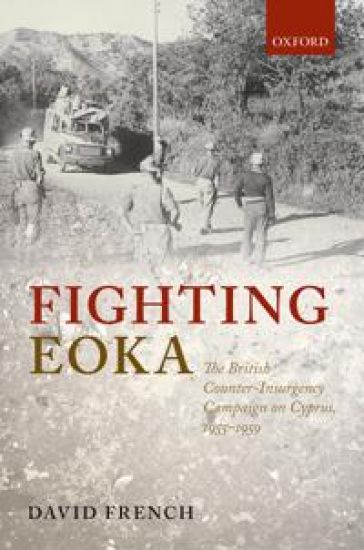
Fighting EOKA

Fighting EOKA

David French

Oxford University Press
2015
sidottu
Drawing upon a wide range of unpublished sources, including files from the recently-released Foreign and Commonwealth Office 'migrated archive', Fighting EOKA is the first full account of the operations of the British security forces on Cyprus in the second half of the 1950s. It shows how between 1955 and 1959 these forces tried to defeat the Greek Cypriot paramilitary organisation, EOKA, which was fighting to bring about enosis, that is the union between Cyprus and Greece. By tracing the evolving pattern of EOKA violence and the responses of the police, the British army, the civil administration on the island, and the minority Turkish Cypriot community, David French explains why the British could contain the military threat posed by EOKA, but could not eliminate it. The result was that by the spring of 1959 a political stalemate had descended upon Cyprus, and none of the contending parties had achieved their full objectives. Greek Cypriots had to be content with independence rather than enosis. Turkish Cypriots, who had hoped to see the island partitioned on ethnic lines, were given only a share of power in the government of the new Republic, and the British, who had hoped to retain sovereignty over the whole of the island, were left in control of just two military enclaves.
British Economic and Strategic Planning
The political manoeuvres which brought about the collapse of Britain's last Liberal government in May 1915 have already been the subject of much scholarly debate. This book will attempt to go beyond the arena of strictly party and factional politics and will examine some of the administrative problems the Liberals faced on the home front.
The British Way in Warfare 1688 - 2000 (Routledge Revivals)
First published in 1990, this title examines British defence policy from 1688 onwards; the year in which Britain was successfully invaded for the final time, and which marked a generation of warfare that lasted until 1714, during which Britain came to be known as a major European power. David French considers the strategic alliances that formed and changed throughout the period, and tests his hypotheses in light of the varying paradigms of war, and British wartime and peacetime practices. The ways in which the needs of both the army and the navy have been balanced over time are analysed, with particular attention paid to how parliament allotted money and resources to each. Wars under discussion include the American War of Independence, and the French Revolutionary and Napoleonic Wars. A detailed and critical title, this reissue will be of great value to history students studying Early Modern diplomacy, with a particular emphasis on the strategic development of British warfare and policy, and the place of Britain within the European power structure.
Army, Empire, and Cold War

Army, Empire, and Cold War

David French

Oxford University Press
2012
sidottu
The veterans of the Fourteenth Army who fought in Burma between 1942 and 1945 called themselves 'the forgotten army'. But that appellation could equally well be applied to the whole of the British army after 1945. Histories of Britain's post-war defence policy have usually focused on how and why Britain acquired a nuclear deterrent. David French takes a new look at these policies by placing the army centre-stage. Drawing on archival sources that have hardly been used by historians, he shows how British governments tried to create an army that would enable them to maintain their position as a major world power at a time when their economy struggled to foot the bill. The result was a growing mismatch between the military resources that the government thought it could afford on the one hand, and a long list of overseas commitments, in Europe, Africa, the Middle East, and the Far East, that it was reluctant to surrender. The result was that the British created a Potemkin army, a force that had an outwardly impressive facade, but that in reality had only very limited war-fighting capabilities. Army, Empire, and Cold War will interest not only historians of the British army, but also those who are trying to understand Britain's role in the Cold War, and how and why the British came to surrender formal rule over their empire.
The British Way in Counter-Insurgency, 1945-1967

The British Way in Counter-Insurgency, 1945-1967

David French

Oxford University Press
2011
sidottu
The claim by the Ministry of Defence in 2001 that 'the experience of numerous small wars has provided the British Army with a unique insight into this demanding form of conflict' unravelled spectacularly in Iraq and Afghanistan. One important reason for that, David French suggests, was because contemporary British counter-insurgency doctrine was based upon a serious misreading of the past. Until now, many observers believed that during the wars of decolonisation in the two decades after 1945, the British had discovered how western liberal notions of right and wrong could be made compatible with the imperatives of waging war amongst the people, that force could be used effectively but with care, and that a more just and prosperous society could emerge from these struggles. By using only the minimum necessary force, and doing so with the utmost discrimination, the British were able to win by securing the 'hearts and minds' of the people. But this was a serious distortion of actual British practice on the ground. David French's main contention is that the British hid their use of naked force behind a carefully constructed veneer of legality. In reality, they commonly used wholesale coercion, including cordon and search operations, mass detention without trial, forcible population resettlement, and the creation of free-fire zones to intimidate and lock-down the civilian population. The British waged their counter-insurgency campaigns by being nasty, not nice, to the people. The British Way in Counter-Insurgency is a seminal reassessment of the historical foundation of British counter doctrine and practice.
Leaving Home

Leaving Home

David French

Samuel French, Inc
2011
pokkari
Drama Characters: 4 male, 3 female Interior Set An exceptional drama by an award winning Canadian playwright. The Mercer family's cohesiveness is being torn asunder. The subtle threads of mutual understanding, confidence and trust have come unraveled. The key character is the patriarch, Jacob, a man obsessed with making his two sons reflections of himself. A complex man, sometimes compassionate, and often contradictory, who inspires rebellion in his sons, Billy, and Ben. Jacob's wife, Mary, remains loyal to her husband but wants her sons to be free to go their own way. The crisis takes place when Billy, the younger son, is about to be married to Kathy, pregnant and of another religion. But a greater shock is in store for Jacob when Ben tells him he is leaving home and going to rent a room at the young newlywed's place. Oedipal conflicts explode that marriage eve and the family is never the same again. "The lacerating quality of inter-family warfare carries both superb comedy and powerful emotional force...an overwhelming dramatic experience." -The Toronto Star