Kirjojen hintavertailu – 12 870 382 kirjaa ja 27 kauppaa

Kirjailija

David Osborne

Kirjat ja teokset yhdessä paikassa: 25 kirjaa, julkaisuja vuosilta 1993–2025, suosituimpiin kuuluu Papa's Story. Vertaile teosten hintoja ja tarkista saatavuus suomalaisista kirjakaupoista.

25 kirjaa

Kirjojen julkaisuvuodet: 1993–2025.

Reason to Hope

Reason to Hope

David Osborne

WILD GOOSE PUBLICATIONS
2025
nidottu
Is hope just a feeling? Or something more powerful? In a world grappling with climate change, rampant pollution and collapsing ecosystems, hope can seem like a luxury – a temporary mood easily extinguished. We try to stay positive, but the question remains of whether there is any fundamental reason to hope. David Osborne takes us on a profound exploration that challenges superficial thinking. Merging insights from science and religion, counselling and campaigning, pastoral work and parenthood, he digs beneath the surface to examine: • The nature of the world we are part of • Why societies and individuals act the way they do • The rich tapestry of spiritual experience and insight • How ancient Hebrew and Christian scriptures can be interpreted into our own understanding of the world and society • How their wisdom is relevant to the question of hope in the face of today’s urgent problems Hope is shown to be a substantial, energising force which can move us beyond fragile optimism. This book suggests how we can tap into the vital energy we need not just to cope but to work for change. It shows a way to move beyond despair to an empowering hope.
The Law of Ship Mortgages

The Law of Ship Mortgages

David Osborne; Charles Buss; Joanne Champkins

TAYLOR FRANCIS LTD
2024
sidottu
This fully updated and comprehensive 3rd edition of The Law of Ship Mortgages provides readers with a practical, commercially based and definitive guide to the English law of ship mortgages. The authors, being seasoned practitioners, bring their extensive experience to bear on a number of difficult and developing areas of the law, such as: mortgagees’ duties, liability to charterers, the conflict of laws, work-outs, restructurings and cross-border insolvency. The 3rd edition includes new chapters on pre-delivery security, security over shares and on the increasingly important topic of ship leasing as a method of finance. It is written against the background of, and has regard to, ever-increasing sanctions affecting shipping and ship finance as well as the continued regulatory and industry-driven push towards reduction of emissions (IMO 2020 and IMO 2050). Written primarily with practitioners in mind, The Law of Ship Mortgages will continue to be extremely useful to legal professionals, especially in common law jurisdictions, involved in international ship finance or ship mortgage enforcement. It will also be a valuable resource for postgraduate students and academics, especially those with an interest in shipping law or the law of personal property more generally.
Twenty

Twenty

David Osborne

austin macauley publishers llc
2022
pokkari
COVID-19 is real. Twenty is an imagined outbreak that could be unleashed on the Earth's population. We could even be at threat from otherworldly contamination. Labs exist for research everywhere, mostly driven by greed, which is a basal instinct of human nature. There are some who believe the COVID-19 epidemic was wrought on civilization either by intentional or accidental release from a laboratory funded in most part by the United States in Wuhan, China. The ensuing ineptitude of all parties involved should convince someone their safety is most definitely at risk from future disease mutations and creation in the incubator the global population provides. Trust in governments, drug companies, and major corporations to ensure your ultimate protection is doubtful at the very best. This novel portrays one of the possible scenarios that could happen. All you need is to turn the first and the journey thereafter will hook and lead you to the explosive finish.
Twenty

Twenty

David Osborne

austin macauley publishers llc
2022
sidottu
COVID-19 is real. Twenty is an imagined outbreak that could be unleashed on the Earth's population. We could even be at threat from otherworldly contamination. Labs exist for research everywhere, mostly driven by greed, which is a basal instinct of human nature. There are some who believe the COVID-19 epidemic was wrought on civilization either by intentional or accidental release from a laboratory funded in most part by the United States in Wuhan, China. The ensuing ineptitude of all parties involved should convince someone their safety is most definitely at risk from future disease mutations and creation in the incubator the global population provides. Trust in governments, drug companies, and major corporations to ensure your ultimate protection is doubtful at the very best. This novel portrays one of the possible scenarios that could happen. All you need is to turn the first and the journey thereafter will hook and lead you to the explosive finish.
Papa's Story

Papa's Story

David Osborne

Xlibris Us
2019
sidottu
It is 1944, and war is raging in Europe and Japan. Chuck is still in high school but his dream is to join the army and fight the Germans. One day, in the spring of 1944, he was walking on a lonely road and met someone that caused him to have another dream. This dream began when he met Betty Watson, the bank president's daughter. His good fortune began when, by a chance meeting, the Desoto she was driving had a flat tire. Her misfortune became Chuck's continuing desire to marry the girl of his dreams even though she was a few years older than he was. Although the two became good friends, Betty frequently reminded him that she had a boyfriend and that he was serving his country in the military. That information, although disheartening, did not keep Chuck from pursuing her. Betty and Chuck spent weeks together going places such as the bowling alley, the skating rink and the movies, while both insisted they were not dating. Chuck's older sister spilled the beans about the couple to his father who was not thrilled. His father suggested he date girls in school that were closer to his age but to no avail. Chuck had a one-track mind and that one track was Betty. In conversations between them Betty expressed doubt about a commitment from her soldier boyfriend and that was all the encouragement Chuck needed. After avoiding Chuck for several weeks, Betty confided in him that she was pregnant and her boyfriend, Bobby, was the father of the child. The announcement was a blow to him but Chuck was still not ready to give up on marrying her. However, when Betty's parents found out about her pregnancy, they shipped her off to California to have the baby and place it up for adoption. With one dream dimming the other was still very much alive. He graduated from high school and joined the army. Even though the war in Europe was winding down, the war in Japan was still very much alive. Chuck continued to write letters to Betty but at some point, her letters stopped. Chuck's interest in Betty had to be put on the back burner because of his military duties including guarding a brothel in Japan. After his discharge from the army Chuck attempted to rekindle their story but by that time Betty had married the father of her child. Even though he was still in love with Betty, he felt it was time for him to move on with his life. Where would he go from there?
Papa's Story

Papa's Story

David Osborne

Xlibris Us
2019
pokkari
It is 1944, and war is raging in Europe and Japan. Chuck is still in high school but his dream is to join the army and fight the Germans. One day, in the spring of 1944, he was walking on a lonely road and met someone that caused him to have another dream. This dream began when he met Betty Watson, the bank president's daughter. His good fortune began when, by a chance meeting, the Desoto she was driving had a flat tire. Her misfortune became Chuck's continuing desire to marry the girl of his dreams even though she was a few years older than he was. Although the two became good friends, Betty frequently reminded him that she had a boyfriend and that he was serving his country in the military. That information, although disheartening, did not keep Chuck from pursuing her. Betty and Chuck spent weeks together going places such as the bowling alley, the skating rink and the movies, while both insisted they were not dating. Chuck's older sister spilled the beans about the couple to his father who was not thrilled. His father suggested he date girls in school that were closer to his age but to no avail. Chuck had a one-track mind and that one track was Betty. In conversations between them Betty expressed doubt about a commitment from her soldier boyfriend and that was all the encouragement Chuck needed. After avoiding Chuck for several weeks, Betty confided in him that she was pregnant and her boyfriend, Bobby, was the father of the child. The announcement was a blow to him but Chuck was still not ready to give up on marrying her. However, when Betty's parents found out about her pregnancy, they shipped her off to California to have the baby and place it up for adoption. With one dream dimming the other was still very much alive. He graduated from high school and joined the army. Even though the war in Europe was winding down, the war in Japan was still very much alive. Chuck continued to write letters to Betty but at some point, her letters stopped. Chuck's interest in Betty had to be put on the back burner because of his military duties including guarding a brothel in Japan. After his discharge from the army Chuck attempted to rekindle their story but by that time Betty had married the father of her child. Even though he was still in love with Betty, he felt it was time for him to move on with his life. Where would he go from there?
Love for the Future

Love for the Future

David Osborne

WILD GOOSE PUBLICATIONS
2013
nidottu
Environment * Spirituality * Personal growth * Virtue ethics Climate change, pollution and diminishing resources mean that the future will be difficult for life on earth. We face an environmental crisis. Clearly we need technological solutions to some of our problems, and appropriate political and social programmes. But to meet the challenge we must also change ourselves. We need the courage to face up to what is happening, the determination to work at the problems and the freedom to let go of the old ways of living which are causing such damage to the earth. And that is hard. The scale of the problem can feel overwhelming. We may be drained by fear or worn down by our seeming lack of progress. In this book David Osborne tells of a long pilgrimage on foot to the island of Iona, an ancient centre of Celtic Christianity. In telling the story he draws on the Bible, the Christian tradition and other sources of wisdom to suggest the qualities we need to develop in ourselves for the journey we face into the future. He points to some of the spiritual resources available to us and suggests ways to develop our spiritual lives in order to grow in compassion, faith, hope and wisdom, while tapping into the energy of the Creator to work for the healing of the creation. The book contains material for personal reflection and group discussion, pointers for further reading, and practical suggestions for a way of living in which we can make our own journey into the future with love. Using the thread of a long walk from Shropshire to Iona, David Osborne weaves together autobiography, spiritual reflection, and passionate concern for the future of the earth threatened by irreversible climate change. A rare resource for all those people struggling to keep faith and hope going in the face of what feel like insuperable odds. - Tim Gorringe, St Luke's Professor of Theology, Exeter University
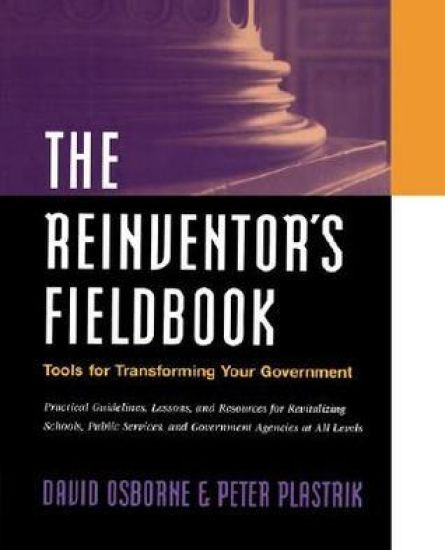
The Reinventor's Fieldbook

The Reinventor's Fieldbook

David Osborne; Peter Plastrik

Jossey-Bass Inc.,U.S.
2000
nidottu
Presenting more than 70 tools, The Reinventor's Fieldbook includes hundreds of practical "lessons learned," "do's and don'ts," "steps to take," and "pitfalls to avoid" in public management and governance. Based on dozens of case studies from five countries, it covers the waterfront of high-performance public organizations, including: customer choice and customer service standards, performance measurement, and performance budgeting; employee empowerment and labor-management partnerships; managed competition and asset privatization; partnerships with communities; culture change strategies; and administrative system reform.
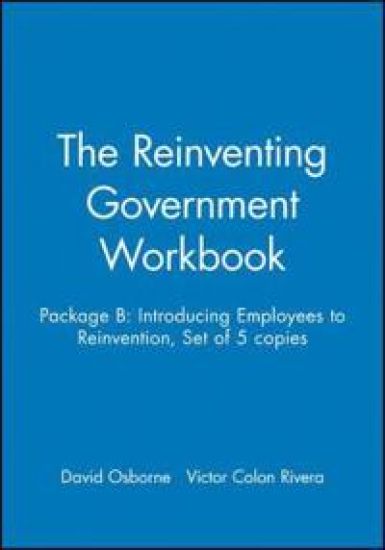
The Reinventing Government Workbook

The Reinventing Government Workbook

David Osborne; Victor Colon Rivera

Pfeiffer Wiley
1999
nidottu
A revolution is stirring in America. People are angry at governments that spend more but deliver less, frustrated with bureaucracies that give them no control, and tired of politicians who raise taxes and cut services but fail to solve the problems we face. Reinventing Government is both a call to arms in the revolt against bureaucratic malaise and a guide to those who want to build something better. It shows that there is a third way: that the options are not simply liberal or conservative, but that our systems of governance can be fundamentally reframed; that a caring government can still function as efficiently and productively as the best-run businesses. Authors Osborne and Gaebler describe school districts that have used choice, empowerment, and competition to quadruple their students’ performance; sanitation departments that have cut their costs in half and now beat the private sector in head-to-head competition; military commands that have slashed red tape, decentralized authority, and doubled the effectiveness of their troops. They describe a fundamental reinvention of government already underway—in part beneath the bright lights of Capitol Hill, but more often in the states and cities and school districts of America, where the real work of government goes on. From Phoenix to St. Paul, Washington, D. C. to Washington state, entrepreneurial public managers have discarded budget systems that encourage managers to waste money, scrapped civil service systems developed for the nineteenth century, and jettisoned bureaucracies built for the 1930s. They have replaced these industrial-age systems with more decentralized, more entrepreneurial, more responsive organizations designed for the rapidly changing, information-rich world of the 1990s. Osborne and Gaebler isolate and describe ten principles around which entrepreneurial public organizations are built. They:1) steer more than they row 2) empower communities rather than simply deliver services 3) encourage competition rather than monopoly 4) are driven by their missions, not their rules 5) fund outcomes rather than inputs 6) meet the needs of the customer, not the bureaucracy 7) concentrate on earning, not just spending 8) invest in prevention rather than cure 9) decentralize authority 10) solve problems by leveraging the marketplace, rather than simple creating public programs. Reinventing Government is not a partisan book. It focuses not on what government should do, but on how government should work. As such, it has been embraced by both liberals and conservatives, Democrats and Republicans.