Kirjailija
David Williams
Kirjat ja teokset yhdessä paikassa: 219 kirjaa, julkaisuja vuosilta 1966–2026, suosituimpiin kuuluu The Bible, Teetotalism, and Dr. Lees [A Reply to Teetotalism Plainly Taught in the Bible]. Vertaile teosten hintoja ja tarkista saatavuus suomalaisista kirjakaupoista.
219 kirjaa
Kirjojen julkaisuvuodet: 1966–2026.
Statistics do not lie, nor is probability paradoxical. You just have to have the right intuition. In this lively look at both subjects, David Williams convinces mathematics students of the intrinsic interest of statistics and probability, and statistics students that the language of mathematics can bring real insight and clarity to their subject. He helps students build the intuition needed, in a presentation enriched with examples drawn from all manner of applications, e.g., genetics, filtering, the Black–Scholes option-pricing formula, quantum probability and computing, and classical and modern statistical models. Statistics chapters present both the Frequentist and Bayesian approaches, emphasising Confidence Intervals rather than Hypothesis Test, and include Gibbs-sampling techniques for the practical implementation of Bayesian methods. A central chapter gives the theory of Linear Regression and ANOVA, and explains how MCMC methods allow greater flexibility in modelling. C or WinBUGS code is provided for computational examples and simulations. Many exercises are included; hints or solutions are often provided.

Intended as a first year text, no prior knowledge of perfumery is assumed, and the authors provide integrated coverage of topics from raw materials to supermarket shelves, from science to creation and through to marketing and business policy.
Turning Bricks Into Jade
David Williams; Julie Haiyan Chao; Mary Wang; Richard W. Brislin; Wei-zhong Wang
Intercultural Press
2000
pokkari
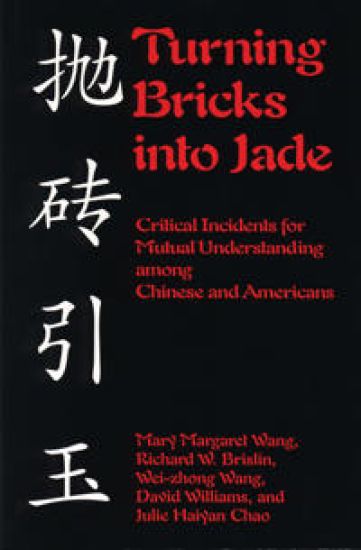
The Chinese are fond of using four-character phrases, known as cheng yu, to improve their writing style. The Chinese characters on the cover spell out one such idiom: pao zhuan yin yu. Translated literally, this would be "throw bricks attract jade." It can also express the idea of throwing out something of little value to induce a potential business partner to offer something more valuable. The authors of Turning Bricks into Jade, a more idiomatic rendering of pao zhuan yin yu, like to think of each critical incident in this collection as a brick, which, when combined with similar bricks, good sense and effort, can be used to construct relationships more valuable even than jade. A critical incident is a story about cross-cultural conflict or misunderstanding. Many of the forty-one incidents are based on actual events that involved one or more of the authors or their acquaintances. Some are a composite of several authors' experiences. You choose one of four or five possible alternatives that explain the misunderstanding. Following each incident is a discussion of possible solutions, based on the authors' experiences and grounded in current research. Misunderstandings between Chinese and American interactants are complicated; there is almost never just one thing going on. One result of this complexity is that many of the incidents have more than one correct explanation. Forty-one Americans and Chinese with considerable experience in both cultures read the collection of incidents for validation. As you work through the incidents, you may feel the need for a more detailed explanation or definition of certain recurring themes. A section on key theoretical concepts in Chinese-American interactions provides such detail. Included are individualism and collectivism, guanxi (interpersonal connections), hierarchies, gender relations in the workplace, regulations, deference to authority, work incentives and ownership. The Index of Incidents According to Themes and Concepts is also helpful.
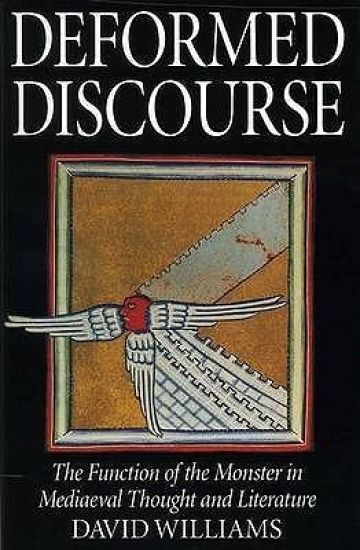
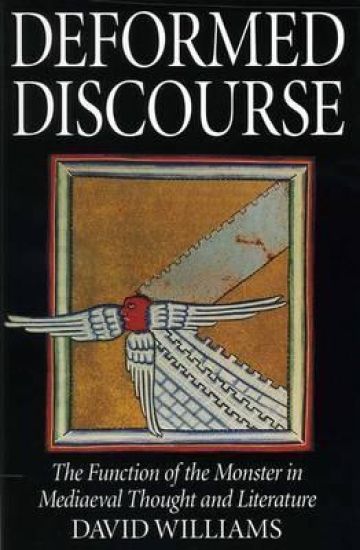
Now published in paperback, this fully-illustrated book explores the concept of the monster in the Middle Ages, examining its philosophical and theological roots and analysing its symbolic function in medieval literature and art. Fascinating and comprehensive, this study of the grotesque in medieval aesthetic expression successfully brings together medieval research and modern criticism.
In Rich Man's War historian David Williams focuses on the Civil War experience of people in the Chattahoochee River Valley of Georgia and Alabama to illustrate how the exploitation of enslaved blacks and poor whites by a planter oligarchy generated overwhelming class conflict across the South, eventually leading to Confederate defeat. This conflict was so clearly highlighted by the perception that the Civil War was "a rich man's war and a poor man's fight" that growing numbers of oppressed whites and blacks openly rebelled against Confederate authority, undermining the fight for independence. After the war, however, the upper classes encouraged enmity between freedpeople and poor whites to prevent a class revolution. Trapped by racism and poverty, the poor remained in virtual economic slavery, still dominated by an almost unchanged planter elite. The publication of this book was supported by the Historic Chattahoochee Commission.
Mechanics is the first foundation for the study of physics. This book takes first-year undergraduates through an entertaining and instructive set of practical examples of the uses of mechanics. The author adopts a fresh approach which recognizes mechanics as an observational science, and uses worked examples that can be easily visualized and understood by the reader. By the end of the book students will have not only painlessly learned the principles of mechanics, but will have also obtained a good grasp of techniques needed for solving typical mechanics problems. They will also have covered all the essentials of a first-year university course in mechanics. The book can then be used as a reference of a quick aid to revision.
This fully-illustrated book explores the concept of the monster in the Middle Ages, examining its philosophical and theological roots and analysing its symbolic function in medieval literature and art. Fascinating and comprehensive, this study of the grotesque in medieval aesthetic expression successfully brings together medieval research and modern criticism.
The central argument of Japan and the Enemies of Open Political Science is that Eurocentric blindness is not a moral but a scientific failing. In this wide-ranging critique of Western social science, Anglo-American philosophy and French theory, Williams works on the premise that Japan is the most important political system of our time. He explains why social scientists have been so keen to ignore or denigrate Japan's achievements. If social science is to meet the needs of the `Pacific Century', it requires a sustained act of intellectual demolition and subsequent renewal.
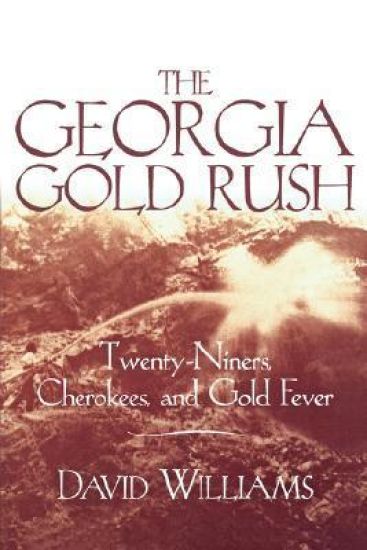
This work covers the story of Georgia's role in the first US gold rush. This southern gold rush reached Georgia with the discovery of the Dahlonega Gold Belt in 1829. However, the early 1840s saw a dramatic decline in the fortunes of the southern gold region.
In this analysis of Japan's policy-making, David Williams places his argument within the debates about Japanese political economy in the United States and Britain, debates previously polarised between `market' and `ministry' views. He presents Japanese-style nationalist development as a serious challenge to Western values and theory.
Taxation for Environmental Protection
Asbjorn Eriksson; Robert Hertzog; John Tiley; David Williams; Friedrich Von Zezschwitz
Praeger Publishers Inc
1991
sidottu
This book brings together the work of scholars from England, France, Germany, Sweden, and the United States to examine the ways in which industrialized nations have used and are developing tax laws to help alleviate environmental problems. For each country, the contributors offer a thorough review of existing and proposed initiatives and an in-depth evaluation of their effectiveness. They also discuss the theoretical framework behind environmental tax initiatives, explain alternative systems to taxation, reveal problems in dealing with environmental concerns that are common to all of the countries studied, and suggest ways to more efficiently coordinate tax and environmental policies. Based on their research, the contributors conclude that the general tax systems of the United States and other countries unintentionally conflict with environmental policies and that no country has yet been able to adequately control automobile pollution, although some have had varying degrees of success in other areas. The volume begins with an introduction that presents a nontechnical discussion of the current economic thinking on environmental taxes and alternatives such as direct government regulation and granting polluters limited or tradable rights to pollute. The following chapters discuss each country in turn. Each chapter first examines the institutional framework of the country--central versus regional government, how legislation is enacted and executed, the distribution of authority over environmental matters, and important environmental policy goals. Next, the compatability of the tax system with environmental goals is analyzed. Finally, there is a thorough treatment of that country's environmental tax initiatives, including an in-depth assessment of their relative success or failure. Policymakers, lobbyists, economists, and attorneys will find Taxation for Environmental Protection enlightening reading.
Probability with Martingales
David Williams
Cambridge University Press
1991
pokkari
Halvin toimitettuna 52,50 €
Probability theory is nowadays applied in a huge variety of fields including physics, engineering, biology, economics and the social sciences. This book is a modern, lively and rigorous account which has Doob’s theory of martingales in discrete time as its main theme. It proves important results such as Kolmogorov’s Strong Law of Large Numbers and the Three-Series Theorem by martingale techniques, and the Central Limit Theorem via the use of characteristic functions. A distinguishing feature is its determination to keep the probability flowing at a nice tempo. It achieves this by being selective rather than encyclopaedic, presenting only what is essential to understand the fundamentals; and it assumes certain key results from measure theory in the main text. These measure-theoretic results are proved in full in appendices, so that the book is completely self-contained. The book is written for students, not for researchers, and has evolved through several years of class testing. Exercises play a vital rôle. Interesting and challenging problems, some with hints, consolidate what has already been learnt, and provide motivation to discover more of the subject than can be covered in a single introduction.
First published in 1982. This is the biography of Alhaji Shehu Shagari of Nigeria, Africa's most populous state and the world's third biggest democracy. He was elected in 1979, against four opponents, in the election which signified the peaceful end of thirteen and a half years of military rule. Alhaji Shehu was the first boy from Shagari, founded in what is now Sokoto State by his ancestors 170 years ago, to go to secondary school. Education has remained one of his main interests throughout a political career which included many ministerial posts. Thoughtful, scholarly and conciliatory he is now a world figure. The book presents the man and his policies against the lively political, social and economic background of a country of eighty million people, which is among the world's six most important oil exporters.
Published in 1981, My Vision of Nigeria is a valuable contribution to the field of History.