Kirjojen hintavertailu – 12 859 829 kirjaa ja 27 kauppaa
Kirjailija
Department of Defense
Kirjat ja teokset yhdessä paikassa: 439 kirjaa, julkaisuja vuosilta 1989–2024, suosituimpiin kuuluu Nike Zeus: The U.S. Army's First Antiballistic Missile. Vertaile teosten hintoja ja tarkista saatavuus suomalaisista kirjakaupoista.
Printed in Color This FC provides requirements for planning, programming, designing, and constructing legal facilities. The information in this FC applies to the design of all new construction projects, to include additions, alterations, and renovation projects in the continental United States (CONUS) and outside the continental United States (OCONUS). It also applies to the procurement of design/build services for the above-noted types of projects. Alteration and renovation projects should update existing facilities to meet the guidance and criteria within budgetary constraints. Includes a list of applicable NIST, UFC, and MIL-HDBK cybersecurity publications for consideration. Why buy a book you can download for free? First you gotta find a good clean (legible) copy and make sure it's the latest version (not always easy). Some documents found on the web are missing some pages or the image quality is so poor, they are difficult to read. We look over each document carefully and replace poor quality images by going back to the original source document. We proof each document to make sure it's all there - including all changes. If you find a good copy, you could print it using a network printer you share with 100 other people (typically its either out of paper or toner). If it's just a 10-page document, no problem, but if it's 250-pages, you will need to punch 3 holes in all those pages and put it in a 3-ring binder. Takes at least an hour. It's much more cost-effective to just order the latest version from Amazon.com This book is published by 4th Watch Books and includes copyright material. We publish compact, tightly-bound, full-size books (8 1/2 by 11 inches), with glossy covers. 4th Watch Books is a Service Disabled Veteran-Owned Small Business (SDVOSB). For more titles published by 4th Watch Books, please visit: cybah.webplus.net UFC 2-100-01 Installation Master Planning UFC 3-120-01 Design: Sign Standards UFC 3-101-01 Architecture UFC 3-440-01 Facility-Scale Renewable Energy Systems UFC 3-201-02 Landscape Architecture UFC 3-501-01 Electrical Engineering UFC 3-540-08 Utility-Scale Renewable Energy Systems UFC 3-550-01 Exterior Electrical Power Distribution UFC 3-550-07 Operation and Maintenance (O&M) Exterior Power Distribution Systems UFC 3-560-01 Electrical Safety, O & M UFC 3-520-01 Interior Electrical Systems UFC 4-010-06 Cybersecurity of Facility-Related Control Systems UFC 4-021-02 Electronic Security Systems by Department of Defense FC 4-141-05N Navy and Marine Corps Industrial Control Systems Monitoring Stations UFC 4-010-01 DoD Minimum Antiterrorism Standards for Buildings UFC 4-020-01 DoD Security Engineering Facilities Planning Manual UFC 3-430-08N Central Heating Plant UFC 3-410-01 Heating, Ventilating, and Air Conditioning Systems
This UFC 3-520-01 provides design guidance for interior electrical systems. The document has been extensively revised to update the criteria for interior electrical systems. This UFC has also been coordinated with new UFC 3-501-01, Electrical Engineering. UFC 3-501-01 provides overall electrical engineering criteria, including electrical design analysis and documentation criteria. This type of material has been removed from UFC 3-520-01 so that duplication of criteria is eliminated. Why buy a book you can download for free? First you gotta find it and make sure it's the latest version (not always easy). Then you gotta print it using a network printer you share with 100 other people - and its outta paper - and the toner is low (take out the toner cartridge, shake it, then put it back). If it's just 10 pages, no problem, but if it's a 250-page book, you will need to punch 3 holes in all those pages and put it in a 3-ring binder. Takes at least an hour. An engineer that's paid $75 an hour has to do this himself (who has assistant's anymore?). If you are paid more than $10 an hour and use an ink jet printer, buying this book will save you money. It's much more cost-effective to just order the latest version from Amazon.com This book is published by 4th Watch Books and includes copyright material. We publish compact, tightly-bound, full-size books (8 1/2 by 11 inches), with glossy covers. 4th Watch Books is a Service Disabled Veteran-Owned Small Business (SDVOSB). For more titles published by 4th Watch Books, please visit: cybah.webplus.net UFC 2-100-01 Installation Master Planning UFC 4-010-06 Cybersecurity of Facility-Related Control Systems UFC 4-021-02 Electronic Security Systems by Department of Defense FC 4-141-05N Navy and Marine Corps Industrial Control Systems Monitoring Stations UFC 4-010-01 DoD Minimum Antiterrorism Standards for Buildings UFC 4-020-01 DoD Security Engineering Facilities Planning Manual UFC 3-501-01 Electrical Engineering UFC 3-550-07 Operation and Maintenance (O&M) Exterior Power Distribution Systems UFC 3-550-01 Exterior Electrical Power Distribution UFC 3-560-01 Electrical Safety, O & M UFC 3-201-02 Landscape Architecture UFC 3-540-08 Utility-Scale Renewable Energy Systems UFC 3-440-01 Facility-Scale Renewable Energy Systems
FC 1-300-09N 1 May 2014 Includes Change 4, 14 Jun 2018 This FC provides specific guidance on how and when to provide a project design deliverable for NAVFAC. This document is organized into design deliverables and design phases. Requirements for design deliverables, beyond or in more detail of what is already required by a Core UFC, are provided for NAVFAC-only. The requirements for when or to what extent these deliverables are provided are in the Phase chapters. Includes a list of applicable NIST cybersecurity publications for consideration. Why buy a book you can download for free? First you gotta find it and make sure it's the latest version (not always easy). Then you gotta print it using a network printer you share with 100 other people - and its outta paper - and the toner is low (take out the toner cartridge, shake it, then put it back). If it's just 10 pages, no problem, but if it's a 250-page book, you will need to punch 3 holes in all those pages and put it in a 3-ring binder. Takes at least an hour. An engineer that's paid $75 an hour has to do this himself (who has assistant's anymore?). If you are paid more than $10 an hour and use an ink jet printer, buying this book will save you money. It's much more cost-effective to just order the latest version from Amazon.com This book is published by 4th Watch Books and includes copyright material. We publish compact, tightly-bound, full-size books (8 1/2 by 11 inches), with glossy covers. 4th Watch Books is a Service Disabled Veteran-Owned Small Business (SDVOSB). For more titles published by 4th Watch Books, please visit: www.usgovpub.com UFC 2-100-01 Installation Master Planning UFC 3-120-01 Design: Sign Standards UFC 3-101-01 Architecture UFC 3-440-01 Facility-Scale Renewable Energy Systems UFC 3-201-02 Landscape Architecture UFC 3-501-01 Electrical Engineering UFC 3-540-08 Utility-Scale Renewable Energy Systems UFC 3-550-01 Exterior Electrical Power Distribution UFC 3-550-07 Operation and Maintenance (O&M) Exterior Power Distribution Systems UFC 3-560-01 Electrical Safety, O & M UFC 3-520-01 Interior Electrical Systems UFC 4-010-06 Cybersecurity of Facility-Related Control Systems UFC 4-021-02 Electronic Security Systems by Department of Defense FC 4-141-05N Navy and Marine Corps Industrial Control Systems Monitoring Stations UFC 4-010-01 DoD Minimum Antiterrorism Standards for Buildings UFC 4-020-01 DoD Security Engineering Facilities Planning Manual UFC 3-430-08N Central Heating Plant UFC 3-410-01 Heating, Ventilating, and Air Conditioning Systems UFC 3-810-01N Navy and Marine Corps Environmental Engineering for Facility Construction UFC 3-730-01 Programming Cost Estimates for Military Construction UFC 1-200-02 High-Performance and Sustainable Building Requirements UFC 3-301-01 Structural Engineering UFC 3-430-02FA Central Steam Boiler Plants UFC 3-430-11 Boiler Control Systems
The Army Equipment Modernization Plan 2014 describes the Army Research, Development, and Acquisition (RDA) for ten capability portfolio areas and the Science and Technology portion of Fiscal Year 2014 (FY 14) President's Budget Request. The plan breaks down the RDA investments into ten capability portfolio areas, highlights the portfolio accomplishments over the last two years and provides intent for FY 14 investments as well as the way ahead. Dollars and quantities in this document do not reflect sequestration impacts. In addition to capability portfolio investment strategies, the plan links RDA investments to Army Strategy and discusses specific modernization priorities and objectives, priority materiel programs, the Army's Science and Technology program, equipment fielding and distribution. The Soldier and Squad are the foundation of our Army. Army equipment modernization builds from the Soldier out, equipping our Squads for tactical overmatch in all situations, connected to an integrated network, and operating in vehicles that improve mobility and lethality while preserving survivability. The objective of Army equipment modernization is to develop and field versatile and tailorable equipment that is affordable, sustainable, cost-effective, enables our Soldiers to fight and win across the entire range of conflict. To achieve this objective the Army uses portfolio management to help ensure efficiencies and eliminate redundancies, evolutionary acquisition to ensure program risk is reduced by emphasizing mature technologies, and the Army readiness model to ensure the timely fielding of equipment. The Army will continue to pursue mission command capabilities by enhancing our network; remain prepared for decisive action by improving or transforming our combat platforms; and enable Soldiers and squads with improved lethality, protection and situation awareness. These enhancements also enable our Soldiers and squads to leverage Joint capabilities. As the Army transitions from Afghanistan and reinforces its commitment in the Asia-pacific region, the Army will continue to make cost-effective, sustainable and affordable choices. Overall, our modernization efforts will prepare the total force for a complex and uncertain battlefield by putting squads, with precise information and over match capability, in the right place at the right time to accomplish their mission. This plan enhances our advantages leader development, mobility, logistics at the tactical, operational, and strategic levels of our Army, and C4I.
Each year, the Department is required to conduct an assessment of policies and programs to address sexual harassment and sexual assault at the Military Service Academies (MSAs). The following is a brief synopsis of last year's key findings compared with this year's key findings. This Year's Key Findings - APY 12-13 Reports of sexual assault decreased at two of three MSAs, with 53 reports made by cadets and midshipmen during APY 12-13 for events they experienced while they were in military service. Of the 53 reports, 89% involved cadet/midshipman on cadet/midshipman crime. An additional 5 reports involved civilian victims who reported being sexually assaulted by a cadet or midshipman. No unwanted sexual contact rate is available, as no survey was conducted during this academic program year. A survey is being fielded in 2014 to update past-year prevalence rates of unwanted sexual contact and sexual harassment. The 53 victims who reported a sexual assault for an incident that occurred while they were in military service during APY 12-13 is less than the 58 victims that reported in APY 11-12. Because there was no survey to establish a prevalence rate for this past academic year, the Department cannot say with certainty whether the decrease in reporting this year at the MSAs was due to fewer assaults occurring, or due to fewer victims opting to report. Given focus group feedback, cadets and midshipmen feel that incidents would be taken seriously by MSA leadership and dealt with immediately. However, they remain concerned that reporting a sexual assault will impact their reputation and social standing with classmates. In the report that follows, the Department has made numerous recommendations that will help address perceptions that deter reporting, and advance and sustain an environment of dignity and respect at the MSAs.
MIL-STD-461G, 2 March 2015 contains some of the most recent information on Electromagnetic Pulse (EMP) and protection of the Electromagnetic Environment (EME) for DoD equipment. Unfortunately, there is very little current information describing how best to protect an entire facility from intentional electromagnetic interference (IEMI). Although this standard is best suited for items such as electronic enclosures that are no larger than an equipment rack, electrical interconnections that are discrete wiring harnesses between enclosures, and electrical power input derived from prime power sources, the technical aspects are equally relevant to facilities design and construction. The principles in this standard may be useful as a basis for developing suitable requirements for facility design and construction. This MIL STD provides guidance on frequency scanning, emission identification, susceptibility testing, susceptibility requirements, limits, and test procedures for equipment installed in mission-critical facilities. This book is even more important nowadays as nations like China combine information warfare, electronic warfare and space warfare to create "intelligentized warfare". Why buy a book you can download for free? We print this book so you don't have to. First you gotta find a good clean (legible) copy and make sure it's the latest version (not always easy). Some documents found on the web are missing some pages or the image quality is so poor, they are difficult to read. We look over each document carefully and replace poor quality images by going back to the original source document. We proof each document to make sure it's all there - including all changes. If you find a good copy, you could print it using a network printer you share with 100 other people (typically its either out of paper or toner). If it's just a 10-page document, no problem, but if it's 250-pages, you will need to punch 3 holes in all those pages and put it in a 3-ring binder. Takes at least an hour. It's much more cost-effective to just order the latest version from Amazon.com This book includes original commentary which is copyright material. Note that government documents are in the public domain. We print these large documents as a service so you don't have to. The books are compact, tightly-bound, full-size (8 1/2 by 11 inches), with large text and glossy covers. 4th Watch Publishing Co. is a SDVOSB. If you like the service we provide, please leave positive review on Amazon.com. www. USGOVPUB.com
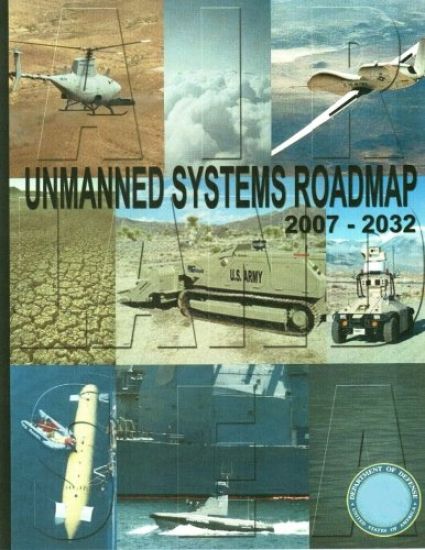
As the Department of Defense (DoD) develops and employs an increasingly sophisticated forceof unmanned systems over the next 25 years (2007 to 2032), technologists, acquisition officials, and operational planners require a clear, coordinated plan for the evolution and transition ofunmanned systems technology. With the publication of this document, individual roadmaps and master plans for UASs, UGVs, and UMSs (defined as Unmanned Undersea Vehicles (UUVs)and Unmanned Surface Vehicles (USVs)) have been incorporated into a comprehensive DoDUnmanned Systems Roadmap. This integrated Unmanned Systems Roadmap is the plan forfuture prioritization and funding of these systems development and technology, thus ensuring aneffective return on the Department's investment. Its overarching goal, in accordance with theStrategic Planning Guidance (SPG), is to guide military departments and defense agenciestoward logically and systematically migrating applicable mission capabilities to this new class ofmilitary tools. This Roadmap highlights the most urgent mission needs that are supported bothtechnologically and operationally by various unmanned systems. These needs, listed below, should be considered when prioritizing future research, development, and procurement ofunmanned systems technology to ensure an effective return on the Department's investmen
As the Department of Defense (DoD) develops and employs an increasingly sophisticated forceof unmanned systems over the next 25 years (2007 to 2032), technologists, acquisition officials, and operational planners require a clear, coordinated plan for the evolution and transition ofunmanned systems technology. With the publication of this document, individual roadmaps and master plans for UASs, UGVs, and UMSs (defined as Unmanned Undersea Vehicles (UUVs)and Unmanned Surface Vehicles (USVs)) have been incorporated into a comprehensive DoDUnmanned Systems Roadmap. This integrated Unmanned Systems Roadmap is the plan forfuture prioritization and funding of these systems development and technology, thus ensuring aneffective return on the Department's investment. Its overarching goal, in accordance with theStrategic Planning Guidance (SPG), is to guide military departments and defense agenciestoward logically and systematically migrating applicable mission capabilities to this new class ofmilitary tools. This Roadmap highlights the most urgent mission needs that are supported bothtechnologically and operationally by various unmanned systems. These needs, listed below, should be considered when prioritizing future research, development, and procurement ofunmanned systems technology to ensure an effective return on the Department's investmen
More than 20 million men, women, and children throughout the world are victims of trafficking in persons. The U. S. Government (USG), which maintains a zero-tolerance policy for government employees and contractors engaging in trafficking in persons, views human trafficking as a serious human rights abuse which is modern-day slavery. DoD policy centers on deterrence of any activities of Service members, civilian employees, indirect hires, contractor personnel, and command-sponsored dependents that facilitate or support trafficking in persons in both domestic and overseas environments. This includes activities such as enabling prostitution or patronizing a prostitute, even though such activities may be legal within a host nation. In the last ten years, a number of trafficking in persons allegations occurred in conjunction with contracting and subcontracting services tied to overseas contingency operations. In response, President Obama issued EO 13627, "Strengthening Protections Against Trafficking in Persons in Federal Contracts," which calls for stronger prohibitions on contractor engagement in human trafficking-related activities, new tailored compliance measures particularly in at-risk industries and sectors, and additional training in support of monitoring, identification, and compliance efforts. The USG recognizes the need to further strengthen barriers and monitoring to ensure such affronts to human dignity are not committed in association with government activities. The Department is dedicated to eliminating human trafficking not only because it is a crime against humanity, but also because it disrupts the stability of U. S. national security interests at home and abroad. Left unchecked, human trafficking fuels organized crime and other illegal activity that disrupts democratic transitions and intensifies conflict. This DoD Strategic Plan for Combating Trafficking in Persons provides a vision and mission for the Department in its collective effort to eliminate human trafficking across the defense enterprise. The Plan provides a strategic framework underpinned by four goals and nine objectives-all focused on realizing the Department's vision to eliminate human trafficking.