Kirjojen hintavertailu – 12 903 724 kirjaa ja 27 kauppaa

Kirjailija

Desiderius Erasmus

Kirjat ja teokset yhdessä paikassa: 315 kirjaa, julkaisuja vuosilta 1933–2026, suosituimpiin kuuluu Ulrich Von Hutten Gegen Desiderius Erasmus, Und Desiderius Erasmus Gegen Ulrich Von Hutten. Vertaile teosten hintoja ja tarkista saatavuus suomalaisista kirjakaupoista.

315 kirjaa

Kirjojen julkaisuvuodet: 1933–2026.

Collected Works of Erasmus

Collected Works of Erasmus

Desiderius Erasmus

University of Toronto Press
1988
sidottu
Erasmus yearned to make the Bible an effective instrument in the reform of society, church, and the life of individuals in the turbulent world of the sixteenth century. He therefore composed paraphrases in which the words of Holy Scripture provided the core of a text vastly expanded to embrace the reforming ‘philosophy of Christ.’ The Paraphrases were successful beyond expectation and were quickly translated into French, German, English and other languages. Volume 49 of the Collected Works of Erasmus series.
The Correspondence of Erasmus

The Correspondence of Erasmus

Desiderius Erasmus

University of Toronto Press
1988
sidottu
The tranquil world reflected in Erasmus’ early letters from Louvain gradually disintegrated in the years covered by Volume 7. In the letters of Volume 8, which spans the period of Erasmus’ last fifteen months in the Netherlands and his move to Basel during 1520 and 1521, his situation worsens. On the political front, the golden age of peace for which he had hoped is further destroyed by the war-mongering of Francis I, Henry VIII, Leo X and Charles V. In spiritual matters, Erasmus continues to be pressed harder to take a firm position for or against Luther. He persists in his earlier view, that Luther was right in his spirit but wrong in his language, and chooses not to make a public judgment against him, saying only that he will plant his feet firmly ‘on the same side, whatever it may be, as the peace of the Gospel.’ For the next seven and a half years, Erasmus is to live in Basel, a city as yet undecided which side it will take in the religious conflict, while he works ahead on his editions of the Christian Fathers and attempts to cope with the conflicts in the world around him. An exchange of letters between Juan de Vergara and Diego López Zúñiga which bears on the controversy then raging between Erasmus and Zúñiga is included as an appendix to this volume. Volume 8 of the Collected Works of Erasmus series.
The Correspondence of Erasmus

The Correspondence of Erasmus

Desiderius Erasmus

University of Toronto Press
1987
sidottu
A painful time in Erasmus' life is reflected in this volume of letters. As the two volumes immediately previous to this one indicated, Erasmus' first two years in Louvain were agreeable, productive, and carefree. But the spirit of congenial scholarship in which he lived at this time was gradually giving way to bitter conflict and controversy: Louvain was merely a microcosm of Erasmus' entire world, which was undergoing great strain. The exuberant expectancy of a Golden Age of civilized Christianity was yielding to the bleak prospect of helplessly watching the progress of what Erasmus termed the 'Lutherana tragoedia,' a play that he felt would end in catastrophe. The reader of this volume encounters a troubled Erasmus, who fights back constantly and unhappily against innuendo and open attacks, especially against the accusation that he is in connivance with Luther. His literary production and scholarly research suffer considerably as a result of his preoccupation and the general turmoil. Erasmus' conflicts with two younger theologians in particular. Jacobus Latomus and Edward Lee, loom large in this volume, and his over-reaction to Lee's criticisms shows him to be his own worst enemy. The volume features several memorable letters by Thomas More that testify to his integrity and clear-sightedness, his capacity for sober self-assessment and restraint combined with charity. It also contains one of Erasmus' most famous letters, Ep 999, which paints a subtle and sparkling pen portrait of More, the man and the Christian. Volume 7 of the Collected Works of Erasmus series.
27-28Collected Works of Erasmus

27-28Collected Works of Erasmus

Desiderius Erasmus

University of Toronto Press
1986
sidottu
Satire, as the concept was understood in the sisteenth century, covered any sort of commentary on personal or social behaviour or values. The six works collected in these two volumes are among the most important examples of Erasmus' satire, in the sixteenth-century sense of the word, and, in some cases, judged by modern standards as well. they reveal a great deal, not only about Erasmus' attitudes to the moral questions of his time, but also about the circumstances of his own life. These satires reflect aspect of the religious, political, social, and military conflicts of the time and the qualities that enabled Erasmus to articulate them: great intelligence, remarkable shrewdness, deep sensitivity, spectacular ability, and a boundless capacity for staying cool. Volumes 27 and 28 of the Collected Works of Erasmus series – Two-volume set.
25-26Collected Works of Erasmus

25-26Collected Works of Erasmus

Desiderius Erasmus

University of Toronto Press
1985
sidottu
Erasmus was above all an educator, and his writings as a teacher and theorist give him a claim to be regarded as the greatest figure in the history of education since antiquity. By the decade of the i32os, he had become the leading spokesman for the cause of humanistic education in Europe. The five translations in Collected Works of Erasmus 23 and 26 reflect Erasmus' main ideas about education: concern for the most desirable and effective curriculum; the need to read and appreciate the best writings of the finest classical authors; the importance of well-trained, well-paid, competent, inventive, and compassionate teachers; practical advice on the temperament and conduct of parents; the provision of adequate education for women and mature students; in short, the development of a philosophy of education that would produce the kind of person best educated for the service of God and man. Contained in these volumes are the first modern English translations of De conscribendis epistolis I On the Writing of Letters, Conficiendarum epistolarum formula I A Formula for the Composition of Letters, De civilitate I On Good Manners for Boys, De pueris I A Declamation on the Subject of Early Liberal Education for Children, and De recta pronuntiatione I The Right Way of Speaking Latin and Greek A Dialogue. These works present Erasmus' educational program for children from the very young to pre-university age - a compendium of his views on the nature and value of a humanistic education that remains of importance for all times and places. Volumes 25 and 26 of the Collected Works of Erasmus series – Two-volume set.
Collected Works of Erasmus

Collected Works of Erasmus

Desiderius Erasmus

University of Toronto Press
1984
sidottu
Erasmus yearned to popularize the New Testament, to make the Bible and the understanding of Scripture available to everyone – to ‘the farmer, the tailor, the mason, prostitutes, pimps, and Turks,’ in his words. He therefore composed paraphrases in order to simplify and explain Scripture. The Paraphrases were successful beyond his expectations and were quickly translated into French, German, English and other languages. In them the words of the Apostle Paul provide the core of a text which is expanded to clarify Paul’s argument, revealing its assumptions, suggesting its implications, and setting its parts more clearly in relation to each other. In this respect, it is like a commentary. But the Paraphrases are much more than commentary. They seek not only to clarify, but also to enliven. They bring the reader to a direct confrontation with the Apostle himself by presenting the whole (both core words and expansion) under the persona of Paul, vividly portraying the Apostle’s reactions to the situation to which he was responding in this letters. Erasmus takes the images and analogies through which Paul argues his case for ‘justification through faith’ and expands them into colorful and dramatic vignettes of the inner spiritual struggle and victory of ‘everyman.’ Volume 42 of the Collected Works of Erasmus series.
Collected Works of Erasmus

Collected Works of Erasmus

Desiderius Erasmus

University of Toronto Press
1982
sidottu
Erasmus' Adagia has been called 'one of the world's biggest bedside books,' and certainly the more than 4000 proverbs and maxims gathered and commented on by Erasmus, sometimes in a few lines and sometimes in full-scale essays, have great appeal for both scholar and educated layman. The aim of the Adages was to recapture, in this handy portmanteau form, the outlook and way of life of the classical world through its customs, legends, and social institutions, and to put within reach of a modern public the accumulated wisdom of the past. Each adage is traced in the works of as many authors as Erasmus had to hand; always an authority is given (usually several) and often a close reference providing chapter and verse. The commentaries in the Adages give a forthright and often eloquent expression of Erasmus' opinions on the world of his day, dovetailing with his satirical works on the one hand and his popular evangelical writings on the other. Many, if not most, of the proverbs cited by Erasmus are still in our common stock of speech today. The Collected Works of Erasmus is providing the first complete translation of Erasmus' Adagia. This volume contains the initial 300 adages with notes that identify the classical sources and indicate how Erasmus' reading and thinking developed over the quarter-century spanned by the eight revisions of the original work. Volume 31 of the Collected Works of Erasmus series.
Collected Works of Erasmus

Collected Works of Erasmus

Desiderius Erasmus

University of Toronto Press
1982
pokkari
Erasmus' Adagia has been called 'one of the world's biggest bedside books,' and certainly the more than 4000 proverbs and maxims gathered and commented on by Erasmus, sometimes in a few lines and sometimes in full-scale essays, have great appeal for both scholar and educated layman. The aim of the Adages was to recapture, in this handy portmanteau form, the outlook and way of life of the classical world through its customs, legends, and social institutions, and to put within reach of a modern public the accumulated wisdom of the past. Each adage is traced in the works of as many authors as Erasmus had to hand; always an authority is given (usually several) and often a close reference providing chapter and verse. The commentaries in the Adages give a forthright and often eloquent expression of Erasmus' opinions on the world of his day, dovetailing with his satirical works on the one hand and his popular evangelical writings on the other. Many, if not most, of the proverbs cited by Erasmus are still in our common stock of speech today. The Collected Works of Erasmus is providing the first complete translation of Erasmus' Adagia. This volume contains the initial 300 adages with notes that identify the classical sources and indicate how Erasmus' reading and thinking developed over the quarter-century spanned by the eight revisions of the original work. Volume 31 of the Collected Works of Erasmus series.
The Correspondence of Erasmus

The Correspondence of Erasmus

Desiderius Erasmus

University of Toronto Press
1979
sidottu
This volume covers the first ten months of Erasmus' residence at Louvain. He lived during this time in the College of the Lily, his position presitgious and secure. he was a member of the theological faculty, yet free of regular academic duties and entitled to receive a regular income more than adequate to his modest needs. His predominant task in the course of these months was the re–editing of the New Testament, which he considered his magnum opus: through his work on the New Testament the use he made of his time and talent would be judged by God and man alike. There are frequent references in the letters to the long and arduous hours devoted to the annotation of these volumes. As a release from the drudgery of annotation he tried his hand at paraphrases of the gospels, gave Ratio verae theologiae its final form, and allowed himself a little time in the company of classical authors who refreshed his mind and refurbished his style. As never before, Erasmus' name counted now among the educated and powerful of the age, and he was overwhelmed with invitations from every corner of Europe. He was developing influential friends across Europe, and in Germany especially he gained enthusiastic admirers who expected him to join in the defence of Johann Reuchlin and made certain that he became promptly acquainted with the Ninety-five Theses of Luther whose name Erasmus at first still had trouble remembering. This volume is of particular interest because more than half the letters derive from the Deventer Letter–book, into which Erasmus had his amaneunses copy incoming and outgoing letters, among them many which were truly private rather than composed with a mind to subsequent publication. As a result we become intimately acquainted with the daily life of Erasmus and his friends, with the domestic pleasures and annoyances, private worries and hopes that made up and continue to make up the substance of human existance. Volume 5 of the Collected Works of Erasmus series.
The Correspondence of Erasmus

The Correspondence of Erasmus

Desiderius Erasmus

University of Toronto Press
1977
sidottu
The year that began in August 1515 was the annus mirabilis of Erasmus' career, the year, notably of the epistles of St Jerome and the first edition of his New Testament. In the months following, covered in this volume of the CWE, from August 1516 to June 1517, the active exchange of letters that began with volume 3 continued, giving a vivid impression of the impact of Erasmus' great achievement upon his contemporaries. In his own words, "The New Testament has made me friends everywhere." To Erasmus, the most important event of these months was intensely private, the dispensation granted by Leo X allowing him to escape permanently from the restraints of his religious community, to earn his living with the freedom of a secular priest. In elucidating the complex circumstances surrounding this crucial development in Erasmus' career, Dr McConica advances a new view of the obscure circumstances surrounding Erasmus' illegitimacy. We are also given Erasmus' thinly veiled account of his boyhood in the "Letter to Grunnius," and, in an Appendix, the closely related account in the Compendium vitae, a vital if controversial document for our knowledge of his early life. In the background are the life and enterprise of the Low Countries. Pursuit of personal promotion, the politics of the Burgundian Court, and the emergence of the young Prince Charles–soon to be Charles V–in the European scene, provide further tuition for the great humanist in the use and abuse of princely power. In this volume Erasmus moves between the Burgundian court at Brussels and the domestic quiet of Pieter Gillis' household at Antwerp, where he was prearing further work for the Froben press at Basel. He is drawn to Louvain but avoids it, fearing a scrutiny of his works by the hostile theologians of the University. The England of Tunstall and More is always at hand, and the letters of volume 4 incidentally provide the most important chronicle for the publication of More's Utopia, over which Erasmus kept a watchful eye. This volume records important developments in Erasmus' many–faceted philosophy, especially in politics and education. There is the sharpest condemnation of princely power beneath the veil of rhetorical courtesy, with classical statements of Erasmus' programme for men of education and Christan principle, the rulers upon whom he rested his hope for the reform of Christiandom. Educated Europe now waited upon Erasmus' words, and, as a French humanist writes, "Words never fail him; and such words!" Volume 4 of the Collected Works of Erasmus series
The Correspondence of Erasmus

The Correspondence of Erasmus

Desiderius Erasmus

University of Toronto Press
1976
sidottu
Volume 3 contains Erasmus' surviving correspondence from August 1514 to August 1516, including one letter by Erasmus never before published in a collection of his correspondence. There are one hundred and fifty–one letters from this period, more than survive from the whole of the first forty years of his life. They range in character from hasty personal notes to extended formal treatises, and they appear with remarkable regularity. This closely woven and uniform fabric of evidence coincides with the moment in Erasmus' career that marks his departure from England and his reception on the international stage of European intellectual life. As a result we have the sense of meeting the mature Erasmus poised and confident about his future and career. When Eramus left England for Basel, he entered into an association with the printer whose household was to be the nearest thing to a spiritual home that he would ever know. And from the firm of Froben in the next two years were to appear those great works which were largely the fruit of Erasmus' labours in England – the revised Adagiorum chiliades, the edition of the letters of St Jerome, the new edition and the translation of the New Testament, and the Institutio principis christiani Together they confirmed his place at the summit of European leanring, as his new home in the Upper Rhine symbolized Erasmus' central position in the religious controversy about to divide Europe. In the words of P. S. Allen, "Eramsmus had now reached his highest point. He had equipped himself thoroughly for the work he desired to do. He was the acknowledged leader of a large band of scholars, who looked to him for guidance and were ready to second his efforts; and with the resources of Froben's press at his disposal, nothing seemed beyond his powers and his hopes." Volume 3 of the Collected Works of Erasmus series
The Correspondence of Erasmus

The Correspondence of Erasmus

Desiderius Erasmus

University of Toronto Press
1975
sidottu
The correspondence of Erasmus has never been completely translated into English, although it has long been acknowledged to be one of the most illuminating sources for the history of northern humanism and the first two decades of the Protestant Reformation. In his letters to and from scholars and religious leaders, printers and patrons, princes and prelates in every country of western Europe, the interests and issues of that critical era found free expression. They are connected by the thread of Erasmus' personal experience, his joys and sorrows, triumphs and tribulations, and his uninhibited conversation with his friends. Volume 2 contains what has survived of Erasmus' correspondence from the beginning of 1501 to the summer of 1514. This was a period of crucial importance in the career, of Erasmus, during which he emerged from the relative obscurity of his early years to achieve a dominant position as the acknowledged prince of Christian humanism. During this time he acquired his hard-won mastery of Greek, adumbrated the basic concepts of his religious thought in the Enchiridion, established his scholarly reputation with the magnificent Aldine edition of the Adagia, wrote The Praise of Folly, edited the correspondence of St Jerome, and laid the foundations for his great edition of the Greek New Testament. Although most of the letters from this period are familiar letters to friends or formal dedications to prospective patrons, there are occasional glimpses into the intense intellectual activity that filled these years. It is unfortunate that the letters which have survived do not form a continuous record of the period: the years from 1502 to 1-504 are but sparsely represented, the all- important visit to Italy in 1506-9 scarcely at all, and the first two years after the return to England completely blank. We can be grateful, however, that from 1511 on we have a substantial number of letters, including the charming series of familiar letters from Erasmus to Colet, Ammonio, and his other friends in England, written from Cambridge or London. From them emerges a portrait of Erasmus the man, newly self-confident and relaxed, sharp- tongued in criticism but a warm friend, and intensely curious about the world of affairs in England and on the continent as well as the private concerns of members of his own circle. Erasmus himself regarded his letters as a form of literature, and they were valued in his time, as they are now, as much for their style as for their content. In The Study of Good Letters (Clarendon 1963) H. VV. Garrod wrote: 'As a document of the history of the times the Letters have primary importance. Yet they are to be valued, ultimately, not as they enable us to place Erasmus in history but as they help us to disengage him from it, to redeem him out of history into literature, placing him where, in truth, he longed to be. Not the Folly, nor the Colloquies, but the Letters, are his best piece of literature. What he did in scholarship, whether biblical, patristic, or classical, has been superseded - though not the fine free temper of it. That fine free temper shines also in the Letters, being indeed one of the elements of literature . . . In the immortality of their readableness Erasmus lives securely, immune from the discredits of circumstances.' Volume 2 of the Collected Works of Erasmus series

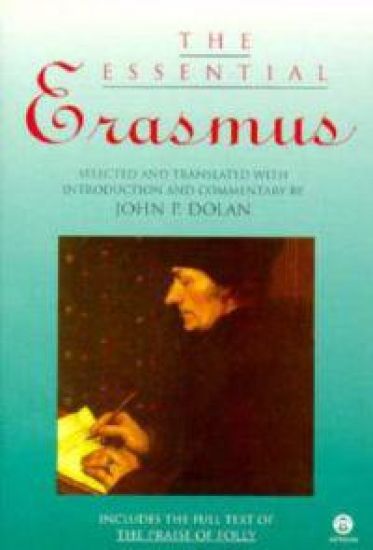
The Essential Erasmus

The Essential Erasmus

Desiderius Erasmus

PENGUIN BOOKS LTD
1964
pokkari
In his own day a center of controversy, in the four hundred years since his death known too often solely as an apostle of mockery and irreverence, Erasmus can be seen today in a new light--as a humanist whose concen is at once contemporary and Christian. The Essential Erasmus is the first single volume in English to show the full spectrum of this Renaissance man's thought, which is no less profound because it is expressed with the grace, wit, and ironic detachment only a great writer can achieve. Contains the full text of In Praise of Folly