Kirjojen hintavertailu – 12 903 725 kirjaa ja 27 kauppaa

Kirjailija

Douglas Walton

Kirjat ja teokset yhdessä paikassa: 49 kirjaa, julkaisuja vuosilta 1979–2026, suosituimpiin kuuluu خُطَاطات الحِجَاج في المنطق الظني - Argumentation Schemes in Presumptive Reasoning. Vertaile teosten hintoja ja tarkista saatavuus suomalaisista kirjakaupoista.

49 kirjaa

Kirjojen julkaisuvuodet: 1979–2026.

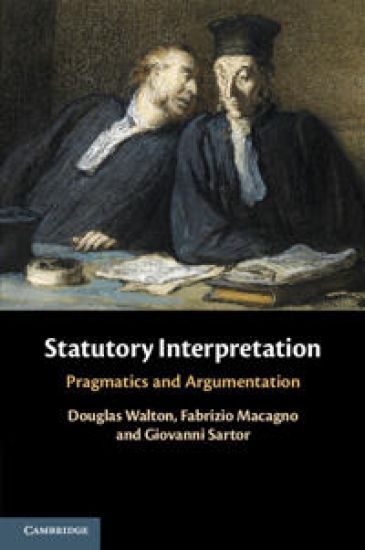
Statutory Interpretation

Statutory Interpretation

Douglas Walton; Fabrizio Macagno; Giovanni Sartor

Cambridge University Press
2022
pokkari

Halvin toimitettuna 35,30 €

Statutory interpretation involves the reconstruction of the meaning of a legal statement when it cannot be considered as accepted or granted. This phenomenon needs to be considered not only from the legal and linguistic perspective, but also from the argumentative one - which focuses on the strategies for defending a controversial or doubtful viewpoint. This book draws upon linguistics, legal theory, computing, and dialectics to present an argumentation-based approach to statutory interpretation. By translating and summarizing the existing legal interpretative canons into eleven patterns of natural arguments - called argumentation schemes - the authors offer a system of argumentation strategies for developing, defending, assessing, and attacking an interpretation. Illustrated through major cases from both common and civil law, this methodology is summarized in diagrams and maps for application to computer sciences. These visuals help make the structures, strategies, and vulnerabilities of legal reasoning accessible to both legal professionals and laypeople.
Statutory Interpretation

Statutory Interpretation

Douglas Walton; Fabrizio Macagno; Giovanni Sartor

Cambridge University Press
2021
sidottu
Statutory interpretation involves the reconstruction of the meaning of a legal statement when it cannot be considered as accepted or granted. This phenomenon needs to be considered not only from the legal and linguistic perspective, but also from the argumentative one - which focuses on the strategies for defending a controversial or doubtful viewpoint. This book draws upon linguistics, legal theory, computing, and dialectics to present an argumentation-based approach to statutory interpretation. By translating and summarizing the existing legal interpretative canons into eleven patterns of natural arguments - called argumentation schemes - the authors offer a system of argumentation strategies for developing, defending, assessing, and attacking an interpretation. Illustrated through major cases from both common and civil law, this methodology is summarized in diagrams and maps for application to computer sciences. These visuals help make the structures, strategies, and vulnerabilities of legal reasoning accessible to both legal professionals and laypeople.
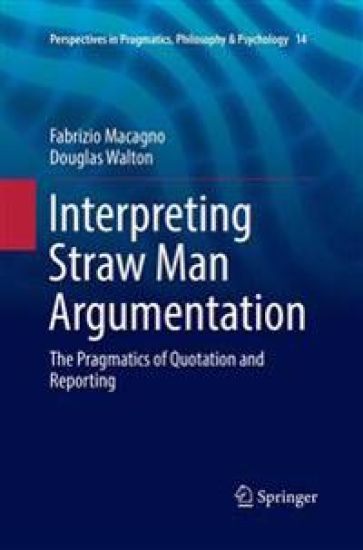
Interpreting Straw Man Argumentation

Interpreting Straw Man Argumentation

Fabrizio Macagno; Douglas Walton

Springer International Publishing AG
2018
nidottu
This book shows how research in linguistic pragmatics, philosophy of language, and rhetoric can be connected through argumentation to analyze a recognizably common strategy used in political and everyday conversation, namely the distortion of another’s words in an argumentative exchange. Straw man argumentation refers to the modification of a position by misquoting, misreporting or wrenching the original speaker’s statements from their context in order to attack them more easily or more effectively. Through 63 examples taken from different contexts (including political and forensic discourses and dialogs) and 20 legal cases, the book analyzes the explicit and implicit types of straw man, shows how to assess the correctness of a quote or a report, and illustrates the arguments that can be used for supporting an interpretation and defending against a distortion. The tools of argumentation theory, a discipline aimed at investigating the uses of arguments by combining insights from pragmatics, logic, and communication, are applied to provide an original account of interpretation and reporting, and to describe and illustrate tactics and procedures that can be used and implemented for practical purposes.. This book will appeal to scholars in the fields of political communication, communication in general, argumentation theory, rhetoric and pragmatics, as well as to people working in public speech, speech writing, and discourse analysis.
Interpreting Straw Man Argumentation

Interpreting Straw Man Argumentation

Fabrizio Macagno; Douglas Walton

Springer International Publishing AG
2017
sidottu
This book shows how research in linguistic pragmatics, philosophy of language, and rhetoric can be connected through argumentation to analyze a recognizably common strategy used in political and everyday conversation, namely the distortion of another’s words in an argumentative exchange. Straw man argumentation refers to the modification of a position by misquoting, misreporting or wrenching the original speaker’s statements from their context in order to attack them more easily or more effectively. Through 63 examples taken from different contexts (including political and forensic discourses and dialogs) and 20 legal cases, the book analyzes the explicit and implicit types of straw man, shows how to assess the correctness of a quote or a report, and illustrates the arguments that can be used for supporting an interpretation and defending against a distortion. The tools of argumentation theory, a discipline aimed at investigating the uses of arguments by combining insights from pragmatics, logic, and communication, are applied to provide an original account of interpretation and reporting, and to describe and illustrate tactics and procedures that can be used and implemented for practical purposes.. This book will appeal to scholars in the fields of political communication, communication in general, argumentation theory, rhetoric and pragmatics, as well as to people working in public speech, speech writing, and discourse analysis.
Historical Foundations of Informal Logic

Historical Foundations of Informal Logic

Douglas Walton; Alan Brinton

Routledge
2016
nidottu
In just the last twenty years there has arisen a strong interest, especially among teachers of logic at the universities, in teaching techniques of applied logical reasoning and critical thinking. Many universities are now stressing these skills at an introductory level, and to meet the need, informal logic has begun to form and grow as a discipline in its own right. Like all subjects, it helps us to understand it if we can situate it in a context of historical development. This collection of essays provides the readings required to understand the development of a subject whose historical origins have been so far little studied. Many of the chapters are written by scholars in philosophy and speech communication who are themselves leading contributors to the subject, and their contemporary views throw light on how these earlier writers have influenced their thinking. This dimension gives an added interest to the essays, and indicates the way informal logic is currently evolving and seeking out its ancient historical origins.
Argument Evaluation and Evidence

Argument Evaluation and Evidence

Douglas Walton

Springer International Publishing AG
2016
nidottu
? This monograph poses a series of key problems of evidential reasoning and argumentation. It then offers solutions achieved by applying recently developed computational models of argumentation made available in artificial intelligence. Each problem is posed in such a way that the solution is easily understood. The book progresses from confronting these problems and offering solutions to them, building a useful general method for evaluating arguments along the way. It provides a hands-on survey explaining to the reader how to use current argumentation methods and concepts that are increasingly being implemented in more precise ways for the application of software tools in computational argumentation systems. It shows how the use of these tools and methods requires a new approach to the concepts of knowledge and explanation suitable for diverse settings, such as issues of public safety and health, debate, legal argumentation, forensic evidence, science education, and the use of expertopinion evidence in personal and public deliberations.
Goal-based Reasoning for Argumentation

Goal-based Reasoning for Argumentation

Douglas Walton

Cambridge University Press
2015
pokkari
This book provides an argumentation model for means end-reasoning, a distinctive type of reasoning used for problem-solving and decision-making. Means end-reasoning is modelled as goal-directed argumentation from an agent's goals and known circumstances, and from an action selected as a means, to a decision to carry out the action. Goal-based Reasoning for Argumentation provides an argumentation model of this kind of reasoning showing how it is employed in settings of intelligent deliberation where agents try to collectively arrive at a conclusion on what they should do to move forward in a set of circumstances. The book explains how this argumentation model can help build more realistic computational systems of deliberation and decision-making, and shows how such systems can be applied to solve problems posed by goal-based reasoning in numerous fields, from social psychology and sociology, to law, political science, anthropology, cognitive science, artificial intelligence, multi-agent systems, and robotics.
Goal-based Reasoning for Argumentation

Goal-based Reasoning for Argumentation

Douglas Walton

Cambridge University Press
2015
sidottu
This book provides an argumentation model for means end-reasoning, a distinctive type of reasoning used for problem-solving and decision-making. Means end-reasoning is modelled as goal-directed argumentation from an agent's goals and known circumstances, and from an action selected as a means, to a decision to carry out the action. Goal-based Reasoning for Argumentation provides an argumentation model of this kind of reasoning showing how it is employed in settings of intelligent deliberation where agents try to collectively arrive at a conclusion on what they should do to move forward in a set of circumstances. The book explains how this argumentation model can help build more realistic computational systems of deliberation and decision-making, and shows how such systems can be applied to solve problems posed by goal-based reasoning in numerous fields, from social psychology and sociology, to law, political science, anthropology, cognitive science, artificial intelligence, multi-agent systems, and robotics.
Argument Evaluation and Evidence

Argument Evaluation and Evidence

Douglas Walton

Springer International Publishing AG
2015
sidottu
? This monograph poses a series of key problems of evidential reasoning and argumentation. It then offers solutions achieved by applying recently developed computational models of argumentation made available in artificial intelligence. Each problem is posed in such a way that the solution is easily understood. The book progresses from confronting these problems and offering solutions to them, building a useful general method for evaluating arguments along the way. It provides a hands-on survey explaining to the reader how to use current argumentation methods and concepts that are increasingly being implemented in more precise ways for the application of software tools in computational argumentation systems. It shows how the use of these tools and methods requires a new approach to the concepts of knowledge and explanation suitable for diverse settings, such as issues of public safety and health, debate, legal argumentation, forensic evidence, science education, and the use of expertopinion evidence in personal and public deliberations.
Burden of Proof, Presumption and Argumentation

Burden of Proof, Presumption and Argumentation

Douglas Walton

Cambridge University Press
2014
sidottu
The notion of burden of proof and its companion notion of presumption are central to argumentation studies. This book argues that we can learn a lot from how the courts have developed procedures over the years for allocating and reasoning with presumptions and burdens of proof, and from how artificial intelligence has built precise formal and computational systems to represent this kind of reasoning. The book provides a model of reasoning with burden of proof and presumption, based on analyses of many clearly explained legal and non-legal examples. The model is shown to fit cases of everyday conversational argumentation as well as argumentation in legal cases. Burden of proof determines (1) under what conditions an arguer is obliged to support a claim with an argument that backs it up and (2) how strong that argument needs to be to prove the claim in question.
Abductive Reasoning

Abductive Reasoning

Douglas Walton

The University of Alabama Press
2014
nidottu
This book examines three areas in which abductive reasoning is especially important: medicine, science, and law. The reader is introduced to abduction and shown how it has evolved historically into the framework of conventional wisdom in logic. Discussions draw upon recent techniques used in artificial intelligence, particularly in the areas of multi-agent systems and plan recognition, to develop a dialogue model of explanation. Cases of causal explanations in law are analysed using abductive reasoning, and all the components are finally brought together to build a new account of abductive reasoning. By clarifying the notion of abduction as a common and significant type of reasoning in everyday argumentation, Abductive Reasoning will be useful to scholars and students in many fields, including argumentation, computing and artificial intelligence, psychology and cognitive science, law, philosophy, linguistics, and speech communication and rhetoric.
Emotive Language in Argumentation

Emotive Language in Argumentation

Fabrizio Macagno; Douglas Walton

Cambridge University Press
2014
sidottu
This book analyzes the uses of emotive language and redefinitions from pragmatic, dialectical, epistemic and rhetorical perspectives, investigating the relationship between emotions, persuasion and meaning, and focusing on the implicit dimension of the use of a word and its dialectical effects. It offers a method for evaluating the persuasive and manipulative uses of emotive language in ordinary and political discourse. Through the analysis of political speeches (including President Obama's Nobel Peace Prize address) and legal arguments, the book offers a systematic study of emotive language in argumentation, rhetoric, communication, political science and public speaking.
Legal Argumentation and Evidence

Legal Argumentation and Evidence

Douglas Walton

Pennsylvania State University Press
2012
pokkari
A leading expert in informal logic, Douglas Walton turns his attention in this new book to how reasoning operates in trials and other legal contexts, with special emphasis on the law of evidence. The new model he develops, drawing on methods of argumentation theory that are gaining wide acceptance in computing fields like artificial intelligence, can be used to identify, analyze, and evaluate specific types of legal argument. In contrast with approaches that rely on deductive and inductive logic and rule out many common types of argument as fallacious, Walton’s aim is to provide a more expansive view of what can be considered "reasonable" in legal argument when it is construed as a dynamic, rule-governed, and goal-directed conversation. This dialogical model gives new meaning to the key notions of relevance and probative weight, with the latter analyzed in terms of pragmatic criteria for what constitutes plausible evidence rather than truth.
Fallacies Arising from Ambiguity

Fallacies Arising from Ambiguity

Douglas Walton

Springer
2010
nidottu
We are happy to present to the reader the first book of our Applied Logic Series. Walton's book on the fallacies of ambiguity is firmly at the heart of practical reasoning, an important part of applied logic. There is an increasing interest in artifIcial intelligence, philosophy, psychol­ ogy, software engineering and linguistics, in the analysis and possible mechanisation of human practical reasoning. Continuing the ancient quest that began with Aristotle, computer scientists, logicians, philosophers and linguists are vigorously seeking to deepen our understanding of human reasoning and argumentation. Significant communities of researchers are actively engaged in developing new approaches to logic and argumentation, which are better suited to the urgent needs of today's applications. The author of this book has, over many years, made significant contributions to the detailed analysis of practical reasoning case studies, thus providing solid foundations for new and more applicable formal logical systems. We welcome Doug Walton's new book to our series.
Scare Tactics

Scare Tactics

Douglas Walton

Springer
2010
nidottu
Scare Tactics, the first book on the subject, provides a theory of the structure of reasoning used in fear and threat appeal argumentation. Such arguments come under the heading of the argumentum ad baculum, the `argument to the stick/club', traditionally treated as a fallacy in the logic textbooks. The new dialectical theory is based on case studies of many interesting examples of the use of these arguments in advertising, public relations, politics, international negotiations, and everyday argumentation on all kinds of subjects. Many of these arguments are amusing, once you see the clever tactic used; others are scary. Some of the arguments appear to be quite reasonable, while others are highly suspicious, or even outrageously fraudulent. In addition to the examples taken from logic textbooks, other cases treated come from a variety of sources, including political debates, legal arguments, and arguments from media sources, like magazine articles and television ads. The purpose of this book is to explain how such arguments work as devices of persuasion, and to develop a method for analyzing and evaluating their reasonable and fallacious uses in particular cases. The book shows how such arguments share a common structure, revealing several distinctive forms of argument nested within each other. Based on its account of this cognitive structure, the new dialectical theory presents methods for identifying, analyzing, and evaluating these arguments, as they are used in specific cases. The book is a scholarly contribution to argumentation theory. It is written in an accessible style, and uses many colorful and provocative examples of fear and threat appeal arguments that are suitable for classroom discussions. The matters treated will be of interest to professionals and students in law, critical thinking, advertising, speech communication, informal logic, cognitive science, rhetoric, and media studies.

Character Evidence

Character Evidence

Douglas Walton

Springer
2010
nidottu
The theory in the book is based on the latest research in argumentation theory, and especially on new applications of artificial intelligence (AI) to legal argumentation. The methodology of the book derives from recent work in argumentation theory and AI in which forms of reasoning other than deductive and inductive have been the focus of much investigation. The aim is not just to show how character judgments are made, but to show how they should properly be made based on sound reasoning, in order to avoid certain fallacies, errors and superficial judgments of a kind that are common. The book is about character judgments, but centrally about the kind of logical reasoning and evidence that should properly be used to support or question such judgments. According to the new theory put forward in this book, such evidence is based on a kind of multi-agent simulative reasoning in which one agent is able to explain the actions of another by understanding the situation confronted by the other,and recreating the plan adopted by the other. According to the theory, one agent can reach reasoned conclusions about the presumed character properties of another, using plan recognition and ar- mentation schemes representing stereotypical forms of reasoning. We use character evidence every day in reasoning, as in the inference, “He has a certain character trait, so that is evidence he is the one who carried out this particular action”.
Argumentation Methods for Artificial Intelligence in Law

Argumentation Methods for Artificial Intelligence in Law

Douglas Walton

Springer-Verlag Berlin and Heidelberg GmbH Co. K
2010
nidottu
During a recent visit to China to give an invited lecture on legal argumentation I was asked a question about conventional opinion in western countries. If legal r- soning is thought to be important by those both inside and outside the legal prof- sion, why does there appear to be so little attention given to the study of legal logic? This was a hard question to answer. I had to admit there were no large or well-established centers of legal logic in North America that I could recommend as places to study. Going through customs in Vancouver, the customs officer asked what I had been doing in China. I told him I had been a speaker at a conf- ence. He asked what the conference was on. I told him legal logic. He asked 1 whether there was such a thing. He was trying to be funny, but I thought he had a good point. People will question whether there is such a thing as “legal logic”, and some recent very prominent trials give the question some backing in the common opinion. But having thought over the question of why so little attention appears to be given to legal logic as a mainstream subject in western countries, I think I now have an answer. The answer is that we have been looking in the wrong place.
Ethical Argumentation

Ethical Argumentation

Douglas Walton

Lexington Books
2009
nidottu
Bridging the gap between applied ethics and ethical theory, Ethical Argumentation draws on recent research in argumentation theory to develop a more realistic model of how ethical justification actually works. Douglas Walton presents a new model of ethical argumentation in which ethical justification is analyzed as a defeasible form of argumentation considered in a balanced dialogue. Walton's new model employs techniques such as: asking the appropriate critical questions, probing accepted values, finding nonexplicit assumptions in an ethical argument, and deconstructing emotive terms and persuasive definitions. This book will be of significant interest to scholars and advanced students in applied ethics and theory.
Argumentation Schemes

Argumentation Schemes

Douglas Walton; Christopher Reed; Fabrizio Macagno

Cambridge University Press
2008
pokkari
This book provides a systematic analysis of many common argumentation schemes and a compendium of 96 schemes. The study of these schemes, or forms of argument that capture stereotypical patterns of human reasoning, is at the core of argumentation research. Surveying all aspects of argumentation schemes from the ground up, the book takes the reader from the elementary exposition in the first chapter to the latest state of the art in the research efforts to formalize and classify the schemes, outlined in the last chapter. It provides a systematic and comprehensive account, with notation suitable for computational applications that increasingly make use of argumentation schemes.