Kirjojen hintavertailu – 12 903 725 kirjaa ja 27 kauppaa

Kirjailija

Durs Grünbein

Kirjat ja teokset yhdessä paikassa: 34 kirjaa, julkaisuja vuosilta 2003–2027, suosituimpiin kuuluu Ariskopi : en bok om och till Aris Fioretos. Vertaile teosten hintoja ja tarkista saatavuus suomalaisista kirjakaupoista.

Nimi esiintyy myös muodoissa: Durs Grunbein

34 kirjaa

Kirjojen julkaisuvuodet: 2003–2027.

Ariskopi : en bok om och till Aris Fioretos

Ariskopi : en bok om och till Aris Fioretos

Paul Auster; Anna Bengtsson; Magnus Bergh; Mats Bigert; Lars Bergström; Daniel Birnbaum; Mircea Cartarescu; Love Derwinger; Kjell Espmark; Magnus Florin; Jörgen Gassilewski; Durs Grünbein; Gunnar D. Hansson; Gabriel Itkes-Sznap; Elfriede Jelinek; Stefan Jonsson; Mara Lee; Claudia Lindén; Arne Melberg; Lothar Müller; Ernst Osterkamp; Daniel Pedersen; Håkan Rehnberg; Mikael van Reis; Monika Rinck; Hans Ruin; Cecilia Sjöholm; Sophie Tottie; Jan Wagner; Sven-Olov Wallenstein; Ola Wallin; Magnus William-Olsson

Ersatz
2021
nidottu
En bok om och till Aris Fioretos. Redaktör Cecilia SjöholmRedaktörsassistent Astrid GrelzOmslag Håkan LiljemärkerBegränsad upplaga: 250 exemplar Medverkande:Paul Auster Anna Bengtsson Magnus Bergh Bigert & Bergström Daniel Birnbaum Mirces Cartarescu Love Derwinger Kjell Espmark Magnus Florin Jörgen Gassilewski Durs Grünbein Gunnar D. Hansson Gabriel Itkes-SznapElfriede Jelinek Stefan Jonsson Mara Lee Claudia Lindén Arne Melberg Lothar Müller Ernst Osterkamp Daniel Pedersen Håkan Rehnberg Mikael van Reis Monika Rinck Hans Ruin Cecilia Sjöholm Sophie Tottie Jan Wagner Sven-Olov Wallenstein Ola Wallin Magnus William-Olsson
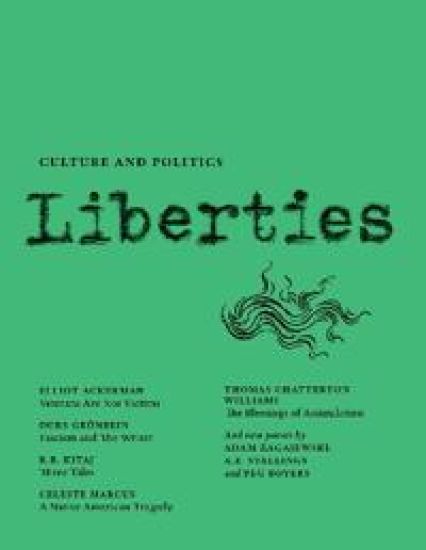
Liberties Journal of Culture and Politics

Liberties Journal of Culture and Politics

Elliot Ackerman; Durs Grünbein; Thomas Chatterton Williams; Anita Shapira; Adam Zagajewski; Sally Satel; R.B. Kitaj; Matthew Stephenson; Helen Vendler; David Haziza; A.E. Stallings; Paul Berman; Clara Collier; Michael Kimmage; Peg Boyers

Liberties Journal Foundation
2021
pokkari
“A Meteor of Intelligent Substance” “Something was Missing in our Culture, and Here It Is” Liberties – A Journal of Culture and Politics features new essays and poetry from some of the world's best writers and artists to inspire and impact the intellectual and creative lifeblood of our current culture and today's politics. This summer issue of Liberties includes: Elliot Ackerman on Veterans Are Not Victims; Durs Grünbein on Fascism and the Writer; R. B. Kitaj’s Three Tales; Thomas Chatterton Williams on The Blessings of Assimilation; Anita Shapira on The Fall of Israel’s House of Labor; Sally Satel on Woke Medicine; Matthew Stephenson On Corruption’s Honey and Poison; Helen Vender on Wallace Stevens; David Haziza on Illusions of Immunity; Paul Berman on the Library of America; Clara Collier’s nostalgia for strong women in film; Michael Kimmage on American Inquisitions; Leon Wieseltier (editor) on the high price of Stoicism; Celeste Marcus (managing editor) on a Native American Tragedy; and new poetry from Adam Zagajewski, A. E. Stallings, and Peg Boyers.
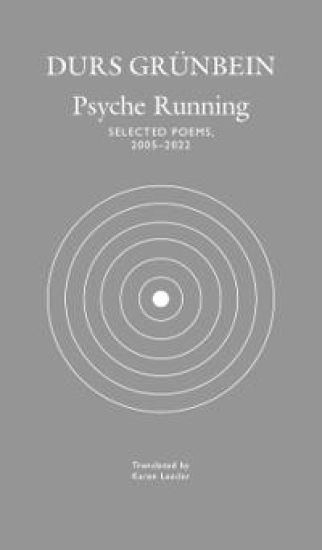
Psyche Running

Psyche Running

Durs Grünbein

SEAGULL BOOKS LONDON LTD
2024
sidottu
A dazzling selection of more than one hundred poems that trace the development of Durs Grünbein’s work over the past two decades. Born in Dresden in 1962, Durs Grünbein is the most significant and successful poet of his generation in Germany. Since 1988, when the then-twenty-five-year-old burst onto the scene with his poetry collection Grauzone morgens—a mordant reckoning with the East Germany he grew up in—Grünbein has published more than thirty books of poetry and prose, which have been translated into dozens of languages. In 2005 the volume Ashes for Breakfast introduced Grünbein to English-language readers for the first time by sampling poetry from his first four collections. Psyche Running picks up where that volume left off and offers a selection of poems from his nine subsequent collections, which shows how Grünbein has developed from his ironic take on the classical into an elegiac exploration of history through dream fragments and poems with a haunting existential unease.
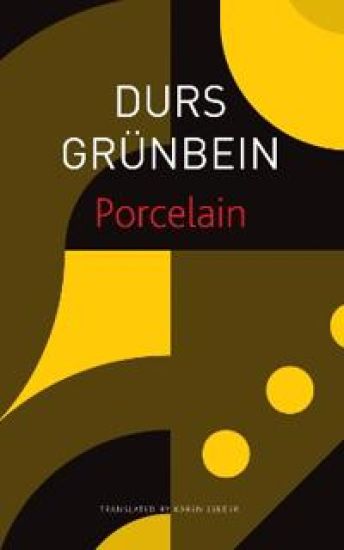
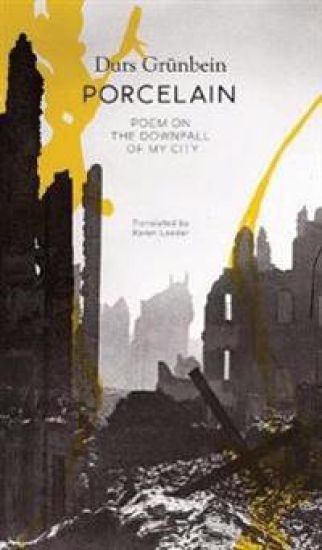
Porcelain – Poem on the Downfall of My City

Porcelain – Poem on the Downfall of My City

Durs Grünbein; Karen Leeder

SEAGULL BOOKS LONDON LTD
2023
nidottu
A book-length cycle of forty-nine poems written over the course of more than a decade that together serve as a lament for Durs Grünbein’s hometown, Dresden, which was destroyed in the Allied firebombing of February 1945. Porcelain is a book-length cycle of forty-nine poems written over the course of more than a decade that together serve as a lament for Durs Grünbein’s hometown, Dresden, which was destroyed in the Allied firebombing of February 1945. The book is at once a history and “declaration of love” to the famed “Venice on the Elbe,” so catastrophically razed by British bombs; a musical fusion of eyewitness accounts, family memories, and stories, of monuments and relics; the story of the city’s destiny as seen through a prism of biographical enigmas, its intimate relation to the “white gold” porcelain that made its fortune and reflections on the power and limits of poetry. Musical, fractured, ironic, and elegiac, Porcelain is controversial, too, in setting itself against what Grünbein calls the “myth” of the Germans as innocent victims of a war crime. At the same time, it never loses sight of the horror deliberately visited on an unwitting civilian population, nor the devastation that looms so large in the German memory. Published for the first time in English, on the seventy-fifth year anniversary of the firebombing, this edition contains new images, notes, Grünbein’s own reflections, and an additional canto—an extraordinary act of poetic kintsugi for the fractured remains of Dresden’s memory.
Liberties Journal of Culture and Politics

Liberties Journal of Culture and Politics

Laura Kipnis; Dorian Abbot; Bernard-Henri Levy; Bruce D. Jones; Durs Grunbein; David Greenberg; Ingrid Rowland; Clara Collier; David A. Bell; Morten Hoi Jensen; Nathaniel Mackey; Robert Cooper; Steven M. Nadler; Helen Vendler; Haris Vlavianos

Liberties Journal Foundation
2022
pokkari
“A Meteor of Intelligent Substance”“Something was Missing in our Culture, and Here It Is”"Liberties is THE place to be." Liberties, a journal of Culture and Politics, is essential reading for those engaged in the cultural and political issues and causes of our time. Liberties features serious, independent, stylish, and controversial essays by significant writers and leaders throughout the world; new poetry; and, introduces the next generation of writers and voices to inspire and impact the intellectual and creative lifeblood of today’s culture and politics. In this issue of Liberties: Laura Kipnis on Genders Without Fear; Dorian Abbot’s call to arms - Science to Politics: Drop Dead; Bernard Henri-Lévy on What is Reading?; Bruce D. Jones on today’s reality of Taiwan, China, America; David Greenberg examines The War on Objectivity; Helen Vendler on Art vs. Stereotypes through the work of Marianne Moore; Ingrid Rowland captures Thucydides on our Conflicts; David A. Bell exposes the Greatest Enemy of Democracy in France; Robert Cooper reports on Myanmar, Atrocity in the Garden of Eden; Steven M. Nadler on Bans and Excommunications, Then and Now; Morten Høi Jensen on the State of Literary Biography; Clara Collier on Women with Whips — Joan Crawford, Marlene Dietrich, Barbara Stanwyck; Celeste Marcus on Unknown Heroes of Modern Art; Leon Wieseltier reveals Christianism in Modern Politics; and, new poetry from Durs Grünbein, Nathaniel Mackey, and Haris Vlavianos.
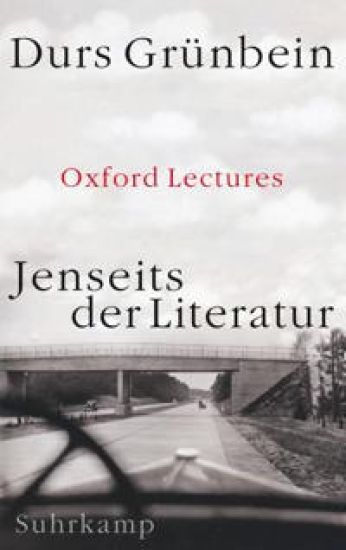
For the Dying Calves

For the Dying Calves

Durs Grünbein

Seagull Books London Ltd
2022
sidottu
Poetically written and originally given as lectures, this is a moving essay collection from Durs Grünbein. In his four Lord Weidenfeld Lectures held in Oxford in 2019, German poet Durs Grünbein dealt with a topic that has occupied his mind ever since he began to perceive his own position within the past of his nation, his linguistic community, and his family: How is it possible that history can determine the individual poetic imagination and segregate it into private niches? Shouldn’t poetry look at the world with its own sovereign eyes instead? In the form of a collage or “photosynthesis,” in image and text, Grünbein lets the fundamental opposition between poetic license and almost overwhelming bondage to history appear in an exemplary way. From the seeming trifle of a stamp with the portrait of Adolf Hitler, he moves through the phenomenon of the “Führer’s streets” and into the inferno of aerial warfare. In the end, Grünbein argues that we are faced with the powerlessness of writing and the realization, valid to this day, that comes from confronting history. As he muses, “There is something beyond literature that questions all writing.”
Porcelain

Porcelain

Durs Grünbein

Seagull Books London Ltd
2020
sidottu
A book-length cycle of forty-nine poems written over the course of more than a decade that together serve as a lament for Durs Grünbein’s hometown, Dresden, which was destroyed in the Allied firebombing of February 1945. Porcelain is a book-length cycle of forty-nine poems written over the course of more than a decade that together serve as a lament for Durs Grünbein’s hometown, Dresden, which was destroyed in the Allied firebombing of February 1945. The book is at once a history and “declaration of love” to the famed “Venice on the Elbe,” so catastrophically razed by British bombs; a musical fusion of eyewitness accounts, family memories, and stories, of monuments and relics; the story of the city’s destiny as seen through a prism of biographical enigmas, its intimate relation to the “white gold” porcelain that made its fortune and reflections on the power and limits of poetry. Musical, fractured, ironic, and elegiac, Porcelain is controversial, too, in setting itself against what Grünbein calls the “myth” of the Germans as innocent victims of a war crime. At the same time, it never loses sight of the horror deliberately visited on an unwitting civilian population, nor the devastation that looms so large in the German memory. Published for the first time in English, on the seventy-fifth year anniversary of the firebombing, this edition contains new images, notes, Grünbein’s own reflections, and an additional canto—an extraordinary act of poetic kintsugi for the fractured remains of Dresden’s memory.
Åren på zoo

Åren på zoo

Durs Grünbein

Ersatz
2018
sidottu
En minnesbåge av prosa, dikter och fotografier, från sekelskiftet 1900 till vändpunkten 1989. I en bok full av historier, verser och sällsynta fotografier visar sig poeten Durs Grünbein från en självbiografisk sida. Men han griper ännu längre tillbaka, till tiden då 1900-talets tidiga konturer började framträda. Från Hellerau, trädgårdsstaden i utkanten av Dresden, når ett reformprogram för livet långt utanför förortens gränser. Det blir en station för Kafka, Rilke, Benn och många andra. För Grünbein blir det en utgångspunkt mot hållplatserna på den egna levnadsbanan. Fortsättningen är händelser i familjen under 1900-talet, skräckupplevelserna under eldstormen i Dresden i februari 1945, ett trauma som tränger djupt in i hans egen livsberättelse. Och slutligen uppstår en bild av den egna barndomen i Östtyskland under kalla krigets långa, solgassande somrar. Durs Grünbein, född 1962 i Dresden och sedan 1986 bosatt i Berlin, där han är verksam som poet, översättare och essäist. Han har fått ett flertal priser för sina verk, bland annat Peter-Huchel-Preis, Georg-Büchner-Preis, Friedrich Nietzsche-Preis och Berliner Literaturpreis 2006. I april 2012 tilldelades han Tomas Tranströmer-priset. KRITIKERRÖSTER: »Alla genregränser är upphävda, ett grepp som inte verkar sökt utan bara kongenialt med motivet: om ett provisorium kan man kanske bara skriva i en öppen, föränderlig form som trevar sig fram.« Jens Christian Brandt, Dagens Nyheter »Man måste läsa om, stycken kan kännas olästa efter läsning med penna, tankar och associationer kommer i stim, vänder. Det är omöjligt och härligt och man kan inte behärska boken. Tvärtom känns det som om Grünbein kastar smörgås över sin minnesyta med läsaren som sten. Som en flat, glidskuttande sten flyger och nuddar och sjunker jag långt ute i den rikt mönstrade myren med titeln Åren på Zoo .« Sigrid Combüchen, Svenska Dagbladet»I Ulrika Wallenströms fabulösa översättning är Grünbeins skildring av sin uppväxt under det kalla kriget på andra sidan den mur som i hans värld kallades Skyddsvallen mot fascismens och imperialismens ondska, ett svindlande, vindlande läsäventyr.« Ragnar Strömberg, Göteborgs-Posten»Öppen i sinnet, inhägnad geografiskt. Formidabelt formulerar Grünbein i Åren på zoo på ett både för det lilla barnet och den kunskapstörstande ynglingen förbryllande intryck och känslor av isolering. Nästan varje sida känns klibbig, eller liksom vibrerande av historiens inte alltid så lyckobringande vindslag.« Nina Lekander, Expressen»Det är poetiskt, kaleidoskopiskt, och underbart.« Durs Grünbeins »Åren på zoo« recenseras i Arbetarbladet. »Senast en liknande text tog sig in i läsarrummet var en vinter för några år sedan: W. G Sebalds Logi på landet och Dikt, prosa, essä .« Bengt Söderhäll