
Kirjailija
Emile Durkheim
Kirjat ja teokset yhdessä paikassa: 179 kirjaa, julkaisuja vuosilta 1960–2026, suosituimpiin kuuluu Emile Durkheim, 1858-1917: A Collection of Essays. Vertaile teosten hintoja ja tarkista saatavuus suomalaisista kirjakaupoista.
Nimi esiintyy myös muodoissa: Émile Durkheim
179 kirjaa
Kirjojen julkaisuvuodet: 1960–2026.
Moral Education: A Study in the Theory and Application of the Sociology of Education
Emile Durkheim; Everett K. Wilson
Literary Licensing, LLC
2011
nidottu
18 lectures by an influential theorist who discusses school as an appropriate setting for moral education. A pioneer of sociology, Durkheim explains the first element in fostering morality as the development of a sense of discipline, followed by a willingness to behave in accordance with collective interest, and a sense of autonomy.
Emile Durkheim, 1858-1917: A Collection of Essays
Emile Durkheim; Kurt H. Wolff
Literary Licensing, LLC
2011
nidottu
Moral Education: A Study in the Theory and Application of the Sociology of Education
Emile Durkheim; Everett K. Wilson
Literary Licensing, LLC
2011
sidottu
""Moral Education: A Study In The Theory And Application Of The Sociology Of Education"" is a book written by Emile Durkheim, a prominent French sociologist. The book explores the relationship between education and morality, and how education can be used to instill moral values in individuals and society as a whole. Durkheim argues that moral education is essential for the development of a healthy and cohesive society, and that it is the responsibility of the education system to provide this education. The book examines the history of moral education, the role of the teacher in moral education, and the various methods and techniques used to impart moral values. Durkheim also discusses the challenges and obstacles that exist in implementing moral education, such as the influence of external factors such as family and religion. The book is a seminal work in the field of sociology of education, and continues to be studied and referenced by scholars today. Foreword By Paul Fauconnet. This scarce antiquarian book is a facsimile reprint of the old original and may contain some imperfections such as library marks and notations. Because we believe this work is culturally important, we have made it available as part of our commitment for protecting, preserving, and promoting the world's literature in affordable, high quality, modern editions, that are true to their original work.
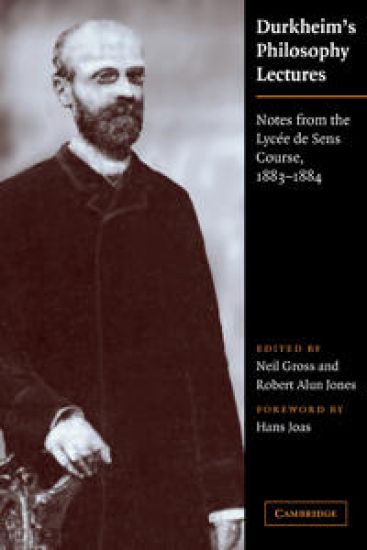
Moving back and forth between the history of philosophy and the contributions of philosophers in his own day, Durkheim takes up topics as diverse as philosophical psychology, logic, ethics, and metaphysics, and seeks to articulate a unified philosophical position. Remarkably, in these lectures, given more than a decade before the publication of his groundbreaking book, The Division of Labour in Society (1893), the 'social realism' that is so characteristic of his later work - where he insists, famously, that social facts cannot be reduced to psychological or economic ones, and that such facts constrain human action in important ways - is totally absent in these early lectures. For this reason, they will be of special interest to students of the history of the social sciences, for they shed important light on the course of Durkheim's intellectual development.
Die elementaren Formen des religiösen Lebens
Emile Durkheim
Verlag der Weltreligionen Taschenbuch
2010
pokkari
Emile Durkheims (1858-1917) - längst klassisch gewordene, aber noch immer aktuelle - Studie geht der Frage nach dem Wesen der Religion nach. Durkheim entwirft die Grundlage für eine funktionalistische Betrachtung der Religion, indem er als ihren sozialen Kern die Aufgabe zur Stiftung gesellschaftlichen Zusammenhalts und gesellschaftlicher Identität ausmacht. Mit der Abgrenzung eines funktionalistischen Religionsbegriffs von einem substantialistischen Verständnis der Religion verdankt die moderne Religionssoziologie Durkheim wichtige Impulse.

In this influential work, first published in English in 1963, Durkheim and Mauss claim that the individual mind is capable of classification and they seek the origin of the ‘classificatory function’ in society. On the basis of an intensive examination of forms and principles of symbolic classification reported from the Australian aborigines, the Zuñi and traditional China, they try to establish a formal correspondence between social and symbolic classification. From this they argue that the mode of classification is determined by the form of society and that the notions of space, time, hierarchy, number, class and other such cognitive categories are products of society. Dr Needham’s introduction assesses the validity of Durkhiem and Mauss’s argument, traces its continued influence in various disciplines, and indicates its analytical value for future researches in social anthropology.
First published in English in 1953, this volume represents a collection of three essays written by seminal sociologist and philsopher Emile Durkheim in which he puts forward the thesis that society is both a dynamic system and the seat of moral life. Each essay stands alone, but their connecting thread is the dialectic demonstration that a phenomenon, be a sociological or psychological one, is relatively independent of its matrix. The essays provide a valuable insight into Durkeheimian thought on sociological and philsophical matters and offer an excellent guide to Durkheim for students of both disciplines.
First Published in 2005. Emile Durkheim's writing on education is well-known and widely recognized to be of great significance. In these lectures - given for the first time in 1902 to meet an urgent contemporary need - Durkheim presents a 'vast and bold fresco' of educational development in Europe. He covers nearly eight hundred years of history. The book culminates in two long chapters of positive recommendations for modern curriculum, which should be of special interest and value to those concerned with education policy, in whatever capacity.
First published in English in 1953, this volume represents a collection of three essays written by seminal sociologist and philsopher Emile Durkheim in which he puts forward the thesis that society is both a dynamic system and the seat of moral life. Each essay stands alone, but their connecting thread is the dialectic demonstration that a phenomenon, be a sociological or psychological one, is relatively independent of its matrix. The essays provide a valuable insight into Durkeheimian thought on sociological and philsophical matters and offer an excellent guide to Durkheim for students of both disciplines.

In this influential work, first published in English in 1963, Durkheim and Mauss claim that the individual mind is capable of classification and they seek the origin of the ‘classificatory function’ in society. On the basis of an intensive examination of forms and principles of symbolic classification reported from the Australian aborigines, the Zuñi and traditional China, they try to establish a formal correspondence between social and symbolic classification. From this they argue that the mode of classification is determined by the form of society and that the notions of space, time, hierarchy, number, class and other such cognitive categories are products of society. Dr Needham’s introduction assesses the validity of Durkhiem and Mauss’s argument, traces its continued influence in various disciplines, and indicates its analytical value for future researches in social anthropology.
The Elementary Forms of Religious Life
Émile Durkheim
Oxford University Press
2008
nidottu
Halvin toimitettuna 20,90 €
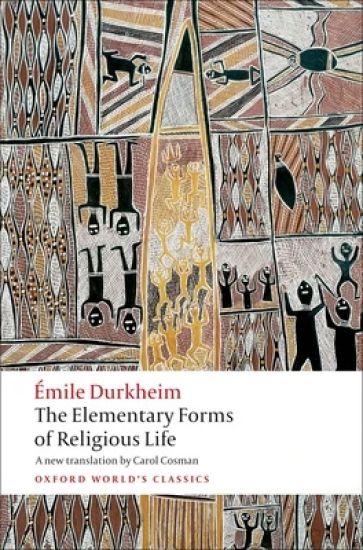
'If religion generated everything that is essential in society, this is because the idea of society is the soul of religion.' In The Elementary Forms of Religious Life (1912), Émile Durkheim set himself the task of discovering the enduring source of human social identity. He investigated what he considered to be the simplest form of documented religion - totemism among the Aborigines of Australia. Aboriginal religion was an avenue 'to yield an understanding of the religious nature of man, by showing us an essential and permanent aspect of humanity'. The need and capacity of men and women to relate socially lies at the heart of Durkheim's exploration, in which religion embodies the beliefs that shape our moral universe. The Elementary Forms has been applauded and debated by sociologists, anthropologists, ethnographers, philosophers, and theologians, and continues to speak to new generations about the origin and nature of religion and society. This new, lightly abridged edition provides an excellent introduction to Durkheim's ideas. ABOUT THE SERIES: For over 100 years Oxford World's Classics has made available the widest range of literature from around the globe. Each affordable volume reflects Oxford's commitment to scholarship, providing the most accurate text plus a wealth of other valuable features, including expert introductions by leading authorities, helpful notes to clarify the text, up-to-date bibliographies for further study, and much more.
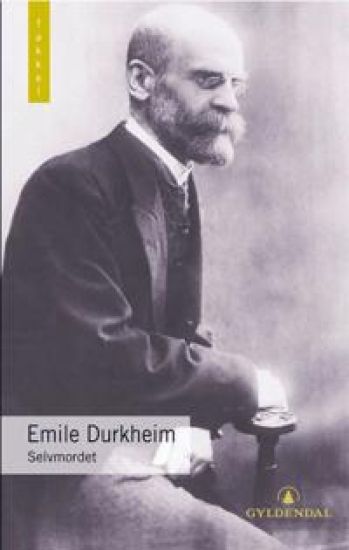
Emile Durkheim (1858–1917) fikk med utgivelsen av Selvmordet i 1897 sitt gjennombrudd som sosiolog. Durkheim var blant de første som hevdet studiet av sosiale fenomener som et selvstendig forskningsområde. I Selvmordet undersøker han de sosiale årsaker til selvmord. Den stigende selvmordshyppigheten i det moderne samfunnet tolkes som en følge av større avstand mellom menneskene og av uklart definerte sosiale situasjoner. Utvalget og innledningen er ved Dag Østerberg. Boken utkommer nå for treje gang i Fakkel-serien.
Emile Durkheim's On Suicide (1897) was a groundbreaking book in the field of sociology. Traditionally, suicide was thought to be a matter of purely individual despair but Durkheim recognized that the phenomenon had a social dimension. He believed that if anything can explain how individuals relate to society, then it is suicide: Why does it happen? What goes wrong? Why do certain social, religious or racial groups have higher incidences of suicide than others? As Durkheim explored these questions he became convinced that abnormally high or low levels of social integration lead to an increased likelihood of suicide. On Suicide was the result of his extensive research. Divided into three parts - individual reasons for suicide, social forms of suicide and the relation of suicide to society as a whole - Durkheim's revelations have fascinated, challenged and informed readers for over a century.
The Elementary Forms of the Religious Life
Emile Durkheim; Joseph Ward Swain
Kessinger Pub
2005
pokkari
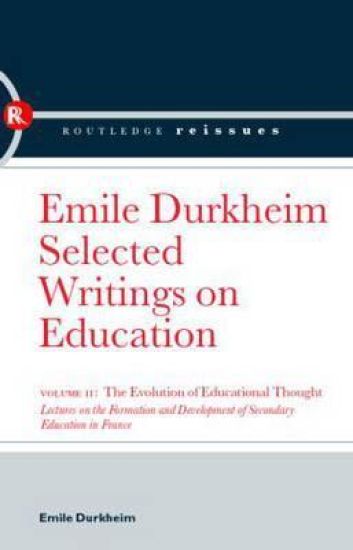
First Published in 2005. Emile Durkheim's writing on education is well-known and widely recognized to be of great significance. In these lectures - given for the first time in 1902 to meet an urgent contemporary need - Durkheim presents a 'vast and bold fresco' of educational development in Europe. He covers nearly eight hundred years of history. The book culminates in two long chapters of positive recommendations for modern curriculum, which should be of special interest and value to those concerned with education policy, in whatever capacity.
The Elementary Forms of the Religious Life
Emile Durkheim; Joseph Ward (TRN) Swain
Kessinger Pub
2005
sidottu