Kirjojen hintavertailu – 12 903 725 kirjaa ja 27 kauppaa

Kirjailija

Eric Voegelin

Kirjat ja teokset yhdessä paikassa: 40 kirjaa, julkaisuja vuosilta 1982–2023, suosituimpiin kuuluu Das Okumenische Zeitalter - Die Legitimitat Der Antike. Vertaile teosten hintoja ja tarkista saatavuus suomalaisista kirjakaupoista.

40 kirjaa

Kirjojen julkaisuvuodet: 1982–2023.

History of Political Ideas (CW26)

History of Political Ideas (CW26)

Eric Voegelin

University of Missouri Press
2023
sidottu
Reaching into our own time, Crisis and the Apocalypse of Man confronts the disintegration of traditional sources of meaning and the correlative attempt to generate new sources of order from within the self. Voegelin allows us to contemplate the crisis in its starkest terms as the apocalypse of man that now seeks to replace the apocalypse of God. The totalitarian upheaval that convulsed Voegelin's world, and whose aftermath still defines ours, is only the external manifestation of an inner spiritual turmoil. Its roots have been probed throughout the eight volumes of History of Political Ideas, but its emergence is marked by the age of Enlightenment. In our postmodern era, discussions of the collapse of the "enlightenment project" have become commonplace. Voegelin compels us to follow the great-souled individuals who sought to go from disintegration of the present toward evocations of order for the future. Such thinkers as Comte, Bakunin, and Marx suffered through the crisis and fully understood the need for a new outpouring of the spirit. They resolved to supply the deficiency themselves. As a consequence they launched us irrevocably on the path of the apocalypse of man. One of the great merits of Voegelin's analysis is his exposition of the pervasive character of this crisis. It is not confined to the megalomaniacal dreamers of a revolutionary apocalypse; rather, echoes of it are found in the more moderate Enlightenment preoccupation with progress to be attained through application of the scientific method. Faith in the capacity of instrumental reason to answer the ultimate questions of human existence defined men such as Voltaire, HelvÉtius, Diderot, D'Alembert, and Condorcet. It remains the authoritative faith of our world today, Voegelin argues, demonstrated by our continuing inability to step outside the parameters of the Enlightenment. Are we condemned, then, to oscillate between the rational incoherence of a science that never delivers on its promises and a now discredited revolutionary idealism that wreaks havoc in practice? This is the question toward which Voegelin's final volume points. While not direct, his response is evident everywhere. Crisis and the Apocalypse of Man could have been written only by a man who had reached his own resolution of the crisis.
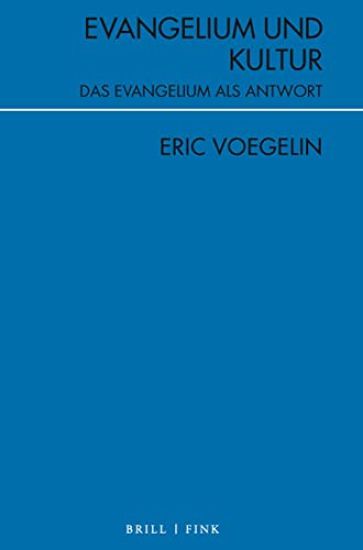
Evangelium Und Kultur: Das Evangelium ALS Antwort, 2., Erweiterte Auflage
Das Evangelium war in der Kultur, in der es entstand, als befreiende Antwort auf das R tsel der menschlichen Existenz empfunden worden. Im Laufe der Geschichte wurde seine Botschaft durch die Verdinglichung der Glaubenssymbole so sehr deformiert, dass es bei suchenden Menschen au erhalb der Kirche auf Gleichg ltigkeit st t und innerhalb der Kirche die Unruhe der Gl ubigen hervorruft. In der vorliegenden Studie versucht Eric Voegelin, die dogmatischen Ablagerungen abzutragen und die existenziellen Erfahrungen wieder aufzudecken, die den zentralen christlichen Symbolen - vor allem der Menschwerdung Gottes - zugrunde liegen. Auf diese Weise wird die Frage wiedergewonnen, auf die das Evangelium die befreiende Antwort ist. Indem Voegelin die Besonderheit der christlichen Erfahrung durch analytischen Vergleich mit den dem Christentum vorausgehenden Kulturen herausarbeitet, wird die Einbettung des Christentums in das Kontinuum der Menschheitsgeschichte sichtbar. Die Analyse zeigt das Evangelium als Kulminationspunkt eines theophanischen Prozesses, der sich ber Jahrtausende erstreckt, gleichzeitig aber auch als den Punkt, der gnostische Entgleisungen erm glichte, deren destruktives Potential bis in unsere Gegenwart reicht.
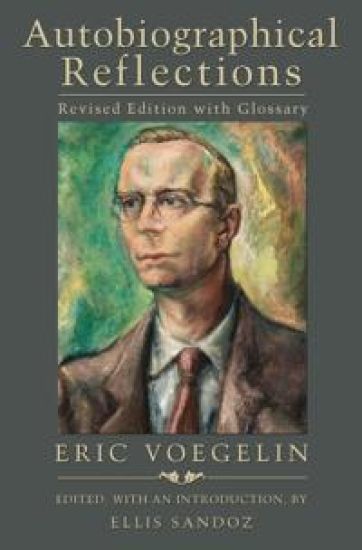
Autobiographical Reflections

Autobiographical Reflections

Eric Voegelin

University of Missouri Press
2011
nidottu
Autobiographical Reflections is a window into the mind of a man whose reassessment of the nature of history and thought has overturned traditional approaches to, and appraisals of, the Western intellectual tradition. Here we encounter the motivations for Voegelin's work, the stages in the development of his unique philosophy of consciousness, his key intellectual breakthroughs, his theory of history, and his diagnosis of the political ills of the modern age. Included in this revised volume is a glossary of terms used in Voegelin's writings. The glossary lists, defines, and illustrates from the author's writings many of the key terms employed, paying particular attention to the Greek terms. Together, the glossary and enlarged index systematically include names, subjects, ideas, writings, and terms, making this volume an indispensable help for any serious study of Eric Voegelin's oeuvre.
Selected Correspondence, 1924-1949 (CW29)

Selected Correspondence, 1924-1949 (CW29)

Eric Voegelin

University of Missouri Press
2009
sidottu
This volume contains selected correspondence written by Eric Voegelin during the period 1924 to 1949. The Editorial Board of the Collected Works of Eric Voegelin agreed from the beginning that a representative number of Voegelin's letters should complete the edition in an attempt to provide the reader with insights into Voegelin's intellectual life and into the fundamental experiences that went into shaping the growth of his personality. It was the board's aim to select material in accordance with the guidelines that Voegelin himself laid down as fundamental to a hermeneutical understanding of spiritual reality. Voegelin wrote that in studying a thinker, one must try to elucidate the biographical 'radices of philosophizing'. He said that one must penetrate to the 'experiences that impel [him] toward reflection, and do so because they have excited consciousness to the 'awe' of existence'. Voegelin made these remarks on the occasion of conducting anamnetic experiments, which reveal the motivational center of his own life. At the core of Voegelin's concept of political science is a noetic interpretation of man, society, and history that confronts the conception of order prevalent in the surrounding society with the criteria of the critical knowledge of order. From the 1930's onward, Voegelin labored to find a satisfactory self-reflexive explication of the principles of a contemplative understanding of human reality, one grounded in the spiritual experience of reason. Naturally, it is the published word that determines a thinker's scholarly stature. But Voegelin's letters also grant insight into the development of his thought; document the author's struggle with himself, the telos of his scholarship; and, reveal an often-involuntary conflict with his life-world. These letters shed light on an ongoing and open-ended thought process from which a multifaceted, sometimes apparently contradictory, work emerged. Because of the enormous number of letters that Voegelin wrote in his later years - now published in the second volume of the ""Selected Correspondence"" (Volume 30 of the ""Collected Works"") - the editors agreed that these books would contain only letters from Eric Voegelin. While such a selection of letters cannot provide the completeness that the publication of both dialogue partners would provide, nevertheless they reveal Voegelin's ongoing reflection on human affairs. They reveal patterns of thought and their development in the atmosphere of intimate communication that personal and intellectual 'elective affinities' produce, and they also disclose the silences that accompany such discourse. This volume is certain to interest all readers concerned with political theory and with better understanding of Voegelin's intellectual pilgrimage from his earliest academic years to his emergence as one of the most significant philosophers of our time.
Selected Correspondence, 1950-1984 (CW30)

Selected Correspondence, 1950-1984 (CW30)

Eric Voegelin

University of Missouri Press
2007
sidottu
This second volume of letters written by Eric Voegelin covers the period from 1950 through 1984. With few exceptions, the originals are to be found in the Hoover Institution Archives at Stanford University. Correspondents include Leo Strauss, Karl Lowith, Alfred Schutz, Aaron Gurwitsch, Hans Kelsen, Marshal McLuhan, Bertrand de Jouvenel, Arnold Toynbee, and Marie Konig, among others. Beginning at a time when Voegelin was working on a major theoretical breakthrough, reflected in the Walgreen Lectures at the University of Chicago and The New Science of Politics, the correspondence highlights the years of publication of the first four volumes of ""Order and History""; Voegelin's move to ""Munich"", where he founded and directed the university's Institut fur Politische Wissenschaft; and his years as Henry Salvatori Distinguished Fellow at the Hoover Institution in Stanford from 1969 to 1974. Voegelin remained a tireless correspondent until the last years of his life. Voegelin's Munich years, while not without controversy, can be seen as the most successful time in his life, as well as his most creative and prolific as a political philosopher. During that time, Voegelin worked on volume IV of ""Order and History"", and the letters written to successive directors of the Louisiana State University Press, as well as to friends and colleagues, give a vivid account of the changing nature of this seminal project. Voegelin's letters written between 1969 and 1984 provide compelling evidence of the intellectual vigor that characterized his work throughout his life and continued virtually undiminished until the last weeks before his death. Voegelin's realism, his sharp wit, and his superbly developed sense of irony remain evident in the correspondence throughout all these years. While letters to Leo Strauss, Robert Heilman, and Alfred Schutz have been published in separate volumes of correspondence, this selection adds an abundance of hitherto unpublished letters, many of them translated from the original German, providing for the first time the outlines of an intellectual biography of one of the most profound thinkers of the twentieth century. Any reader with a serious interest in Voegelin's work will find that the freshness and vitality of his thought are perhaps nowhere more evident than in the letters collected here. As a letter writer, Voegelin always challenged his counterparts, and he is bound to challenge the reader of this correspondence.
Autobiographical Reflections (CW34)

Autobiographical Reflections (CW34)

Eric Voegelin

University of Missouri Press
2006
sidottu
The thirty-fourth volume of The Collected Works of Eric Voegelin consists of Voegelin's Autobiographical Reflections, reprinted from the 1989 edition with additional annotations; a glossary of terms used in Voegelin's writings, illustrated with examples from throughout the Collected Works; a volume index; and a cumulative index. The last covers the entire edition, apart from The History of Political Ideas, which has its own index, and volumes 29 and 30, the Selected Correspondence, which are at present not published. The glossary lists, defines, and illustrates from the author's writings many of the key terms employed, paying particular attention to the Greek terms. The cumulative index supplies a more comprehensive access to the contents of the entire Collected Works. Together, the glossary and index systematically include names, subjects, ideas, writings, and terms, making this culminating volume an indispensable help for any serious study of Eric Voegelin's oeuvre.
The Theory of Governance and Other Miscellaneous Papers, 1921-1938 (CW32)
This first of two volumes of Voegelin's miscellaneous papers brings together crucial writings, published for the first time, from the early, formative period of this scholar's thought. The book begins with Voegelin's dissertation on sociological method, completed under the direction of Othmar Spann and Hans Kelsen at the University of Vienna in 1922. It reveals an intimate knowledge of the writings of Georg Simmel and a skillful use of insights gained from Edmund Husserl's Logical Investigations and Ideas. The dissertation, and other smaller pieces written at this time, addresses problems that remained of great importance to Voegelin throughout his life: the relation of insight to language, the structure of the human being, and the human's spiritual center. They disclose both Voegelin's theoretical reference points during these early years, including the thought of Henri Bergson, Othmar Spann, Georg Simmel, and Edmund Husserl, as well the young scholar's remarkably independent approach to theoretical problems. Moreover, this volume includes a work that is fundamental to an understanding of Voegelin's theoretical development: his extended study on the ""theory of governance,"" written between 1930 and 1932. It follows the issues that confront political society to their roots in the soul and in the soul's relationship to the ground of being. The Theory of Governance and Other Miscellaneous Papers presents a meditative-exegetic study of texts from Augustine, Descartes, and Husserl, early examples of the meditations that became central to Voegelin's later work. Other essays included in this volume such as ""The Theory of Law"" and ""Political Science as Human Science"" develop these theoretical insights and refine Voegelin's methodological tools. This volume will be of interest to all scholars of the work of Eric Voegelin and of the refoundation of political philosophy in the twentieth century in general.
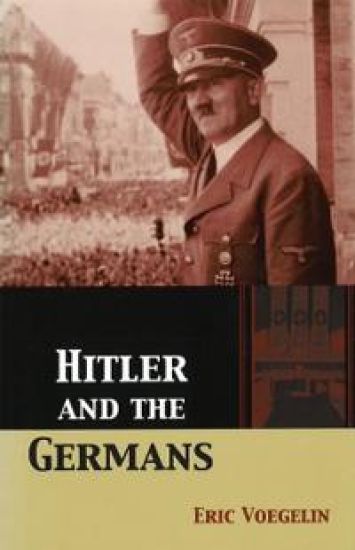
Hitler and the Germans

Hitler and the Germans

Eric Voegelin

University of Missouri Press
2003
nidottu
Between 1933 and 1938, Eric Voegelin published four books that expressly stated his opposition to the increasingly powerful Hitler regime. As a result, he was forced to leave his homeland in 1938. Twenty years later, he returned to Germany as a professor of political science at Ludwig-Maximilian University. Voegelin's homecoming allowed him the opportunity to voice once again his opinions on the Nazi regime and its aftermath. In 1964 at the University of Munich, Voegelin gave a series of memorable lectures on what he considered ""the central German experiential problem"" of his time: Adolf Hitler's rise to power, the reasons for it, and its consequences for post-Nazi Germany. For Voegelin, these questions demanded a scrutiny of the mentality of individual Germans and of the order of German society during and after the Nazi period. ""Hitler and the Germans"" offers Voegelin's most extensive and detailed critique of the Hitler era. Voegelin interprets this era in terms of the basic diagnostic tools provided by the philosophy of Plato and Aristotle, Judeo-Christian culture, and contemporary German-language writers like Heimito von Doderer, Karl Kraus, Thomas Mann and Robert Musil. His inquiry uncovers a historiography that was substantially unhistoric: a German Evangelical Church that misinterpreted the Gospel, a German Catholic Church that denied universal humanity, and a legal process enmeshed in criminal homicide.
Anamnesis (CW6)

Anamnesis (CW6)

Eric Voegelin; David Walsh

University of Missouri Press
2002
sidottu
Volume 6 of the Collected Works of Eric Voegelin offers the first translation of the full German text of Anamnesis published in 1966. The previous English edition, translated by Gerhart Niemeyer, focused largely on the sections of Anamnesis dealing directly with Voegelin's philosophy of consciousness. It omitted some of the extensive historical studies on which the philosophy of consciousness was based. To properly understand Voegelin's work, however, it is essential to give equal weight to the empirical as well as the philosophical aspects. This complete version of Anamnesis captures the full integrity of his vision. It is at once scientific, in the sense of fidelity to the demands of historiographic scholarship, and philosophical, in exploring the significance of the texts for the meaning of human existence in society and history. Anamnesis is a pivotal work within Voegelin's intellectual odyssey. Alone among Voegelin's books, it reveals an author looking back and taking stock of his growth rather than customarily forging ahead into new regions and new problems. This critical work is both a recollection of Voegelin's own development, reaching back even to his infant memories, and a demonstration of the anamnetic method as applied to a wide range of historically remembered materials. Written as more than just a collection of essays, Anamnesis is the volume in which Voegelin works out for himself the reconceptualization of what Order and History, and by definition his central philosophical approach, is going to be. By revisiting his previous work - a departure from Voegelin's usual scholarly habits - he found at last the literary form for the kind of empirical philosophical meditation that had long absorbed his labors. Parts I and III contain two meditative exercises written by Voegelin in 1943 and 1965, respectively. The first exercise was the breakthrough by which Voegelin recovered consciousness from the current theories of consciousness. Part III begins as a rethinking of the Aristotelian exegesis of consciousness, and then expands into new areas of awareness that had not come within the knowledge of classic philosophy. Between the two meditations are eight studies that demonstrate how the historical phenomena of order gave rise to the type of analysis which culminates in the meditative exploration of consciousness.
Selected Book Reviews (CW13)

Selected Book Reviews (CW13)

Eric Voegelin

University of Missouri Press
2002
sidottu
Over the course of his varied and distinguished academic life, Eric Voegelin was often called upon by review editors of scholarly journals as well as by editors in the popular press to examine, summarize, and critically assess the work of other scholars, of statesmen, and of men of affairs. The contents of the books Voegelin reviewed mirror his changing interests over the years, including questions of method, points of legal philosophy and jurisprudence, and issues of race, war, and the afternath of war. Of course, he was frequently called upon as well to review standard texts and new editions and monographs across the full range of political science. This collection of Voegelin's reviews amounts to a reflection in miniature of many of the problems Voegelin tackled in his essays, articles, and books from the 1920s until the 1950s, when, owing to the press of other business, he began to decline requests to review the work of others. Some of his reviews are little more than clinical summaries; others are analytic essays. A few are extended engagements with a text or a set of problems. Occasionally, particularly among the later reviews originally written in English, one finds flashes of Voegelin's legendary wit and a restrained impatience with the inadequate approaches or sheer incompetence of others. These book reviews will be of interest to all students and scholars of Eric Voegelin's work.
Order and History (CW14)

Order and History (CW14)

Eric Voegelin

University of Missouri Press
2001
sidottu
Eric Voegelin's Israel and Revelation is the opening volume in his monumental Order and History, which traces the history of order in human society. This volume examines the ancient near eastern civilizations as a backdrop to a discussion of the historical locus of order in Israel. The drama of Israel mirrors the problems associated with the tension of existence as Israel attempted to reconcile the claims of transcendent order with those of pragmatic existence and so becomes paradigmatic. According to Voegelin, what happened in Israel was a decisive step, not only in the history of Israel, but also in the human attempt to achieve order in society. The uniqueness of Israel is the fact that it was the first to create history as a form of life, that is, the recognition by human beings of their existence under a world-transcendent God, and the evaluation of their actions as conforming to or defecting from the divine will. In the course of its history, Israel learns that redemption comes from a source beyond itself. Voegelin develops rich insights into the Old Testament by reading the text as part of the universal drama of being. His philosophy of symbolic forms has immense implications for the treatment of the biblical narrative as a symbolism that articulates the experiences of a people's order. The author initiates us into attunement with all the partners in the community of being: God and humans, work and society. This may well be his most significant contribution to political thought: ""the experience of divine being as world transcendent is inseparable from an understanding of man as human.
Order and History (CW16)

Order and History (CW16)

Eric Voegelin

University of Missouri Press
1999
sidottu
This third volume of Order and History completes Voegelin's study of Greek culture from its earliest pre- Hellenic origins to its full maturity with the dominance of Athens. As the title suggests, Plato and Aristotle is principally devoted to the work of the two great thinkers who represent the high point of philosophic inquiry among the Greeks. Through an absorbing analysis of the Platonic and Aristotelian vision of soul, polis, and cosmos, Voegelin demonstrates how the symbolic framework of the older myth was superseded by the more precisely differentiated symbols of philosophy. Although this outmoding and rejection of past symbols of truth might seem to lead to a chaotic and despairing relativism, Voegelin makes it the basis of a profound conception of the historical process: "the attempts to find the symbolic forms that will adequately express the meaning [of a society], while imperfect, do not form a senseless series of failures. For the great societies have created a sequence of orders, intelligibly connected with one another as advances toward, or recessions from, an adequate symbolization of the truth concerning the order of being of which the order of society is a part." In this view, history has no obvious "meaning," yet each society makes a similar venture after truth. Although every society works out its destiny under different conditions, each nonetheless creates symbols"in its deeds and institutions"which bear the meaning of its own existence. History, then, acquires a unity in the common endeavor toward meaning and order. The rationality and nobility of this view of history has much to say to the present age. Dante Germino's powerful introduction to this edition of Plato and Aristotle eloquently directs the reader into Voegelin's search through the thought of Plato foremost and Aristotle secondarily and toward a full understanding of their relevance to the "modern" world. This masterpiece, Germino argues, provides a welcome antidote to the spirit of an era Voegelin once called the Gnostic age.
Hitler and the Germans (CW31)

Hitler and the Germans (CW31)

Eric Voegelin; Brendan Purcell

University of Missouri Press
1999
sidottu
Between 1933 and 1938, Eric Voegelin published four books that expressly stated his opposition to the increasingly powerful Hitler regime. As a result, he was forced to leave his homeland in 1938. Twenty years later, he returned to Germany as a professor of political science at Ludwig-Maximilian University. Voegelin's homecoming allowed him the opportunity to voice once again his opinions on the Nazi regime and its aftermath. In 1964 at the University of Munich, Voegelin gave a series of memorable lectures on what he considered ""the central German experiential problem"" of his time: Adolf Hitler's rise to power, the reasons for it, and its consequences for post-Nazi Germany. For Voegelin, these questions demanded a scrutiny of the mentality of individual Germans and of the order of German society during and after the Nazi period. ""Hitler and the Germans"" offers Voegelin's most extensive and detailed critique of the Hitler era. Voegelin interprets this era in terms of the basic diagnostic tools provided by the philosophy of Plato and Aristotle, Judeo-Christian culture, and contemporary German-language writers like Heimito von Doderer, Karl Kraus, Thomas Mann and Robert Musil. His inquiry uncovers a historiography that was substantially unhistoric: a German Evangelical Church that misinterpreted the Gospel, a German Catholic Church that denied universal humanity, and a legal process enmeshed in criminal homicide.
The Authoritarian State (CW4)

The Authoritarian State (CW4)

Eric Voegelin

University of Missouri Press
1999
sidottu
Published in Vienna in 1936, Voegelin's work offers a critical examination of the most prominent European theories of state and constitutional law of the period, and provides a political and historical analysis of the Austrian situation. A critique of Kelsen's pure theory of law lies at its heart.