Kirjojen hintavertailu – 12 903 725 kirjaa ja 27 kauppaa

Kirjailija

Eric Voegelin

Kirjat ja teokset yhdessä paikassa: 40 kirjaa, julkaisuja vuosilta 1982–2023, suosituimpiin kuuluu Das Okumenische Zeitalter - Die Legitimitat Der Antike. Vertaile teosten hintoja ja tarkista saatavuus suomalaisista kirjakaupoista.

40 kirjaa

Kirjojen julkaisuvuodet: 1982–2023.

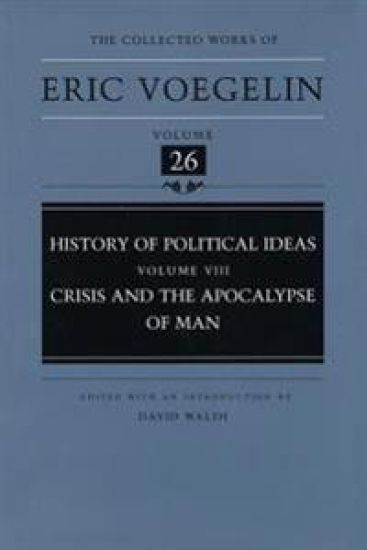
History of Political Ideas (CW25)

History of Political Ideas (CW25)

Eric Voegelin

University of Missouri Press
1999
sidottu
In this text, Eric Voegelin explores two aspects of modernity. He offers an account of the political situation in 17th-century Europe after the decline of the church and the empire, and also explains his theory of ""phenomenalism"".
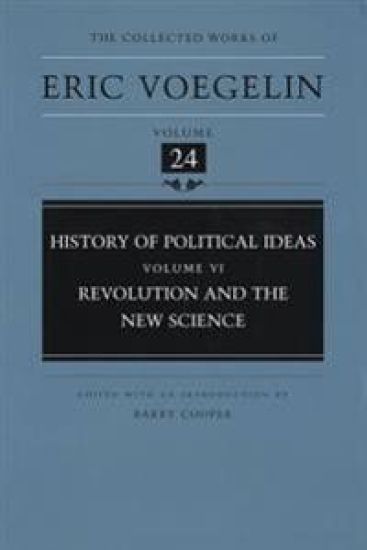
History of Political Ideas (CW24)

History of Political Ideas (CW24)

Eric Voegelin

University of Missouri Press
1999
sidottu
This study of the history of Western political ideas begins with a discussion of the conflict between Bishop Bousset and Voltaire concerning the relationship between what is conventionally identified as sacred and profane history, and goes on to examine the ""New Science"" of Vico.
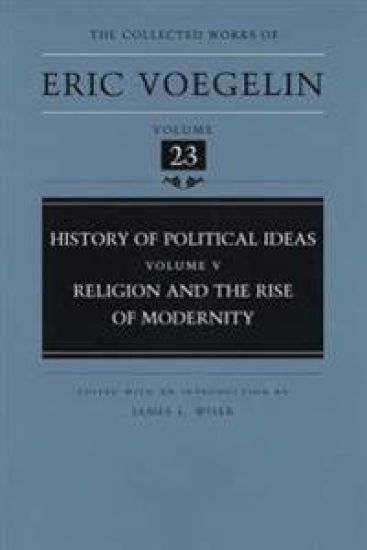
History of Political Ideas (CW23)

History of Political Ideas (CW23)

Eric Voegelin; James L. Wiser

University of Missouri Press
1998
sidottu
Examining the emergence of modernity within the philosophical and political debates of the 16th century, this book analyzes the ""great confusion"". It features such thinkers as Calvin, Althusius, Hooker, Bracciolini, Savonarola, Copernicus, Tycho de Brahe, Giordano Bruno and Jean Bodin.
The History Of The Race Idea (CW3)

The History Of The Race Idea (CW3)

Eric Voegelin

Louisiana State University Press
1998
sidottu
In The History of the Race Idea: From Ray to Carus, Eric Voegelin places the rise of the race idea in the context of the development of modern philosophy. The history of the race idea, according to Voegelin, begins with the post-Christian orientation toward a natural system of living forms. In the late seventeenth century, philosophy set about a new task--to oppose the devaluation of man's physical nature. By the middle of the eighteenth century the effort of philosophy was to place man, with his variety of physical manifestations throughout the world, within a systemic order of nature. Voegelin perceives the problem of race as the epitome of the difficulties presented by this new theoretical approach. Part I covers the development of race theories from the English naturalist John Ray to Blumenbach and Kant. Voegelin, anticipating fairly recent genetic insights, explains that human beings must be seen as one species, different races must not be interpreted as emerging from separate species. In Part II, Voegelin discusses the evolution of the concepts of the body, the organism, and the person. The finite image of the person as a body-mind unit in which body is equal to mind in value provides the basis for Carl Gustav Carus' theory of race, the first significant racial ideology, in Voegelin's estimation. Voegelin's complex analysis levels a scathing critique at Nazi pretensions. He writes: "Compared to its classical form, the current condition of race theory is one of decay. . . . [T]hese men, with no eyes for the brilliance of the German spirit, want to interfere in human relations and ultimately presume to explicate the German nation to us and to the world--an undertaking with evil consequences. . . . [The] great thinkers of the past would have been horrified at somebody finding in himself all the traits of the Nordic race with the help of a book on anthropology and then imagining himself to be somebody special who does not have to do anything else." Let us now take a look at contemporary race theory--we will see an image of destruction. . . . It is a nightmare to think that we should recognize the people whom we follow and whom we allow to come near us not by their looks, their words, and their gestures, but by their cranial index." Ultimately, Voegelin dismisses any attempt to reduce the human being—his existence, appearance, or actionsto a lower level: "Man as mind-body and historical substance cannot be explained' by an element that is less than man himself.

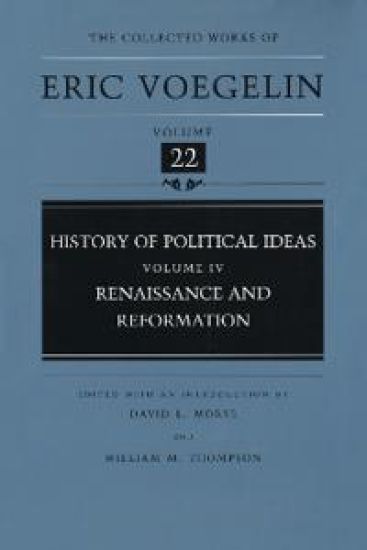
History of Political Ideas (CW22)

History of Political Ideas (CW22)

Eric Voegelin

University of Missouri Press
1998
sidottu
By closely examining the sources, movements and persons of the Renaissance and Reformation, Eric Voegelin reveals the roots of today's political ideologies in this fourth volume of his ""History of Political Ideas"". This study lays the groundwork for his critique of the modern period and is essential to an understanding of his later analysis. Voegelin identifies not one but two distinct beginnings of the movement toward modern political consciousness: the Renaissance and the Reformation. This volume considers both periods and their presence in modern thought. Represented by the works of Niccolo Machiavelli, Desiderius Erasmus and Thomas More, the Renaissance is characterized by Voegelin as a struggle for balance. Exploring the transition from Renaissance to Reformation is a chapter entitled, ""The People of God"", which examines the sectarian movement. These pages contain the historical background that led to Voegelin's later conclusions about Gnosticism and its modern influences. Voegelin is unenthusiastic about the political philosophy of the Reformation, saying, ""We cannot connect it with the name of a single great political thinker"". Yet he illuminates the strengths and inadequacies of its key figures, Martin Luther and John Calvin. By analyzing the political ideas that first emerged during the Renaissance and Reformation, this volume provides a foundation for understanding the events of following centuries.
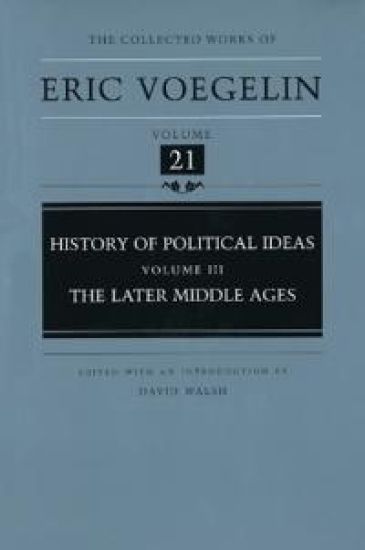
History of Political Ideas (CW21)

History of Political Ideas (CW21)

Eric Voegelin

University of Missouri Press
1998
sidottu
In this text, the third volume of ""History of Political Ideas"", the author continues his exploration of one of the most crucial periods in the history of political thought. Illuminating the great figures of the high Middle Ages, Voegelin traces the historical momentum of our modern world in the core evocative symbols which constituted medieval civilization. These symbols revolved around the enduring aspiration for the ""sacrum imperium"", the one order capable of embracing the transcendent and immanent, the ecclesiastical and political, the divine and human. The story of the later Middle Ages is that of the ""civilizational schism"" - the movement in which not only the reality of but the aspiration for the sacrum imperium gradually disappeared. His recognition of this civilizational schism provides Voegelin with his perspective on medieval society. William of Ockham, Dante, Giles of Rome and Marsilius of Padua all emerge in his study as predecessors to modern thought; each turns to personal authority and intellectual analysis in an attempt to comprehend the loss of the sacrum imperium. Yet the story of the later Middle Ages is not shown to merely revolve around disintegration. Voegelin recognizes the emergence of the constitutional political tradition as the most positive development of this period. His study of the English political pattern is juxtaposed with his perspective on the German imperial zone.
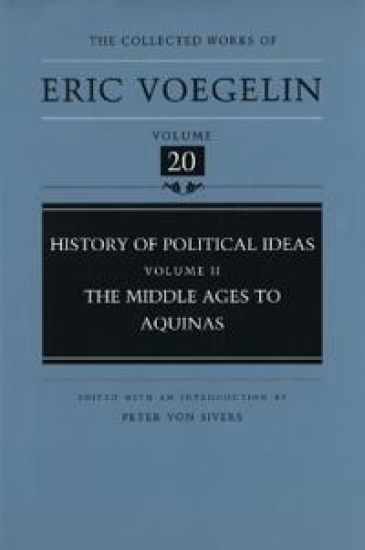
History of Political Ideas (CW20)

History of Political Ideas (CW20)

Eric Voegelin

University of Missouri Press
1998
sidottu
Voegelin's magisterial account of medieval political thought opens with a survey of the structure of the period and continues with an analysis of the Germanic invasions, the fall of Rome, and the rise of empire and monastic Christianity. The political implications of Christianity and philosophy in the period are elaborated in chapters devoted to John of Salisbury, Joachim of Flora (Fiore), Frederick II, Siger de Brabant, Francis of Assisi, Roman law, and climaxing in a remarkable study of Saint Thomas Aquinas's mighty thirteenth-century synthesis. Although History of Political Ideas was begun as a textbook for Macmillan, Voegelin never intended it to be a conventional chronological account. He sought instead an original comprehensive interpretation, founded on primary materials and taking into account the most advanced specialist scholarship—or science as he called it—available to him. Because of this, the book grew well beyond the confines of an easily marketable college survey and until now remained unpublished. In the process of writing it, Voegelin himself outgrew the conceptual frame of a "History of Political Ideas," turning to compose Order and History and the other works of his maturity. History of Political Ideas became the ordered collection of materials from which much of Voegelin's later theoretical elaboration grew, structured in a manner that reveals the conceptual intimations of his later thought. As such, it provides an unparalleled opportunity to observe the working methods and the intellectual evolution of one of our century's leading political thinkers. In its embracing scope, History of Political Ideas contains both analyses of themes Voegelin developed in his later works and discussions of authors and ideas to which he did not return or which he later approached from a different angle and with a different emphasis. The Middle Ages to Aquinas has withstood the test of time. What makes it still highly valuable is its thoroughly revisionist approach, cutting through all the convenient clichés and generalizations and seeking to establish the experiential underpinnings that typified the medieval period.
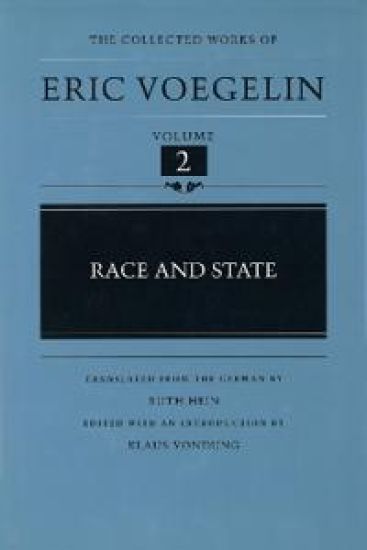
Race and State (CW2)

Race and State (CW2)

Eric Voegelin

Louisiana State University Press
1997
sidottu
Race and State is the second of five books that Eric Voegehn wrote before his emigration to the United States from Austria in 1938. First published in Germany in 1933, the year Hitler came to power, the study was prompted in part by the rise of national socialism during the preceding year. Yet Voegelin neither descended to the level of contemporary debates on race nor dismissed these debates by way of value judgments. Although still young when he wrote this book, Voegelin already demonstrates his singular analytical capacity as well as his ability to put political phenomena into a new perspective. In Part I Voegelin analyzes contemporary race theories by placing the question of race in the context of the more comprehensive philoiophical problem of the interrelationships of body, mind, and soul. He demonstrates the intellectual shortcomings and theoretical fallacies of current theories; more important, he contributes to the development of a modern philosophical anthropology that aims, as Helmuth Plessner put it in a review of Race and State, "at a concept of the human being that does justice to its multilayered existence as a physical, vital, psychic, and intellectual being, without making one of these layers the measure and explanatory basis for the others." In Part II Voegelin deals with race ideas, which he distinguishes from race theories. Race ideas, like other political ideas, form a part of political reality itself, contributing to the formation of social groups and societies. Voegelin shows that the modern race idea is just one "body ideal" among others, such as the tribal state and the Kingdom of Christ, each offering a different symbolic image of community. He traces the rise of the modem race idea, analyzes its function to structure community, and offers an answer to the question of why race ideas became successful in Germany. Voegelin's meticulous sifting of all the Nazi race literature finally arrives at this blunt statement regarding its overall validity: "In order to preclude even the slightest possibility of a misunderstanding, let us again point out emphatically that the contrasting descriptions of the Semitic and the Aryan, the Jewish and the German character . . . contain little that is true about the nature of Jewishness.
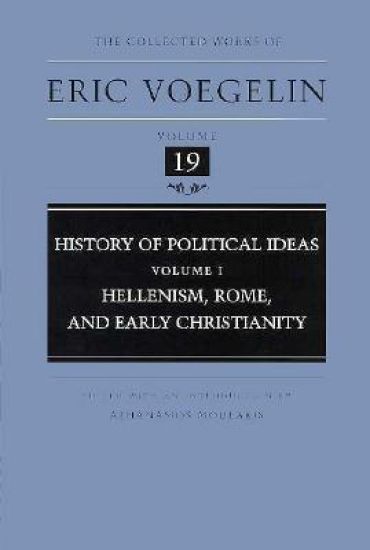
History of Political Ideas (CW19)

History of Political Ideas (CW19)

Eric Voegelin; Athanasios Moulakis

University of Missouri Press
1997
sidottu
From the decline of the Greek Polis to Saint Augustine, this text provides an account of Apostolic Christianity's political implications and the work of the early church fathers. It considers the political philosophy of Rome and includes an analysis of Greek and early Roman law.
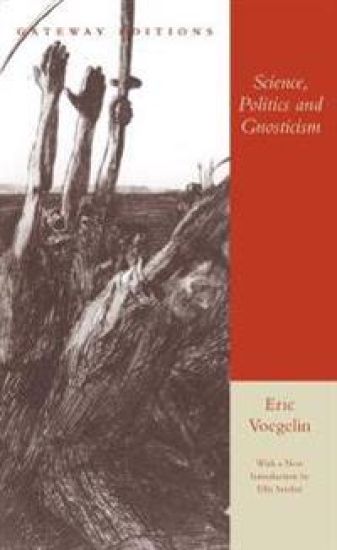
Science, Politics and Gnosticism

Science, Politics and Gnosticism

Eric Voegelin

Regnery Publishing Inc
1997
pokkari
Eric Voegelin, one of today's leading political theorists and author of the contemporary classic The New Science of Politics, here contends that certain modern movements, including Positivism, Hegelianism, Marxism and the "God is Dead" movement, are variants of the Gnostic tradition of antiquity. He attempts to resolve the intellectual confusion that has resulted from the dominance of gnostic thought by clarifying the distinction between political gnosticism and the philosophy of politics. Highly provocative, this book is essential reading for students of modern politics, philosophy, and religion.
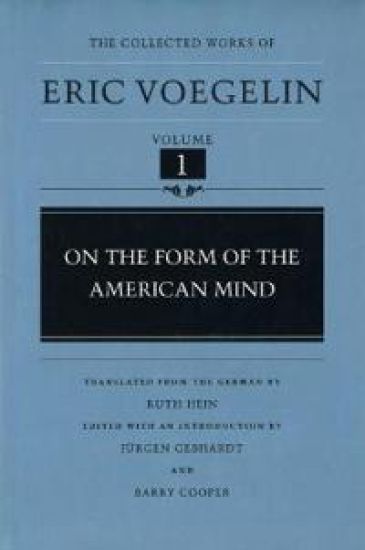
On the Form of the American Mind (CW1)

On the Form of the American Mind (CW1)

Eric Voegelin

LOUISIANA STATE UNIVERSITY PRESS
1995
sidottu
Voegelin begins his inquiry into the form of the American mind with a discussion of the concepts of time and existence in European and American philosophy, interprets the works of George Santayana and the Puritan mystic Jonathan Edwards, and analyzes the ideas of historian and political scientist Jo
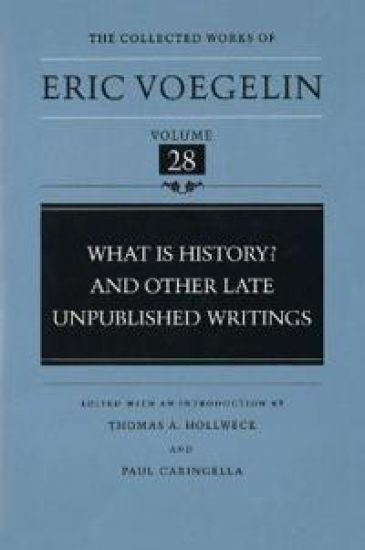
What is History? and Other Late Unpublished Writings (CW28)

What is History? and Other Late Unpublished Writings (CW28)

Eric Voegelin

University of Missouri Press
1990
sidottu
This volume contains the most significant pieces of unpublished writing completed by Eric Voegelin during an important time of his career. Spanning the period from the early 1960s to the late 1970s, these selections supplement the body of work Voegelin published after the appearance of the first three volumes of Order and History in 1956 and 1957. The five texts included here are "What Is History?" "Anxiety and Reason," "The Eclipse of Reality," "The Moving Soul," and "The Beginning and the Beyond." In their introduction to the volume, Thomas A. Hollweck and Paul Caringella place these writings in their proper context and discuss the ways in which they reveal clues to the evolution of Voegelin's thought. In What Is History? Voegelin considers the development of a transcendent structure of history while simultaneously rejecting the notion that history can have a universal meaning. "Anxiety and Reason" focuses on Voegelin's critically important theory of historiogenesis, which links events in pragmatic history with legendary and mythical events leading back to the beginning of the cosmic order. In "The Eclipse of Reality," Voegelin presents a critique of modernity by analyzing the work of Sartre, Schiller, Comte, and others. "The Moving Soul"—a "thought experiment" inspired by a remark Henry Margenau makes in The Nature of Physical Reality—attempts to reformulate the connections between physics and myth. The most important of these essays is "Me Beginning and the Beyond." Here Voegelin meditates on the universality of experience formed by the tension of existence under God. Publication of these previously unpublished writings will enable scholars to trace the genesis of many of the concerns that occupied Voegelin during a period in which the conception of his main work was undergoing frequent and perhaps fundamental changes.
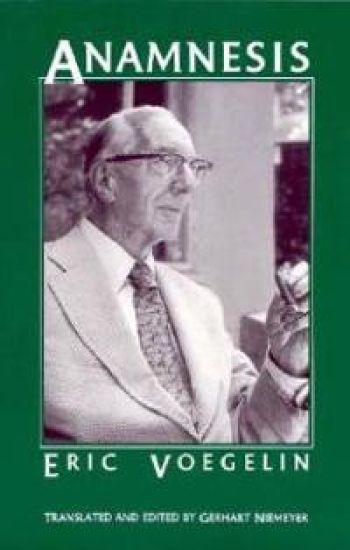
Anamnesis (CW6)

Anamnesis (CW6)

Eric Voegelin; Gerhart Niemeyer

University of Missouri Press
1990
nidottu

Halvin toimitettuna 36,00 €

This is the first English paperback version of this text originally published in German in 1966, and first made available in English in 1978. The translated version includes Voegelin's ""Reason: the Classic Experience"", as well as a new first chapter written by Voegelin especially for this translation. ""Anamnesis"" pulls together those materials that focus most sharply upon the development of Eric Voegelin's philosophy of consciousness. One of the most influential and profound philosophers of our time, Voegelin has had an enormous impact on contemporary intellectual life where he was formerly Salvatori Distinguished Scholar of the Hoover Institution at Stanford University.
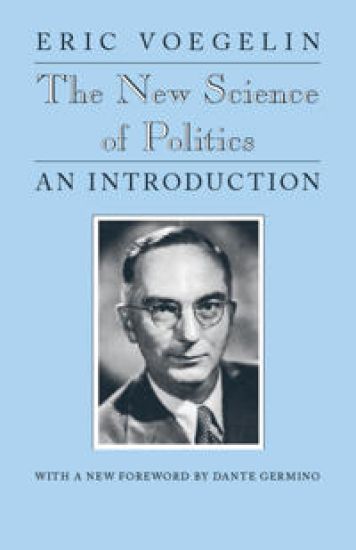
The New Science of Politics

The New Science of Politics

Eric Voegelin

University of Chicago Press
1987
nidottu
"Thirty-five years ago few could have predicted that The New Science of Politics would be a best-seller by political theory standards. Compressed within the Draconian economy of the six Walgreen lectures is a complete theory of man, society, and history, presented at the most profound and intellectual level. . . . Voegelin's [work] stands out in bold relief from much of what has passed under the name of political science in recent decades. . . . The New Science is aptly titled, for Voegelin makes clear at the outset that a 'return to the specific content' of premodern political theory is out of the question. . . . The subtitle of the book, An Introduction, clearly indicates that The New Science of Politics is an invitation to join the search for the recovery of our full humanity."—From the new Foreword by Dante Germino "This book must be considered one of the most enlightening essays on the character of European politics that has appeared in half a century. . . . This is a book powerful and vivid enough to make agreement or disagreement with even its main thesis relatively unimportant."—Times Literary Supplement "Voegelin . . . is one of the most distinguished interpreters to Americans of the non-liberal streams of European thought. . . . He brings a remarkable breadth of knowledge, and a historical imagination that ranges frequently into brilliant insights and generalizations."—Francis G. Wilson, American Political Science Review "This book is beautifully constructed . . . his erudition constantly brings a startling illumination."—Martin Wright, International Affairs "A ledestar to thinking men who seek a restoration of political science on the classic and Christian basis . . . a significant accomplishment in the retheorization of our age."—Anthony Harrigan, Christian Century