Kirjojen hintavertailu – 12 859 828 kirjaa ja 27 kauppaa

Kirjailija

Ezra Pound

Kirjat ja teokset yhdessä paikassa: 145 kirjaa, julkaisuja vuosilta 1957–2026, suosituimpiin kuuluu Hugh Selwyn Mauberley. Vertaile teosten hintoja ja tarkista saatavuus suomalaisista kirjakaupoista.

145 kirjaa

Kirjojen julkaisuvuodet: 1957–2026.

Gaudier-Brzeska

Gaudier-Brzeska

Ezra Pound

New Directions Publishing Corporation
1974
nidottu
Ezra Pound's book on the French sculptor Henri Gaudier-Brzeska was first published in 1916. An enlarged edition, including thirty pages of illustrations (sculpture and drawings) as well as Pound's later pieces on Gaudier, was brought out in 1970, and is now re-issued as an ND Paperbook. The memoir is valuable both for the history of modern art and for what it shows us of Pound himself, his ability to recognize genius in others and then to publicize it effectively. Would there today be a Salle Gaudier-Brzeska in the Musée de L'Art Moderne in Paris if Pound had not championed him? Gaudier's talent was impressive and his Vorticist aesthetic important as theory, but he was killed in World War I at the age of twenty-three, leaving only a small body of work. Pound knew Gaudier in London, where the young artist had come with his companion, the Polish-born Sophie Brzeska. whose name he added to his own. They were living in poverty when Pound bought Gaudier the stone from which the famous "hieratic head" of the poet was made. Pound arranged exhibitions and for the publication of Gaudier's manifestoes in Blast and The Egoist. And he wrote and sent packages to him in the trenches, where Gaudier––a sculptor to the last––carved a madonna and child from the butt of a captured German rifle, just two days before he died.
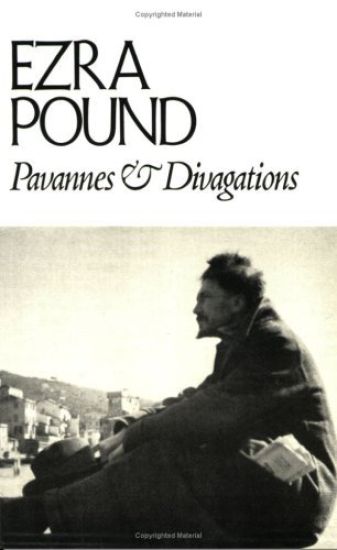
Pavannes and Divagations: Light Prose and Poetry

Pavannes and Divagations: Light Prose and Poetry

Ezra Pound

NEW DIRECTIONS PUBLISHING CORPORATION
1974
nidottu
The canon of Ezra Pound would be incomplete without a representative collection in the master's lighter vein. Pavanes and Divagations seeks to meet this need. Included are Pound's long essay ''Indiscretions, '' one of his rare autobiographical writings, an assortment of facetious verses, his superb translations from the dialogues of Fontenelle, causeries on topics ranging from religion to the mores of moneyed society, as well as a miscellany of editorials, denunciations, and literary masquerades. Pound's barbed wit is displayed here to its best advantage. But more than a simple diversion, this volume presents an important but neglected aspect of the prime shaper of modern poetry in English.
Confucius

Confucius

Ezra Pound

New Directions Publishing Corporation
1969
nidottu
The study of Chinese culture was a dominant concern in Ezra Pound's life and work. His great Canto XIII is about Kung (Confucius), Cantos LII-LXI deal with Chinese history, and in the later Cantos key motifs are often given in Chinese quotations with the characters set into the English text. His introduction to Oriental literature was chiefly through Ernest Fenollosa whose translations and notes were given him by the scholars widow in London about 1913. From these notebooks came, in time, the superb poems entitled Cathay and Pound's edition of Fenollosa's Chinese Written Character as a Medium for Poetry. But it was Confucius’ ethical and political teachings––that most influenced Pound. And now, for the first time, his versions, with commentary, of three basic texts that he translated have been assembled in one volume: The Great Digest (Ta Hsio), first published in 1928; The Unwobbling Pivot (Chung Yung), 1947; and The Analects (Lun-yü), 1950. For the first two, the Chinese characters from the ancient "Stone Classics” are printed en face in our edition, with a note by Achilles Fang. Pound never wanted to be a literal translator. What he could do, as no other could, is to identify the essence, pick out "what matters now," and phrase it so pungently, so beautifully, that it will stick in the head and start new thinking.