Kirjojen hintavertailu – 12 859 824 kirjaa ja 27 kauppaa

Kirjailija

F. A. Hayek

Kirjat ja teokset yhdessä paikassa: 60 kirjaa, julkaisuja vuosilta 1978–2025, suosituimpiin kuuluu The Road to Serfdom. Vertaile teosten hintoja ja tarkista saatavuus suomalaisista kirjakaupoista.

Nimi esiintyy myös muodoissa: F.A. Hayek, F A Hayek, F.A Hayek, F. A Hayek

60 kirjaa

Kirjojen julkaisuvuodet: 1978–2025.

The Sensory Order and Other Writings on the Foundations of Theoretical Psychology: Volume 14
F. A. Hayek (1899-1992) was one of the leading voices in economic and social theory, but he also wrote on theoretical psychology, including in the landmark book The Sensory Order. Although The Sensory Order was not widely engaged with by either psychologists or social scientists at the time of publication, it is seen today as essential for fully understanding Hayek's more well-known work. The latest addition to the University of Chicago Press's Collected Works of F. A. Hayek series, The Sensory Order and Other Writings on the Foundations of Theoretical Psychology pairs the book, originally published in 1952, with additional essays related to The Sensory Order's key themes, including a student paper from 1920 in which Hayek outlined the basic ideas he fully developed in the 1952 book. Rounding out the volume is an insightful introduction by editor Viktor Vanberg that sketches out the central problems Hayek was grappling with when he wrote The Sensory Order and the influential role this early thinking on theoretical psychology would play over the next six decades of his career. The book also features ample footnotes and citations for further reading, making this an essential contribution to the series.
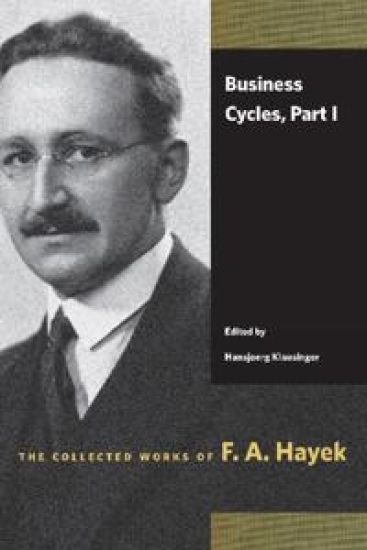
Business Cycles

Business Cycles

F A Hayek

Liberty Fund Inc
2017
nidottu
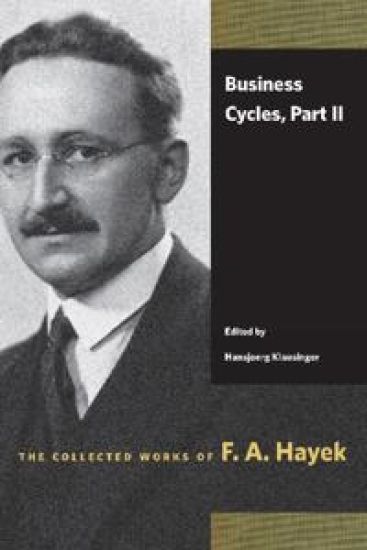
In the years following its publication, F A Hayeks pioneering work on business cycles was regarded as an important challenge to what was later known as Keynesian macroeconomics. Today, as debates rage on over monetary origins of the current economic and financial crisis, economics are once again paying heed to Hayeks thoughts on the repercussions of excessive central bank interventions. Business Cycles, Part II assembles twelve of Hayeks shorter papers on the topic, ranging from 1920s to 1981, his final word on the subject. They include four previously unpublished works.
Business Cycles

Business Cycles

F A Hayek

Liberty Fund Inc
2017
nidottu
In the years following its publication, F A Hayeks pioneering work on business cycles was regarded as an important challenge to what was later known as Keynesian macroeconomics. Today, as debates rage on over monetary origins of the current economic and financial crisis, economics are once again paying heed to Hayeks thoughts on the repercussions of excessive central bank interventions. Business Cycles, Part II assembles twelve of Hayeks shorter papers on the topic, ranging from 1920s to 1981, his final word on the subject. They include four previously unpublished works.
Hayek on Mill: The Mill-Taylor Friendship and Related Writings Volume 16
Best known for reviving the tradition of classical liberalism, F. A. Hayek was also a prominent scholar of the philosopher John Stuart Mill. One of his greatest undertakings was a collection of Mill's extensive correspondence with his longstanding friend and later companion and wife, Harriet Taylor-Mill. Hayek first published the Mill-Taylor correspondence in 1951, and his edition soon became required reading for any study of the nineteenth-century foundations of liberalism. This latest addition to the University of Chicago Press's Collected Works of F. A. Hayek series showcases the fascinating intersections between two of the most prominent thinkers from two successive centuries. Hayek situates Mill within the complex social and intellectual milieu of nineteenth-century Europe--as well as within twentieth-century debates on socialism and planning--and uncovers the influence of Taylor-Mill on Mill's political economy. The volume features the Mill-Taylor correspondence and brings together for the first time Hayek's related writings, which were widely credited with beginning a new era of Mill scholarship.
The Road to Serfdom

The Road to Serfdom

F. A. Hayek

Routledge
2014
nidottu
A classic work in political philosophy, intellectual history and economics, The Road to Serfdom has inspired and infuriated politicians and scholars for half a century. Originally published in 1944, it was seen as heretical for its passionate warning against the dangers of state control over the means of production. For Hayek, the collectivist idea of empowering government with increasing economic control would lead not to a utopia but to the horrors of Nazi Germany and Fascist Italy. This new edition includes a foreword by series editor and leading Hayek scholar Bruce Caldwell explaining the book's origins and publishing history and assessing common misinterpretations of Hayek's thought. Caldwell has also standardized and corrected Hayek's references and added helpful new explanatory notes. Supplemented with an appendix of related materials and forewords to earlier editions by the likes of Milton Friedman, and Hayek himself, this new edition of The Road to Serfdom will be the definitive version of Friedrich Hayek's enduring masterwork.
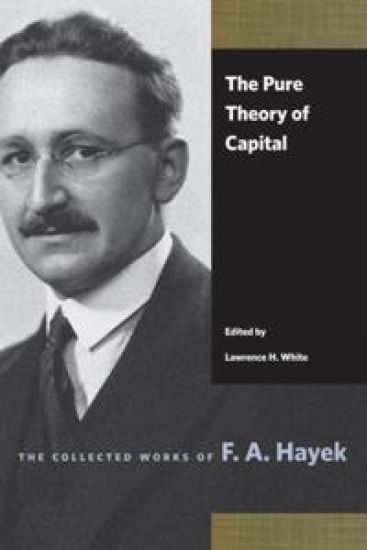
The Pure Theory of Capital

The Pure Theory of Capital

F. A. Hayek

Routledge
2014
nidottu
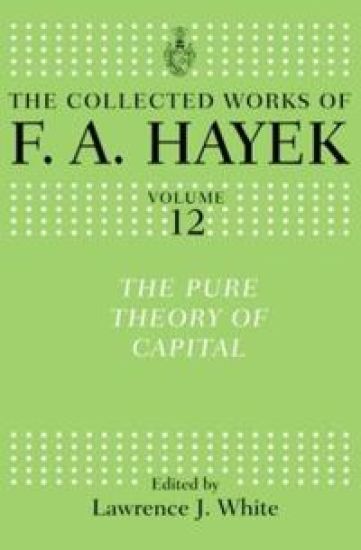
F. A. Hayek’s long-overlooked volume, was his most detailed work in economic theory. Originally published in 1941 when fashionable economic thought had shifted to John Maynard Keynes, Hayek’s manifesto of capital theory is now available again for today’s students and economists to discover. With a new introduction by Hayek expert Lawrence H. White, who firmly situates the book not only in historical and theoretical context but within Hayek’s own life and his struggle to complete the manuscript, this edition commemorates the celebrated scholar’s last major work in economics. Offering a detailed account of the equilibrium relationships between inputs and outputs in an economy, Hayek’s stated objective was to make capital theory "useful for the analysis of the monetary phenomena of the real world.” His ambitious goal was nothing less than to develop a capital theory that could be fully integrated into the business cycle theory.
Studies on the Abuse & Decline of Reason

Studies on the Abuse & Decline of Reason

F A Hayek; Bruce Caldwell

Liberty Fund Inc
2013
nidottu

Halvin toimitettuna 21,10 €

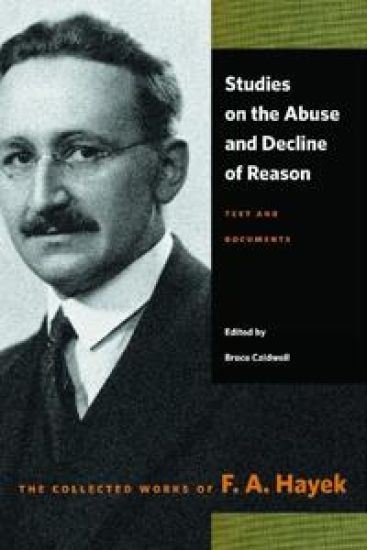
F. A. Hayek never published the grand project he conceived in a letter to Fritz Machlup in 1939. As described in the introduction, this work would incorporate intellectual history, methodology, and an analysis of social problems, all aimed at shedding light on the consequences of socialism. He told Machlup that a series of case studies should come first, . . . leading to the fundamental scientific principles of economic policy and ultimately to the consequences of socialism, and the work would form the basis of a systematic intellectual historical investigation of the fundamental principles of the social development of the last hundred years (Introduction, p. 1). Studies on the Abuse and Decline of Reason collects the essays that were to be the foundation of this work. The essay Individualism: True and False was written as the introduction to the work. Scientism and the Study of Society provides the case studies, followed by two essays of intellectual history: The Counter-Revolution of Science (his study of the history of scientism in France) and Comte and Hegel. Hayek did publish all the works found in this volume, but they had never been gathered in a single work as he originally conceived. Editor Bruce Caldwell has provided translations where they were absent and has revised and corrected the text, and his introduction tells the story of Hayeks greatest unfinished piece of work.
Pure Theory of Capital

Pure Theory of Capital

F A Hayek

Liberty Fund Inc
2012
nidottu
Hayek's most detailed work in economic theory, "The Pure Theory of Capital" has long been overlooked. First published in 1941, it stood in sharp contrast with fashionable economic thought, which had shifted under the influence of John Maynard Keynes. This publication represents Hayek's last major work in economics. This volume offers a detailed account of the equilibrium relationships between inputs and outputs in a time-filled economy. Hayek's stated objective was to make capital theory -- which had previously been devoted almost entirely to the explanation of interest rates -- "useful for the analysis of the monetary phenomena of the real world." His ambitious goal was nothing less than to develop a capital theory that could be fully integrated into business cycle theory. Hayek's manifesto of captial theory is now available again for today's students and economists to discover. The introduction, by Hayek expert Lawrence H White, firmly situates the book in a historical and theoretical context, as well as within Hayek's own life and his struggle to complete the manuscript. It provides important insights into Hayek's theories, the intellectual environment in which he wrote, and the personal context of this important work.
Business Cycles

Business Cycles

F.A. Hayek

Routledge
2012
sidottu
In the years following its publication, F. A. Hayek's pioneering work on business cycles was regarded as an important challenge to what was later known as Keynesian macroeconomics. Today, as debates rage on over the monetary origins of the current economic and financial crisis, economists are once again paying heed to Hayek's thoughts on the repercussions of excessive central bank interventions. The latest editions in Routledge's ongoing series The Collected Works of F. A. Hayek, these volumes bring together Hayek's work on what causes periods of boom and bust in the economy. Moving away from the classical emphasis on equilibrium, Hayek demonstrates that business cycles are generated by the adaptation of the structure of production to changes in relative demand. Thus, when central banks artificially lower interest rates, the result is a misallocation of capital and the creation of asset bubbles and additional instability. Business Cycles: Part I contains Hayek's two major monographs on the topic: Monetary Theory and the Trade Cycle and Prices and Production. Reproducing the text of the original 1933 translation of the former, this edition also draws on the original German, as well as more recent translations. For Prices and Production, a variorum edition is presented, incorporating the 1931 first edition and its 1935 revision. Business Cycles: Part II assembles a series of Hayek's shorter papers on the topic, ranging from the 1920s to 1981. In addition to bringing together Hayek's work on the evolution of business cycles, the two volumes of Business Cycles also include extensive introductions by Hansjoerg Klausinger, placing the writings in intellectual context, including their reception and the theoretical debates to which they contributed, and providing background on the evolution of Hayek's thought.
Business Cycles

Business Cycles

F.A. Hayek

Routledge
2012
sidottu
In the years following its publication, F. A. Hayek's pioneering work on business cycles was regarded as an important challenge to what was later known as Keynesian macroeconomics. Today, as debates rage on over the monetary origins of the current economic and financial crisis, economists are once again paying heed to Hayek's thoughts on the repercussions of excessive central bank interventions. The latest editions in Routledge's ongoing series The Collected Works of F. A. Hayek, these volumes bring together Hayek's work on what causes periods of boom and bust in the economy. Moving away from the classical emphasis on equilibrium, Hayek demonstrates that business cycles are generated by the adaptation of the structure of production to changes in relative demand. Thus, when central banks artificially lower interest rates, the result is a misallocation of capital and the creation of asset bubbles and additional instability. Business Cycles: Part I contains Hayek's two major monographs on the topic: Monetary Theory and the Trade Cycle and Prices and Production. Reproducing the text of the original 1933 translation of the former, this edition also draws on the original German, as well as more recent translations. For Prices and Production, a variorum edition is presented, incorporating the 1931 first edition and its 1935 revision. Business Cycles: Part II assembles a series of Hayek's shorter papers on the topic, ranging from the 1920s to 1981. In addition to bringing together Hayek's work on the evolution of business cycles, the two volumes of Business Cycles also include extensive introductions by Hansjoerg Klausinger, placing the writings in intellectual context, including their reception and the theoretical debates to which they contributed, and providing background on the evolution of Hayek's thought.
Law, Legislation and Liberty

Law, Legislation and Liberty

F. A. Hayek; Paul Kelly

Routledge
2012
nidottu

Halvin toimitettuna 33,30 €

With a new foreword by Paul Kelly 'I regard Hayek's work as a new opening of the most fundamental debate in the field of political philosophy' – Sir Karl Popper 'This promises to be the crowning work of a scholar who has devoted a lifetime to thinking about society and its values. The entire work must surely amount to an immense contribution to social and legal philosophy' - Philosophical Studies Law, Legislation and Liberty is Hayek's major statement of political philosophy and one of the most ambitious yet subtle defences of a free market society ever written. A robust defence of individual liberty, it is also crucial for understanding Hayek’s influential views concerning the role of the state: far from being an innocent bystander, he argues that the state has an important role to play in defending the norms and practices of an ordered and free society. His arguments had a profound influence on the policies of Thatcher in the 1980s and resonate today in visions of the ‘Big Society’. First published in three separate volumes, this Routledge Classics edition makes one of his most important books available in a single volume. Essential reading for understanding the background to the recent world economic turmoil and financial crisis, it also foreshadows the subsequent heated debate about regulation and political governance if such disasters are to be avoided in the future.
Business Cycles: Part I Volume 7

Business Cycles: Part I Volume 7

F. A. Hayek

University of Chicago Press
2012
sidottu
In the years following its publication, F. A. Hayek's pioneering work on business cycles was regarded as an important challenge to what was later known as Keynesian macroeconomics. Today, as debates rage on over the monetary origins of the current economic and financial crisis, economists are once again paying heed to Hayek's thoughts on the repercussions of excessive central bank interventions. The latest editions in the University of Chicago Press's ongoing series The Collected Works of F. A. Hayek, these volumes bring together Hayek's work on what causes periods of boom and bust in the economy. Moving away from the classical emphasis on equilibrium, Hayek demonstrates that business cycles are generated by the adaptation of the structure of production to changes in relative demand. Thus, when central banks artificially lower interest rates, the result is a misallocation of capital and the creation of asset bubbles and additional instability. Business Cycles, Part I contains Hayek's two major monographs on the topic: Monetary Theory and the Trade Cycle and Prices and Production. Reproducing the text of the original 1933 translation of the former, this edition also draws on the original German, as well as more recent translations. For Prices and Production, a variorum edition is presented, incorporating the 1931 first edition and its 1935 revision. Business Cycles, Part II assembles a series of Hayek's shorter papers on the topic, ranging from the 1920s to 1981. In addition to bringing together Hayek's work on the evolution of business cycles, the two volumes of Business Cycles also include extensive introductions by Hansjoerg Klausinger, placing the writings in intellectual context--including their reception and the theoretical debates to which they contributed--and providing background on the evolution of Hayek's thought.
Business Cycles: Part II Volume 8

Business Cycles: Part II Volume 8

F. A. Hayek

University of Chicago Press
2012
sidottu
In the years following its publication, F. A. Hayek's pioneering work on business cycles was regarded as an important challenge to what was later known as Keynesian macroeconomics. Today, as debates rage on over the monetary origins of the current economic and financial crisis, economists are once again paying heed to Hayek's thoughts on the repercussions of excessive central bank interventions. The latest editions in the University of Chicago Press's ongoing series The Collected Works of F. A. Hayek, these volumes bring together Hayek's work on what causes periods of boom and bust in the economy. Moving away from the classical emphasis on equilibrium, Hayek demonstrates that business cycles are generated by the adaptation of the structure of production to changes in relative demand. Thus, when central banks artificially lower interest rates, the result is a misallocation of capital and the creation of asset bubbles and additional instability. Business Cycles, Part I contains Hayek's two major monographs on the topic: Monetary Theory and the Trade Cycle and Prices and Production. Reproducing the text of the original 1933 translation of the former, this edition also draws on the original German, as well as more recent translations. For Prices and Production, a variorum edition is presented, incorporating the 1931 first edition and its 1935 revision. Business Cycles, Part II assembles a series of Hayek's shorter papers on the topic, ranging from the 1920s to 1981. In addition to bringing together Hayek's work on the evolution of business cycles, the two volumes of Business Cycles also include extensive introductions by Hansjoerg Klausinger, placing the writings in intellectual context--including their reception and the theoretical debates to which they contributed--and providing background on the evolution of Hayek's thought.
The Constitution of Liberty

The Constitution of Liberty

F.A. Hayek

Routledge
2011
sidottu
Originally published in 1960, The Constitution of Liberty delineates and defends the principles of a free society and traces the origin, rise, and decline of the rule of law. Casting a skeptical eye on the growth of the welfare state, Hayek examines the challenges to freedom posed by an ever expanding government as well as its corrosive effect on the creation, preservation, and utilization of knowledge. In distinction to those who confidently call for the state to play a greater role in society, Hayek puts forward a nuanced argument for prudence. Guided by this quality, he elegantly demonstrates that a free market system in a democratic polity—under the rule of law and with strong constitutional protections of individual rights—represents the best chance for the continuing existence of liberty. Striking a balance between skepticism and hope, Hayek’s profound insights remain strikingly vital half a century on. This definitive edition of The Constitution of Liberty will give a new generation the opportunity to learn from Hayek’s enduring wisdom.
The Constitution of Liberty: The Definitive Edition Volume 17

The Constitution of Liberty: The Definitive Edition Volume 17

F. a. Hayek

University of Chicago Press
2011
nidottu

Halvin toimitettuna 27,00 €

From the $700 billion bailout of the banking industry to president Barack Obama's $787 billion stimulus package to the highly controversial passage of federal health-care reform, conservatives and concerned citizens alike have grown increasingly fearful of big government. Enter Nobel Prize-winning economist and political theorist F. A. Hayek, whose passionate warning against empowering states with greater economic control, The Road to Serfdom, became an overnight sensation last summer when it was endorsed by Glenn Beck. The book has since sold over 150,000 copies. The latest entry in the University of Chicago Press's series of newly edited editions of Hayek's works, The Constitution of Liberty is, like Serfdom, just as relevant to our present moment. The book is considered Hayek's classic statement on the ideals of freedom and liberty, ideals that he believes have guided--and must continue to guide--the growth of Western civilization. Here Hayek defends the principles of a free society, casting a skeptical eye on the growth of the welfare state and examining the challenges to freedom posed by an ever expanding government--as well as its corrosive effect on the creation, preservation, and utilization of knowledge. In opposition to those who call for the state to play a greater role in society, Hayek puts forward a nuanced argument for prudence. Guided by this quality, he elegantly demonstrates that a free market system in a democratic polity--under the rule of law and with strong constitutional protections of individual rights--represents the best chance for the continuing existence of liberty. Striking a balance between skepticism and hope, Hayek's profound insights are timelier and more welcome than ever before. This definitive edition of The Constitution of Liberty will give a new generation the opportunity to learn from his enduring wisdom.
The Constitution of Liberty: The Definitive Edition

The Constitution of Liberty: The Definitive Edition

F. A. Hayek

University of Chicago Press
2011
sidottu

Halvin toimitettuna 170,60 €

From the $700 billion bailout of the banking industry to president Barack Obama's $787 billion stimulus package to the highly controversial passage of federal health-care reform, conservatives and concerned citizens alike have grown increasingly fearful of big government. Enter Nobel Prize-winning economist and political theorist F. A. Hayek, whose passionate warning against empowering states with greater economic control, The Road to Serfdom, became an overnight sensation last summer when it was endorsed by Glenn Beck. The book has since sold over 150,000 copies. The latest entry in the University of Chicago Press's series of newly edited editions of Hayek's works, The Constitution of Liberty is, like Serfdom, just as relevant to our present moment. The book is considered Hayek's classic statement on the ideals of freedom and liberty, ideals that he believes have guided-and must continue to guide-the growth of Western civilization. Here Hayek defends the principles of a free society, casting a skeptical eye on the growth of the welfare state and examining the challenges to freedom posed by an ever expanding government-as well as its corrosive effect on the creation, preservation, and utilization of knowledge. In opposition to those who call for the state to play a greater role in society, Hayek puts forward a nuanced argument for prudence. Guided by this quality, he elegantly demonstrates that a free market system in a democratic polity-under the rule of law and with strong constitutional protections of individual rights-represents the best chance for the continuing existence of liberty. Striking a balance between skepticism and hope, Hayek's profound insights are timelier and more welcome than ever before. This definitive edition of The Constitution of Liberty will give a new generation the opportunity to learn from his enduring wisdom.
Studies on the Abuse and Decline of Reason
"The studies of which this book is the result have from the beginning been guided by and in the end confirmed the somewhat old-fashioned conviction of the author that it is human ideas which govern the development of human affairs," Hayek wrote in his notes in 1940. Indeed, Studies on the Abuse and Decline of Reason remains Hayek’s greatest unfinished work and is here presented for the first time under the expert editorship of Bruce Caldwell. In the book, Hayek argues that the abuse and decline of reason was caused by hubris, by man’s pride in his ability to reason, which in Hayek’s mind had been heightened by the rapid advance and multitudinous successes of the natural sciences, and the attempt to apply natural science methods in the social sciences.
Studies on the Abuse and Decline of Reason

Studies on the Abuse and Decline of Reason

F. A. Hayek

University of Chicago Press
2010
sidottu
"Studies on the Abuse and Decline of Reason" is a series of fascinating essays on the study of social phenomena. How to best and most accurately study social interactions has long been debated intensely, and there are two main approaches: the positivists, who ignore intent and belief and draw on methods based in the sciences; and the nonpositivists, who argue that opinions and ideas drive action and are central to understanding social behavior. F. A. Hayek's opposition to the positivists and their claims to scientific rigor and certainty in the study of human behavior is a running theme of this important book. Hayek argues that the vast number of elements whose interactions create social structures and institutions make it unlikely that social science can predict precise outcomes. Instead, he contends, we should strive to simply understand the principles by which phenomena are produced. For Hayek, this modesty of aspirations went hand in hand with his concern over widespread enthusiasm for economic planning. As a result, these essays are relevant to ongoing debates within the social sciences and to discussion about the role government can and should play in the economy.