Kirjojen hintavertailu – 12 859 824 kirjaa ja 27 kauppaa

Kirjailija

F. A. Hayek

Kirjat ja teokset yhdessä paikassa: 60 kirjaa, julkaisuja vuosilta 1978–2025, suosituimpiin kuuluu The Road to Serfdom. Vertaile teosten hintoja ja tarkista saatavuus suomalaisista kirjakaupoista.

Nimi esiintyy myös muodoissa: F.A. Hayek, F A Hayek, F.A Hayek, F. A Hayek

60 kirjaa

Kirjojen julkaisuvuodet: 1978–2025.

Contra Keynes & Cambridge

Contra Keynes & Cambridge

F A Hayek

Liberty Fund Inc
2009
nidottu
"Contra Keynes & Cambridge" is composed of three parts: Part I consists of two essays, the first being a recollection by Hayek of his time at the London School of Economics in the 1930s, followed by his contribution to an early debate about the paradox of saving. Part II reprints the full debates between Hayek and Keynes in Economics in the early 1930s, and Hayek's exchanges with Sraffa that followed. Part III includes some of Hayek's reminiscences on Keynes. F A Hayek challenged one of the world's leading economists, John Maynard Keynes, and his economic theories,which sparked a spirited debate that has influenced economic policy in democratic countries for decades.
Good Money

Good Money

F A Hayek

Liberty Fund Inc
2009
nidottu
This complementary volume provides five additional essays to expand our understanding of Hayek's ideas about money and monetary policy. Good Money, Part II: The Standard investigates the consequences of the predicament of composition which led to one of Hayek's most controversial proposals: that governments should be denied a monopoly on the coining of money.
Good Money

Good Money

F A Hayek

Liberty Fund Inc
2009
nidottu
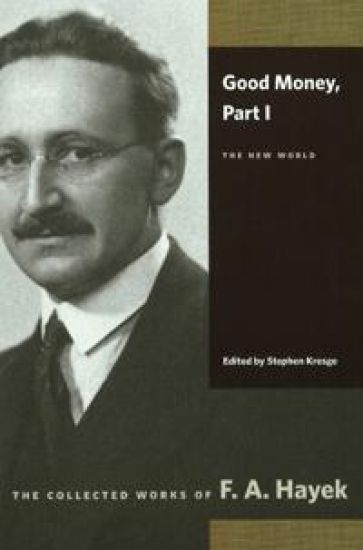
Hayek's deep interest in the concept of money and its role within the economy is developed in "Good Money, Part I". Consisting of seven of Hayek's most significant monetary writings from the 1920s, this collection focuses on his critique of the idea that price stabilisation is consistent with the stabilisation of foreign exchange.
The Pure Theory of Capital

The Pure Theory of Capital

F. A. Hayek

Routledge
2007
sidottu
F. A. Hayek’s long-overlooked volume, was his most detailed work in economic theory. Originally published in 1941 when fashionable economic thought had shifted to John Maynard Keynes, Hayek’s manifesto of capital theory is now available again for today’s students and economists to discover. With a new introduction by Hayek expert Lawrence H. White, who firmly situates the book not only in historical and theoretical context but within Hayek’s own life and his struggle to complete the manuscript, this edition commemorates the celebrated scholar’s last major work in economics. Offering a detailed account of the equilibrium relationships between inputs and outputs in an economy, Hayek’s stated objective was to make capital theory "useful for the analysis of the monetary phenomena of the real world.” His ambitious goal was nothing less than to develop a capital theory that could be fully integrated into the business cycle theory.
The Road to Serfdom

The Road to Serfdom

F. A. Hayek

Routledge
2007
sidottu
A classic work in political philosophy, intellectual history and economics, The Road to Serfdom has inspired and infuriated politicians and scholars for half a century. Originally published in 1944, it was seen as heretical for its passionate warning against the dangers of state control over the means of production. For Hayek, the collectivist idea of empowering government with increasing economic control would lead not to a utopia but to the horrors of Nazi Germany and Fascist Italy. This new edition includes a foreword by series editor and leading Hayek scholar Bruce Caldwell explaining the book's origins and publishing history and assessing common misinterpretations of Hayek's thought. Caldwell has also standardized and corrected Hayek's references and added helpful new explanatory notes. Supplemented with an appendix of related materials and forewords to earlier editions by the likes of Milton Friedman, and Hayek himself, this new edition of The Road to Serfdom will be the definitive version of Friedrich Hayek's enduring masterwork.
The Pure Theory of Capital

The Pure Theory of Capital

F. A. Hayek

University of Chicago Press
2007
sidottu
"The Pure Theory of Capital", F. A. Hayek's long-overlooked, little-understood volume, was his most detailed work in economic theory. Originally published in 1941 when fashionable economic thought had shifted to John Maynard Keynes, Hayek's manifesto of capital theory is available again for today's students and economists to discover. With a new introduction by Hayek expert Lawrence H. White, who firmly situates the book not only in historical and theoretical context but within Hayek's own life and his struggle to complete the manuscript, this edition commemorates the celebrated scholar's last major work in economics. Offering a detailed account of the equilibrium relationships between inputs and outputs in an economy, Hayek's stated objective was to make capital theory - which had previously been devoted almost entirely to the explanation of interest rates - "useful for the analysis of the monetary phenomena of the real world." His ambitious goal was nothing less than to develop a capital theory that could be fully integrated into business cycle theory.
The Constitution of Liberty

The Constitution of Liberty

F.A. Hayek

Routledge
2006
nidottu
Working after the war, Hayek's writing was very much against the tide of mainstream Keynesian economic thought. But in the 1970s and 1980s - the eras of Thatcherism and Reaganomics - he was championed as a prophet of neo-liberalism by those who were seeking to revolutionize the post-war social consensus. The Constitution of Liberty is crucial reading for all those seeking to understand ideas that have become the orthodoxy in the age of the globalized economy.
The Road to Serfdom

The Road to Serfdom

F.A. Hayek

Routledge
2001
sidottu
The Road to Serfdom remains one of the all-time classics of twentieth-century intellectual thought. For over half a century, it has inspired politicians and thinkers around the world, and has had a crucial impact on our political and cultural history. With trademark brilliance, Hayek argues convincingly that, while socialist ideals may be tempting, they cannot be accomplished except by means that few would approve of. Addressing economics, fascism, history, socialism and the Holocaust, Hayek unwraps the trappings of socialist ideology. He reveals to the world that little can result from such ideas except oppression and tyranny. Today, more than fifty years on, Hayek's warnings are just as valid as when The Road to Serfdom was first published.
The Road to Serfdom

The Road to Serfdom

F.A. Hayek

Routledge
2001
nidottu

Halvin toimitettuna 29,70 €

Addressing economics, fascism, history, socialism and the Holocaust, Hayek unwraps the trappings of socialist ideology. The Road to Serfdom remains one of the all-time classics of twentieth-century intellectual thought.
The Sensory Order

The Sensory Order

F. A. Hayek

University of Chicago Press
1999
nidottu
The Sensory Order, first published in 1952, sets forth F. A. Hayek's classic theory of mind in which he describes the mental mechanism that classifies perceptions that cannot be accounted for by physical laws. Hayek's substantial contribution to theoretical psychology has been addressed in the work of Thomas Szasz, Gerald Edelman, and Joaquin Fuster. "A most encouraging example of a sustained attempt to bring together information, inference, and hypothesis in the several fields of biology, psychology, and philosophy."--Quarterly Review of Biology F. A. Hayek (1899-1992), recipient of the Medal of Freedom in 1991 and co-winner of the Nobel Memorial Prize in Economics in 1974, taught at the University of London, the University of Chicago, and the University of Freiburg.
The New World

The New World

F. A. Hayek

University of Chicago Press
1999
sidottu
The two volumes of Good Money concentrate on Hayek's work on money and monetary policy. Published in the centenary of his birth, these volumes bring forth some of the economist's most distinguished articles on monetary policy and offer another vital addition to the collection of Hayek's life work. Good Money, Part I: The New World includes seven of Hayek's articles from the 1920s that were written largely in reaction to the work of Irving Fisher and W. C. Mitchell. Hayek encountered Fisher's work on the quantity theory of money and Mitchell's studies on business cycles during a U. S. visit in 1923-24. These articles attack the idea that price stabilization was consistent with the stabilization of foreign exchange and foreshadow Hayek's general critique that the whole of an economy is not simply the sum of its parts. Good Money, Part II: The Standard offers five more of Hayek's articles that advance his ideas about money. In these essays, Hayek investigates the consequences of the "predicament of composition." This principle works on the premise that the entire society cannot simultaneously increase liquidity by selling property or services for cash. This analysis led Hayek to make what was perhaps his most controversial proposal: that governments should be denied a monopoly on the coining of money. Taken together, these volumes present a comprehensive chronicle of Hayek's writings on monetary policy and offer readers an invaluable reference to some of his most profound thoughts about money. "Each new addition to The Collected Works of F. A. Hayek, the University of Chicago's painstaking series of reissues and collections, is a gem."-- Liberty on Volume IX of The Collected Works of F. A. Hayek "Intellectually Hayek] towers like a giant oak in a forest of saplings."--Chicago Tribune "One of the great thinkers of our age who . . . revolutionized the world's intellectual and political life."--Former President George Herbert Walker Bush
Socialism and War

Socialism and War

F.A. Hayek

University of Chicago Press
1997
sidottu
Throughout the 20th century socialism and war have been intimately connected, the two world wars providing the opportunity and the impetus for a variety of socialist experiments. This volume in a series of works by Hayek, documents the evolution of his thought on socialism and war during the 1930s and 1940s. Opening with Hayak's arguments against market socialism, the book continues with his writings on the economics of war, many in response to the proposals made in John Maynard Keynes's pamphlet "How to Pay for the War". The final section presents articles which anticipated "The Road to Serfdom", Hayak's meditation on the dangers of collectivism. An appendix contains a number of book reviews written by Hayak during this crucial period, and an introduction which sets the work in context.
The Fortunes of Liberalism

The Fortunes of Liberalism

F.A. Hayek

Routledge
1992
sidottu
In this new collection of essays, F. A. Hayek traces his intellectual roots to the `Austrian school' of economics and links it to the modern rebirth of classical liberal or `libertarian' thought. There is much new interesting material here for scholars of Hayek: essays on Hayek's early life and on the intellectual climate of Vienna in the early part of the twentieth century; Hayek's opening address to the inaugural meeting of the Mont Pélerin Society and other material from the period when Hayek was playing his part in the revival of liberal thought; Hayek's views on his teachers and on other leading figures in the Austrian school. This is the fourth volume of The Collected Works of F. A. Hayek and the third to appear. This series provides a new standard edition of Hayek's writing - complete, newly ordered and comprehensively annotated. Much of the material in this volume is either previously unpublished or previously unavailable in English.
The Trend of Economic Thinking
This volume presents much newly published work by Hayek on methodology of economics, its development as a subject, its key thinkers and its important debates. It is published in corrected, revised and annotated form with a long introduction.
Denationalisation of Money

Denationalisation of Money

F. A. Hayek

Institute of Economic Affairs
1990
pokkari
In this groundbreaking work, first published in 1976, Friedrich von Hayek argues that the government monopoly of money must be abolished to stop recurring bouts of inflation and deflation. Abolition is also the cure for the more deep-seated disease of the recurring waves of depression and unemployment attributed to 'capitalism'.
The Fatal Conceit

The Fatal Conceit

F.A. Hayek

Routledge
1990
nidottu
F. A. Hayek presents a fundamental examination and critique of the central issues of socialism. His analysis begins with David Hume's insight that 'the rules of morality ... are not conclusions of our reason.' 'Was Socialism a mistake?' he asks, and drawing upon research in evolutionary epistemology, moral tradition, and other current ethical thinking, he probes for answers. He argues that socialism, from its origins, has been mistaken on scientific and factual, even on logical grounds - and that its repeated failures were the direct outcome of these scientific errors. Highly readable and controversial, a work of considerable scholarship and energy, The Fatal Conceit will greatly advance our contemporary understanding of the economic and political issues confronting the world, especially important as debates between socialism and capitalism grow.
Law, Legislation and Liberty

Law, Legislation and Liberty

F.A. Hayek

Routledge
1982
nidottu
Combines all three volumes of Hayek's comprehensive study of the basic principles of the political order of free society: Rules and Order, The Mirage of Social Justice and The Political Order of a Free Society. 'A careful and brilliant statement of the conditions of human freedom. It is a major work of political and economic philosophy which sets terms that neither its friends or critics can ignore.' - THES