Kirjojen hintavertailu – 12 903 725 kirjaa ja 27 kauppaa
Kirjailija
Fanny Burney
Kirjat ja teokset yhdessä paikassa: 280 kirjaa, julkaisuja vuosilta 1972–2026, suosituimpiin kuuluu Cecilia. Vertaile teosten hintoja ja tarkista saatavuus suomalaisista kirjakaupoista.
L'histoire de ce roman tourne autour de l'h ro ne, Cecilia Beverley, orpheline, qui vient d'entrer dans sa vingt-et-uni me ann e lorsque commence le roman. Ses anc tres ont t de riches fermiers du comt de Suffolk. L'h ritage que lui l gue son oncle est accompagn d'une clause stipulant qu'elle devra trouver un mari qui reprenne son nom. Compte tenu du climat social qui l'entoure, cela se r v le impossible, et elle abandonne sa fortune pour se marier par amour.
Dans ce roman pistolaire en trois volumes, Evelina, l'h ro ne ponyme, est la fille non reconnue d'un aristocrate anglais qui m ne une vie dissip e. Elle doit sa naissance quivoque d' tre lev e loin du monde, la campagne, jusqu' ses dix-sept ans. travers toute une s rie d' v nements humoristiques qui se d roulent Londres et dans le lieu de vill giature qu'est Hotwells, pr s de Bristol, Evelina apprend trouver son chemin dans le d dale complexe de la soci t du XVIIIe si cle et gagne l'amour d'un noble seigneur. Ce roman sentimental comprend des aspects faisant appel la sensibilit (sensibility, dans le sens que le terme avait alors en Angleterre) ainsi qu' un romantisme pr coce; la satire de la soci t qu'il dresse en fait un pr curseur important des oeuvres ult rieures de Jane Austen et de Maria Edgeworth, dont les romans explorent de nombreux aspects tr s similaires.
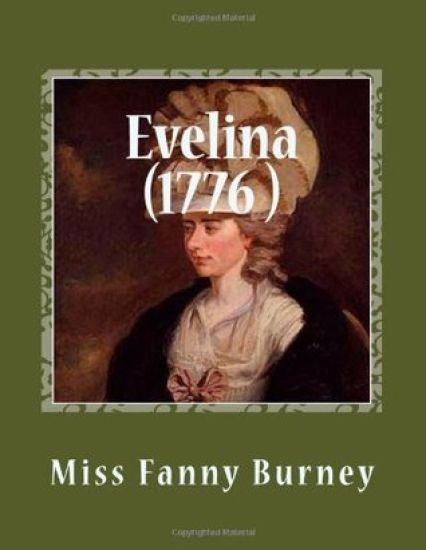
Evelina, or the History of a Young Lady's Entrance into the World is a novel written by English author Fanny Burney and first published in 1778. Although published anonymously, its authorship was revealed by the poet George Huddesford in what Burney called a "vile poem". The novel opens with a distressed letter from Lady Howard to her longtime acquaintance, the Reverend Arthur Villars, in which she reports that Mme. Duval, the grandmother of Villars' ward, Evelina Anville, intends to visit England to renew her acquaintance with her granddaughter Evelina. Eighteen years earlier, Mme. Duval had broken off her relationship with her daughter Caroline, Evelina's mother, and has never acknowledged Evelina. Reverend Villars fears Mme. Duval's influence could lead Evelina to a fate similar to that of her mother Caroline, who secretly wedded Sir John Belmont, a libertine, who afterwards denied the marriage. To keep Evelina from Mme. Duval, the Reverend lets her visit Howard Grove, Lady Howard's home, on an extended holiday. While she is there, the family learns that Lady Howard's son-in-law, naval officer Captain Mirvan, is returning to England after a seven-year absence. Desperate to join the Mirvans on their trip to London, Evelina entreats her guardian to let her attend them, promising that the visit will last only a few weeks. Villars reluctantly consents. In London, Evelina's beauty and ambiguous social status attract unwanted attention and unkind speculation. Ignorant of the conventions and behaviors of 18th-century London society, she makes a series of humiliating (but humorous) faux pas that further expose her to social ridicule. She soon earns the attentions of two gentlemen: Lord Orville, a handsome and extremely eligible peer and pattern-card of modest, becoming behavior; and Sir Clement Willoughby, a baronet with duplicitous intentions. Evelina's untimely reunion with her grandmother and the Branghtons, her long-unknown extended family, along with the embarrassment their boorish, social-climbing antics cause, soon convince her that Lord Orville is completely out of reach.... Henry Austin Dobson (18 January 1840 - 2 September 1921), commonly Austin Dobson, was an English poet and essayist.... Hugh Thomson (1 June 1860 - 7 May 1920) was an Irish Illustrator born at Coleraine near Derry. He is best known for his pen-and-ink illustrations of works by authors such as Jane Austen, Charles Dickens, and J. M. Barrie..... Frances Burney (13 June 1752 - 6 January 1840), also known as Fanny Burney and after her marriage as Madame d'Arblay, was an English satirical novelist, diarist and playwright. She was born in Lynn Regis, now King's Lynn, England, on 13 June 1752, to the musician and music historian Dr. Charles Burney (1726-1814) and his first wife, Esther Sleepe Burney (1725-1762). The third of six children, she was self-educated and began writing what she called her "scribblings" at the age of ten. In 1793, aged 41, she married a French exile, General Alexandre D'Arblay. Their only son, Alexander, was born in 1794. After a lengthy writing career, and travels during which she was stranded in France by warfare for more than ten years, she settled in Bath, England, where she died on 6 January 1840..........
la fois roman sentimental et critique sociale, cette histoire dont le personnage principal, la jeune et jolie velina, d couvre la soci t aristocratique du XVIIIe si cle est aussi pleine d'humour. Pr curseur dans son approche et dans son style, elle suscita en son temps de vives pol miques et fut un v ritable best-seller qui influen a ult rieurement l'oeuvre de Jane Austen. Afin de faciliter la lecture du texte, l'orthographe et la grammaire ont t modernis es.
Good-looking, kind-hearted Evelina Anville has grown up in rural obscurity as the ward of a country parson. At the age of seventeen, she begins her progress from provincial life to fashionable London a transition that's complicated by vulgar relatives and her own naivete. Evelina's shrewd intelligence, however, perceives the hypocrisy behind the refined facades as she learns to balance the honesty and simplicity of her upbringing with the sophisticated etiquette of high society. Written in the form of letters, this 1778 novel offers an intimate look at coming-of-age among England's eighteenth-century upper crust. Evelina's comic misadventures provide a subtle commentary on some of the problems faced by her contemporaries, from women's limited roles to class snobbery and prejudice. Fanny Burney's witty approach to manners and mores was a significant influence on Jane Austen, and her deft combination of satire, sentimentality, and farce provides sparkling entertainment."
" velina" de Fanny Burney. N e Frances Burney, apr s son mariage aussi connue comme Madame d'Arblay, femme de lettres et romanci re anglaise (1752-1840).
"C cilia" de Fanny Burney. N e Frances Burney, apr s son mariage aussi connue comme Madame d'Arblay, femme de lettres et romanci re anglaise (1752-1840).
Pr sentation: Evelina Dans ce roman pistolaire en trois volumes, Evelina, l'h ro ne ponyme, est la fille non reconnue d'un aristocrate anglais qui m ne une vie dissip e. Elle doit sa naissance quivoque d' tre lev e loin du monde, la campagne, jusqu' ses dix-sept ans. travers toute une s rie d' v nements humoristiques qui se d roulent Londres et dans le lieu de vill giature qu'est Hotwells, pr s de Bristol, Evelina apprend trouver son chemin dans le d dale complexe de la soci t du XVIIIe si cle et gagne l'amour d'un noble seigneur. Ce roman sentimental comprend des aspects faisant appel la sensibilit (sensibility, dans le sens que le terme avait alors en Angleterre) ainsi qu' un romantisme pr coce; la satire de la soci t qu'il dresse en fait un pr curseur important des oeuvres ult rieures de Jane Austen et de Maria Edgeworth, dont les romans explorent de nombreux aspects tr s similaires.
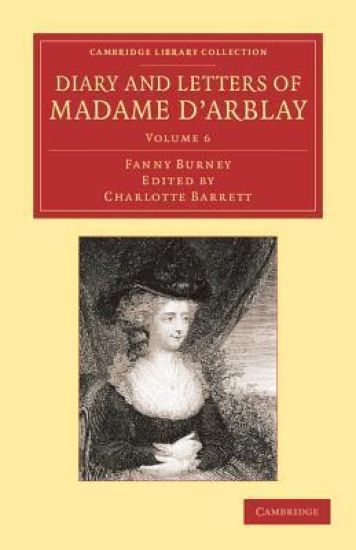
Born into a musical family as the daughter of Charles Burney, Frances 'Fanny' Burney (1752–1840) opted for a life of letters. Her epistolary novel Evelina generated both sensation and sales upon its appearance early in 1778, and when her identity as the author was soon revealed, it opened the door to intellectual circles frequented by the likes of Samuel Johnson and fellow diarist Hester Thrale. Appearing under her married name of Madame d'Arblay, her witty and candid journals and correspondence, from her breakthrough until her final years, were edited by her niece Charlotte Barrett (1786–1870) and first published in seven volumes between 1842 and 1846. Reissued here is the new edition of 1854, including biographical notes. Volume 6 covers the period from September 1793 through to 1812, during which she published Camilla (1796) and, in an episode omitted here, endured a mastectomy without anaesthetic.