Kirjailija
Flavius Josephus
Kirjat ja teokset yhdessä paikassa: 304 kirjaa, julkaisuja vuosilta 1987–2026, suosituimpiin kuuluu The works of Flavius Josephus. Translated into English by Sir Roger L'Estrange, Kt. ... All carefully revised and compared with the original Greek. To which are prefix'd two discourses. Vertaile teosten hintoja ja tarkista saatavuus suomalaisista kirjakaupoista.
304 kirjaa
Kirjojen julkaisuvuodet: 1987–2026.
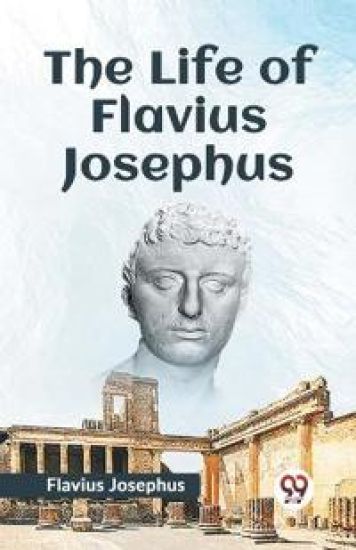
The Life of Flavius Josephus, has been acknowledged as a major work throughout human history, and we have taken precautions to assure its preservation by republishing this book in a modern manner for both present and future generations. This book has been completely retyped, revised, and reformatted. The text is readable and clear because these books are not created from scanned copies.
"The Life of Flavius Josephus," authored by Flavius Josephus himself, is an autobiographical work that provides a unique window into the life of one of the most prominent Jewish historians and scholars of the 1st century CE. Josephus was a Jewish military the captain who eventually became a Roman citizen and historian. He was born in Jerusalem around 37 CE. In this autobiographical memoir, Josephus recounts his childhood, his involvement in the Jewish-Roman War, and his arrest by the Romans. He discusses his interactions with multiple Roman emperors, like as Vespasian and Titus, that led to his Roman citizenship and protection. In the works he wrote, Josephus discusses his efforts to preserve Jewish history and culture, most notably in his extensive volumes "The Jewish War" and "Antiquities of the Jews." These historical works continue to be significant resources for understanding Jewish history as well as the political and social dynamics of the Roman Empire during his reign. The autobiography gives readers an insight into the complicated interplay between Jewish identity and Roman citizenship in the first century CE. It also gives light on Josephus' function as a bridge builder between the Jewish and Roman worlds, a role that elicited both praise and distrust from his contemporaries.
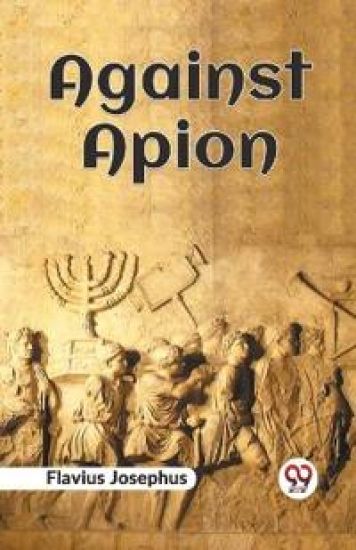
"Against Apion" is an important literary work written by Flavius Josephus, a 1st century CE Jewish historian and scholar. The book is a detailed refutation to the Alexandrian grammarian and scholar Apion's writings, which levied many charges and falsehoods against the Jewish people and their traditions. Readers are compelled to continue reading to find out what happens next since the title character is so indulgent. Being a Jew, Josephus takes on the duty of defending Judaism and its antiquity against Apion's malicious charges. He challenges Apion's charges with carefully documented data and reasoned arguments that verify the legitimacy and venerable heritage of Jewish religion and culture. One of the key themes of "Against Apion" is the refutation of the idea that Jews were a recent and inferior the group when compared to other ancient countries. Josephus emphasizes the ancient origins of Jewish practices, laws, and traditions, dating them back to the dawn of time. Furthermore, Josephus argues for Jewish culture's moral and intellectual superiority, rejecting Apion's claims of Jewish brutality and ignorance.
The Wars Of The Jews Or The History Of The Destruction Of Jerusalem
Flavius Josephus
Double 9 Books
2023
nidottu
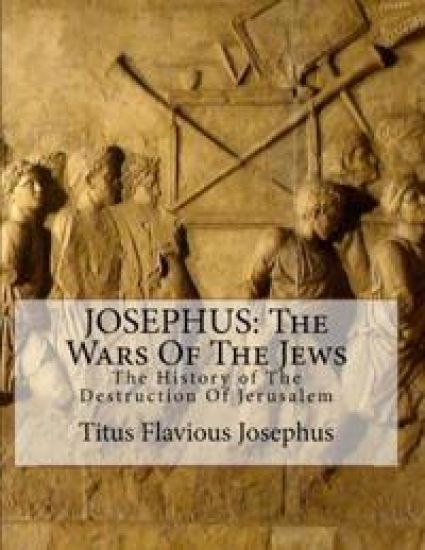
The Wars of the Jews; Or, The History of the Destruction of Jerusalem' is a monumental historical work written by Flavius Josephus, a Jewish historian and military leader of the first century. This book provides a comprehensive and detailed account of the Jewish revolt against Roman rule and the subsequent destruction of Jerusalem. Flavius Josephus's vivid descriptions transport readers to the battlefields and the streets of Jerusalem, immersing them in the chaos and devastation of the war. 'The Wars of the Jews' is not only a historical record but also a reflection on the tragic consequences of political strife and the futility of armed resistance against overwhelming power. Josephus's account stands as a testament to the enduring impact of the Jewish-Roman conflict on the history and identity of the Jewish people.
The Wars of the Jews; Or, The History of the Destruction of Jerusalem
Flavius Josephus
Outlook Verlag
2022
pokkari
The Wars of the Jews; Or, The History of the Destruction of Jerusalem
Flavius Josephus
Outlook Verlag
2022
sidottu
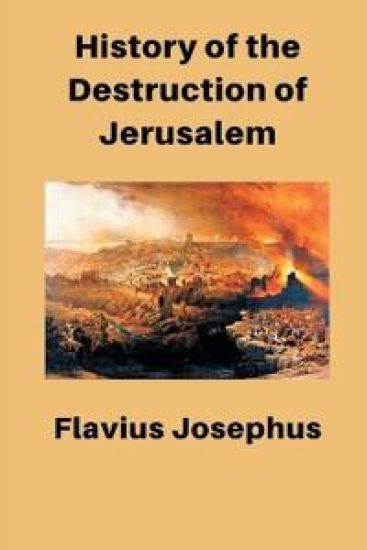
The destruction of Jerusalem and its temple led to a religious, spiritual and political crisis, which left its mark in prophetic literature and biblical tradition. The Kingdom of Judah was abolished and annexed as a Babylonian province with its center in Mizpah. The Judean elite, including the Davidic dynasty, were exiled to Babylon. After Babylon had fallen to Cyrus the Great, founder of the Persian Achaemenid Empire, in 539 BCE, he allowed the exiled Judeans to return to Zion and rebuild Jerusalem. The Second Temple was completed in 516 BCE. The author has comprehended all these things in seven books, and has left no occasion for complaint or accusation to such as have been acquainted with this war. These have been written down for the sake of those that love truth, but not for those that please themselves with fictitious relations].
Josephus was born Joseph Ben Mattathias in 37 C. E. in Jerusalem of a priestly and royal family. He excelled in his studies of Jewish law and studied with the Sadducees, Pharisees, and the Essenes, eventually aligning himself with the Pharisees. In 62 C. E. he went to Rome to free some imprisoned priests. After accomplishing this mission through the intercession of Nero's wife, Poppaea, he returned to Jerusalem in 65 C. E. to find the country in revolt against Rome. Although Josephus had deep misgivings about the revolt, it became inevitable, due to reasons he discusses in his history, primarily the abuses of the Romans; this spurred the growth of fanatical Messianic Jewish movements which believed that the world was coming to an end shortly. In 66 C. E. the Masada was seized by the Zealots and the Romans were on the march; Josephus was appointed the commander of Galilee. Josephus had to fight a defensive war against overwhelming force while refereeing internecine squabbles in the Jewish ranks. In 67 C. E. Josephus and other rebels were cornered in a cave during the siege of Jotapata and took a suicide pact. However, Josephus survived, and was taken hostage by the Romans, led by Vespasian. Josephus shrewdly reinterpreted the Messianic prophecies. He predicted that Vespasian would become the ruler of the 'entire world'. Josephus joined the Romans, for which he was branded a traitor. He acted as consultant to the Romans and a go-between with the revolutionaries. Unable to convince the rebels to surrender, Josephus ended up watching the second destruction of the Temple and the defeat of the Jewish nation. His prophecy became true in 68 C. E. when Nero committed suicide and Vespasian became Ceasar. As a result, Josephus was freed; he moved to Roman and became a Roman citizen, taking the Vespasian family name Flavius. Vespasian commissioned Josephus to write a history of the war, which he finished in 78 C. E., the Jewish War. His second major work, the Antiquities of the Jews, was completed in 93 C. E. He wrote Against Apion in about 96-100 C. E. and The Life of Josephus, his autobiography, about 100. He died shortly after. Despite his ambivalent role, Josephus was an eyewitness to history, and his writings are considered authoritative. These texts are key to understanding a pivotal point in world history, which has tragic repercussions even to this day.
The Life of Flavius Josephus By Flavius Josephus1. The family from which I am derived is not an ignoble one, but hath descended all along from the priests and as nobility among several people is of a different origin, so with us to be of the sacerdotal dignity, is an indication of the splendor of a family. Now, I am not only sprung from a sacerdotal family in general, but from the first of the twenty-four courses and as among us there is not only a considerable difference between one family of each course and another, I am of the chief family of that first course also nay, further, by my mother I am of the royal blood for the children of Asamoneus, from whom that family was derived, had both the office of the high priesthood, and the dignity of a king, for a long time together. I will accordingly set down my progenitors in order. My grandfather's father was named Simon, with the addition of Psellus: he lived at the same time with that son of Simon the high priest, who first of all the high priests was named Hyrcanus. This Simon Psellus had nine sons, one of whom was Matthias, called Ephlias: he married the daughter of Jonathan the high priest, which Jonathan was the first of the sons of Asamoneus, who was high priest, and was the brother of Simon the high priest also. This Matthias had a son called Matthias Curtus, and that in the first year of the government of Hyrcanus: his son's name was Joseph, born in the ninth year of the reign of Alexandra: his son Matthias was born in the tenth year of the reign of Archclaus as was I born to Matthias in the first year of the reign of Caius Caesar. I have three sons: Hyrcanus, the eldest, was born in the fourth year of the reign of Vespasian, as was Justus born in the seventh, and Agrippa in the ninth. Thus have I set down the genealogy of my family as I have found it described in the public records, and so bid adieu to those who calumniate me as of a lower original]. 2. Now, my father Matthias was not only eminent on account of his nobility, but had a higher commendation on account of his righteousness, and was in great reputation in Jerusalem, the greatest city we have. I was myself brought up with my brother, whose name was Matthias, for he was my own brother, by both father and mother and I made mighty proficiency in the improvements of my learning, and appeared to have both a great memory and understanding.

The book, "" Antiquities of the Jews; Book - XVII "", has been considered important throughout the human history, and so that this work is never forgotten we have made efforts in its preservation by republishing this book in a modern format for present and future generations. This whole book has been reformatted, retyped and designed. These books are not made of scanned copies and hence the text is clear and readable.
The book, "" Antiquities of the Jews; Book - V "", has been considered important throughout the human history, and so that this work is never forgotten we have made efforts in its preservation by republishing this book in a modern format for present and future generations. This whole book has been reformatted, retyped and designed. These books are not made of scanned copies and hence the text is clear and readable.
The book, "" Antiquities of the Jews; Book - XVIII "", has been considered important throughout the human history, and so that this work is never forgotten we have made efforts in its preservation by republishing this book in a modern format for present and future generations. This whole book has been reformatted, retyped and designed. These books are not made of scanned copies and hence the text is clear and readable.
The book, "" Antiquities of the Jews; Book - XV "", has been considered important throughout the human history, and so that this work is never forgotten we have made efforts in its preservation by republishing this book in a modern format for present and future generations. This whole book has been reformatted, retyped and designed. These books are not made of scanned copies and hence the text is clear and readable.
The book, "" Antiquities of the Jews; Book - XIV "", has been considered important throughout the human history, and so that this work is never forgotten we have made efforts in its preservation by republishing this book in a modern format for present and future generations. This whole book has been reformatted, retyped and designed. These books are not made of scanned copies and hence the text is clear and readable.
The book, "" Antiquities of the Jews; Book - III "", has been considered important throughout the human history, and so that this work is never forgotten we have made efforts in its preservation by republishing this book in a modern format for present and future generations. This whole book has been reformatted, retyped and designed. These books are not made of scanned copies and hence the text is clear and readable.