Kirjojen hintavertailu – 12 859 819 kirjaa ja 27 kauppaa

Kirjailija

François Jullien

Kirjat ja teokset yhdessä paikassa: 38 kirjaa, julkaisuja vuosilta 1995–2026, suosituimpiin kuuluu Reopening Possibilities. Vertaile teosten hintoja ja tarkista saatavuus suomalaisista kirjakaupoista.

Nimi esiintyy myös muodoissa: Francois Jullien

38 kirjaa

Kirjojen julkaisuvuodet: 1995–2026.

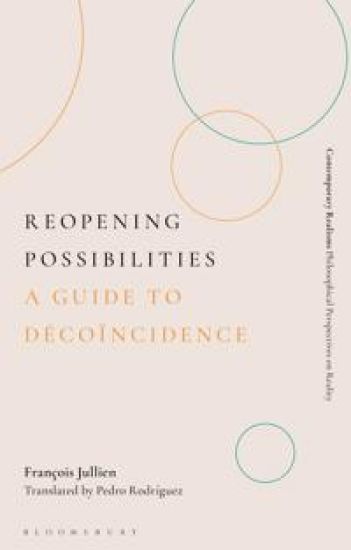
Reopening Possibilities

Reopening Possibilities

François Jullien

Bloomsbury Publishing PLC
2026
Sidottu
How can collective action, based on clear-set ideals and goals, respond to our contemporary reality in which uncertainty and precarity reign? In this bold new interpretation of the politics of the collective, François Jullien plots a way through the challenges brought about by AI, digital communication and individualisation. He reimagines the political event – not as a causal link or premeditated action, but as a moment that opens fissures and cracks within the current situation, leading, in turn, to a new set of possibilities. The history of Western thought has been largely characterised by an insistence on models and ends; eidos and telos, which have caused us to fixate on the future as a knowable, finite entity. But in our global, interconnected world, where the future remains uncertain, models idealism and empiricism have become obsolete. Julien proposes a third, alternative path: decoincidence. This turns away from the tired normativity of coinciding ideas, from imposed structures or teleology, and asks what happens when we look again at reality on its own terms. Can we rediscover the immanent possibility hidden within the present? The notion of decoincidence is not, then, intended to be explanatory nor offer a model for the future, but rather a reconceptualization of the event itself. As the world seems bound to repeat itself, Reopening Possibilities diverts us from mere agreement and disagreement, and instead offers a way out of stagnation, into something wholly new and unexpected.

Reopening Possibilities

Reopening Possibilities

François Jullien

Bloomsbury Publishing PLC
2026
Nidottu
How can collective action, based on clear-set ideals and goals, respond to our contemporary reality in which uncertainty and precarity reign? In this bold new interpretation of the politics of the collective, François Jullien plots a way through the challenges brought about by AI, digital communication and individualisation. He reimagines the political event – not as a causal link or premeditated action, but as a moment that opens fissures and cracks within the current situation, leading, in turn, to a new set of possibilities. The history of Western thought has been largely characterised by an insistence on models and ends; eidos and telos, which have caused us to fixate on the future as a knowable, finite entity. But in our global, interconnected world, where the future remains uncertain, models idealism and empiricism have become obsolete. Julien proposes a third, alternative path: decoincidence. This turns away from the tired normativity of coinciding ideas, from imposed structures or teleology, and asks what happens when we look again at reality on its own terms. Can we rediscover the immanent possibility hidden within the present? The notion of decoincidence is not, then, intended to be explanatory nor offer a model for the future, but rather a reconceptualization of the event itself. As the world seems bound to repeat itself, Reopening Possibilities diverts us from mere agreement and disagreement, and instead offers a way out of stagnation, into something wholly new and unexpected.

This Strange Idea of the Beautiful

This Strange Idea of the Beautiful

François Jullien; Krzysztof Fijalkowski; Michael Richardson

SEAGULL BOOKS LONDON LTD
2022
nidottu
An exploration of what it means when we say something is beautiful. Bringing together ideas of beauty from both Eastern and Western philosophy, François Jullien challenges the assumptions underlying our commonly agreed-upon definition of what is beautiful and offers a new way of beholding art. Jullien argues that the Western concept of beauty was established by Greek philosophy and became consequently embedded within the very structure of European languages. And due to its relationship to language, this concept has determined ways of thinking about beauty that often go unnoticed or unchecked in discussions of Western aesthetics. Moreover, through globalization, Western ideals of beauty have even spread to cultures whose ancient traditions are based upon radically different aesthetic foundations; yet, these cultures have adopted such views without question and without recognizing the cultural assumptions they contain. Looking specifically at how Chinese texts have been translated into Western languages, Jullien reveals how the traditional Chinese refusal to isolate or abstract beauty is obscured in translation in order to make the works more understandable to Western readers. Creating an engaging dialogue between Chinese and Western ideas, Jullien reassesses the essence of beauty.
The Philosophy of Living

The Philosophy of Living

François Jullien; Krzysztof Fijalkowski; Michael Richardson

SEAGULL BOOKS LONDON LTD
2022
nidottu
This volume asks poignant questions about what it means to be alive and inhabit the present. Living holds us between two places. It expresses what is most elementary—to be alive—and the absoluteness of our aspiration—finally living! But could we desire anything other than to live? In The Philosophy of Living, François Jullien meditates on Far Eastern thought and philosophy to analyze concepts that can be folded into a complete philosophy of living, including the idea of the moment, the ambiguity of the in-between, and what he calls the “transparency of morning.” Jullien here develops a strategy of living that goes beyond morality and dwells in the space between health and spirituality.
There Is No Such Thing as Cultural Identity

There Is No Such Thing as Cultural Identity

François Jullien

Polity Press
2021
sidottu
As people throughout the world react to globalization and revert to nationalism, they are proclaiming distinct cultural identities for themselves. Cultural identity seems to offer a defensive wall against the homogenizing effects of globalization and a framework for nurturing and protecting cultural differences. In this short and provocative book, François Jullien argues that this emphasis on cultural identity is a mistake. Cultures exist in relation to one another and they are constantly mutating and transforming themselves. There is no cultural identity, there are only what Jullien calls ‘resources’. Resources are created in a certain space, they are available to all and belong to no one. They are not exclusive, like the values to which we proclaim loyalty; instead, we deploy them or not, activate them or let them fall by the wayside, and each of us as individuals is responsible for these choices. This conceptual shift requires us to redefine three key terms – the universal, the uniform and the common. Equipped with these concepts, we can rethink the dialogue between cultures in a way that avoids what Jullien sees as the false debate about identity and difference. This powerful critique of the modern shibboleth of cultural identity will appeal to anyone interested in the great social and political questions of our time.
There Is No Such Thing as Cultural Identity

There Is No Such Thing as Cultural Identity

François Jullien

Polity Press
2021
nidottu
As people throughout the world react to globalization and revert to nationalism, they are proclaiming distinct cultural identities for themselves. Cultural identity seems to offer a defensive wall against the homogenizing effects of globalization and a framework for nurturing and protecting cultural differences. In this short and provocative book, François Jullien argues that this emphasis on cultural identity is a mistake. Cultures exist in relation to one another and they are constantly mutating and transforming themselves. There is no cultural identity, there are only what Jullien calls ‘resources’. Resources are created in a certain space, they are available to all and belong to no one. They are not exclusive, like the values to which we proclaim loyalty; instead, we deploy them or not, activate them or let them fall by the wayside, and each of us as individuals is responsible for these choices. This conceptual shift requires us to redefine three key terms – the universal, the uniform and the common. Equipped with these concepts, we can rethink the dialogue between cultures in a way that avoids what Jullien sees as the false debate about identity and difference. This powerful critique of the modern shibboleth of cultural identity will appeal to anyone interested in the great social and political questions of our time.
Resources of Christianity

Resources of Christianity

François Jullien

Polity Press
2021
sidottu
Christianity is bound up with the very idea of the West: we cannot evade it even if we would like to. While many people no longer believe in Christianity, we cannot deny that it has left a deep imprint on Western thought. But how might we develop a philosophy of Christianity that is not a Christian philosophy? How can we take a view that is external to the traditions of apologetics and criticism? For there is a question that concerns us all here: are the coherences of Christianity still useful for thought, and especially for thought about existence? To address this question, François Jullien considers Christianity as constituting a set of resources. Resources are available to all and can be used by those who discover and exploit them; they belong to no one. Christianity offers us resources inasmuch as we can draw some benefit from it, inasmuch as it can be the source of an effect, without our having to believe it or determine its truth in advance. Jullien reads the Gospels, and especially the Gospel of John, as he would read any other text, seeking to account for the text's coherence (rather than its ‘meaning’), seeking to account for its pertinence (rather than its ‘truth’), but without any need to adhere – the exploitation of resources demands no conversion. And in reading the Gospel of John in this way, we discover the fertile veins of a theory of existence. This fresh and erudite reflection on Christianity will be of great value to anyone interested in religion and its relevance today.
Resources of Christianity

Resources of Christianity

François Jullien

Polity Press
2021
nidottu
Christianity is bound up with the very idea of the West: we cannot evade it even if we would like to. While many people no longer believe in Christianity, we cannot deny that it has left a deep imprint on Western thought. But how might we develop a philosophy of Christianity that is not a Christian philosophy? How can we take a view that is external to the traditions of apologetics and criticism? For there is a question that concerns us all here: are the coherences of Christianity still useful for thought, and especially for thought about existence? To address this question, François Jullien considers Christianity as constituting a set of resources. Resources are available to all and can be used by those who discover and exploit them; they belong to no one. Christianity offers us resources inasmuch as we can draw some benefit from it, inasmuch as it can be the source of an effect, without our having to believe it or determine its truth in advance. Jullien reads the Gospels, and especially the Gospel of John, as he would read any other text, seeking to account for the text's coherence (rather than its ‘meaning’), seeking to account for its pertinence (rather than its ‘truth’), but without any need to adhere – the exploitation of resources demands no conversion. And in reading the Gospel of John in this way, we discover the fertile veins of a theory of existence. This fresh and erudite reflection on Christianity will be of great value to anyone interested in religion and its relevance today.
From Being to Living : a Euro-Chinese lexicon of thought

From Being to Living : a Euro-Chinese lexicon of thought

François Jullien; Michael Richardson; Krzysztof Fijalkowski

SAGE Publications Ltd
2019
nidottu
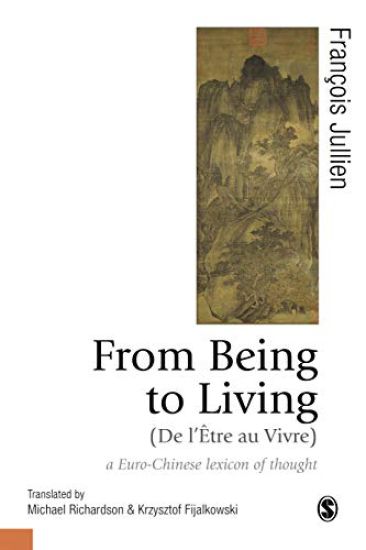
This new English translation of François Jullien’s work is a compelling summation of his thinking on the comparison between Western and Chinese thought. The title, From Being to Living, summarises his essential point: that western thinking is obsessed by – and determined as well as limited by – the notion of Being, whereas traditional Chinese thought was always situated in Living. Organized as a lexicon around some 20 concepts that juxtapose Chinese and Western thought, Jullien explores the ways the two have historically evolved, and how many aspects of Chinese thought developed in complete isolation from the West, revealing a different way of relating to the world. Translated by Michael Richardson and Krzysztof Fijalkowski, this text explores Chinese thinking and language in order to excavate elements from them that reveal the fault lines of western thinking. This is an important book for students, scholars and practitioners alike across the Social Sciences.
From Being to Living : a Euro-Chinese lexicon of thought

From Being to Living : a Euro-Chinese lexicon of thought

François Jullien; Michael Richardson; Krzysztof Fijalkowski

SAGE Publications Ltd
2019
sidottu
This new English translation of François Jullien’s work is a compelling summation of his thinking on the comparison between Western and Chinese thought. The title, From Being to Living, summarises his essential point: that western thinking is obsessed by – and determined as well as limited by – the notion of Being, whereas traditional Chinese thought was always situated in Living. Organized as a lexicon around some 20 concepts that juxtapose Chinese and Western thought, Jullien explores the ways the two have historically evolved, and how many aspects of Chinese thought developed in complete isolation from the West, revealing a different way of relating to the world. Translated by Michael Richardson and Krzysztof Fijalkowski, this text explores Chinese thinking and language in order to excavate elements from them that reveal the fault lines of western thinking. This is an important book for students, scholars and practitioners alike across the Social Sciences.
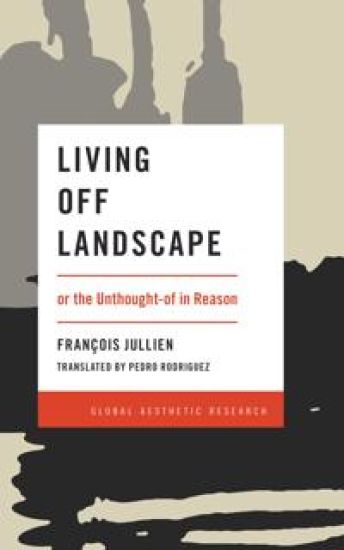
Living Off Landscape

Living Off Landscape

Francois Jullien

Rowman Littlefield
2018
sidottu
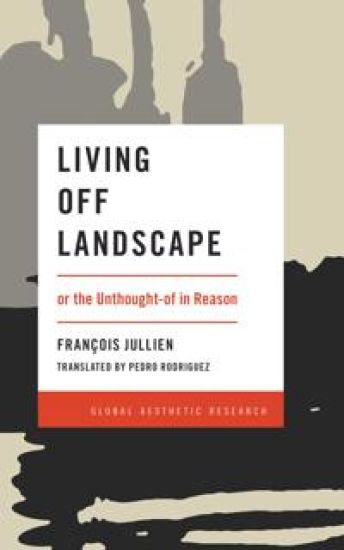
Is it only through vision that we can perceive a landscape? Is the space opened by the landscape truly an expanse cut off by the horizon? Do we observe a landscape in the way that we watch a 'show'? What, ultimately, does it mean to 'look'? In this important new book, one of France's most influential living theorists argues that the first civilization to truly consider landscape was China. In giving landscape the name 'mountain(s)-water(s)', the Chinese language provides a powerful alternative to Western biases. The Chinese conception speaks of a correlation between high and low, between the still and the motile, between what has form and what is formless, between what we see and what we hear. No longer a matter of 'vision', landscape becomes a matter of living. Francois Jullien invites the reader to explore reason's unthought choices, and to take a fresh look at our more basic involvement in the world.
Living Off Landscape

Living Off Landscape

Francois Jullien

Rowman Littlefield
2018
nidottu

Halvin toimitettuna 51,70 €

Is it only through vision that we can perceive a landscape? Is the space opened by the landscape truly an expanse cut off by the horizon? Do we observe a landscape in the way that we watch a 'show'? What, ultimately, does it mean to 'look'? In this important new book, one of France's most influential living theorists argues that the first civilization to truly consider landscape was China. In giving landscape the name 'mountain(s)-water(s)', the Chinese language provides a powerful alternative to Western biases. The Chinese conception speaks of a correlation between high and low, between the still and the motile, between what has form and what is formless, between what we see and what we hear. No longer a matter of 'vision', landscape becomes a matter of living. Francois Jullien invites the reader to explore reason's unthought choices, and to take a fresh look at our more basic involvement in the world.