Kirjojen hintavertailu – 12 903 724 kirjaa ja 27 kauppaa

Kirjailija

Frank L. Lewis

Kirjat ja teokset yhdessä paikassa: 24 kirjaa, julkaisuja vuosilta 1998–2025, suosituimpiin kuuluu Robot Manipulator Control. Vertaile teosten hintoja ja tarkista saatavuus suomalaisista kirjakaupoista.

Nimi esiintyy myös muodoissa: Frank L Lewis

24 kirjaa

Kirjojen julkaisuvuodet: 1998–2025.

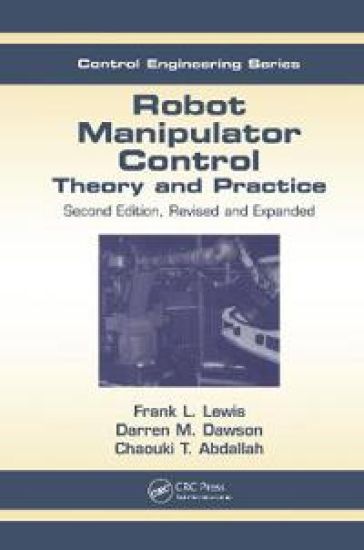
Robot Manipulator Control

Robot Manipulator Control

Frank L. Lewis; Darren M. Dawson; Chaouki T. Abdallah

CRC Press Inc
2003
sidottu
Robot Manipulator Control offers a complete survey of control systems for serial-link robot arms and acknowledges how robotic device performance hinges upon a well-developed control system. Containing over 750 essential equations, this thoroughly up-to-date Second Edition, the book explicates theoretical and mathematical requisites for controls design and summarizes current techniques in computer simulation and implementation of controllers. It also addresses procedures and issues in computed-torque, robust, adaptive, neural network, and force control. New chapters relay practical information on commercial robot manipulators and devices and cutting-edge methods in neural network control.
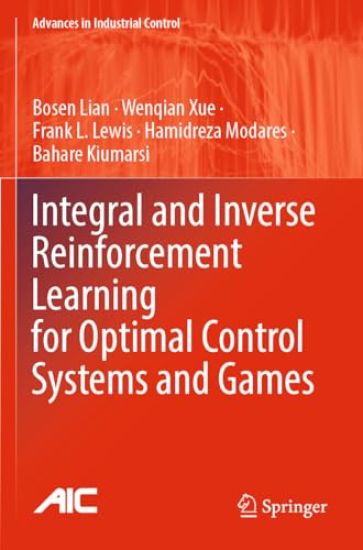
Integral and Inverse Reinforcement Learning for Optimal Control Systems and Games

Integral and Inverse Reinforcement Learning for Optimal Control Systems and Games

Bosen Lian; Wenqian Xue; Frank L. Lewis; Hamidreza Modares; Bahare Kiumarsi

Springer International Publishing AG
2025
nidottu
Integral and Inverse Reinforcement Learning for Optimal Control Systems and Games develops its specific learning techniques, motivated by application to autonomous driving and microgrid systems, with breadth and depth: integral reinforcement learning (RL) achieves model-free control without system estimation compared with system identification methods and their inevitable estimation errors; novel inverse RL methods fill a gap that will help them to attract readers interested in finding data-driven model-free solutions for inverse optimization and optimal control, imitation learning and autonomous driving among other areas. Graduate students will find that this book offers a thorough introduction to integral and inverse RL for feedback control related to optimal regulation and tracking, disturbance rejection, and multiplayer and multiagent systems. For researchers, it provides a combination of theoretical analysis, rigorous algorithms, and a wide-ranging selection of examples. The book equips practitioners working in various domains – aircraft, robotics, power systems, and communication networks among them – with theoretical insights valuable in tackling the real-world challenges they face.
Reinforcement Learning

Reinforcement Learning

Jinna Li; Frank L. Lewis; Jialu Fan

Springer International Publishing AG
2024
nidottu
This book offers a thorough introduction to the basics and scientific and technological innovations involved in the modern study of reinforcement-learning-based feedback control. The authors address a wide variety of systems including work on nonlinear, networked, multi-agent and multi-player systems. A concise description of classical reinforcement learning (RL), the basics of optimal control with dynamic programming and network control architectures, and a brief introduction to typical algorithms build the foundation for the remainder of the book. Extensive research on data-driven robust control for nonlinear systems with unknown dynamics and multi-player systems follows. Data-driven optimal control of networked single- and multi-player systems leads readers into the development of novel RL algorithms with increased learning efficiency. The book concludes with a treatment of how these RL algorithms can achieve optimal synchronization policies for multi-agentsystems with unknown model parameters and how game RL can solve problems of optimal operation in various process industries. Illustrative numerical examples and complex process control applications emphasize the realistic usefulness of the algorithms discussed. The combination of practical algorithms, theoretical analysis and comprehensive examples presented in Reinforcement Learning will interest researchers and practitioners studying or using optimal and adaptive control, machine learning, artificial intelligence, and operations research, whether advancing the theory or applying it in mineral-process, chemical-process, power-supply or other industries.
Integral and Inverse Reinforcement Learning for Optimal Control Systems and Games

Integral and Inverse Reinforcement Learning for Optimal Control Systems and Games

Bosen Lian; Wenqian Xue; Frank L. Lewis; Hamidreza Modares; Bahare Kiumarsi

Springer International Publishing AG
2024
sidottu
Integral and Inverse Reinforcement Learning for Optimal Control Systems and Games develops its specific learning techniques, motivated by application to autonomous driving and microgrid systems, with breadth and depth: integral reinforcement learning (RL) achieves model-free control without system estimation compared with system identification methods and their inevitable estimation errors; novel inverse RL methods fill a gap that will help them to attract readers interested in finding data-driven model-free solutions for inverse optimization and optimal control, imitation learning and autonomous driving among other areas. Graduate students will find that this book offers a thorough introduction to integral and inverse RL for feedback control related to optimal regulation and tracking, disturbance rejection, and multiplayer and multiagent systems. For researchers, it provides a combination of theoretical analysis, rigorous algorithms, and a wide-ranging selection of examples. The book equips practitioners working in various domains – aircraft, robotics, power systems, and communication networks among them – with theoretical insights valuable in tackling the real-world challenges they face.
Reinforcement Learning

Reinforcement Learning

Jinna Li; Frank L. Lewis; Jialu Fan

Springer International Publishing AG
2023
sidottu
This book offers a thorough introduction to the basics and scientific and technological innovations involved in the modern study of reinforcement-learning-based feedback control. The authors address a wide variety of systems including work on nonlinear, networked, multi-agent and multi-player systems. A concise description of classical reinforcement learning (RL), the basics of optimal control with dynamic programming and network control architectures, and a brief introduction to typical algorithms build the foundation for the remainder of the book. Extensive research on data-driven robust control for nonlinear systems with unknown dynamics and multi-player systems follows. Data-driven optimal control of networked single- and multi-player systems leads readers into the development of novel RL algorithms with increased learning efficiency. The book concludes with a treatment of how these RL algorithms can achieve optimal synchronization policies for multi-agentsystems with unknown model parameters and how game RL can solve problems of optimal operation in various process industries. Illustrative numerical examples and complex process control applications emphasize the realistic usefulness of the algorithms discussed. The combination of practical algorithms, theoretical analysis and comprehensive examples presented in Reinforcement Learning will interest researchers and practitioners studying or using optimal and adaptive control, machine learning, artificial intelligence, and operations research, whether advancing the theory or applying it in mineral-process, chemical-process, power-supply or other industries.
Cooperative Synchronization in Distributed Microgrid Control

Cooperative Synchronization in Distributed Microgrid Control

Ali Bidram; Vahidreza Nasirian; Ali Davoudi; Frank L. Lewis

Springer International Publishing AG
2018
nidottu
This book brings together emerging objectives and paradigms in the control of both AC and DC microgrids; further, it facilitates the integration of renewable-energy and distribution systems through localization of generation, storage and consumption. The control objectives in a microgrid are addressed through the hierarchical control structure. After providing a comprehensive survey on the state of the art in microgrid control, the book goes on to address the most recent control schemes for both AC and DC microgrids, which are based on the distributed cooperative control of multi-agent systems. The cooperative control structure discussed distributes the co-ordination and optimization tasks across all distributed generators. This does away with the need for a central controller, and the control system will not collapse in response to the outage of a single unit. This avoids adverse effects on system flexibility and configurability, as well as the reliabilityconcerns in connection with single points of failure that arise in traditional, centralized microgrid control schemes. Rigorous proofs develop each control methodology covered in the book, and simulation examples are provided to justify all of the proposed algorithms. Given its extensive yet self-contained content, the book offers a comprehensive source of information for graduate students, academic researchers, and practicing engineers working in the field of microgrid control and optimization.
Intelligent Diagnosis and Prognosis of Industrial Networked Systems

Intelligent Diagnosis and Prognosis of Industrial Networked Systems

Chee Khiang Pang; Frank L. Lewis; Tong Heng Lee; Zhao Yang Dong

CRC Press
2017
nidottu
In an era of intense competition where plant operating efficiencies must be maximized, downtime due to machinery failure has become more costly. To cut operating costs and increase revenues, industries have an urgent need to predict fault progression and remaining lifespan of industrial machines, processes, and systems. An engineer who mounts an acoustic sensor onto a spindle motor wants to know when the ball bearings will wear out without having to halt the ongoing milling processes. A scientist working on sensor networks wants to know which sensors are redundant and can be pruned off to save operational and computational overheads. These scenarios illustrate a need for new and unified perspectives in system analysis and design for engineering applications. Intelligent Diagnosis and Prognosis of Industrial Networked Systems proposes linear mathematical tool sets that can be applied to realistic engineering systems. The book offers an overview of the fundamentals of vectors, matrices, and linear systems theory required for intelligent diagnosis and prognosis of industrial networked systems. Building on this theory, it then develops automated mathematical machineries and formal decision software tools for real-world applications. The book includes portable tool sets for many industrial applications, including:Forecasting machine tool wear in industrial cutting machinesReduction of sensors and features for industrial fault detection and isolation (FDI)Identification of critical resonant modes in mechatronic systems for system design of R&DProbabilistic small-signal stability in large-scale interconnected power systemsDiscrete event command and control for military applicationsThe book also proposes future directions for intelligent diagnosis and prognosis in energy-efficient manufacturing, life cycle assessment, and systems of systems architecture. Written in a concise and accessible style, it presents tools that are mathematically rigorous but not involved. Bridging academia, research, and industry, this reference supplies the know-how for engineers and managers making decisions about equipment maintenance, as well as researchers and students in the field.
Cooperative Synchronization in Distributed Microgrid Control

Cooperative Synchronization in Distributed Microgrid Control

Ali Bidram; Vahidreza Nasirian; Ali Davoudi; Frank L. Lewis

Springer International Publishing AG
2017
sidottu
This book brings together emerging objectives and paradigms in the control of both AC and DC microgrids; further, it facilitates the integration of renewable-energy and distribution systems through localization of generation, storage and consumption. The control objectives in a microgrid are addressed through the hierarchical control structure. After providing a comprehensive survey on the state of the art in microgrid control, the book goes on to address the most recent control schemes for both AC and DC microgrids, which are based on the distributed cooperative control of multi-agent systems. The cooperative control structure discussed distributes the co-ordination and optimization tasks across all distributed generators. This does away with the need for a central controller, and the control system will not collapse in response to the outage of a single unit. This avoids adverse effects on system flexibility and configurability, as well as the reliabilityconcerns in connection with single points of failure that arise in traditional, centralized microgrid control schemes. Rigorous proofs develop each control methodology covered in the book, and simulation examples are provided to justify all of the proposed algorithms. Given its extensive yet self-contained content, the book offers a comprehensive source of information for graduate students, academic researchers, and practicing engineers working in the field of microgrid control and optimization.
Cooperative Control of Multi-Agent Systems

Cooperative Control of Multi-Agent Systems

Frank L. Lewis; Hongwei Zhang; Kristian Hengster-Movric; Abhijit Das

Springer London Ltd
2016
nidottu
Cooperative Control of Multi-Agent Systems extends optimal control and adaptive control design methods to multi-agent systems on communication graphs. It develops Riccati design techniques for general linear dynamics for cooperative state feedback design, cooperative observer design, and cooperative dynamic output feedback design. Both continuous-time and discrete-time dynamical multi-agent systems are treated. Optimal cooperative control is introduced and neural adaptive design techniques for multi-agent nonlinear systems with unknown dynamics, which are rarely treated in literature are developed. Results spanning systems with first-, second- and on up to general high-order nonlinear dynamics are presented. Each control methodology proposed is developed by rigorous proofs. All algorithms are justified by simulation examples. The text is self-contained and will serve as an excellent comprehensive source of information for researchers and graduate students working with multi-agent systems.
Aircraft Control and Simulation

Aircraft Control and Simulation

Brian L. Stevens; Frank L. Lewis; Eric N. Johnson

John Wiley Sons Inc
2016
sidottu

Halvin toimitettuna 186,30 €

Get a complete understanding of aircraft control and simulation Aircraft Control and Simulation: Dynamics, Controls Design, and Autonomous Systems, Third Edition is a comprehensive guide to aircraft control and simulation. This updated text covers flight control systems, flight dynamics, aircraft modeling, and flight simulation from both classical design and modern perspectives, as well as two new chapters on the modeling, simulation, and adaptive control of unmanned aerial vehicles. With detailed examples, including relevant MATLAB calculations and FORTRAN codes, this approachable yet detailed reference also provides access to supplementary materials, including chapter problems and an instructor's solution manual. Aircraft control, as a subject area, combines an understanding of aerodynamics with knowledge of the physical systems of an aircraft. The ability to analyze the performance of an aircraft both in the real world and in computer-simulated flight is essential to maintaining proper control and function of the aircraft. Keeping up with the skills necessary to perform this analysis is critical for you to thrive in the aircraft control field. Explore a steadily progressing list of topics, including equations of motion and aerodynamics, classical controls, and more advanced control methodsConsider detailed control design examples using computer numerical tools and simulation examplesUnderstand control design methods as they are applied to aircraft nonlinear math modelsAccess updated content about unmanned aircraft (UAVs) Aircraft Control and Simulation: Dynamics, Controls Design, and Autonomous Systems, Third Edition is an essential reference for engineers and designers involved in the development of aircraft and aerospace systems and computer-based flight simulations, as well as upper-level undergraduate and graduate students studying mechanical and aerospace engineering.
Cooperative Control of Multi-Agent Systems

Cooperative Control of Multi-Agent Systems

Frank L. Lewis; Hongwei Zhang; Kristian Hengster-Movric; Abhijit Das

Springer London Ltd
2014
sidottu
Cooperative Control of Multi-Agent Systems extends optimal control and adaptive control design methods to multi-agent systems on communication graphs. It develops Riccati design techniques for general linear dynamics for cooperative state feedback design, cooperative observer design, and cooperative dynamic output feedback design. Both continuous-time and discrete-time dynamical multi-agent systems are treated. Optimal cooperative control is introduced and neural adaptive design techniques for multi-agent nonlinear systems with unknown dynamics, which are rarely treated in literature are developed. Results spanning systems with first-, second- and on up to general high-order nonlinear dynamics are presented. Each control methodology proposed is developed by rigorous proofs. All algorithms are justified by simulation examples. The text is self-contained and will serve as an excellent comprehensive source of information for researchers and graduate students working with multi-agent systems.
Optimal Adaptive Control and Differential Games by Reinforcement Learning Principles

Optimal Adaptive Control and Differential Games by Reinforcement Learning Principles

Draguna Vrabie; Kyriakos G. Vamvoudakis; Frank L. Lewis

Institution of Engineering and Technology
2012
sidottu
This book gives an exposition of recently developed approximate dynamic programming (ADP) techniques for decision and control in human engineered systems. ADP is a reinforcement machine learning technique that is motivated by learning mechanisms in biological and animal systems. It is connected from a theoretical point of view with both adaptive control and optimal control methods. The book shows how ADP can be used to design a family of adaptive optimal control algorithms that converge in real-time to optimal control solutions by measuring data along the system trajectories. Generally, in the current literature adaptive controllers and optimal controllers are two distinct methods for the design of automatic control systems. Traditional adaptive controllers learn online in real time how to control systems, but do not yield optimal performance. On the other hand, traditional optimal controllers must be designed offline using full knowledge of the systems dynamics. It is also shown how to use ADP methods to solve multi-player differential games online. Differential games have been shown to be important in H-infinity robust control for disturbance rejection, and in coordinating activities among multiple agents in networked teams. The focus of this book is on continuous-time systems, whose dynamical models can be derived directly from physical principles based on Hamiltonian or Lagrangian dynamics.
Optimal Control

Optimal Control

Frank L. Lewis; Draguna Vrabie; Vassilis L. Syrmos

John Wiley Sons Inc
2012
sidottu
A NEW EDITION OF THE CLASSIC TEXT ON OPTIMAL CONTROL THEORY As a superb introductory text and an indispensable reference, this new edition of Optimal Control will serve the needs of both the professional engineer and the advanced student in mechanical, electrical, and aerospace engineering. Its coverage encompasses all the fundamental topics as well as the major changes that have occurred in recent years. An abundance of computer simulations using MATLAB and relevant Toolboxes is included to give the reader the actual experience of applying the theory to real-world situations. Major topics covered include: Static OptimizationOptimal Control of Discrete-Time SystemsOptimal Control of Continuous-Time SystemsThe Tracking Problem and Other LQR ExtensionsFinal-Time-Free and Constrained Input ControlDynamic ProgrammingOptimal Control for Polynomial SystemsOutput Feedback and Structured ControlRobustness and Multivariable Frequency-Domain TechniquesDifferential GamesReinforcement Learning and Optimal Adaptive Control
Intelligent Diagnosis and Prognosis of Industrial Networked Systems

Intelligent Diagnosis and Prognosis of Industrial Networked Systems

Chee Khiang Pang; Frank L. Lewis; Tong Heng Lee; Zhao Yang Dong

CRC Press Inc
2011
sidottu
In an era of intense competition where plant operating efficiencies must be maximized, downtime due to machinery failure has become more costly. To cut operating costs and increase revenues, industries have an urgent need to predict fault progression and remaining lifespan of industrial machines, processes, and systems. An engineer who mounts an acoustic sensor onto a spindle motor wants to know when the ball bearings will wear out without having to halt the ongoing milling processes. A scientist working on sensor networks wants to know which sensors are redundant and can be pruned off to save operational and computational overheads. These scenarios illustrate a need for new and unified perspectives in system analysis and design for engineering applications. Intelligent Diagnosis and Prognosis of Industrial Networked Systems proposes linear mathematical tool sets that can be applied to realistic engineering systems. The book offers an overview of the fundamentals of vectors, matrices, and linear systems theory required for intelligent diagnosis and prognosis of industrial networked systems. Building on this theory, it then develops automated mathematical machineries and formal decision software tools for real-world applications. The book includes portable tool sets for many industrial applications, including:Forecasting machine tool wear in industrial cutting machinesReduction of sensors and features for industrial fault detection and isolation (FDI)Identification of critical resonant modes in mechatronic systems for system design of R&DProbabilistic small-signal stability in large-scale interconnected power systemsDiscrete event command and control for military applicationsThe book also proposes future directions for intelligent diagnosis and prognosis in energy-efficient manufacturing, life cycle assessment, and systems of systems architecture. Written in a concise and accessible style, it presents tools that are mathematically rigorous but not involved. Bridging academia, research, and industry, this reference supplies the know-how for engineers and managers making decisions about equipment maintenance, as well as researchers and students in the field.
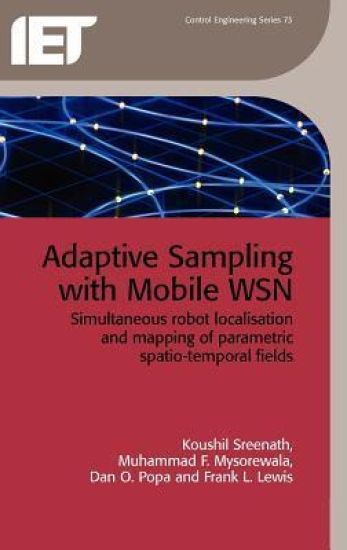
Adaptive Sampling with Mobile WSN

Adaptive Sampling with Mobile WSN

Koushil Sreenath; Muhammad F. Mysorewala; Dan O. Popa; Frank L. Lewis

Institution of Engineering and Technology
2011
sidottu
Adaptive Sampling with Mobile WSN develops algorithms for optimal estimation of environmental parametric fields. With a single mobile sensor, several approaches are presented to solve the problem of where to sample next to maximally and simultaneously reduce uncertainty in the field estimate and uncertainty in the localisation of the mobile sensor while respecting the dynamics of the time-varying field and the mobile sensor. A case study of mapping a forest fire is presented. Multiple static and mobile sensors are considered next, and distributed algorithms for adaptive sampling are developed resulting in the Distributed Federated Kalman Filter. However, with multiple resources a possibility of deadlock arises and a matrix-based discrete-event controller is used to implement a deadlock avoidance policy. Deadlock prevention in the presence of shared and routing resources is also considered. Finally, a simultaneous and adaptive localisation strategy is developed to simultaneously localise static and mobile sensors in the WSN in an adaptive manner. Experimental validation of several of these algorithms is discussed throughout the book.
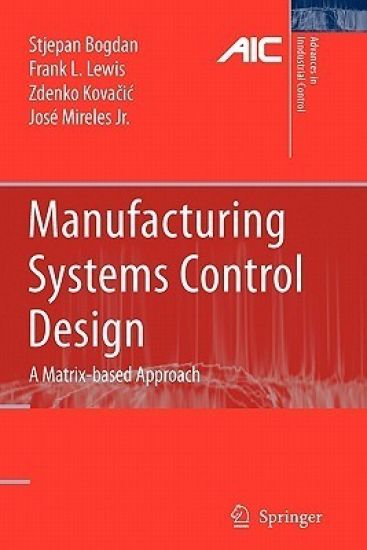
Manufacturing Systems Control Design

Manufacturing Systems Control Design

Stjepan Bogdan; Frank L. Lewis; Zdenko Kovacic; Jose Mireles

Springer London Ltd
2010
nidottu
The series Advances in Industrial Control aims to report and encourage technology transfer in control engineering. The rapid development of control technology has an impact on all areas of the control discipline. New theory, new controllers, actuators, sensors, new industrial processes, computer methods, new applications, new philosophies , new challenges. Much of this development work resides in industrial reports, feasibility study papers and the reports of advanced collaborative projects. The series offers an opportunity for researchers to present an extended exposition of such new work in all aspects of industrial control for wider and rapid dissemination. In some areas of manufacturing, the elements of a flexible manufacturing system form the key components of the process line. These key components are four-fold: a set of programmable robots and machines, an automated materia- handling system that allows parts to be freely routed and re-routed, a buffer storage system where parts and partly-assembled components can wait until required for further processing and assembly and finally, a supervisory control system. The technology employed to coordinate and control all these components as a working system is usually based on programmable logic controllers. The use of this automation hardware and software in manufacturing is designed to yield significant cost reductions and to enhance quality.
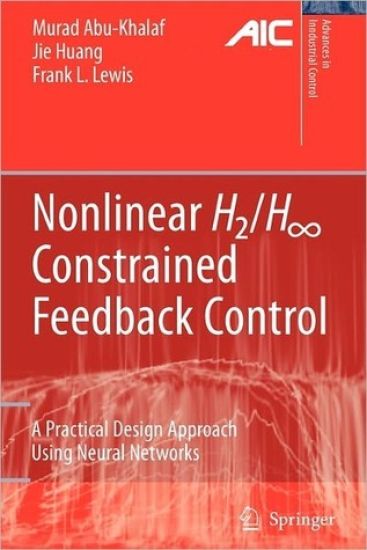
Nonlinear H2/H-Infinity Constrained Feedback Control

Nonlinear H2/H-Infinity Constrained Feedback Control

Murad Abu-Khalaf; Jie Huang; Frank L. Lewis

Springer London Ltd
2010
nidottu
The series Advances in Industrial Control aims to report and encourage technology transfer in control engineering. The rapid development of control technology has an impact on all areas of the control discipline. New theory, new controllers, actuators, sensors, new industrial processes, computer methods, new applications, new philosophies , new challenges. Much of this development work resides in industrial reports, feasibility study papers and the reports of advanced collaborative projects. The series offers an opportunity for researchers to present an extended exposition of such new work in all aspects of industrial control for wider and rapid dissemination. Almost all physical systems are nonlinear and the success of linear control techniques depends on the extent of the nonlinear system behaviour and the careful attention given to switching linear controllers through the range of nonlinear system operations. In many industrial and process-control applications, good engineering practice, linear control systems and classical PID control can give satisfactory performance because the process nonlinearity is mild and the control system performance specification is not particularly demanding; however, there are other industrial system applications where the requirement for high-performance control can only be achieved if nonlinear control design techniques are used. Thus, in some industrial and technological domains there is a strong justification for more applications of nonlinear methods. One prevailing difficulty with nonlinear control methods is that they are not so easily understood nor are they easy to reduce to formulaic algorithms for routine application.
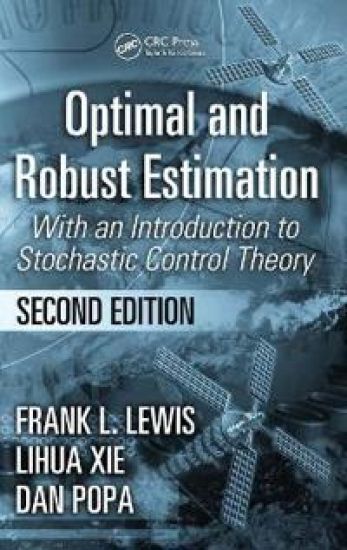
Optimal and Robust Estimation

Optimal and Robust Estimation

Frank L. Lewis; Lihua Xie; Dan Popa

CRC Press Inc
2007
sidottu
More than a decade ago, world-renowned control systems authority Frank L. Lewis introduced what would become a standard textbook on estimation, under the title Optimal Estimation, used in top universities throughout the world. The time has come for a new edition of this classic text, and Lewis enlisted the aid of two accomplished experts to bring the book completely up to date with the estimation methods driving today's high-performance systems. A Classic Revisited Optimal and Robust Estimation: With an Introduction to Stochastic Control Theory, Second Edition reflects new developments in estimation theory and design techniques. As the title suggests, the major feature of this edition is the inclusion of robust methods. Three new chapters cover the robust Kalman filter, H-infinity filtering, and H-infinity filtering of discrete-time systems. Modern Tools for Tomorrow's Engineers This text overflows with examples that highlight practical applications of the theory and concepts. Design algorithms appear conveniently in tables, allowing students quick reference, easy implementation into software, and intuitive comparisons for selecting the best algorithm for a given application. In addition, downloadable MATLAB® code allows students to gain hands-on experience with industry-standard software tools for a wide variety of applications. This cutting-edge and highly interactive text makes teaching, and learning, estimation methods easier and more modern than ever.
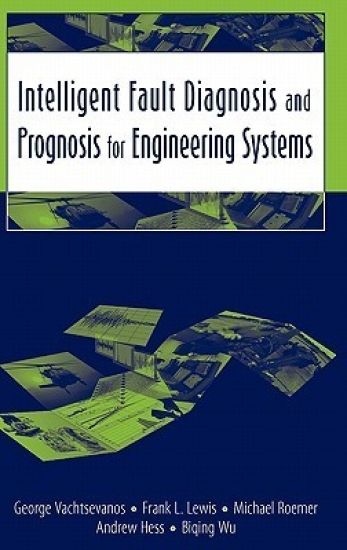
Intelligent Fault Diagnosis and Prognosis for Engineering Systems

Intelligent Fault Diagnosis and Prognosis for Engineering Systems

George Vachtsevanos; Frank L. Lewis; Michael Roemer; Andrew Hess; Biqing Wu

John Wiley Sons Inc
2006
sidottu
Expert guidance on theory and practice in condition-based intelligent machine fault diagnosis and failure prognosis Intelligent Fault Diagnosis and Prognosis for Engineering Systems gives a complete presentation of basic essentials of fault diagnosis and failure prognosis, and takes a look at the cutting-edge discipline of intelligent fault diagnosis and failure prognosis technologies for condition-based maintenance. It thoroughly details the interdisciplinary methods required to understand the physics of failure mechanisms in materials, structures, and rotating equipment, and also presents strategies to detect faults or incipient failures and predict the remaining useful life of failing components. Case studies are used throughout the book to illustrate enabling technologies. Intelligent Fault Diagnosis and Prognosis for Engineering Systems offers material in a holistic and integrated approach that addresses the various interdisciplinary components of the field--from electrical, mechanical, industrial, and computer engineering to business management. This invaluably helpful book: * Includes state-of-the-art algorithms, methodologies, and contributions from leading experts, including cost-benefit analysis tools and performance assessment techniques * Covers theory and practice in a way that is rooted in industry research and experience * Presents the only systematic, holistic approach to a strongly interdisciplinary topic