Kirjojen hintavertailu – 12 859 829 kirjaa ja 27 kauppaa

Kirjailija

Franklin E. Zimring

Kirjat ja teokset yhdessä paikassa: 28 kirjaa, julkaisuja vuosilta 1989–2020, suosituimpiin kuuluu Punishment and Democracy. Vertaile teosten hintoja ja tarkista saatavuus suomalaisista kirjakaupoista.

Nimi esiintyy myös muodoissa: Franklin E Zimring

28 kirjaa

Kirjojen julkaisuvuodet: 1989–2020.

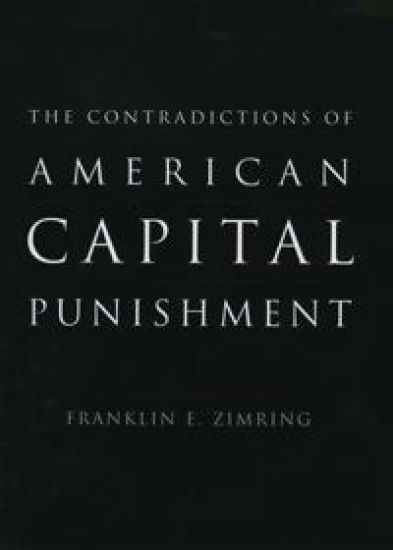
The Contradictions of American Capital Punishment

The Contradictions of American Capital Punishment

Franklin E. Zimring

Oxford University Press Inc
2003
sidottu
Why does the United States continue to employ the death penalty when fifty other developed democracies have abolished it? Why does capital punishment become more problematic each year? How can the death penalty conflict be resolved? In Contradictions in American Capital Punishment, Frank Zimring reveals that the seemingly insoluble turmoil surrounding the death penalty reflects a deep and long-standing division in American values, a division that he predicts will soon bring about the end of capital punishment in our country. On the one hand, execution would seem to violate our nation's highest legal principles of fairness and due process. It sets us increasingly apart from our allies and indeed is regarded by European nations as a barbaric and particularly egregious form of American exceptionalism. On the other hand, the death penalty represents a deeply held American belief in violent social justice that sees the hangman as an agent of local control and safeguard of community values. Zimring uncovers the most troubling symptom of this attraction to vigilante justice in the lynch mob. He shows that the great majority of executions in recent decades have occurred in precisely those Southern states where lynchings were most common a hundred years ago. It is this legacy, Zimring suggests, that constitutes both the distinctive appeal of the death penalty in the United States and one of the most compelling reasons for abolishing it. Impeccably researched and engagingly written, Contradictions in American Capital Punishment casts a clear new light on America's long and troubled embrace of the death penalty.

American Youth Violence

American Youth Violence

Franklin E. Zimring

Oxford University Press Inc
2000
nidottu
In the past decade, alarming reports of youth violence have appeared with increasing frequency in the news media. Legislators across the United States have responded to this sense of national emergency by changing many of the laws designed to cope with juvenile offenders. But are we really in the midst of a surge in youth violence? More to the point, what causes youth violence and what should we do about it? Franklin Zimring offers the definitive examination of adolescent violence in the United States both as a social phenomenon and a policy problem. This book covers the range of youth violence issues in the 1990s, from crime statistics to demographic projections to new legislation. The result is a thorough debunking of Congressional predictions of "a coming storm of juvenile violence" and the half-baked policy proposals that accompany such warnings. The book sets forth comprehensive and dispassionate analyses of three key areas of youth violence policy: adolescent firearms possession and use, standards for transfer from juvenile to criminal court jurisdiction, and legal sanctions for adolescents who kill. Throughout the book, the core issues of youth violence in the 1990s are examined with an unprecedented degree of analytic rigour. Zimring also offers an appropriate set of responses to youth violence that are consistent with a positive future for the juvenile court and for America's children. Timely and authoritative, American Youth Violence gives students, scholars, and policy makers a much-needed tool with which to fashion a constructive response to one of the nation's most disturbing social ills.
American Youth Violence

American Youth Violence

Franklin E. Zimring

Oxford University Press Inc
1999
sidottu
This is the definitive examination of adolescent violence in the United States as both a social phenomenon and a policy problem. Franklin Zimring, one of America's most esteemed scholars of law and crime, scrutinizes criminal statistics and demographic trends in order to authoritatively address public worries. The result is a thorough debunking of Congressional predictions of "a coming storm of juvenile violence" and the half-baked policy proposals that accompany such warnings. The book sets forth comprehensive and dispassionate analyses of three key areas of youth violence policy: adolescent firearms possession and use, standards for transfer from juvenile to criminal court jurisdiction, and legal sanctions for adolescents who kill. Throughout American Youth Violence, the core issues of youth violence in the 1990s are examined with an unprecedented degree of analytic rigour. Zimring also offers an appropriate set of responses to youth violence that are consistent with a positive future for the juvenile court and for American youth.
The Search for Rational Drug Control

The Search for Rational Drug Control

Franklin E. Zimring; Gordon Hawkins

Cambridge University Press
1995
pokkari
This book presents a comprehensive examination of the drug control policy process in the United States. How are policy choices identified, debated and selected? How are the consequences of governmental policy measured and evaluated? How, if at all, do we learn from our mistakes. The first section deals with four different ways of understanding American drug policy: drug control as ideology, drugs as an issue of definition and measurement, an historical analysis of drug control, and finally, drug control as an occasion for debating the proper role of the criminal law. Zimring and Hawkins also discuss priority problems for drug control and provide a foundation for an improved policy process. They argue that protection of children and youth should shape policy toward illicit crime, with attention to the fact that youth protection objectives may limit the effectiveness of some drug controls.
The Scale of Imprisonment

The Scale of Imprisonment

Franklin E. Zimring; Gordon J. Hawkins

University of Chicago Press
1993
nidottu
Two of the nation's foremost criminal justice scholars present a comprehensive assessment of the factors behind the growth and subsequent overcrowding of American prisons. By critiquing the existing scholarship on prison scale from sociology and history to correctional forecasting and economics, they both reveal that explicit policy changes have had little influence on the increases in imprisonment in recent years and analyze whether it is possible to place limits effectively on prison population. "The Scale of Imprisonment has an exceptionally well designed literature review of interest to public policy, criminal justice, and public law scholars. Its careful review, analysis, and critique of research is stimulating and inventive."—American Political Science Review "The authors fram our thoughts about the soaring use of imprisonment and stimulate our thinking about the best way we as criminologists can conduct rational analysis and provide meaningful advice."—Susan Guarino-Ghezzi, Journal of Quantitative Criminology "Zimring and Hawkins bring a long tradition of excellent criminological scholarship to the seemingly intractable problems of prisons, prison overcrowding, and the need for alternative forms of punishment."—J. C. Watkins, Jr., Choice
The Search for Rational Drug Control

The Search for Rational Drug Control

Franklin E. Zimring; Gordon Hawkins

Cambridge University Press
1992
sidottu
This book presents a comprehensive examination of the drug control policy process in the United States. How are policy choices identified, debated and selected? How are the consequences of governmental policy measured and evaluated? How, if at all, do we learn from our mistakes. The first section deals with four different ways of understanding American drug policy: drug control as ideology, drugs as an issue of definition and measurement, an historical analysis of drug control, and finally, drug control as an occasion for debating the proper role of the criminal law. Zimring and Hawkins also discuss priority problems for drug control and provide a foundation for an improved policy process. They argue that protection of children and youth should shape policy toward illicit crime, with attention to the fact that youth protection objectives may limit the effectiveness of some drug controls.
Pornography in a Free Society

Pornography in a Free Society

Gordon Hawkins; Franklin E. Zimring

Cambridge University Press
1991
pokkari
Pornography in a Free Society deals with what has been called the 'civil war over smut'. It addresses an issue about which citizens of Western nations are sharply divided. Gordon Hawkins and Franklin Zimring attempt to look at the problem of pornography in a wider perspective than that of partisan political debate. To that end, they compare two American reports on pornography commissioned by Presidents Johnson and Reagan, the first published in 1970 and the latter in 1986, with the report of the British Committee on Obscenity and Film Censorship, which appeared during the years between the American reports. They discuss the radical feminist challenge to pornography and the question of pornography and children. Going on to consider likely future developments, the authors argue that the furore over pornography and the appointment of commissions are part of a 'ceremony of adjustment' to widespread availability of sexually explicit material and they predict less social concern about pornography as time passes.
Capital Punishment and the American Agenda

Capital Punishment and the American Agenda

Franklin E. Zimring; Gordon Hawkins

Cambridge University Press
1989
pokkari
The death penalty is not simply the most serious criminal punishment. It has been a singular social, legal, and moral problem in the Western world over the past two hundred years. Capital punishment is disappearing from every nation in the West except the United States. No political science of capital punishment in the United States has been attempted until this book. Franklin E. Zimring and Gordon Hawkins offer a redefinition of the central political and legal issues and a re-examination of the whole subject in the light of the social, political, and moral conditions of the United States in the 1980s. Lawyers, criminologists, political scientists, and motivated general readers will find the profile of a United States pursuing an active execution policy in the 1980s and 1990s to be an original and compelling contribution to the discussion of the future of the death penalty. Zimring and Hawkins's prediction for future policy, while based on historical precedent, is in sharp contrast to conventional wisdom about the United States Supreme Court. This book was first published in 1986.