Kirjojen hintavertailu – 12 903 725 kirjaa ja 27 kauppaa

Kirjailija

Franz Boas

Kirjat ja teokset yhdessä paikassa: 137 kirjaa, julkaisuja vuosilta 1911–2026, suosituimpiin kuuluu The Central Eskimo. Vertaile teosten hintoja ja tarkista saatavuus suomalaisista kirjakaupoista.

137 kirjaa

Kirjojen julkaisuvuodet: 1911–2026.

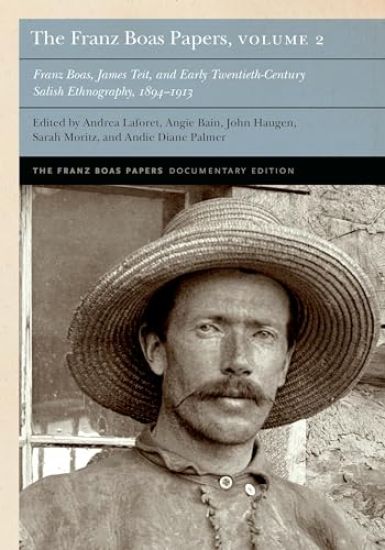
The Franz Boas Papers, Volume 2

The Franz Boas Papers, Volume 2

Franz Boas

University of Nebraska Press
2024
sidottu
The Franz Boas Papers, Volume 2 explores the development of the ethnography of Salishan-speaking societies on the North American Plateau as revealed through the correspondence between Franz Boas and the Scottish-born James Teit, who married into an Interior Salish family and community and became fluent in the Nlaka’pamux language. The letters between Teit (1864–1922) and Boas (1858–1942) chronicle Teit’s varied career as an ethnographer, from shortly after his initial meeting with Boas in 1894 until Teit’s death at the age of fifty-eight. A postscript documents Boas’s contribution to Teit’s legacy through the posthumous publication of the manuscripts Teit left unfinished at his death. Teit made significant contributions to ethnography and the history of southern British Columbia through his photography of the people with whom he worked, his contributions to ethnomusicology and ethnobotany, his anthologies of mythic narrative, and his collections of Interior Salish-primarily Nlaka’pamux-material culture. In addition to collaborating with Boas in the development of Interior Salish ethnography, between 1909 and 1922 Teit worked to support Indigenous groups in British Columbia who were seeking recognition of Aboriginal title and resolution of their outstanding land claims. The Franz Boas Papers, Volume 2 meticulously tracks the impact of the differing career trajectories of Teit and Boas on the primary product of their collaboration-the initial development of the ethnography of societies speaking Interior Salish languages. This second volume of the Franz Boas Papers Documentary Edition is an essential primary source of archival materials for research libraries and for students and scholars of Northwest Coast and Interior Mountain West ethnohistory, Native American and Indigenous studies, history of anthropology, and modern U. S. history. It is also an essential source for Indigenous and settler descendant communities.
Anthropology and Modern Life

Anthropology and Modern Life

Franz Boas

Routledge
2021
sidottu
Franz Boas (1858–1942) is widely regarded as the founder of American anthropology. He influenced an astonishing variety of scholars and researchers, from the anthropologists Margaret Mead and Ruth Benedict, to the philosopher W. E. B. DuBois, and novelist Zora Neale Hurston. Towards the end of his life he also lectured widely in an attempt to educate the public on the dangers of Nazi ideology. Anthropology and Modern Life demonstrates the incredibly rich and fertile range of Boas’s thought, engaging with controversies that resonate loudly today: the problem of race and racial types; heredity versus environment; the significance of intelligence tests; open versus closed societies; the ‘nature versus nurture debate’; and nationality and nationalism. Believing passionately that science should be used to break down racial and cultural barriers, from the book's very opening Boas shatters the myth that anthropology is simply a collection of ‘curious facts about exotic peoples’. Thanks to Boas's influence, anthropologists and other social scientists began to see that differences among the races resulted not from physiological factors, but from historical events and circumstances, and that race itself was a cultural construct. This Routledge Classics edition includes a new Foreword by Regna Darnell and an Introduction and Afterword by Herbert S. Lewis, who details Franz Boas's life, influence, and ideals." In writing the present book I desired to show that some of the most firmly rooted opinions of our times appear from a wider point of view as prejudices, and that a knowledge of anthropology enables us to look with greater freedom at the problems confronting our civilization." - Franz Boas, Anthropology and Modern Life
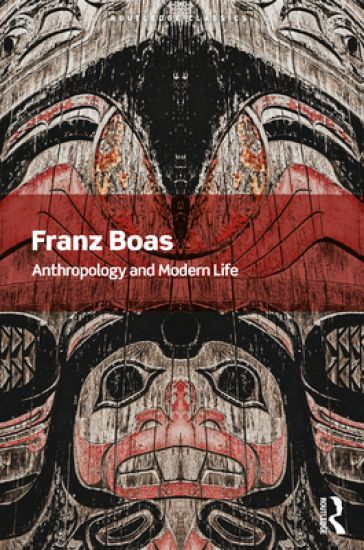
Anthropology and Modern Life

Anthropology and Modern Life

Franz Boas

Routledge
2021
nidottu
Franz Boas (1858–1942) is widely regarded as the founder of American anthropology. He influenced an astonishing variety of scholars and researchers, from the anthropologists Margaret Mead and Ruth Benedict, to the philosopher W. E. B. DuBois, and novelist Zora Neale Hurston. Towards the end of his life he also lectured widely in an attempt to educate the public on the dangers of Nazi ideology. Anthropology and Modern Life demonstrates the incredibly rich and fertile range of Boas’s thought, engaging with controversies that resonate loudly today: the problem of race and racial types; heredity versus environment; the significance of intelligence tests; open versus closed societies; the ‘nature versus nurture debate’; and nationality and nationalism. Believing passionately that science should be used to break down racial and cultural barriers, from the book's very opening Boas shatters the myth that anthropology is simply a collection of ‘curious facts about exotic peoples’. Thanks to Boas's influence, anthropologists and other social scientists began to see that differences among the races resulted not from physiological factors, but from historical events and circumstances, and that race itself was a cultural construct. This Routledge Classics edition includes a new Foreword by Regna Darnell and an Introduction and Afterword by Herbert S. Lewis, who details Franz Boas's life, influence, and ideals." In writing the present book I desired to show that some of the most firmly rooted opinions of our times appear from a wider point of view as prejudices, and that a knowledge of anthropology enables us to look with greater freedom at the problems confronting our civilization." - Franz Boas, Anthropology and Modern Life
The decorative art of the Indians of the North Pacific coast
The decorative art of the Indians of the North Pacific coast is an unchanged, high-quality reprint of the original edition of 1897. Hansebooks is editor of the literature on different topic areas such as research and science, travel and expeditions, cooking and nutrition, medicine, and other genres. As a publisher we focus on the preservation of historical literature. Many works of historical writers and scientists are available today as antiques only. Hansebooks newly publishes these books and contributes to the preservation of literature which has become rare and historical knowledge for the future.
Grammatical notes on the language of the Tlingit Indians
This book has been considered by academicians and scholars of great significance and value to literature. This forms a part of the knowledge base for future generations. So that the book is never forgotten we have represented this book in a print format as the same form as it was originally first published. Hence any marks or annotations seen are left intentionally to preserve its true nature.
Putnam anniversary volume; anthropological essays presented to Frederic Ward Putnam in honor of his seventieth birthday, April 16, 1909
This book has been considered by academicians and scholars of great significance and value to literature. This forms a part of the knowledge base for future generations. So that the book is never forgotten we have represented this book in a print format as the same form as it was originally first published. Hence any marks or annotations seen are left intentionally to preserve its true nature.
The North America Indians

The North America Indians

Franz Boas; Clark Wissler

Createspace Independent Publishing Platform
2018
nidottu
"In North America, as a whole, anthropologists usually recognize from ten to eleven more or less clearly defined culture areas, the approximate borders of which are indicated on the accompanying map. Yet, in most cases these divisions are not absolute, but relative, for rarely can a group of Indians be found anywhere, however small, that does not show some of the cultural traits of all its immediate neighbors. One of the most striking characteristics of culture distribution is the constant intergradation of traits, so that only in exceptional instances can the cultures of even two neighboring groups be considered exactly alike. Nevertheless, certain groups often possess in common highly characteristic traits, whence they are said to be of the same general types. The divisions on the accompanying map mark off the limits within which the respective sets of characteristic traits seem to predominate. Thus, the various tribes of Plains Indians have a number of peculiar traits whose distribution in more or less complete association is taken as indicating the geographical extent of a type of culture..."