Kirjojen hintavertailu – 12 903 725 kirjaa ja 27 kauppaa
Kirjailija
Frédéric Bastiat
Kirjat ja teokset yhdessä paikassa: 264 kirjaa, julkaisuja vuosilta 1850–2026, suosituimpiin kuuluu Harmonies of Political Economies. Vertaile teosten hintoja ja tarkista saatavuus suomalaisista kirjakaupoista.
Nimi esiintyy myös muodoissa: Frederic Bastiat, Fréderic Bastiat
Fr d ric Bastiat's passionate and witty arguments for free trade and enterprise left a mark upon the fledgling science of economics, with the author stridently dispelling myths and misunderstandings. Setting out to outline principles of economics for the reader, Bastiat does so with a difference: by fiercely debunking misconceptions and falsehoods about the concepts and discoveries which comprised economic thought. Sometimes venturing to humor in demonstrating his points, it is thus that Economic Sophisms escapes the impenetrable dryness for which contemporaries were famous. Together with satirical barbs at flawed thinking by both economic scholars and the popular media of his time, Economic Sophisms also contains anecdotes and examples which serve to illustrate the author's points. A supporter of free trade unhindered by regulations, Bastiat was frustrated with emerging trends in society whereby protectionism and socialist policies were increasingly demanded by the populations of Europe.
Trieste Publishing has a massive catalogue of classic book titles. Our aim is to provide readers with the highest quality reproductions of fiction and non-fiction literature that has stood the test of time. The many thousands of books in our collection have been sourced from libraries and private collections around the world. The titles that Trieste Publishing has chosen to be part of the collection have been scanned to simulate the original. Our readers see the books the same way that their first readers did decades or a hundred or more years ago. Books from that period are often spoiled by imperfections that did not exist in the original. Imperfections could be in the form of blurred text, photographs, or missing pages. It is highly unlikely that this would occur with one of our books. Our extensive quality control ensures that the readers of Trieste Publishing's books will be delighted with their purchase. Our staff has thoroughly reviewed every page of all the books in the collection, repairing, or if necessary, rejecting titles that are not of the highest quality. This process ensures that the reader of one of Trieste Publishing's titles receives a volume that faithfully reproduces the original, and to the maximum degree possible, gives them the experience of owning the original work. We pride ourselves on not only creating a pathway to an extensive reservoir of books of the finest quality, but also providing value to every one of our readers. Generally, Trieste books are purchased singly - on demand, however they may also be purchased in bulk. Readers interested in bulk purchases are invited to contact us directly to enquire about our tailored bulk rates.
The Law, original French title La Loi, is a 1849 book by Fr d ric Bastiat. It was published one year after the third French Revolution of 1848 and one year before his death of tuberculosis at age 49. The essay was influenced by John Locke's Second Treatise on Government and in turn influenced Henry Hazlitt's Economics in One Lesson. It is the work for which Bastiat is most famous along with The candlemaker's petition and the Parable of the broken window. In The Law, Bastiat states that "each of us has a natural right - from God - to defend his person, his liberty, and his property." The State is a "substitution of a common force for individual forces" to defend this right. The law becomes perverted when it punishes one's right to self-defense in favor of another's acquired right to plunder. We are delighted to publish this classic book as part of our extensive Classic Library collection. Many of the books in our collection have been out of print for decades, and therefore have not been accessible to the general public. The aim of our publishing program is to facilitate rapid access to this vast reservoir of literature, and our view is that this is a significant literary work, which deserves to be brought back into print after many decades. The contents of the vast majority of titles in the Classic Library have been scanned from the original works. To ensure a high quality product, each title has been meticulously hand curated by our staff. Our philosophy has been guided by a desire to provide the reader with a book that is as close as possible to ownership of the original work. We hope that you will enjoy this wonderful classic work, and that for you it becomes an enriching experience.
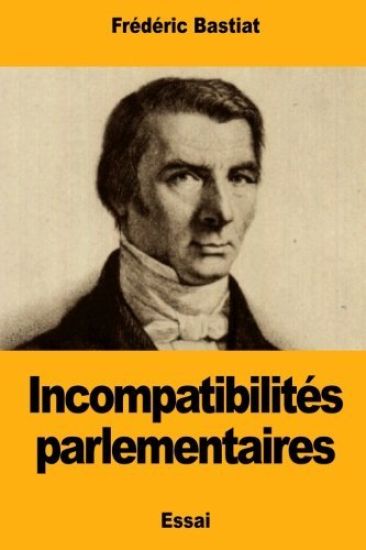
"... Ce que je demande en effet, c'est ceci: Que tout lecteur soit ligible. Que les coll ges lectoraux puissent se faire repr senter par quiconque a m rit leur confiance. Mais si le choix des lecteurs tombe sur un fonctionnaire public, c'est l'homme et non la fonction qui entre la Chambre. Le fonctionnaire ne perdra pas pour cela ses droits ant rieurs et ses titres. On n'exigera pas de lui le sacrifice d'une v ritable propri t acquise, par de longs et utiles travaux. La soci t n'a que faire d'exigences superflues et doit se contenter de pr cautions suffisantes. Ainsi, le fonctionnaire sera soustrait l'influence du pouvoir ex cutif; il ne pourra tre promu ou destitu . Il sera mis l'abri des suggestions de l'esp rance et de la crainte. Il ne pourra exercer ses fonctions ou en percevoir les moluments. En un mot, il sera repr sentant, ne sera que repr sentant, pendant toute la dur e de son mandat. Sa vie administrative sera, pour ainsi dire, suspendue et comme absorb e par sa vie parlementaire. C'est bien l ce qu'on a fait pour les militaires, gr ce la distinction entre le grade et l'emploi. Par quel motif ne le ferait-on pas pour les magistrats ?..."
" Je voulais aborder la question de l'imp t des boissons telle qu'elle me paraissait se poser dans toutes vos consciences, c'est- -dire au point de vue de la n cessit financi re et politique. Je croyais, en effet, que la n cessit tait le seul motif invoqu l'appui du maintien de cet imp t; je croyais qu' vos yeux il r unissait tous les caract res auxquels la science enseigne reconna tre les mauvais imp ts; je croyais qu'il tait admis que cet imp t est injuste, in gal, d'une perception accompagn e de formalit s vexatoires. Mais, puisque ces reproches dirig s contre l'imp t, depuis son tablissement, par tous les hommes d' tat, sont aujourd'hui contest s, j'en dirai seulement quelques mots, - tr s-rapidement. D'abord, nous pr tendons que l'imp t est injuste, et nous nous fondons sur ceci: Voil des terres qui sont c t les unes des autres, et qui sont assujetties un imp t foncier, un imp t direct; ces terres sont class es, compar es entre elles et tax es selon leur valeur; ensuite chacun peut y faire cro tre ce qu'il veut; les uns du bl , les autres, des herbages, les autres, des oeillets et des roses, d'autres, du vin..."
FrEdEric Bastiat is well known for his 'broken window' parable. While other economists were looking at how maintaining a standing army, launching public works projects, and even destroying things, as a way to spur the economy, Bastiat showed in this classic economics essay just how wrong this thinking is -- or at least, how it is incomplete. 'What is seen' is plain enough: the broken window. 'What is not seen' requires some imagination and curiosity, but is nonetheless real: the things not purchased because the money had to be used for the window, and other unintended consequences. This is the original 1853 English translation out of the original French, as found in Bastiat's "Essays on Political Economy."
How is it that the law enforcer itself does not have to keep the law? How is it that the law permits the state to lawfully engage in actions which, if undertaken by individuals, would land them in jail? These are among the most intriguing issues in political and economic philosophy. More specifically, the problem of law that itself violates law is an insurmountable conundrum of all statist philosophies. The problem has never been discussed so profoundly and passionately as in this essay by Frederic Bastiat from 1850. The essay might have been written today. It applies in ever way to our own time, which is precisely why so many people credit this one essay for showing them the light of liberty. Bastiat's essay here is timeless because applies whenever and wherever the state assumes unto itself different rules and different laws from that by which it expects other people to live. And so we have this legendary essay, written in a white heat against the leaders of 19th century France, the reading of which has shocked millions out of their toleration of despotism. This new edition from the Mises Institute revives a glorious translation that has been out of print for a hundred years, one that circulated in Britain in the generation that followed Bastiat's death. This newly available translation provides new insight into Bastiat's argument. It is a more sophisticated, more substantial, and more precise rendering than any in print. The question that Bastiat deals with: how to tell when a law is unjust or when the law maker has become a source of law breaking? When the law becomes a means of plunder it has lost its character of genuine law. When the law enforcer is permitted to do with others' lives and property what would be illegal if the citizens did them, the law becomes perverted. Bastiat doesn't avoid the difficult issues, such as why should we think that a democratic mandate can convert injustice to justice. He deals directly with the issue of the expanse of legislation: It is not true that the mission of the law is to regulate our consciences, our ideas, our will, our education, our sentiments, our sentiments, our exchanges, our gifts, our enjoyments. Its mission is to prevent the rights of one from interfering with those of another, in any one of these things. Law, because it has force for its necessary sanction, can only have the domain of force, which is justice. More from Bastiat's The Law: Socialism, like the old policy from which it emanates, confounds Government and society. And so, every time we object to a thing being done by Government, it concludes that we object to its being done at all. We disapprove of education by the State - then we are against education altogether. We object to a State religion - then we would have no religion at all. We object to an equality which is brought about by the State then we are against equality, etc., etc. They might as well accuse us of wishing men not to eat, because we object to the cultivation of corn by the State. How is it that the strange idea of making the law produce what it does not contain - prosperity, in a positive sense, wealth, science, religion - should ever have gained ground in the political world? The modern politicians, particularly those of the Socialist school, found their different theories upon one common hypothesis; and surely a more strange, a more presumptuous notion, could never have entered a human brain. They divide mankind into two parts. Men in general, except one, form the first; the politician himself forms the second, which is by far the most important. Whether you buy one or one hundred, you can look forward to one of the most penetrating and powerful essays written in the history of political economy.
" Je suis engag . Je ne nomme pas M. tel, parce qu'il ne m'a pas demand mon suffrage. Je vote pour M. tel, parce qu'il m'a rendu service. Je vote pour M. tel, parce qu'il a rendu des services la France. Je vote pour M. tel, parce qu'il m'a promis un service. Je vote pour M. tel, parce que je d sire une place. Je vote pour M. tel, parce que je crains pour ma place. Je vote pour M. tel, parce qu'il est du Pays. Je vote pour M. tel, parce qu'il n'est pas du Pays. Je vote pour M. tel, parce qu'il parlera. Je vote pour M. tel, parce que s'il n'est pas nomm , notre pr fet ou notre sous-pr fet seront destitu s. Chacun de ces sophismes a son caract re sp cial, mais il y a aussi au fond de chacun d'eux quelque chose qui leur est commun et qu'il s'agit de d m ler..."
" Vous avez bien raison de conserver votre calme. Outre que nous en aurons tous besoin, il faudrait que la temp te f t bien furieuse pour qu'elle se f t ressentir a Mugron. Jusqu'ici Paris jouit de la tranquillit la plus parfaite, et ce spectacle est, mes yeux, bien autrement imposant que celui du courage dans la lutte. Nous venons d'assister la c r monie fun bre. Il me semble que tout l'univers tait sur les boulevards. Je n'ai jamais vu tant de monde. Je dois dire que la population m'a paru sympathique mais froide. On ne peut lui arracher des cris d'enthousiasme. Cela vaut peut- tre mieux, et semble prouver que le temps et l'exp rience nous ont m ris. Les manifestations emport es ne sont-elles pas plut t un obstacle la bonne direction des affaires ? Le c t politique de l'avenir occupe peu les esprits. Il semble que le suffrage universel et les autres droits populaires sont tellement dans le consentement unanime qu'on n'y pense pas. Mais ce qui assombrit notre perspective, ce sont les questions conomiques..."
" Nourri l' cole de votre Adam Smith et de notre J. B. Say je commen ais croire que cette doctrine si simple et si claire n'avait aucune chance de se populariser, du moins de bien longtemps, car, chez nous, elle est compl tement touff e par les sp cieuses fallacies que vous avez si bien r fut es, - par les sectes fouri ristes, communistes, etc., dont le pays s'est momentan ment engou , - et aussi par l'alliance funeste des journaux de parti avec les journaux pay s par les comit s manufacturiers. C'est dans l' tat de d couragement complet o m'avaient jet ces tristes circonstances, que m' tant par hasard abonn au Globe and Traveller, j'appris, et l'existence de la Ligue, et la lutte que se livrent en Angleterre la libert commerciale et le monopole. Admirateur passionn de votre si puissante et si morale association, et particuli rement de l'homme qui para t lui donner, au milieu de difficult s sans nombre, une impulsion la fois si nergique et si sage, je n'ai pu contempler ce spectacle sans d sirer faire aussi quelque chose pour la noble cause de l'affranchissement du travail et du commerce. Votre honorable secr taire M. Hickin a eu la bont de me faire parvenir la Ligue, dater de janvier 1844, et beaucoup de documents relatifs l'agitation..."