Kirjailija
G. K. Chesterton
Kirjat ja teokset yhdessä paikassa: 2 054 kirjaa, julkaisuja vuosilta 1900–2026, suosituimpiin kuuluu A Miscellany of Poems by G. K. Chesterton. Vertaile teosten hintoja ja tarkista saatavuus suomalaisista kirjakaupoista.
Nimi esiintyy myös muodoissa: G K Chesterton, G.K. Chesterton, G.K Chesterton, G. K Chesterton
2 054 kirjaa
Kirjojen julkaisuvuodet: 1900–2026.
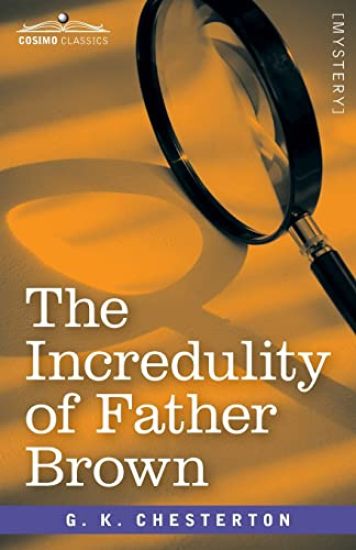
The Innocence of Father Brown is a classic mystery collection by G. K. Chesterton and an exciting compilation of twelve mystery classics featuring the amatuer detective, Father Brown, the short, stumpy Catholic priest with "uncanny insight into human evil." Contents: The blue cross -- The secret garden -- The queer feet -- The flying stars -- The invisible man -- The honour of Israel Gow -- The wrong shape -- The sins of Prince Saradine -- The hammer of God -- The eye of Apollo -- The sign of the broken sword -- The three tools of death. Father Brown is a fictional Roman Catholic priest and amateur detective who is featured in 53 short stories published between 1910 and 1936 written by English novelist G. K. Chesterton. Father Brown solves mysteries and crimes using his intuition and keen understanding of human nature.
These fleeting sketches are all republished by kind permission of the Editor of the DAILY NEWS, in which paper they appeared. They amount to no more than a sort of sporadic diary--a diary recording one day in twenty which happened to stick in the fancy-- the only kind of diary the author has ever been able to keep. Even that diary he could only keep by keeping it in public, for bread and cheese. But trivial as are the topics they are not utterly without a connecting thread of motive. As the reader's eye strays, with hearty relief, from these pages, it probably alights on something, a bed-post or a lamp-post, a window blind or a wall. It is a thousand to one that the reader is looking at something that he has never seen: that is, never realised. He could not write an essay on such a post or wall: he does not know what the post or wall mean. He could not even write the synopsis of an essay; as "The Bed-Post; Its Significance--Security Essential to Idea of Sleep--Night Felt as Infinite--Need of Monumental Architecture," and so on. He could not sketch in outline his theoretic attitude towards window-blinds, even in the form of a summary. "The Window-Blind-- Its Analogy to the Curtain and Veil--Is Modesty Natural? --Worship of and Avoidance of the Sun, etc., etc." None of us think enough of these things on which the eye rests. But don't let us let the eye rest. Why should the eye be so lazy? Let us exercise the eye until it learns to see startling facts that run across the landscape as plain as a painted fence. Let us be ocular athletes. Let us learn to write essays on a stray cat or a coloured cloud. I have attempted some such thing in what follows; but anyone else may do it better, if anyone else will only try.

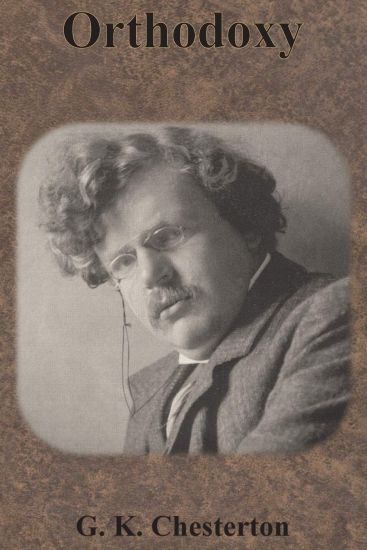
Complete edition of Orthodoxy by G. K. Chesterton. Arranged upon a riddle and an answer, it tells how Chesterton himself went from pagan, to agnostic, to staunch Christian. Told in Chesterton's own voice, the book is a thought provoking manuscript as impactful today as it was in 1908. Witty, deep, and positively entertaining, no student of thought should be without this historic book. This edition is provided in a slim volume with full text at an affordable price. TABLE OF CONTENTSPREFACE 31. INTRODUCTION IN DEFENCE OF EVERYTHING ELSE 32. THE MANIAC 53. THE SUICIDE OF THOUGHT 124. THE ETHICS OF ELFLAND 195. THE FLAG OF THE WORLD 286. THE PARADOXES OF CHRISTIANITY 347. THE ETERNAL REVOLUTION 448. THE ROMANCE OF ORTHODOXY 549. AUTHORITY AND THE ADVENTURER 61
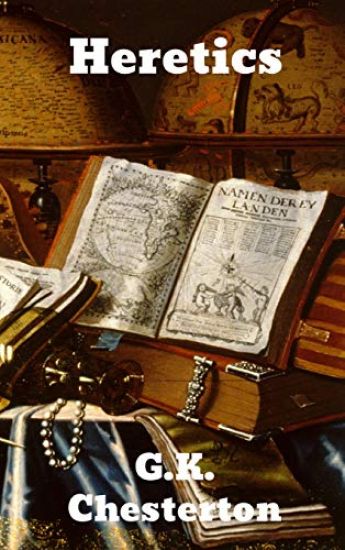
Heretics is a religious studies classic by G. K. Chesterton. Nothing more strangely indicates an enormous and silent evil of modern society than the extraordinary use which is made nowadays of the word "orthodox." In former days the heretic was proud of not being a heretic. It was the kingdoms of the world and the police and the judges who were heretics. He was orthodox. He had no pride in having rebelled against them; they had rebelled against him. Gilbert Keith Chesterton was born in London, England on the 29th of May, 1874. Though he considered himself a mere "rollicking journalist," he was actually a prolific and gifted writer in virtually every area of literature. A man of strong opinions and enormously talented at defending them, his exuberant personality nevertheless allowed him to maintain warm friendships with people--such as George Bernard Shaw and H. G. Wells--with whom he vehemently disagreed. Chesterton had no difficulty standing up for what he believed. He was one of the few journalists to oppose the Boer War. His 1922 "Eugenics and Other Evils" attacked what was at that time the most progressive of all ideas, the idea that the human race could and should breed a superior version of itself. In the Nazi experience, history demonstrated the wisdom of his once "reactionary" views.
The Napoleon of Notting Hill
G K Chesterton
Createspace Independent Publishing Platform
1904
pokkari
The Wild Knight and Other Poems: Classic Literature
G. K. Chesterton
Createspace Independent Publishing Platform
1900
nidottu