Kirjojen hintavertailu – 12 859 824 kirjaa ja 27 kauppaa
Kirjailija
G. K. Chesterton
Kirjat ja teokset yhdessä paikassa: 2 054 kirjaa, julkaisuja vuosilta 1900–2026, suosituimpiin kuuluu A Miscellany of Poems by G. K. Chesterton. Vertaile teosten hintoja ja tarkista saatavuus suomalaisista kirjakaupoista.
Nimi esiintyy myös muodoissa: G K Chesterton, G.K. Chesterton, G.K Chesterton, G. K Chesterton
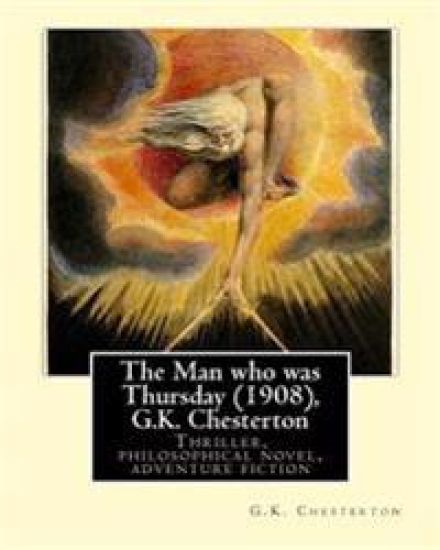
The Man Who Was Thursday: A Nightmare is a novel by G. K. Chesterton, first published in 1908. The book is sometimes referred to as a metaphysical thriller. In Edwardian era London, Gabriel Syme is recruited at Scotland Yard to a secret anti-anarchist police corps. Lucian Gregory, an anarchistic poet, lives in the suburb of Saffron Park. Syme meets him at a party and they debate the meaning of poetry. Gregory argues that revolt is the basis of poetry. Syme demurs, insisting the essence of poetry is not revolution but law. He antagonizes Gregory by asserting that the most poetical of human creations is the timetable for the London Underground. He suggests Gregory isn't really serious about anarchism, which so irritates Gregory that he takes Syme to an underground anarchist meeting place, revealing his public endorsement of anarchy is a ruse to make him seem harmless, when in fact he is an influential member of the local chapter of the European anarchist council. The work is prefixed with a poem written to Edmund Clerihew Bentley, revisiting the pair's early history and the challenges presented to their early faith by the times. Like most of Chesterton's fiction, the story includes some Christian allegory. Chesterton, a Protestant at this time (he joined the Roman Catholic Church about 15 years later), suffered from a brief bout of depression during his college days, and claimed afterwards he wrote this book as an unusual affirmation that goodness and right were at the heart of every aspect of the world. However, he insisted: "The book ... was not intended to describe the real world as it was, or as I thought it was, even when my thoughts were considerably less settled than they are now. It was intended to describe the world of wild doubt and despair which the pessimists were generally describing at that date; with just a gleam of hope in some double meaning of the doubt, which even the pessimists felt in some fitful fashion". The costumes the detectives don towards the end of the book represent what was created on their respective day. Sunday, "the sabbath" and "the peace of God," sits upon a throne in front of them. The name of the girl Syme likes, Rosamond, is derived from "Rosa Mundi," meaning "Rose of the World" in Latin, and a title given to Christ.(Usually a title given to the Virgin Mary) The central council consists of seven men, each using the name of a day of the week as a cover name; the position of Thursday is about to be elected by Gregory's local chapter. Gregory expects to win the election but just before, Syme reveals to Gregory after an oath of secrecy, that he is a secret policeman. Fearful Syme may use his speech in evidence of a prosecution, Gregory's weakened words fail to convince the local chapter that he is sufficiently dangerous for the job. Syme makes a rousing anarchist speech and wins the vote. He is sent immediately as the chapter's delegate to the central council. In his efforts to thwart the council, Syme eventually discovers that the other five members are also undercover detectives; each was employed just as mysteriously and assigned to defeat the Council. They soon find out they were fighting each other and not real anarchists; such was the mastermind plan of their president, Sunday. In a surreal conclusion, Sunday is unmasked as only seeming to be terrible; in fact, he is a force of good like the detectives. Sunday is unable to give an answer to the question of why he caused so much trouble and pain for the detectives. Gregory, the only real anarchist, seems to challenge the good council. His accusation is that they, as rulers, have never suffered like Gregory and their other subjects and so their power is illegitimate. Syme refutes the accusation immediately, because of the terrors inflicted by Sunday on the rest of the council....
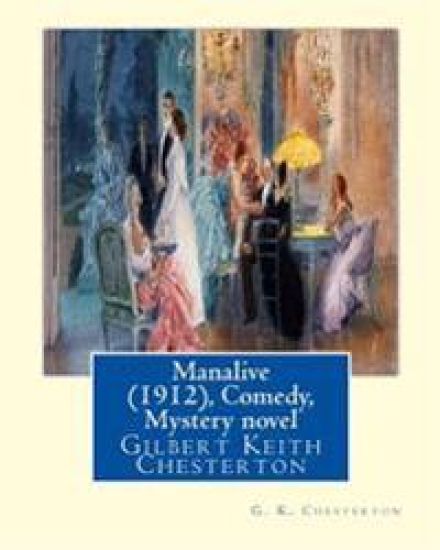
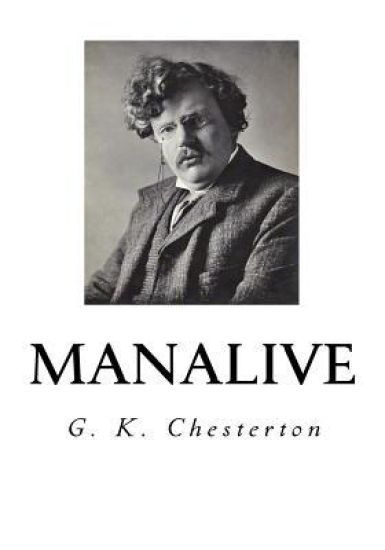
Manalive (1912) is a book by G. K. Chesterton detailing a popular theme both in his own philosophy, and in Christianity, of the "holy fool", such as in Dostoevsky's The Idiot and Cervantes' Don Quixote. This is a book in two parts. The first, "The Enigma of Innocent Smith", concerns the arrival of a new tenant at Beacon House, a London boarding establishment. Like Mary Poppins, this man (who is tentatively identified by lodger Arthur Inglewood as an ex-schoolmate named Innocent Smith) is accompanied by a great wind, and he breathes new life into the household with his games and antics. During his first day in residence the eccentric Smith creates the High Court of Beacon; arranges to elope with Mary Gray, paid companion to heiress Rosamund Hunt; inspires Inglewood to declare his love for Diana Duke, the landlady's niece; and prompts a reconciliation between jaded journalist Michael Moon and Rosamund. However, when the household is at its happiest two doctors appear with awful news: Smith is wanted on charges of burglary, desertion of a spouse, polygamy, and attempted murder. The fact that Smith almost immediately fires several shots from a revolver at Inglewood's friend Dr. Herbert Warner seems to confirm the worst. Before Smith can be taken to a jail or an asylum, Michael Moon declares that the case falls under the purview of the High Court of Beacon and suggests that the household investigate the matter before involving the authorities or the press. The second part, "The Explanations of Innocent Smith", follows the trial. The prosecution consists of Moses Gould, a merrily cynical Jew who lives at Beacon House and considers Smith at best a fool and at worst a scoundrel, and Dr. Cyrus Pym, an American criminal specialist called in by Dr. Warner; Michael Moon and Arthur Inglewood act for the defense. The evidence consists of correspondence from people who witnessed or participated in the exploits that led to the charges against Smith. In every case, the defendant is revealed to be, as his first name states, innocent. He fires bullets near people to make them value life; the house he breaks into is his own; he travels around the world only to return with renewed appreciation for his house and family; and the women he absconded with are actually his wife Mary, posing as a spinster under different aliases so they may repeatedly re-enact their courtship. Smith is, needless to say, acquitted on all charges.... Gilbert Keith Chesterton, KC*SG (29 May 1874 - 14 June 1936), better known as G. K. Chesterton, was an English writer, poet, philosopher, dramatist, journalist, orator, lay theologian, biographer, and literary and art critic. Chesterton is often referred to as the "prince of paradox." Time magazine has observed of his writing style: "Whenever possible Chesterton made his points with popular sayings, proverbs, allegories-first carefully turning them inside out." 4] Chesterton is well known for his fictional priest-detective Father Brown, and for his reasoned apologetics. Even some of those who disagree with him have recognized the wide appeal of such works as Orthodoxy and The Everlasting Man. Chesterton, as a political thinker, cast aspersions on both Progressivism and Conservatism, saying, "The whole modern world has divided itself into Conservatives and Progressives. The business of Progressives is to go on making mistakes. The business of the Conservatives is to prevent the mistakes from being corrected." Chesterton routinely referred to himself as an "orthodox" Christian, and came to identify this position more and more with Catholicism, eventually converting to Catholicism from High Church Anglicanism. George Bernard Shaw, Chesterton's "friendly enemy" according to Time, said of him, "He was a man of colossal genius." Biographers have identified him as a successor to such Victorian authors as Matthew Arnold, Thomas Carlyle, Cardinal John Henry Newman, and John Ruskin...
Continuano con questa terza serie le avventure filosofico-poliziesco del piccolo prete cattolico, alle prese con tutto ci che si dice "soprannaturale". Come dice pi volte Padre Brown nel corso delle sue avventure, "un conto essere credenti, un conto essere creduloni", per cui, con la consueta tenacia, fede, e grande intuito, padre Brown sveler i grandi misteri magici o preternaturali, facendo trionfare la verit del libero arbitrio, che pu anche portare all'omicidio, e che comporta per chi agisce tutte le relative responsabilit . Le storie presenti sono: La resurrezione di Padre Brown, La freccia del cielo, L'oracolo del cane, Il miracolo della Mezzaluna, La maledizione della croce d'oro, Il pugnale alato, Il destino dei Darnaways, Lo spettro di Gideon Wise.
When Theology Butted Up Against the Real World Orthodoxy (1908) is a book by G. K. Chesterton that has become a classic of Christian apologetics. Chesterton considered this book a companion to his other work, Heretics, writing it expressly in response to G. S. Street's criticism of the earlier work, "that he was not going to bother about his theology until I had really stated mine". In the book's preface Chesterton states the purpose is to "attempt an explanation, not of whether the Christian faith can be believed, but of how he personally has come to believe it." In it, Chesterton presents an original view of Christian religion. He sees it as the answer to natural human needs, the "answer to a riddle" in his own words, and not simply as an arbitrary truth received from somewhere outside the boundaries of human experience. Chesterton chose the title, Orthodoxy, to focus instead on the plainness of the Apostles' Creed, though he admitted the general sound of the title was "a thinnish sort of thing".
'The Complete Father Brown Mysteries' includes 24 stories featuring G. K. Chesterton's eponymous Roman Catholic sleuth. These mysteries are the original source material for the current hit BBC TV show 'Father Brown' starring Mark Williams.
The Ballad of the White HorseBy G. K. ChestertonThis ballad needs no historical notes, for the simple reason that it does not profess to be historical. All of it that is not frankly fictitious, as in any prose romance about the past, is meant to emphasize tradition rather than history. King Alfred is not a legend in the sense that King Arthur may be a legend; that is, in the sense that he may possibly be a lie. But King Alfred is a legend in this broader and more human sense, that the legends are the most important things about him. The cult of Alfred was a popular cult, from the darkness of the ninth century to the deepening twilight of the twentieth. It is wholly as a popular legend that I deal with him here. I write as one ignorant of everything, except that I have found the legend of a King of Wessex still alive in the land. I will give three curt cases of what I mean. A tradition connects the ultimate victory of Alfred with the valley in Berkshire called the Vale of the White Horse. I have seen doubts of the tradition, which may be valid doubts. I do not know when or where the story started; it is enough that it started somewhere and ended with me; for I only seek to write upon a hearsay, as the old balladists did. For the second case, there is a popular tale that Alfred played the harp and sang in the Danish camp; I select it because it is a popular tale, at whatever time it arose. For the third case, there is a popular tale that Alfred came in contact with a woman and cakes; I select it because it is a popular tale, because it is a vulgar one. It has been disputed by grave historians, who were, I think, a little too grave to be good judges of it. The two chief charges against the story are that it was first recorded long after Alfred's death, and that (as Mr. Oman urges) Alfred never really wandered all alone without any thanes or soldiers. Both these objections might possibly be met. It has taken us nearly as long to learn the whole truth about Byron, and perhaps longer to learn the whole truth about Pepys, than elapsed between Alfred and the first writing of such tales. And as for the other objection, do the historians really think that Alfred after Wilton, or Napoleon after Leipsic, never walked about in a wood by himself for the matter of an hour or two? Ten minutes might be made sufficient for the essence of the story. But I am not concerned to prove the truth of these popular traditions. It is enough for me to maintain two things: that they are popular traditions; and that without these popular traditions we should have bothered about Alfred about as much as we bother about Eadwig. ContentsDEDICATIONBOOK I. THE VISION OF THE KINGBOOK II. THE GATHERING OF THE CHIEFSBOOK III. THE HARP OF ALFREDBOOK IV. THE WOMAN IN THE FORESTBOOK V. ETHANDUNE: THE FIRST STROKEBOOK VI. ETHANDUNE: THE SLAYING OF THE CHIEFSBOOK VII. ETHANDUNE: THE LAST CHARGEBOOK VIII. THE SCOURING OF THE HORSE
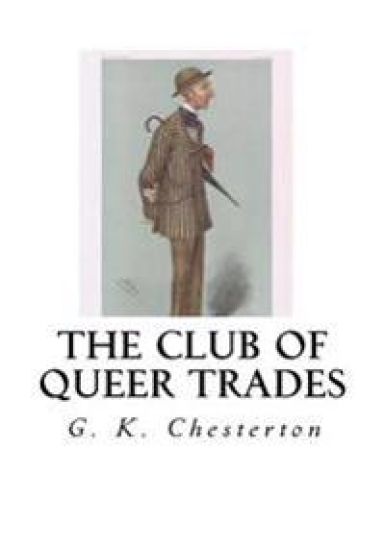
The Club of Queer Tradesby G. K. ChestertonA Collection of Short StoriesThe Club of Queer Trades is a collection of stories by G. K. Chesterton first published in 1905. Each story in the collection is centered on a person who is making his living by some novel and extraordinary means (a "queer trade," using the word "queer" in the sense of "peculiar"). To gain admittance one must have invented a unique means of earning a living and the subsequent trade being the main source of income. The Narrator, Charlie "Cherub" Swinburne. The framing narrative by "Cherub" Swinburne describes his quest for The Club of Queer Trades with his friend Basil Grant, a retired judge, and Rupert Grant, a private detective who is Basil's younger brother. Each of the stories describes their encounter with one of the trades. ContentsChapter 1. The Tremendous Adventures of Major Brown Chapter 2. The Painful Fall of a Great Reputation Chapter 3. The Awful Reason of the Vicar's Visit Chapter 4. The Singular Speculation of the House-Agent Chapter 5. The Noticeable Conduct of Professor Chadd Chapter 6. The Eccentric Seclusion of the Old Lady
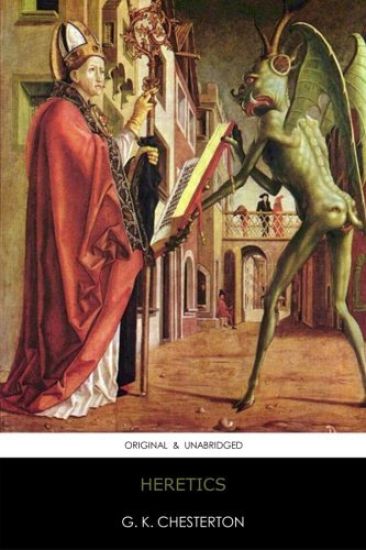
Handsome Trade Paperback Original and Unabridged Version of G. K. Chesterton's Classic "Heretics." - "A hundred years ago our affairs for good or evil were wielded triumphantly by rhetoricians. Now our affairs are hopelessly muddled by strong, silent men." - "I do not say that there are no stronger men than these; but will any one say that there are any men stronger than those men of old who were dominated by their philosophy and steeped in their religion? Whether bondage be better than freedom may be discussed. But that their bondage came to more than our freedom it will be difficult for any one to deny." - "Blasphemy is an artistic effect, because blasphemy depends upon a philosophical conviction. Blasphemy depends upon belief and is fading with it. If any one doubts this, let him sit down seriously and try to think blasphemous thoughts about Thor. I think his family will find him at the end of the day in a state of some exhaustion." - "In the fifteenth century men cross-examined and tormented a man because he preached some immoral attitude; in the nineteenth century we feted and flattered Oscar Wilde because he preached such an attitude, and then broke his heart in penal servitude because he carried it out. It may be a question which of the two methods was the more cruel; there can be no kind of question which was the more ludicrous. The age of the Inquisition has not at least the disgrace of having produced a society which made an idol of the very same man for preaching the very same things which it made him a convict for practising." Chesterton's style and thinking were all his own, and his conclusions were often opposed to those of Oscar Wilde and George Bernard Shaw. In his book Heretics, Chesterton has this to say of Wilde: "The same lesson of the pessimistic pleasure-seeker] was taught by the very powerful and very desolate philosophy of Oscar Wilde. It is the carpe diem religion; but the carpe diem religion is not the religion of happy people, but of very unhappy people. Great joy does not gather the rosebuds while it may; its eyes are fixed on the immortal rose which Dante saw.