
Kirjailija
Georg Wilhelm Friedrich Hegel
Kirjat ja teokset yhdessä paikassa: 312 kirjaa, julkaisuja vuosilta 1970–2026, suosituimpiin kuuluu Hegel's Philosophy of Mind. Vertaile teosten hintoja ja tarkista saatavuus suomalaisista kirjakaupoista.
312 kirjaa
Kirjojen julkaisuvuodet: 1970–2026.
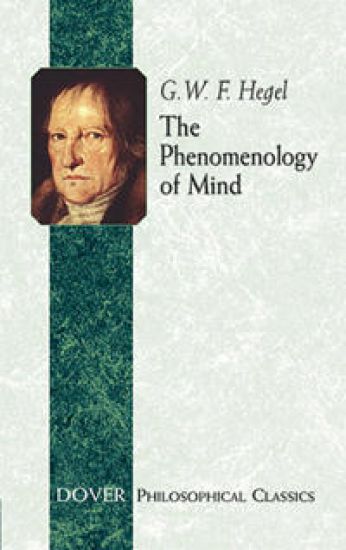
Remarkable for its breadth and profundity, this work combines aspects of psychology, logic, moral philosophy, and history to form a comprehensive view that encompasses all forms of civilization. Its three divisions consist of the subjective mind, the objective mind, and the absolute mind. A wide-ranging survey of the evolution of consciousness.
Wissenschaft der Logik 2. Die Lehre vom Begriff (1816)
Georg Wilhelm Friedrich Hegel
Meiner Felix Verlag GmbH
2003
nidottu
Entgegen der Auffassung von G. Lasson, der den als Reinschriftfragment aus den Jahren 1802-03 in Hegels Nachlass berlieferten Text erstmals edierte, handelt es sich bei dieser Schrift nicht um eine fr he Vorarbeit zu Hegels eigener, sp ter in vollendeter Gestalt vorgelegten Philosophie des objektiven Geistes, sondern um eine systematische Kritik an Fichtes Theorie des Naturrechts. Der Nachweis der richtigen Zuordnung dieser Schrift, die nun als eine Auseinandersetzung mit Fichte gelesen werden muss, kommt daher der Entdeckung gleich, dass eine bislang unbekannte Hegel'sche Schrift erstmals der ffentlichkeit zug nglich wird. V llige Neuausgabe auf der Grundlage der historisch-kritischen Edition des Textes in Gesammelte Werke, Bd. 5.
This anthology, reflecting virtually every stage of Hegel's life and every area of his interests, provides a complete picture of the intellectual development and activity of this philosophical great.
This anthology, reflecting virtually every stage of Hegel's life and every area of his interests, provides a complete picture of the intellectual development and activity of this philosophical great.

Political Writings
Georg Wilhelm Friedrich Hegel; Laurence Winant Dickey; H. B. Nisbet
Cambridge Univ Pr
1999
sidottu
Wissenschaft der Logik. Die Lehre vom Wesen (1813)
Georg Wilhelm Friedrich Hegel
Meiner Felix Verlag GmbH
1999
nidottu
Galt für die Lehre vom Sein der Satz: Das Sein ist das Wesen, so gilt für die Lehre vom Wesen: Das Wesen ist das Sein. Dieses Sein, zu dem sich das Wesen macht, ist das wesentliche Sein, die Existenz, das Existierende oder das Ding. Dieses zeigt sich zunächst als ein Unmittelbares. Indem es sich aber fortbestimmt, zeigt sich die Reflexion als sein Grund. Sie hebt seine Unmittelbarkeit auf, so daß es sich als ein Gesetztsein erweist. Das bedeutet, daß sich als die Wahrheit des Dinges die Erscheinung herausstellt. - Als die Einheit des Wesens und der Existenz ergibt sich die Wirklichkeit. In dieser Studienausgabe auf der Grundlage der historisch-kritischen Ausgabe erscheint die "Lehre vom Wesen" seit 1819 erstmals wieder als selbständiger Band und folgt damit der ursprünglichen Publikationsgeschichte der "Wissenschaft der Logik". Er enthält die Anmerkungen der historisch-kritischen Ausgabe; altsprachlichen Zitaten sind Übersetzungen beigegeben. Mit Einleitung, Literaturverzeichnis und Personenregister.
Preface Introduction de la Phenomenologie de l'Esprit
Georg Wilhelm Friedrich Hegel
Librarie Philosophique J. Vrin
1997
nidottu
La Preface et l' Introduction de la Phenomenologie de l'esprit constituent en leur unite le grand Manifeste hegelien, a la fois le discours de la methode et le discours de metaphysique des temps nouveaux.
On Art, Religion, and the History of Philosophy
Georg Wilhelm Friedrich Hegel; J. Glenn Gray
Hackett Pub Co Inc
1997
pokkari
This is a reprint, with new Introduction, of the Harper Torch edition of 1970. The famous introductory lectures collected in this volume represent the distillation of Hegel's mature views on the three most important activities of spirit, and have the further advantage, shared by his lectures in general, of being more comprehensible than those works of his published during his lifetime. A new Introduction, Select Bibliography, Analytical Table of Contents, and the restoration in the section headings of the outline of Hegel's lectures make this new edition particularly useful and welcome.
Lectures on the History of Philosophy, Volume 2
Georg Wilhelm Friedrich Hegel
University of Nebraska Press
1995
pokkari
G. W. F. Hegel (1770–1831), the influential German philosopher, believed that human history was advancing spiritually and morally according to God's purpose. At the beginning of Lectures on the History of Philosophy, Hegel writes: "What the history of Philosophy shows us is a succession of noble minds, a gallery of heroes of thought, who, by the power of Reason, have penetrated into the being of things, of nature and of spirit, into the Being of God, and have won for us by their labours the highest treasure, the treasure of reasoned knowledge." Volume 2 of Lectures on the History of Philosophy, titled Plato and the Platonists for this Bison Books edition, introduces the most renowned disciple of Socrates and the theory of Platonic forms before moving to Plato's disciple, Aristotle, whose advance to scientific thinking is carefully detailed. The subsequent increasing systematization and sophistication of philosophy leads to a discussion of the Stoics, Epicureans, and Sceptics. The first period in the history of philosophy comes to maturity with Plotinus in the third century B. C.
Lectures on the History of Philosophy, Volume 1
Georg Wilhelm Friedrich Hegel
University of Nebraska Press
1995
pokkari
G. W. F. Hegel (1770–1831), the influential German philosopher, believed that human history was advancing spiritually and morally according to God's purpose. At the beginning of this masterwork, Hegel writes: "What the history of Philosophy shows us is a succession of noble minds, a gallery of heroes of thought, who, by the power of Reason, have penetrated into the being of things, of nature and of spirit, into the Being of God, and have won for us by their labours the highest treasure, the treasure of reasoned knowledge." In his introduction to this Bison Book edition, Frederick C. Beiser notes the complex and controversial history of Hegel's text. He makes a case that this English-language translation by E. S. Haldane and Frances H. Simson is still the most reliable one.
Lectures on the History of Philosophy, Volume 3
Georg Wilhelm Friedrich Hegel
University of Nebraska Press
1995
pokkari
G. W. F. Hegel (1770–1831), the influential German philosopher, believed that human history was advancing spiritually and morally according to God's purpose. At the beginning of Lectures on the History of Philosophy, Hegel writes: "What the history of Philosophy shows us is a succession of noble minds, a gallery of heroes of thought, who, by the power of Reason, have penetrated into the being of things, of nature and of spirit, into the Being of God, and have won for us by their labours the highest treasure, the treasure of reasoned knowledge." Volume 3 of Lectures on the History of Philosophy, titled Medieval and Modern Philosophy for this Bison Books edition, begins with a survey of the philosophy of the middle ages, leaving the pagan world for the Christian and extending to the sixteenth century A. D. Hegel shows how scholastic theology and philosophy developed through the efforts of Peter Lombard, Thomas Aquinas, and others. Hegel's treatment of the modern period of philosophy focuses on Bacon, Descartes, Spinoza, Locke, Hobbes, Leibnitz, Berkeley, Hume, Kant, and Fichte.
Vorlesungen über die Philosophie des Geistes
Georg Wilhelm Friedrich Hegel
Felix Meiner
1994
sidottu
Im Kontrast zu Hegels Rechtsphilosophie, zu der seit seinem Tod eine F lle von Vorlesungsnachschriften publiziert worden sind, ist die 'Philosophie des (subjektiven) Geistes' bisher eher stiefm tterlich behandelt worden. Das ist um so erstaunlicher, als Hegel selbst auf diesen Teil seines Systems besonderen Wert legte; denn in der Philosophie des Geistes wollte er zeigen, dass der Geist darauf aus ist, sich als Wille hervorzubringen, welcher, als der praktische Geist berhaupt, die n chste Wahrheit der Intelligenz ist. Diese Erstedition der Nachschriften der Vorlesung ber die 'Philosophie des Geistes' aus dem WS 1827/28 (erstmals gehalten auf der Basis der erheblich revidierten und erweiterten 2. Auflage der Enzyklop die) erf llt ein seit anderthalb Jahrhunderten bestehendes Desiderat.

Des Manieres de Traiter Scientifiquement Du Droit Naturel; de Sa Place Dans La Philosophie Pratique Et de Son Rapport Aux Sciences Positives Du Droit
Georg Wilhelm Friedrich Hegel
Librarie Philosophique J. Vrin
1990
nidottu
Par sa maitrise encyclopedique de l'existence, la philosophie hegelienne a tente de reconcilier de maniere concrete et definitive - apres la tourmente revolutionnaire ou s'affronterent le monde ancien et le monde moderne - l'objectivite subs-tantielle et la subjectivite singuliere, l'ordre ethico-religieux et la raison progressiste, le totalitarisme politique et le liberalisme social, la nature reelle en son droit et le droit en sa nature formelle.
G.W.F. Hegel: Foi Et Savoir: Kant - Fichte - Jacobi
Georg Wilhelm Friedrich Hegel
Librarie Philosophique J. Vrin
1988
nidottu
Avec l'ecrit sur le Droit naturel, Foi et Savoir constitue la voie d'entree, strategiquement fondamentale, dans le systeme hegelien, comme Theorie et Doctrine du Logos. En sa conclusion Hegel ayant expose la coeur de la philosophie de la reflexion dont les hautes figures sont Kant, Jacobi et Fichte, celebre le Vendredi Saint de l'esprit qui abolit le Dieu perdu de Pascal (Br. 441). Ainsi est annoncee la derniere page de La Phenomenologie de l'esprit ou dans le Golgotha de l'Esprit absolu, comme Savoir absolu, depassant le savoir en devenir (Werdend Wissen) se dit la fin de l'histoire dont emerge le sens depuis le Calice auquel reve Schiller (La Phenomenologie de l'esprit, page derniere).
Encyclopedie Des Sciences Philosophiques: III La Philosophie de l'Esprit
Georg Wilhelm Friedrich Hegel
Librarie Philosophique J. Vrin
1988
nidottu
L'Encyclopedie des sciences philosophiques de Hegel est la premiere, mais aussi la derniere pensee totale de la realite qui fonde sa necessite sur l'identite de l'identite a soi rigoureusement respectee de la pensee et de la difference d'avec soi consretement exploree de la realite; concept et experience triomphent ici conjointement. Or, dans la mesure ou le monde qui s'y offre ainsi maitrise est, pour une part essentielle, encore le notre, la lecture de l'Encyclopedie hegelienne peut aider l'homme contemporain a mieux s'y retrouver dans la profusion chaotique des faits et des idees qui l'assaillent.
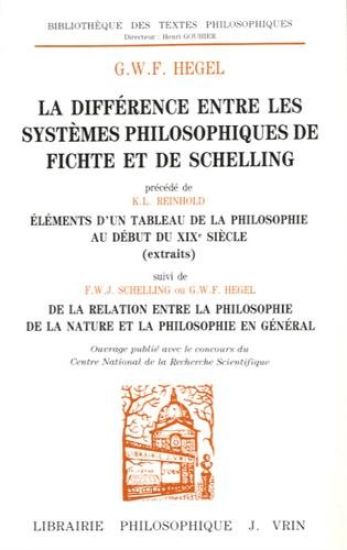
G.W.F. Hegel: La Difference Entre Les Systemes Philosophiques de Fichte Et de Schelling
Georg Wilhelm Friedrich Hegel
Librarie Philosophique J. Vrin
1986
nidottu
La philosophie de Hegel a reussi ; trop bien, peut-etre, car Hegel a trop critique l'entetement individuel afin d'exprimer ce que chacun porte en lui ; mais nul autre n'aurait su l'exprimer avec autant de raison. Avant lui Fichte, avec lui Schelling ont fait epoque . Pris en eux-memes, ces deux philosophes sont importants. De plus, ils font l'objet de la premiere oeuvre publiee par Hegel. A propos des critiques de Reinhold, Hegel oppose Schelling a Fichte dans la difference. L'essai sur la philosophie de la nature reprend cette opposition, mais une controverse s'est elevee: qui l'a ecrit, Schelling ou Hegel?
Vorlesungen über die Philosophie der Religion I
Georg Wilhelm Friedrich Hegel
SUHRKAMP VERLAG
1986
pokkari