Kirjojen hintavertailu – 12 859 818 kirjaa ja 27 kauppaa

Kirjailija

George Pattison

Kirjat ja teokset yhdessä paikassa: 52 kirjaa, julkaisuja vuosilta 1992–2026, suosituimpiin kuuluu The Mystical Sources of Existentialist Thought. Vertaile teosten hintoja ja tarkista saatavuus suomalaisista kirjakaupoista.

52 kirjaa

Kirjojen julkaisuvuodet: 1992–2026.

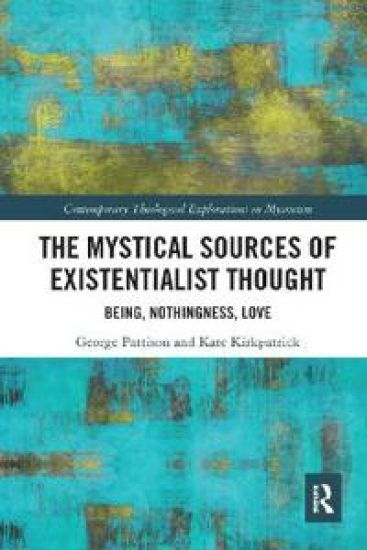
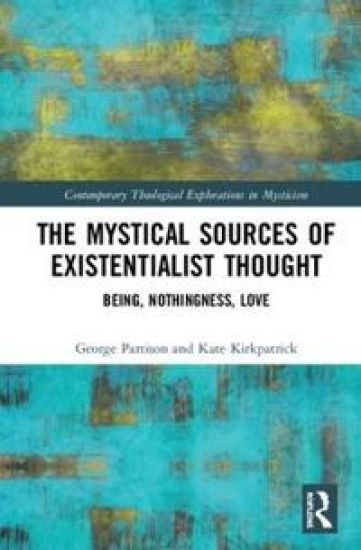
The Mystical Sources of Existentialist Thought

The Mystical Sources of Existentialist Thought

George Pattison; Kate Kirkpatrick

Routledge
2018
sidottu
At the time when existentialism was a dominant intellectual and cultural force, a number of commentators observed that some of the language of existential philosophy, not least its interpretation of human existence in terms of nothingness, evoked the language of so-called mystical writers. This book takes on this observation and explores the evidence for the influence of mysticism on the philosophy of existentialism. It begins by delving into definitions of mysticism and existentialism, and then traces the elements of mysticism present in German and French thought during the late nineteenth and early twentieth centuries. The book goes on to make original contributions to the study of figures including Kierkegaard, Buber, Heidegger, Beauvoir, Sartre, Marcel, Camus, Weil, Bataille, Berdyaev, and Tillich, linking their existentialist philosophy back to some of the key concerns of the mystical tradition. Providing a unique insight into how these two areas have overlapped and interacted, this study is vital reading for any academic with an interest in twentieth-century philosophy, theology and religious studies.

Kierkegaard’s Concept of Anxiety

Kierkegaard’s Concept of Anxiety

George Pattison

Cambridge University Press
2026
Sidottu
With reference to Kierkegaard's religious writings and other pseudonymous works, Kierkegaard's concept of anxiety is explored with a primary focus on the book The Concept of Anxiety. Anxiety itself is shown to be the eminent term for a moment in the human being's psychological development that Kierkegaard also discusses in other terms. In particular, it is the mode in which human being's apprehension of their possible freedom first appears in consciousness and, as such, is not to be confused with pathological anxiety, melancholy, or other negative states. At the same time, Kierkegaard regards human beings as typically failing to realize the possibility of freedom and when this happens anxiety becomes the trigger for despair or sin. The Element concludes by considering the influence of Kierkegaard on discussions of anxiety in Heidegger, Sartre, and Tillich and the relevance of his analysis to the contemporary crisis of social anxiety.
Kierkegaard’s Concept of Anxiety

Kierkegaard’s Concept of Anxiety

George Pattison

Cambridge University Press
2026
Nidottu
With reference to Kierkegaard's religious writings and other pseudonymous works, Kierkegaard's concept of anxiety is explored with a primary focus on the book The Concept of Anxiety. Anxiety itself is shown to be the eminent term for a moment in the human being's psychological development that Kierkegaard also discusses in other terms. In particular, it is the mode in which human being's apprehension of their possible freedom first appears in consciousness and, as such, is not to be confused with pathological anxiety, melancholy, or other negative states. At the same time, Kierkegaard regards human beings as typically failing to realize the possibility of freedom and when this happens anxiety becomes the trigger for despair or sin. The Element concludes by considering the influence of Kierkegaard on discussions of anxiety in Heidegger, Sartre, and Tillich and the relevance of his analysis to the contemporary crisis of social anxiety.
Heidegger and Kierkegaard

Heidegger and Kierkegaard

George Pattison

Cambridge University Press
2025
sidottu
The work examines the presence and significance of Kierkegaard in Heidegger's work. After setting out the context of Heidegger's reception of the Danish thinker and examining his likely knowledge of his writings, the work first examines key Kierkegaardian concepts that are explicitly present in Being and Time, including existence, 'idle talk' (Gerede), anxiety, the moment of vision, repetition, and the existential significance of death. It is seen that Heidegger regarded Kierkegaard as an essentially religious writer whose work was only indirectly relevant to Heidegger's own project of fundamental ontology. Subsequently, the work considers the place of Kierkegaard in Heidegger's writings from the 1930s onwards, concluding with consideration of the paper Heidegger submitted for the 1963 Paris UNESCO conference marking the 150th anniversary of Kierkegaard's thought.
Heidegger and Kierkegaard

Heidegger and Kierkegaard

George Pattison

Cambridge University Press
2025
pokkari

Halvin toimitettuna 30,00 €

The work examines the presence and significance of Kierkegaard in Heidegger's work. After setting out the context of Heidegger's reception of the Danish thinker and examining his likely knowledge of his writings, the work first examines key Kierkegaardian concepts that are explicitly present in Being and Time, including existence, 'idle talk' (Gerede), anxiety, the moment of vision, repetition, and the existential significance of death. It is seen that Heidegger regarded Kierkegaard as an essentially religious writer whose work was only indirectly relevant to Heidegger's own project of fundamental ontology. Subsequently, the work considers the place of Kierkegaard in Heidegger's writings from the 1930s onwards, concluding with consideration of the paper Heidegger submitted for the 1963 Paris UNESCO conference marking the 150th anniversary of Kierkegaard's thought.
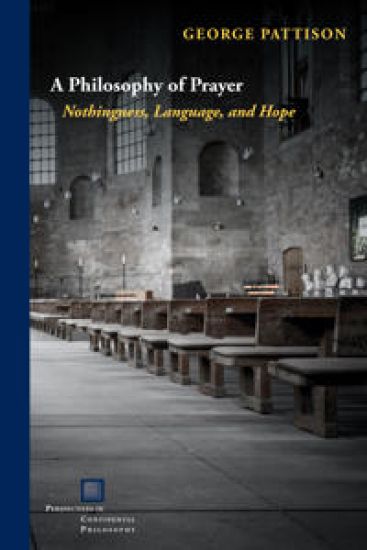
A Philosophy of Prayer

A Philosophy of Prayer

George Pattison

FORDHAM UNIVERSITY PRESS
2024
sidottu
Exploring the silence of prayer in Post-Kantian philosophy and traditional spirituality A Philosophy of Prayer explores prayer within the perspective of post-Kantian philosophy. Against a background of traditional sources, including Augustine, The Cloud of Unknowing, and the seventeenth-century French school of spirituality, the book uses Schleiermacher, Kierkegaard, Dostoevsky, Heidegger, Berdyaev, Tillich, Marcel, Simone Weil, Emmanuel Levinas, and Jean- Louis Chrétien to provide an interpretation of what is meant by the passivity and self-annihilation of the praying self, suggesting an "apophatics of the personality." Pattison pays particular attention to the question of language and the implications of the role given to silence in traditional texts, arguing that language remains a defining element of the human–God relationship and that silence is not to be construed as the negation of language but as the revelation of the depth of language itself. The basic structure of prayer is shown to be implicitly eschatological, oriented toward a coming kingdom of justice and peace while, at the same time, expressing a deep desire for ontological homecoming, a tension manifest in, respectively, Levinas and Heidegger. On Pattison's reading, prayer calls for and develops a particular orientation of the self toward existence, corresponding to the virtue of humility, long understood as the basic Christian virtue. This is shown to be in tension with modernity's commitment to strong versions of autonomy. However, the choice of humility is not presented as the reinstatement of religious heteronomy but as a free choice of the praying self.
A Philosophy of Prayer

A Philosophy of Prayer

George Pattison

FORDHAM UNIVERSITY PRESS
2024
pokkari
Exploring the silence of prayer in Post-Kantian philosophy and traditional spirituality A Philosophy of Prayer explores prayer within the perspective of post-Kantian philosophy. Against a background of traditional sources, including Augustine, The Cloud of Unknowing, and the seventeenth-century French school of spirituality, the book uses Schleiermacher, Kierkegaard, Dostoevsky, Heidegger, Berdyaev, Tillich, Marcel, Simone Weil, Emmanuel Levinas, and Jean- Louis Chrétien to provide an interpretation of what is meant by the passivity and self-annihilation of the praying self, suggesting an "apophatics of the personality." Pattison pays particular attention to the question of language and the implications of the role given to silence in traditional texts, arguing that language remains a defining element of the human–God relationship and that silence is not to be construed as the negation of language but as the revelation of the depth of language itself. The basic structure of prayer is shown to be implicitly eschatological, oriented toward a coming kingdom of justice and peace while, at the same time, expressing a deep desire for ontological homecoming, a tension manifest in, respectively, Levinas and Heidegger. On Pattison's reading, prayer calls for and develops a particular orientation of the self toward existence, corresponding to the virtue of humility, long understood as the basic Christian virtue. This is shown to be in tension with modernity's commitment to strong versions of autonomy. However, the choice of humility is not presented as the reinstatement of religious heteronomy but as a free choice of the praying self.
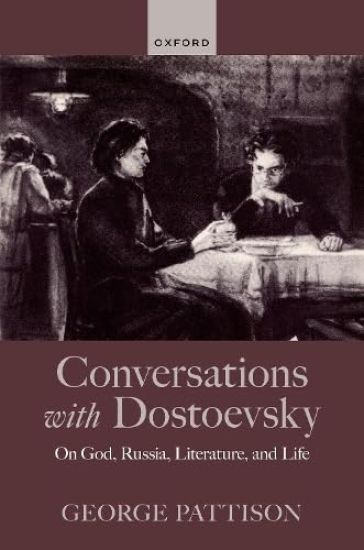
Conversations with Dostoevsky

Conversations with Dostoevsky

George Pattison

Oxford University Press
2024
sidottu
Conversations with Dostoevsky presents a series of fictional conversations taking place between November 2018 and Spring 2019 in the narrator's Glasgow apartment and elsewhere in the city. At the beginning of the conversations, the narrator has been reading Dostoevsky's story A Gentle Spirit, which concludes with a dramatic statement of protest atheism. This statement suggests that love is not possible in a purely mechanical universe in which all living beings are condemned to death and ultimate extinction. The conversations spell out Dostoevsky's response to this view and his advocacy of faith in God, Christ, and immortality. The themes discussed include suicide, truth and lies, guilt, determinism, literature, the Bible, Mary, Christ, Dostoevsky and film, 'the woman question', nationalism, war, the Church, the Jewish question, immortality, and God. In addition to conversations between the narrator and Dostoevsky, we drop in on a dinner party at which Dostoevsky is discussed from various points of view and in another conversation Dostoevsky is joined by the philosopher Vladimir Solovyov to discuss nationalism, the Church, and life. We also attend a seminar on 'Dostoevsky, Anti-Semitism, and Nazism', and visit Glasgow's Necropolis on Easter Eve. The conversations in the first part of the volume are accompanied by a series of commentaries in a second part, which contextualize the issues discussed in the conversations with references to his novels, journalism, letters, and notebooks as well as engaging the relevant critical literature.
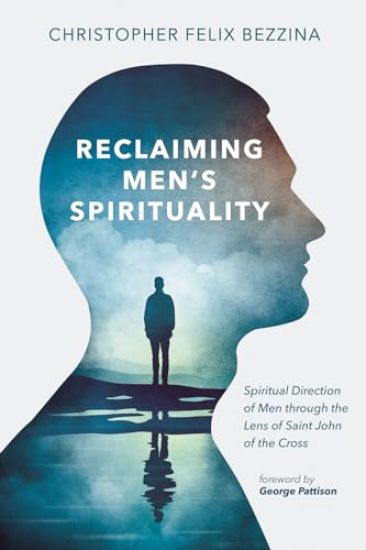
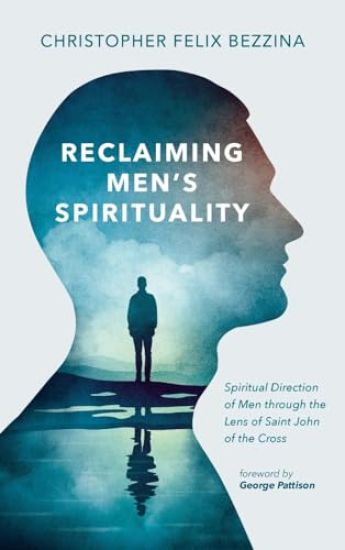
Reclaiming Men's Spirituality

Reclaiming Men's Spirituality

Christopher Felix Bezzina; George Pattison

Pickwick Publications
2024
pokkari
Reclaiming Men's Spirituality is a study that investigates men's spirituality by exploring three research questions: Can a form of spirituality about men be identified and described, how can this spirituality be examined, and what is it that needs to be reclaimed? To answer these questions and at the same time remain committed to the importance of lived experience, this study opted to investigate the lives of men by attending to ten spiritual histories. The study is situated in Malta, and the ten spiritual histories provide access to various features, expressions, and contours that relate closely to men's being. Semi-structured interviews were also conducted with ten spiritual directors who have men as spiritual directees. Their contribution clarifies the structure of men's spirituality, the effort required when directing male spiritual directees and the impact generated in the lives of men thanks to spiritual direction. To provide a frame of reference for the examination of all the gathered data, John of the Cross's spiritual framework has been chosen as the mystical instrument against which men's spiritualities are studied, leading to richer insights into the operations, motives, goals, and problems of such spiritualities.
Reclaiming Men's Spirituality

Reclaiming Men's Spirituality

Christopher Felix Bezzina; George Pattison

Pickwick Publications
2024
sidottu
Reclaiming Men's Spirituality is a study that investigates men's spirituality by exploring three research questions: Can a form of spirituality about men be identified and described, how can this spirituality be examined, and what is it that needs to be reclaimed? To answer these questions and at the same time remain committed to the importance of lived experience, this study opted to investigate the lives of men by attending to ten spiritual histories. The study is situated in Malta, and the ten spiritual histories provide access to various features, expressions, and contours that relate closely to men's being. Semi-structured interviews were also conducted with ten spiritual directors who have men as spiritual directees. Their contribution clarifies the structure of men's spirituality, the effort required when directing male spiritual directees and the impact generated in the lives of men thanks to spiritual direction. To provide a frame of reference for the examination of all the gathered data, John of the Cross's spiritual framework has been chosen as the mystical instrument against which men's spiritualities are studied, leading to richer insights into the operations, motives, goals, and problems of such spiritualities.
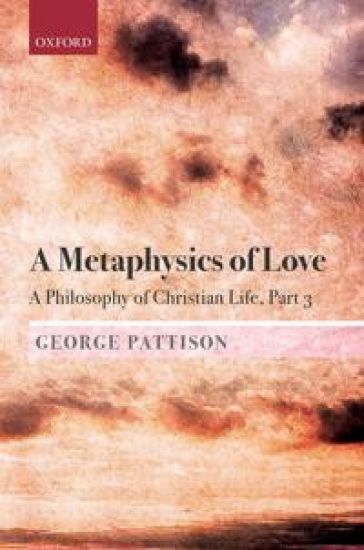
A Metaphysics of Love

A Metaphysics of Love

George Pattison

Oxford University Press
2021
sidottu
As the third part of a philosophy of Christian life, A Metaphysics of Love builds on a view of Christian life as shaped by the dynamic of call, response, and promise. It argues that love is the ultimate content of this dynamic and considers how far this claim extends. Taking its bearings from Dante's vision of divine love as 'the power that moves the sun and other stars', this study explores the requirement that love is both human and cosmic, uniting being and beings. Cognizant of much recent philosophy's desire to overcome or move beyond a metaphysics of being, it examines some of the formal structures that make love possible, including language, time, social being, forgiveness, and ultimacy. Following on from the earlier volumes, extensive use is made of the idea of the poetic as the eminent mode of Christian witness, contextualized within the prose of everyday life. Heidegger provides fundamental philosophical orientation, whilst key features of love are brought to the fore through dialogue with Kierkegaard. Dante and Dostoevsky are frequent points of reference, in addition to a range of literary and religious sources, including the Scottish poet Edwin Muir. Leading scholar George Pattison concludes that the phenomenon of love requires us to articulate a metaphysics that involves both being and nothingness, thereby taking a critical position vis-à-vis both classical theism and existential atheism.
The Mystical Sources of Existentialist Thought

The Mystical Sources of Existentialist Thought

George Pattison; Kate Kirkpatrick

Routledge
2020
nidottu

Halvin toimitettuna 59,20 €

At the time when existentialism was a dominant intellectual and cultural force, a number of commentators observed that some of the language of existential philosophy, not least its interpretation of human existence in terms of nothingness, evoked the language of so-called mystical writers. This book takes on this observation and explores the evidence for the influence of mysticism on the philosophy of existentialism. It begins by delving into definitions of mysticism and existentialism, and then traces the elements of mysticism present in German and French thought during the late nineteenth and early twentieth centuries. The book goes on to make original contributions to the study of figures including Kierkegaard, Buber, Heidegger, Beauvoir, Sartre, Marcel, Camus, Weil, Bataille, Berdyaev, and Tillich, linking their existentialist philosophy back to some of the key concerns of the mystical tradition. Providing a unique insight into how these two areas have overlapped and interacted, this study is vital reading for any academic with an interest in twentieth-century philosophy, theology and religious studies.

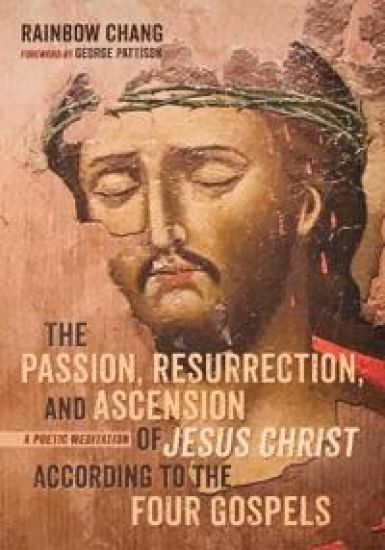
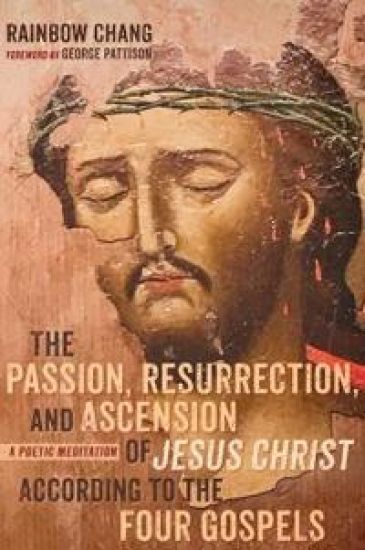
The Passion, Resurrection, and Ascension of Jesus Christ According to the Four Gospels
The haiku poems of this book tell the narrative of the Last Supper, passion, death, resurrection, ascension, and Great Commission of the Gospels, evoking the essence of these momentous events. The distilled style of emotions embedded in the poems may awaken the reader to transcend time and space and experience these events through eyes they have never known. How can we even begin to understand the doctrines of Christianity derived from the Last Supper, passion, death, resurrection, ascension, and Great Commission of the Gospels without singing, and singing fully, with the knowing and unknowing that resides within our hearts, minds, and souls? You will hear the songs of Jesus, Judas, Mary, Thomas, the archangels, Satan, and a seeker of the divine mystery. It is hoped that you will join this choir of past, present, and future, and sing as you have never been.
A Rhetorics of the Word

A Rhetorics of the Word

George Pattison

Oxford University Press
2019
sidottu
A Rhetorics of the Word is the second volume of a three-part philosophy of Christian life. It approaches Christian life as expressive of a divine calling or vocation. The word Church (ekklesia) and the role of naming in baptism indicate the fundamental place of calling in Christian life. However, ideas of vocation are difficult to access in a world shaped by the experience of disenchantment. The difficulties of articulating vocation are explored with reference to Weber, Heidegger, and Kierkegaard. These are further connected to a general crisis of language, manifesting in the degradation of political discourse (Arendt) and the impact of new communications technology on human discourse. This impact can be seen as reinforcing an occlusion of language in favour of rationality already evidenced in the philosophical tradition and technocratic management. New possibilities for thinking vocation are pursued through the biblical prophets (with emphasis on Buber's and Rosenzweig's reinterpretation of the call of Moses), Saint John, and Russian philosophies of language (Florensky to Bakhtin). Vocation emerges as bound up with the possibility of being name-bearers, enabling a mutuality of call and response. This is then evidenced further in ethics and poetics, where Levinas and Hermann Broch (The Death of Virgil) become major points of reference. In conclusion, the themes of calling and the name are seen to shape the possibility of love-the subject of the final part of the philosophy of Christian life: A Metaphysics of Love.
A Phenomenology of the Devout Life

A Phenomenology of the Devout Life

George Pattison

Oxford University Press
2018
sidottu
A Phenomenology of the Devout Life is the first part of a three-part work, A Philosophy of Christian Life. Rather than approaching Christianity through its doctrinal statements, as philosophers of religion have often done, the book starts by offering a phenomenological description of the devout life as that is set out in the teaching of Francois de Sales and related authors. This is because for most Christians practice and life-commitments are more fundamental than formal doctrinal beliefs. Although George Pattison will address the metaphysical truth-claims of Christianity in Part three, the guiding argument is that it is the Christian way of life that best reveals what these beliefs really are. As the work is a philosophical study, it does not presuppose the truth of Christianity but assumes only that there is a humanly accessible meaning to the intention to live a devout life, pleasing to God. This can be said to find expression in a certain view of selfhood that emphasizes the dimensions of feeling and will rather than intellect and that culminates in the experience of the annihilation of self. This is a model of selfhood deeply opposed to contemporary models that privilege autonomous agency and the devout life is therefore presented as offering a corrective to extreme versions of the contemporary view.
Kierkegaard and the Theology of the Nineteenth Century

Kierkegaard and the Theology of the Nineteenth Century

George Pattison

Cambridge University Press
2015
pokkari
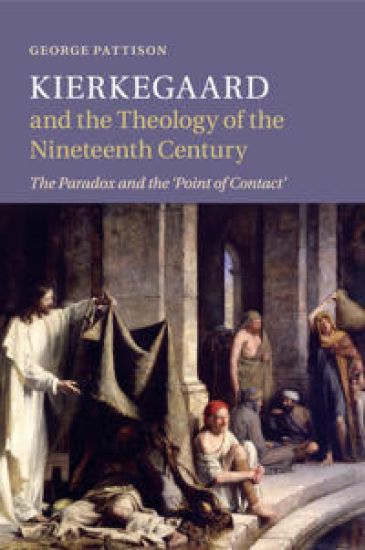
This study shows how Kierkegaard's mature theological writings reflect his engagement with the wide range of theological positions which he encountered as a student, including German and Danish Romanticism, Hegelianism and the writings of Fichte and Schleiermacher. George Pattison draws on both major and lesser-known works to show the complexity and nuances of Kierkegaard's theological position, which remained closer to Schleiermacher's affirmation of religion as a 'feeling of absolute dependence' than to the Barthian denial of any 'point of contact', with which he is often associated. Pattison also explores ways in which Kierkegaard's theological thought can be related to thinkers such as Heidegger and John Henry Newman, and its continuing relevance to present-day debates about secular faith. His volume will be of great interest to scholars and students of philosophy and theology.
Eternal God / Saving Time

Eternal God / Saving Time

George Pattison

Oxford University Press
2015
sidottu
Starting from the assumption that 'time is the horizon of the meaning of Being' (Heidegger), Eternal God/ Saving Time attempts to discover what the central religious idea of eternity or of God as 'the Eternal' might mean today. Negotiating ideas of divine timelessness and sempiternity (everlastingness) as well as the attempts of some philosophers to develop the idea of a temporal God, Professor George Pattison surveys a range of positions from analytic philosophy and from the continental tradition from Spinoza through Hegel to the present. Intellectual and cultural forces have tended to separate time and eternity, and both philosophical and theological examples of this tendency are examined. Nevertheless, starting from the experience of life in time, some modern thinkers have developed a new approach to the Eternal as what grounds or gives time. This leads through ideas of novelty, utopia, hope, promise, and call to the projection of a creative and transformative memory-remembering the future-that affirms human solidarity and mutual responsibility. Even if this cannot be made good in terms of knowledge, it offers a basis for hope, prayer, and commitment and these options are explored through a range of Christian, Jewish, Greek, and secular thinkers. This development re-envisages the idea of redemption, away from the Augustinian view that time is what we need to be rescued from and towards the idea that time itself might save us from all that is destructive and tyrannical in time's rule over human life.