

Kirjailija
George Watt
Kirjat ja teokset yhdessä paikassa: 50 kirjaa, julkaisuja vuosilta 1984–2025, suosituimpiin kuuluu The Lean Entrepreneurship Playbook. Vertaile teosten hintoja ja tarkista saatavuus suomalaisista kirjakaupoista.
50 kirjaa
Kirjojen julkaisuvuodet: 1984–2025.


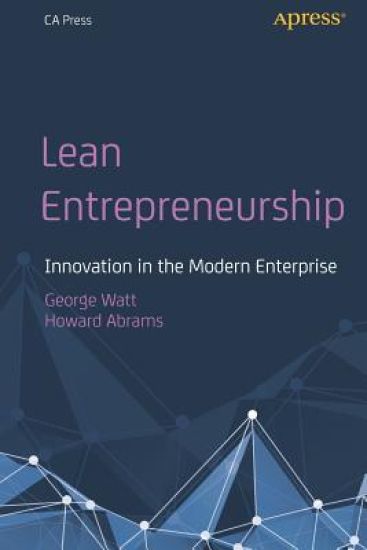
Utilize this comprehensive guide in your organization to create a corporate incubator that protects innovative ideas from oppressive corporate processes and culture and gives those ideas the resources and environment they need to grow and have the best possible chance to thrive. Innovation is hard. Ironically, innovation in a large enterprise can be even more difficult. Policies designed for mature businesses often crush emerging businesses along with the entrepreneurial spirit of the innovators. Procedures can make it difficult, even impossible, for innovative employees to get their ideas funded, or even seen. As a result, even companies with their roots in innovation can find themselves unable to innovate, with a devastating impact on employee morale and often resulting in the exodus of the most creative employees. In Lean Intrapreneurship the authors leverage decades of personal experience innovating in large enterprises to explore the root causes of failure to innovate in established organizations, and offer a solution to the innovator’s dilemma. The book includes a recipe for creating a repeatable program for innovating in large organizations, including tools, tips, and strategies developed by the authors as they created an innovative incubation program for a multi-billion-dollar technology company. It also offers a wealth of information to help aspiring intrapreneurs and entrepreneurs bring their ideas to life. What You’ll LearnDiscover the most common reasons that innovation fails in established organizationsExplore techniques to make innovative ideas a successFollow a recipe to create a program to enable innovation across your companyUnderstand the power of transparency inside and outside an incubatorDevelop employees and foster a culture of innovation across your company Who This Book Is For Anyone with an innovative idea who wants to make it real but does not know where to begin; anyone struggling to innovate inside an established company; anyone who wishes to make their existing company more lean, agile, and efficient; anyone who wishes to start a program to incubate new, innovative ideas inside an established company

Economic Products of India Exhibited in the Economic Court, Calcutta International Exhibition, L883-84
George Watt
Palala Press
2018
pokkari
This work has been selected by scholars as being culturally important, and is part of the knowledge base of civilization as we know it. This work was reproduced from the original artifact, and remains as true to the original work as possible. Therefore, you will see the original copyright references, library stamps (as most of these works have been housed in our most important libraries around the world), and other notations in the work. This work is in the public domain in the United States of America, and possibly other nations. Within the United States, you may freely copy and distribute this work, as no entity (individual or corporate) has a copyright on the body of the work. As a reproduction of a historical artifact, this work may contain missing or blurred pages, poor pictures, errant marks, etc. Scholars believe, and we concur, that this work is important enough to be preserved, reproduced, and made generally available to the public. We appreciate your support of the preservation process, and thank you for being an important part of keeping this knowledge alive and relevant.

A sympathetic view of the fallen women in Victorian England begins in the novel. First published in 1984, this book shows that the fallen woman in the nineteenth-century novel is, amongst other things, a direct response to the new society. Through the examination of Dickens, Gaskell, Collins, Moore, Trollope, Gissing and Hardy, it demonstrates that the fallen woman is the first in a long line of sympathetic creations which clash with many prevailing social attitudes, and especially with the supposedly accepted dichotomy of the ‘two women’. This book will be of interest to students of nineteenth-century literature and women in literature.
Dictionary of the economic products of India is an unchanged, high-quality reprint of the original edition of 1893. Hansebooks is editor of the literature on different topic areas such as research and science, travel and expeditions, cooking and nutrition, medicine, and other genres. As a publisher we focus on the preservation of historical literature. Many works of historical writers and scientists are available today as antiques only. Hansebooks newly publishes these books and contributes to the preservation of literature which has become rare and historical knowledge for the future.
A dictionary of the economic products of India - Volume IV., Gossypium to Linoceria is an unchanged, high-quality reprint of the original edition of 1890. Hansebooks is editor of the literature on different topic areas such as research and science, travel and expeditions, cooking and nutrition, medicine, and other genres. As a publisher we focus on the preservation of historical literature. Many works of historical writers and scientists are available today as antiques only. Hansebooks newly publishes these books and contributes to the preservation of literature which has become rare and historical knowledge for the future.

A sympathetic view of the fallen women in Victorian England begins in the novel. First published in 1984, this book shows that the fallen woman in the nineteenth-century novel is, amongst other things, a direct response to the new society. Through the examination of Dickens, Gaskell, Collins, Moore, Trollope, Gissing and Hardy, it demonstrates that the fallen woman is the first in a long line of sympathetic creations which clash with many prevailing social attitudes, and especially with the supposedly accepted dichotomy of the ‘two women’. This book will be of interest to students of nineteenth-century literature and women in literature.
Economic Products of India Exhibited in the Economic Court, Calcutta International Exhibition 1883 - 84
George Watt
Hansebooks
2016
pokkari
A Dictionary Of The Economic Products Of India; Volume 5
George Watt; Edgar Thurston
Sagwan Press
2015
sidottu
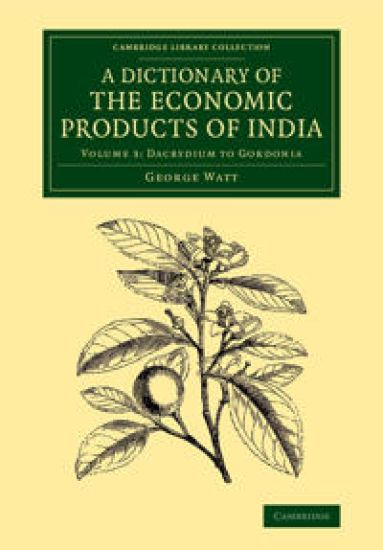
A Dictionary of the Economic Products of India: Volume 3, Dacrydium to Gordonia
George Watt
Cambridge University Press
2014
pokkari
A Scottish doctor and botanist, George Watt (1851–1930) had studied the flora of India for more than a decade before he took on the task of compiling this monumental work. Assisted by numerous contributors, he set about organising vast amounts of information on India's commercial plants and produce, including scientific and vernacular names, properties, domestic and medical uses, trade statistics, and published sources. Watt hoped that the dictionary, 'though not a strictly scientific publication', would be found 'sufficiently accurate in its scientific details for all practical and commercial purposes'. First published in six volumes between 1889 and 1893, with an index volume completed in 1896, the whole work is now reissued in nine separate parts. Volume 3 (1890) contains entries from Dacrydium (a genus of coniferous trees) to Gordonia obtusa (a species of evergreen tree).
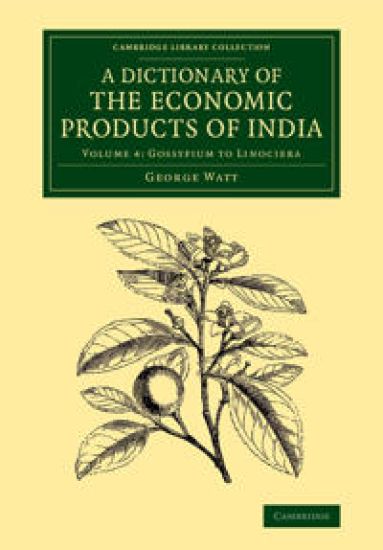
A Dictionary of the Economic Products of India: Volume 4, Gossypium to Linociera
George Watt
Cambridge University Press
2014
pokkari
A Scottish doctor and botanist, George Watt (1851–1930) had studied the flora of India for more than a decade before he took on the task of compiling this monumental work. Assisted by numerous contributors, he set about organising vast amounts of information on India's commercial plants and produce, including scientific and vernacular names, properties, domestic and medical uses, trade statistics, and published sources. Watt hoped that the dictionary, 'though not a strictly scientific publication', would be found 'sufficiently accurate in its scientific details for all practical and commercial purposes'. First published in six volumes between 1889 and 1893, with an index volume completed in 1896, the whole work is now reissued in nine separate parts. Volume 4 (1890) contains entries from Gossypium (the cotton genus) to Linociera intermedia (a species of small tree, used for timber).
A Dictionary of the Economic Products of India: Volume 6, Silk to Tea, Part 3
George Watt
Cambridge University Press
2014
pokkari
A Scottish doctor and botanist, George Watt (1851–1930) had studied the flora of India for more than a decade before he took on the task of compiling this monumental work. Assisted by numerous contributors, he set about organising vast amounts of information on India's commercial plants and produce, including scientific and vernacular names, properties, domestic and medical uses, trade statistics, and published sources. Watt hoped that the dictionary, 'though not a strictly scientific publication', would be found 'sufficiently accurate in its scientific details for all practical and commercial purposes'. First published in six volumes between 1889 and 1893, with an index volume completed in 1896, the whole work is now reissued in nine separate parts. Volume 6, Part 3 (1893) contains entries from silk to tea, two of India's most important economic products.
A Dictionary of the Economic Products of India: Volume 6, Tectona to Zygophillum and Index, Part 4
George Watt
Cambridge University Press
2014
pokkari
A Scottish doctor and botanist, George Watt (1851–1930) had studied the flora of India for more than a decade before he took on the task of compiling this monumental work. Assisted by numerous contributors, he set about organising vast amounts of information on India's commercial plants and produce, including scientific and vernacular names, properties, domestic and medical uses, trade statistics, and published sources. Watt hoped that the dictionary, 'though not a strictly scientific publication', would be found 'sufficiently accurate in its scientific details for all practical and commercial purposes'. First published in six volumes between 1889 and 1893, with an index volume completed in 1896, the whole work is now reissued in nine separate parts. Volume 6, Part 4 (1893) contains entries from Tectona grandis (the common teak tree) to Zygophillum simplex (a flowering plant found in Sindh and the Punjab). The index to the entire work is included as an appendix.