Kirjojen hintavertailu – 12 903 729 kirjaa ja 27 kauppaa

Kirjailija

Gilbert Rozman

Kirjat ja teokset yhdessä paikassa: 24 kirjaa, julkaisuja vuosilta 2004–2025, suosituimpiin kuuluu Xi Jinping’s Quest for a Sinocentric Asia, 2013–2024. Vertaile teosten hintoja ja tarkista saatavuus suomalaisista kirjakaupoista.

24 kirjaa

Kirjojen julkaisuvuodet: 2004–2025.

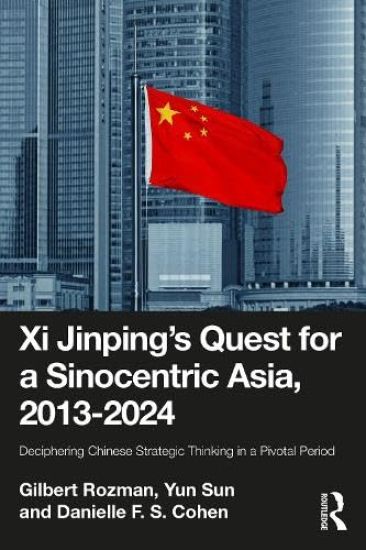
Xi Jinping’s Quest for a Sinocentric Asia, 2013–2024

Xi Jinping’s Quest for a Sinocentric Asia, 2013–2024

Gilbert Rozman; Yun Sun; Danielle F. S. Cohen

TAYLOR FRANCIS LTD
2025
nidottu
Recognizing Sinocentrism as the core motivation behind Xi Jinping’s vision for the reconstruction of Asia, Rozman, Sun, and Cohen present a comprehensive and updated analysis of Chinese foreign policy toward Asia, uncovering the deep-seated calculations behind Xi’s policies across four arenas of distinct interest in the last decade. The book employs strategic thinking and Chinese language resources to examine multiple areas of China’s foreign policy, gaining insight into policy development and its wider consequences for Asia. It critically examines numerous facets of China’s foreign policy, including Chinese perceptions of the US role in the Indo-Pacific; strategic thinking toward Northeast Asia; policies toward India, Southeast Asia and Australia; and the approach to Central Asia to comprehensively ascertain Xi’s strategies and motivations. By examining the reticence of Chinese spokespeople and publications to identify the objectives of China’s policies over a decade, the book interrogates the predominant motivation of Xi’s Sinocentrism in creating a dominant civilization insistent on subservience within its sphere. The authors provide a timely assessment of China’s grand strategy and Xi Jinping’s ambitious efforts to build a Sinocentric axis in Asia and a valuable resource for students, academics, policymakers, and researchers of Asian Studies, International Relations, Asian security, Xi Jinping thought, Sinocentrism, and Chinese foreign policy.
Xi Jinping’s Quest for a Sinocentric Asia, 2013–2024

Xi Jinping’s Quest for a Sinocentric Asia, 2013–2024

Gilbert Rozman; Yun Sun; Danielle F. S. Cohen

TAYLOR FRANCIS LTD
2025
sidottu
Recognizing Sinocentrism as the core motivation behind Xi Jinping’s vision for the reconstruction of Asia, Rozman, Sun, and Cohen present a comprehensive and updated analysis of Chinese foreign policy toward Asia, uncovering the deep-seated calculations behind Xi’s policies across four arenas of distinct interest in the last decade. The book employs strategic thinking and Chinese language resources to examine multiple areas of China’s foreign policy, gaining insight into policy development and its wider consequences for Asia. It critically examines numerous facets of China’s foreign policy, including Chinese perceptions of the US role in the Indo-Pacific; strategic thinking toward Northeast Asia; policies toward India, Southeast Asia and Australia; and the approach to Central Asia to comprehensively ascertain Xi’s strategies and motivations. By examining the reticence of Chinese spokespeople and publications to identify the objectives of China’s policies over a decade, the book interrogates the predominant motivation of Xi’s Sinocentrism in creating a dominant civilization insistent on subservience within its sphere. The authors provide a timely assessment of China’s grand strategy and Xi Jinping’s ambitious efforts to build a Sinocentric axis in Asia and a valuable resource for students, academics, policymakers, and researchers of Asian Studies, International Relations, Asian security, Xi Jinping thought, Sinocentrism, and Chinese foreign policy.
South Korea’s Wild Ride

South Korea’s Wild Ride

Gilbert Rozman; Sue Mi Terry; Eun A Jo

TAYLOR FRANCIS LTD
2023
sidottu
Rozman, Terry, and Jo analyze the geopolitical shifts in South Korea’s policies toward its neighbors and allies over the course of the Park Geun-hye and Moon Jae-in administrations into the early years of the Yoon Suk-yeol administration.2013 to 2022 was a tumultuous decade in South Korean politics and especially in its foreign policy. Through two changes of its own presidency, as well as the rise and fall of the Trump administration in the United States, South Korea’s politicians and diplomats have pursued different attempts at bridge-building with North Korea, before arriving at a more cautious and defensive position. The authors track the different attempts by Park and Moon to pursue increasingly optimistic attempts at reconciliation, and how they were thwarted by excessive idealism, domestic divisions, and broader great power rivalries—notably including Russia, China, and Japan. An essential guide to understanding the trajectory of South Korean foreign policy, for students of Korean politics as well as scholars and policy practitioners.
South Korea’s Wild Ride

South Korea’s Wild Ride

Gilbert Rozman; Sue Mi Terry; Eun A Jo

TAYLOR FRANCIS LTD
2023
nidottu
Rozman, Terry, and Jo analyze the geopolitical shifts in South Korea’s policies toward its neighbors and allies over the course of the Park Geun-hye and Moon Jae-in administrations into the early years of the Yoon Suk-yeol administration.2013 to 2022 was a tumultuous decade in South Korean politics and especially in its foreign policy. Through two changes of its own presidency, as well as the rise and fall of the Trump administration in the United States, South Korea’s politicians and diplomats have pursued different attempts at bridge-building with North Korea, before arriving at a more cautious and defensive position. The authors track the different attempts by Park and Moon to pursue increasingly optimistic attempts at reconciliation, and how they were thwarted by excessive idealism, domestic divisions, and broader great power rivalries—notably including Russia, China, and Japan. An essential guide to understanding the trajectory of South Korean foreign policy, for students of Korean politics as well as scholars and policy practitioners.
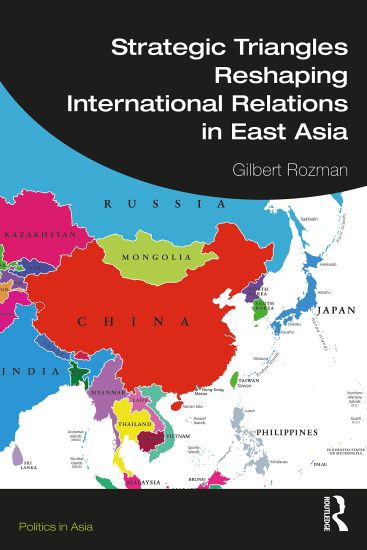
Strategic Triangles Reshaping International Relations in East Asia
Rozman shows how East Asia’s international relations over three decades can be best understood through the lens of triangles, analyzing relations between the key nations through a series of trilateral relationships. He argues that triangles present a convincing answer to the question of whether we had entered a new era of bipolarity like the Cold War or an age of multipolarity. Triangulation emerged as a dynamic in East Asia in the aftermath of the Cold War and was accelerated in the course of the Xi and Trump administrations. Even as Sino-US competition and confrontation deepened, triangles had a substantial presence. East Asian triangles share an unusual mixture of three distinct elements: deep-seated security distrust, extraordinary economic interdependence, and a combustible composition of historical resentments and civilizational confidence. The combination of the three makes the case for triangularity more compelling, Rozman argues. The legacy of communism, the pursuit of reunification on the Korean Peninsula, and moves to expand beyond the US-Japan alliance have all driven the way triangles have evolved. Only as bipolarity intensified in the 2020s was triangularity losing ground. The degree of turnabout is analyzed for all of the cases considered. Rozman evaluates each key triangle of states in turn and assesses how the relationship impacts the region more widely. This book provides an essential framework for understanding the current state and trajectory of East Asian international relations, for students and policymakers. The Open Access version of this book, available at www.taylorfrancis.com, has been made available under a Creative Commons Attribution-Non Commercial-No Derivatives 4.0 license.
Strategic Triangles Reshaping International Relations in East Asia
Rozman shows how East Asia’s international relations over three decades can be best understood through the lens of triangles, analyzing relations between the key nations through a series of trilateral relationships. He argues that triangles present a convincing answer to the question of whether we had entered a new era of bipolarity like the Cold War or an age of multipolarity. Triangulation emerged as a dynamic in East Asia in the aftermath of the Cold War and was accelerated in the course of the Xi and Trump administrations. Even as Sino-US competition and confrontation deepened, triangles had a substantial presence. East Asian triangles share an unusual mixture of three distinct elements: deep-seated security distrust, extraordinary economic interdependence, and a combustible composition of historical resentments and civilizational confidence. The combination of the three makes the case for triangularity more compelling, Rozman argues. The legacy of communism, the pursuit of reunification on the Korean Peninsula, and moves to expand beyond the US-Japan alliance have all driven the way triangles have evolved. Only as bipolarity intensified in the 2020s was triangularity losing ground. The degree of turnabout is analyzed for all of the cases considered. Rozman evaluates each key triangle of states in turn and assesses how the relationship impacts the region more widely. This book provides an essential framework for understanding the current state and trajectory of East Asian international relations, for students and policymakers. The Open Access version of this book, available at www.taylorfrancis.com, has been made available under a Creative Commons Attribution-Non Commercial-No Derivatives 4.0 license.
Urban Networks in Russia, 1750-1800, and Pre-modern Periodization
This book takes an entirely new approach to the evolution of cities and of societies in premodern periods. Refining the theory advanced in his earlier study of China and Japan, Gilbert Rozman examines the development of Russia over several centuries with emphasis on the period immediately preceding the Industrial Revolution. He makes possible comparison of urbanization in five countries (including England and France as well as Russia) and develops a systematic framework for analyzing cities of varying size. Originally published in 1976. The Princeton Legacy Library uses the latest print-on-demand technology to again make available previously out-of-print books from the distinguished backlist of Princeton University Press. These editions preserve the original texts of these important books while presenting them in durable paperback and hardcover editions. The goal of the Princeton Legacy Library is to vastly increase access to the rich scholarly heritage found in the thousands of books published by Princeton University Press since its founding in 1905.
The Chinese Debate about Soviet Socialism, 1978-1985

The Chinese Debate about Soviet Socialism, 1978-1985

Gilbert Rozman

Princeton University Press
2016
sidottu
This study, based largely on Chinese journals rarely available to Western scholars, explores the abrupt turnabout of Chinese views of the Soviet Union from condemnations of revisionism" to appreciation for problems common to both countries. Originally published in 1987. The Princeton Legacy Library uses the latest print-on-demand technology to again make available previously out-of-print books from the distinguished backlist of Princeton University Press. These editions preserve the original texts of these important books while presenting them in durable paperback and hardcover editions. The goal of the Princeton Legacy Library is to vastly increase access to the rich scholarly heritage found in the thousands of books published by Princeton University Press since its founding in 1905.
Japan's Response to the Gorbachev Era, 1985-1991

Japan's Response to the Gorbachev Era, 1985-1991

Gilbert Rozman

Princeton University Press
2016
sidottu
Gorbachev's transformation of both Soviet socialism and the Cold War world atmosphere kindled a far-reaching debate in Japan. Would Japan at last free itself of its secondary postwar standing? Would a new Soviet system and world order soon be established? Gilbert Rozman argues in Japan's Response to the Gorbachev Era, that Japanese perceptions of the Soviet Union are distinctive and are helpful for understanding what will become an influential worldview. Focusing on diverse opinion leaders and the relationship between the Japanese media, policy-making, and public opinion, Rozman shows how long-standing negative images of Soviet socialism and militarism have been reconsidered since the mid-1980s. His analysis treats burning issues such as the Northern Territories dispute, the Soviet commitment to reform, and the Soviet-American relationship. It also sheds light on Japanese views of Soviet history, modernization, and national character. Such views reveal some of the building blocks for the emergent Japanese worldview. Originally published in 1992. The Princeton Legacy Library uses the latest print-on-demand technology to again make available previously out-of-print books from the distinguished backlist of Princeton University Press. These editions preserve the original texts of these important books while presenting them in durable paperback and hardcover editions. The goal of the Princeton Legacy Library is to vastly increase access to the rich scholarly heritage found in the thousands of books published by Princeton University Press since its founding in 1905.
Urban Networks in Ch'ing China and Tokugawa Japan

Urban Networks in Ch'ing China and Tokugawa Japan

Gilbert Rozman

Princeton University Press
2016
sidottu
Ch'ing China and Tokugawa Japan were unusually urbanized premodern societies where about one half of the world's urban population lived as late as 1800. Gilbert Rozman has drawn on both sociology and history to develop original methods of illuminating the historical urbanization of China and Japan and to provide a way of relating urban patterns to other characteristics of social structure in premodern societies. The author also hopes to redirect the analysis of premodern societies into areas where China and Japan can be compared with each other and with other large scale societies. The author divides central places into seven levels and determines how many levels were present in each country century by century. Through this method he is able to demonstrate how Japan was rapidly narrowing China's lead in urbanization and show that Japan was relatively efficient in concentrating resources in high level cities. Explanations for differences in urban concentration are sought in: a general discussion of the social structure of each country; an analysis of marketing patterns; a detailed study of Chihli province and the Kant? region; an examination of regional variations; and a comparison of Peking and Edo, which were probably the world's largest cities throughout the eighteenth century. Originally published in 1974. The Princeton Legacy Library uses the latest print-on-demand technology to again make available previously out-of-print books from the distinguished backlist of Princeton University Press. These editions preserve the original texts of these important books while presenting them in durable paperback and hardcover editions. The goal of the Princeton Legacy Library is to vastly increase access to the rich scholarly heritage found in the thousands of books published by Princeton University Press since its founding in 1905.
A Mirror for Socialism

A Mirror for Socialism

Gilbert Rozman

Princeton University Press
2016
sidottu
Gilbert Rozman examines the Soviet debate on Chinese socialism, revealing striking similarities between what Soviet scholars write about China and what they criticize as anticommunist" in Western writing on the Soviet Union. Originally published in 1985. The Princeton Legacy Library uses the latest print-on-demand technology to again make available previously out-of-print books from the distinguished backlist of Princeton University Press. These editions preserve the original texts of these important books while presenting them in durable paperback and hardcover editions. The goal of the Princeton Legacy Library is to vastly increase access to the rich scholarly heritage found in the thousands of books published by Princeton University Press since its founding in 1905.
Urban Networks in Ch'ing China and Tokugawa Japan

Urban Networks in Ch'ing China and Tokugawa Japan

Gilbert Rozman

Princeton University Press
2015
pokkari
Ch'ing China and Tokugawa Japan were unusually urbanized premodern societies where about one half of the world's urban population lived as late as 1800. Gilbert Rozman has drawn on both sociology and history to develop original methods of illuminating the historical urbanization of China and Japan and to provide a way of relating urban patterns to other characteristics of social structure in premodern societies. The author also hopes to redirect the analysis of premodern societies into areas where China and Japan can be compared with each other and with other large scale societies. The author divides central places into seven levels and determines how many levels were present in each country century by century. Through this method he is able to demonstrate how Japan was rapidly narrowing China's lead in urbanization and show that Japan was relatively efficient in concentrating resources in high level cities. Explanations for differences in urban concentration are sought in: a general discussion of the social structure of each country; an analysis of marketing patterns; a detailed study of Chihli province and the Kant? region; an examination of regional variations; and a comparison of Peking and Edo, which were probably the world's largest cities throughout the eighteenth century. Originally published in 1974. The Princeton Legacy Library uses the latest print-on-demand technology to again make available previously out-of-print books from the distinguished backlist of Princeton University Press. These editions preserve the original texts of these important books while presenting them in durable paperback and hardcover editions. The goal of the Princeton Legacy Library is to vastly increase access to the rich scholarly heritage found in the thousands of books published by Princeton University Press since its founding in 1905.
Urban Networks in Russia, 1750-1800, and Pre-modern Periodization
This book takes an entirely new approach to the evolution of cities and of societies in premodern periods. Refining the theory advanced in his earlier study of China and Japan, Gilbert Rozman examines the development of Russia over several centuries with emphasis on the period immediately preceding the Industrial Revolution. He makes possible comparison of urbanization in five countries (including England and France as well as Russia) and develops a systematic framework for analyzing cities of varying size. Originally published in 1976. The Princeton Legacy Library uses the latest print-on-demand technology to again make available previously out-of-print books from the distinguished backlist of Princeton University Press. These editions preserve the original texts of these important books while presenting them in durable paperback and hardcover editions. The goal of the Princeton Legacy Library is to vastly increase access to the rich scholarly heritage found in the thousands of books published by Princeton University Press since its founding in 1905.
Japan's Response to the Gorbachev Era, 1985-1991

Japan's Response to the Gorbachev Era, 1985-1991

Gilbert Rozman

Princeton University Press
2014
pokkari
Gorbachev's transformation of both Soviet socialism and the Cold War world atmosphere kindled a far-reaching debate in Japan. Would Japan at last free itself of its secondary postwar standing? Would a new Soviet system and world order soon be established? Gilbert Rozman argues in Japan's Response to the Gorbachev Era, that Japanese perceptions of the Soviet Union are distinctive and are helpful for understanding what will become an influential worldview. Focusing on diverse opinion leaders and the relationship between the Japanese media, policy-making, and public opinion, Rozman shows how long-standing negative images of Soviet socialism and militarism have been reconsidered since the mid-1980s. His analysis treats burning issues such as the Northern Territories dispute, the Soviet commitment to reform, and the Soviet-American relationship. It also sheds light on Japanese views of Soviet history, modernization, and national character. Such views reveal some of the building blocks for the emergent Japanese worldview. Originally published in 1992. The Princeton Legacy Library uses the latest print-on-demand technology to again make available previously out-of-print books from the distinguished backlist of Princeton University Press. These editions preserve the original texts of these important books while presenting them in durable paperback and hardcover editions. The goal of the Princeton Legacy Library is to vastly increase access to the rich scholarly heritage found in the thousands of books published by Princeton University Press since its founding in 1905.
The Chinese Debate about Soviet Socialism, 1978-1985

The Chinese Debate about Soviet Socialism, 1978-1985

Gilbert Rozman

Princeton University Press
2014
pokkari
This study, based largely on Chinese journals rarely available to Western scholars, explores the abrupt turnabout of Chinese views of the Soviet Union from condemnations of revisionism" to appreciation for problems common to both countries. Originally published in 1987. The Princeton Legacy Library uses the latest print-on-demand technology to again make available previously out-of-print books from the distinguished backlist of Princeton University Press. These editions preserve the original texts of these important books while presenting them in durable paperback and hardcover editions. The goal of the Princeton Legacy Library is to vastly increase access to the rich scholarly heritage found in the thousands of books published by Princeton University Press since its founding in 1905.
A Mirror for Socialism

A Mirror for Socialism

Gilbert Rozman

Princeton University Press
2014
pokkari
Gilbert Rozman examines the Soviet debate on Chinese socialism, revealing striking similarities between what Soviet scholars write about China and what they criticize as anticommunist" in Western writing on the Soviet Union. Originally published in 1985. The Princeton Legacy Library uses the latest print-on-demand technology to again make available previously out-of-print books from the distinguished backlist of Princeton University Press. These editions preserve the original texts of these important books while presenting them in durable paperback and hardcover editions. The goal of the Princeton Legacy Library is to vastly increase access to the rich scholarly heritage found in the thousands of books published by Princeton University Press since its founding in 1905.
East Asian Security: Two Views - the Security Challenges in Northeast Asia: A Chinese View - Security Challenges to the United States in Northeast Asia: Looking Beyond the Transformation of the Six-Party Talks
Northeast Asia is the most dynamic sector of the global economy, and the most dynamic element is undoubtedly the rise of China. However, in this region conflicts dating back to the Cold War have not yet found resolution. The imbalance between economic progress and political stagnation ensures that international affairs pose many challenges to governments and to students alike. The two papers herein, originally presented at the Strategic Studies Institute's 2007 annual Strategy Conference, highlight the challenges posed by the rise of China and by the new possibility for making progress on Korean issues due to the Six- Party Agreements on North Korean proliferation of February 13, 2007. In keeping with the conference's theme, "Regional Challenges to American Security," Dr. Chu Shulong, the first paper's author, presents a view of China's interests, goals, and perspectives on Northeast Asian issues.
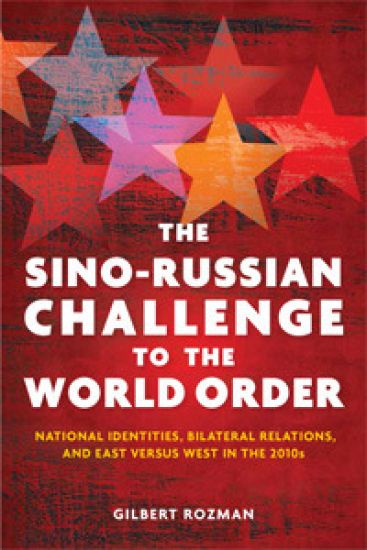
The Sino-Russian Challenge to the World Order

The Sino-Russian Challenge to the World Order

Gilbert Rozman

STANFORD UNIVERSITY PRESS
2014
sidottu
The Sino-Russian Challenge to the World Order is the third volume in Gilbert Rozman's trilogy on national identity. The first two volumes, edited by Gilbert Rozman, concerned the identities of three East Asian countries: China, Japan, and South Korea. These books analyzed how these countries' national identities suffered through their relation to modernization, and examined how the national identity of each differed from the other two and how those differences were shaped by the relation of each country to the United States. In this third volume, Rozman examines Russia together with China. The Sino-Russian Challenge to the World Order argues that China and Russia's national identities are much closer to each other than usually thought, and are growing even closer. Moreover, the closeness of their identities comes neither from their prerevolutionary pasts nor from today's practical politics, but rather from habits carried over from their communist periods, even though the ideological dimensions of their identities have weakened since 1990.
Population and Marketing Settlements in Ch'ing China

Population and Marketing Settlements in Ch'ing China

Gilbert Rozman

Cambridge University Press
2009
pokkari
The historical records of Ch'ing China (1644–1911) contain numerous statistics concerning the population in local areas and the distribution of markets. These figures provide information on two of the most important and least understood factors that were to affect China's modern development: the massive population growth prior to 1850 and the tenacity of small-scale markets as the focus of commercialisation. This book presents and evaluates the data from northern China to ascertain the quality of available records and to determine what they can tell is about variations from area to area and from period to period. The analysis of population centres on sex rations, age distributions, mean household size and growth rates. Without overlooking limitations in the data, this study emphasises the implications of the findings for general problems in the social history of the Ch'ing period.