Kirjojen hintavertailu – 12 903 724 kirjaa ja 27 kauppaa

Kirjailija

Guerino Mazzola

Kirjat ja teokset yhdessä paikassa: 37 kirjaa, julkaisuja vuosilta 1987–2026, suosituimpiin kuuluu Basic Music Technology. Vertaile teosten hintoja ja tarkista saatavuus suomalaisista kirjakaupoista.

37 kirjaa

Kirjojen julkaisuvuodet: 1987–2026.

Basic Music Technology

Basic Music Technology

Guerino Mazzola; Yan Pang; William Heinze; Kyriaki Gkoudina; Gian Afrisando Pujakusuma; Jacob Grunklee; Zilu Chen; Tianxue Hu; Yiqing Ma

Springer Nature Switzerland AG
2018
sidottu
This is an introduction to basic music technology, including acoustics for sound production and analysis, Fourier, frequency modulation, wavelets, and physical modeling and a classification of musical instruments and sound spaces for tuning and counterpoint. The acoustical theory is applied to its implementation in analogue and digital technology, including a detailed discussion of Fast Fourier Transform and MP3 compression. Beyond acoustics, the book discusses important symbolic sound event representation and software as typically realized by MIDI and denotator formalisms. The concluding chapters deal with globalization of music on the Internet, referring to iTunes, Spotify and similar environments. The book will be valuable for students of music, music informatics, and sound engineering.
Classification of Musical Objects for Analysis and Composition

Classification of Musical Objects for Analysis and Composition

Linshujie Zheng; Guerino Mazzola

Springer International Publishing AG
2024
nidottu
This book presents and discusses the fundamental topic of classification of musical objects, such as chords, motifs, and gestures. Their classification deals with the exhibition of isomorphism classes. Our structure types include local and global constructions, the latter being similar to global structures in geometry, such as differentiable manifolds. The discussion extends to the role, which classification plays for the creative construction of musical compositions. Our examples include references to classical compositions, such as Beethoven’s sonatas, and some of the author’s own compositions of classical and jazz styles. We also discuss software that enables the application of classification to musical creativity. The volume is addressed to an audience that would apply classification to programming and creative musical construction.
Classification of Musical Objects for Analysis and Composition

Classification of Musical Objects for Analysis and Composition

Linshujie Zheng; Guerino Mazzola

Springer International Publishing AG
2023
sidottu
This book presents and discusses the fundamental topic of classification of musical objects, such as chords, motifs, and gestures. Their classification deals with the exhibition of isomorphism classes. Our structure types include local and global constructions, the latter being similar to global structures in geometry, such as differentiable manifolds. The discussion extends to the role, which classification plays for the creative construction of musical compositions. Our examples include references to classical compositions, such as Beethoven’s sonatas, and some of the author’s own compositions of classical and jazz styles. We also discuss software that enables the application of classification to musical creativity. The volume is addressed to an audience that would apply classification to programming and creative musical construction.
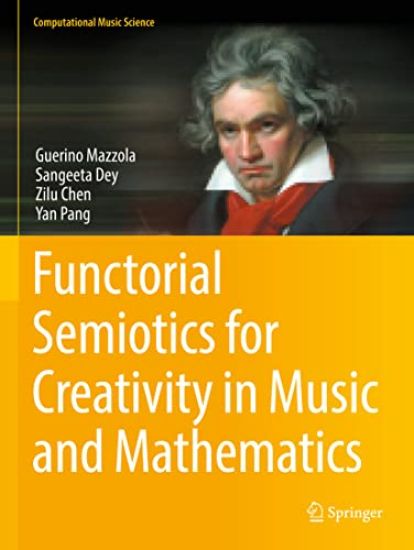
Functorial Semiotics for Creativity in Music and Mathematics

Functorial Semiotics for Creativity in Music and Mathematics

Guerino Mazzola; Sangeeta Dey; Zilu Chen; Yan Pang

Springer Nature Switzerland AG
2023
nidottu
This book presents a new semiotic theory based upon category theory and applying to a classification of creativity in music and mathematics. It is the first functorial approach to mathematical semiotics that can be applied to AI implementations for creativity by using topos theory and its applications to music theory. Of particular interest is the generalized Yoneda embedding in the bidual of the category of categories (Lawvere) - parametrizing semiotic units - enabling a Cech cohomology of manifolds of semiotic entities. It opens up a conceptual mathematics as initiated by Grothendieck and Galois and allows a precise description of musical and mathematical creativity, including a classification thereof in three types. This approach is new, as it connects topos theory, semiotics, creativity theory, and AI objectives for a missing link to HI (Human Intelligence). The reader can apply creativity research using our classification, cohomology theory, generalized Yoneda embedding, and Java implementation of the presented functorial display of semiotics, especially generalizing the Hjelmslev architecture. The intended audience are academic, industrial, and artistic researchers in creativity.
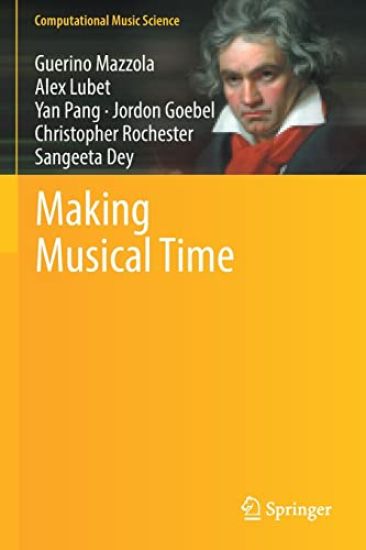
Making Musical Time

Making Musical Time

Guerino Mazzola; Alex Lubet; Yan Pang; Jordon Goebel; Christopher Rochester; Sangeeta Dey

Springer Nature Switzerland AG
2022
nidottu
This book is a comprehensive examination of the conception, perception, performance, and composition of time in music across time and culture. It surveys the literature of time in mathematics, philosophy, psychology, music theory, and somatic studies (medicine and disability studies) and looks ahead through original research in performance, composition, psychology, and education. It is the first monograph solely devoted to the theory of construction of musical time since Kramer in 1988, with new insights, mathematical precision, and an expansive global and historical context. The mathematical methods applied for the construction of musical time are totally new. They relate to category theory (projective limits) and the mathematical theory of gestures. These methods and results extend the music theory of time but also apply to the applied performative understanding of making music. In addition, it is the very first approach to a constructive theory of time, deduced from the recent theory of musical gestures and their categories. Making Musical Time is intended for a wide audience of scholars with interest in music. These include mathematicians, music theorists, (ethno)musicologists, music psychologists / educators / therapists, music performers, philosophers of music, audiologists, and acousticians.
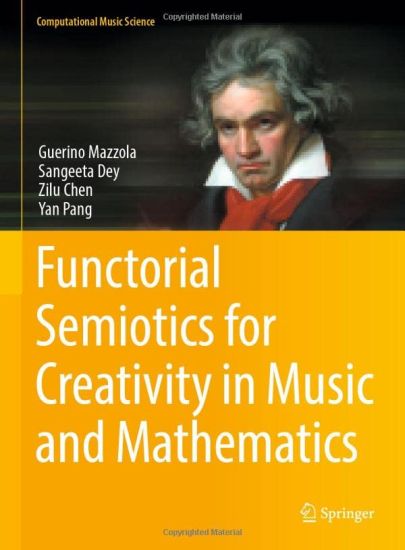
Functorial Semiotics for Creativity in Music and Mathematics

Functorial Semiotics for Creativity in Music and Mathematics

Guerino Mazzola; Sangeeta Dey; Zilu Chen; Yan Pang

Springer Nature Switzerland AG
2022
sidottu
This book presents a new semiotic theory based upon category theory and applying to a classification of creativity in music and mathematics. It is the first functorial approach to mathematical semiotics that can be applied to AI implementations for creativity by using topos theory and its applications to music theory. Of particular interest is the generalized Yoneda embedding in the bidual of the category of categories (Lawvere) - parametrizing semiotic units - enabling a Cech cohomology of manifolds of semiotic entities. It opens up a conceptual mathematics as initiated by Grothendieck and Galois and allows a precise description of musical and mathematical creativity, including a classification thereof in three types. This approach is new, as it connects topos theory, semiotics, creativity theory, and AI objectives for a missing link to HI (Human Intelligence). The reader can apply creativity research using our classification, cohomology theory, generalized Yoneda embedding, and Java implementation of the presented functorial display of semiotics, especially generalizing the Hjelmslev architecture. The intended audience are academic, industrial, and artistic researchers in creativity.
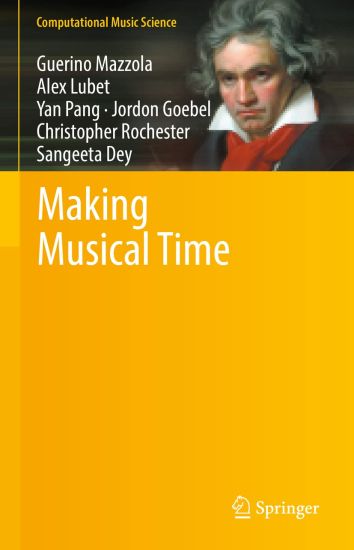
Making Musical Time

Making Musical Time

Guerino Mazzola; Alex Lubet; Yan Pang; Jordon Goebel; Christopher Rochester; Sangeeta Dey

Springer Nature Switzerland AG
2021
sidottu
This book is a comprehensive examination of the conception, perception, performance, and composition of time in music across time and culture. It surveys the literature of time in mathematics, philosophy, psychology, music theory, and somatic studies (medicine and disability studies) and looks ahead through original research in performance, composition, psychology, and education. It is the first monograph solely devoted to the theory of construction of musical time since Kramer in 1988, with new insights, mathematical precision, and an expansive global and historical context. The mathematical methods applied for the construction of musical time are totally new. They relate to category theory (projective limits) and the mathematical theory of gestures. These methods and results extend the music theory of time but also apply to the applied performative understanding of making music. In addition, it is the very first approach to a constructive theory of time, deduced from the recent theory of musical gestures and their categories. Making Musical Time is intended for a wide audience of scholars with interest in music. These include mathematicians, music theorists, (ethno)musicologists, music psychologists / educators / therapists, music performers, philosophers of music, audiologists, and acousticians.
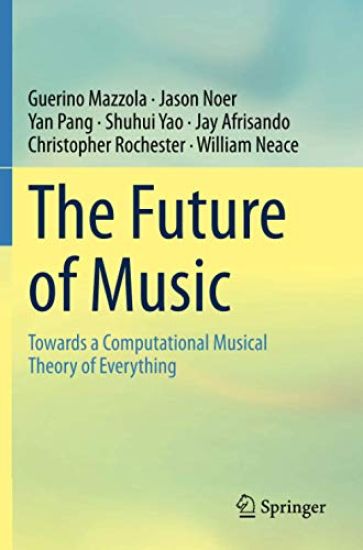
The Future of Music

The Future of Music

Guerino Mazzola; Jason Noer; Yan Pang; Shuhui Yao; Jay Afrisando; Christopher Rochester; William Neace

Springer Nature Switzerland AG
2021
nidottu
The idea of this monograph is to present an overview of decisive theoretical, computational, technological, aesthetical, artistic, economical, and sociological directions to create future music. It features a unique insight into dominant scientific and artistic new directions, which are guaranteed by the authors' prominent publications in books, software, musical, and dance productions. Applying recent research results from mathematical and computational music theory and software as well as new ideas of embodiment approaches and non-Western music cultures, this book presents new composition methods and technologies. Mathematical, computational, and semiotic models of artistic presence (imaginary time, gestural creativity) as well as strategies are also covered. This book will be of interest to composers, music technicians, and organizers in the internet-based music industry, who are offered concrete conceptual architectures and tools for their future strategies in musical creativity and production.
The Future of Music

The Future of Music

Guerino Mazzola; Jason Noer; Yan Pang; Shuhui Yao; Jay Afrisando; Christopher Rochester; William Neace

Springer Nature Switzerland AG
2020
sidottu
The idea of this monograph is to present an overview of decisive theoretical, computational, technological, aesthetical, artistic, economical, and sociological directions to create future music. It features a unique insight into dominant scientific and artistic new directions, which are guaranteed by the authors' prominent publications in books, software, musical, and dance productions. Applying recent research results from mathematical and computational music theory and software as well as new ideas of embodiment approaches and non-Western music cultures, this book presents new composition methods and technologies. Mathematical, computational, and semiotic models of artistic presence (imaginary time, gestural creativity) as well as strategies are also covered. This book will be of interest to composers, music technicians, and organizers in the internet-based music industry, who are offered concrete conceptual architectures and tools for their future strategies in musical creativity and production.
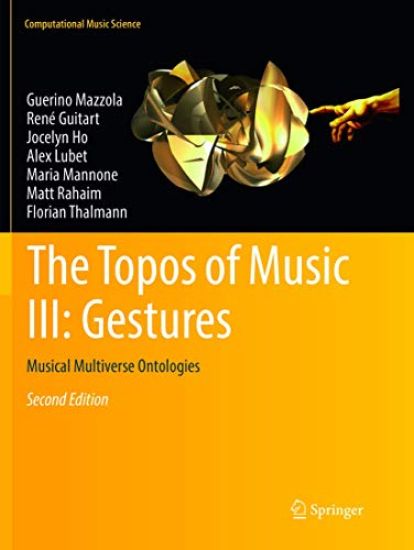
The Topos of Music III: Gestures

The Topos of Music III: Gestures

Guerino Mazzola; René Guitart; Jocelyn Ho; Alex Lubet; Maria Mannone; Matt Rahaim; Florian Thalmann

Springer Nature Switzerland AG
2018
nidottu
This is the third volume of the second edition of the now classic book “The Topos of Music”. The authors present gesture theory, including a gesture philosophy for music, the mathematics of gestures, concept architectures and software for musical gesture theory, the multiverse perspective which reveals the relationship between gesture theory and the string theory in theoretical physics, and applications of gesture theory to a number of musical themes, including counterpoint, modulation theory, free jazz, Hindustani music, and vocal gestures.
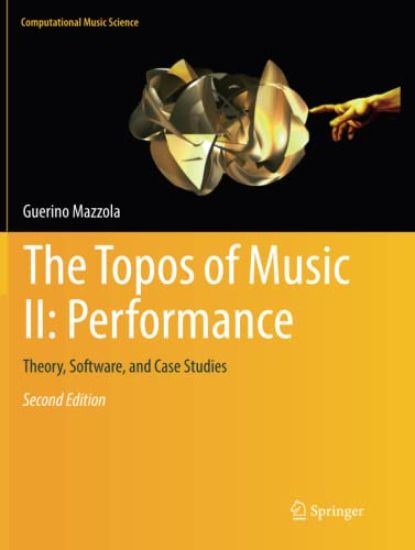
The Topos of Music II: Performance

The Topos of Music II: Performance

Guerino Mazzola

Springer Nature Switzerland AG
2018
nidottu
This is the second volume of the second edition of the now classic book “The Topos of Music”. The author explains his theory of musical performance, developed in the language of differential geometry, introducing performance vector fields that generalize tempo and intonation. The author also shows how Rubato, a software platform for composition, analysis, and performance, allows an experimental evaluation of principles of expressive performance theories.
The Topos of Music I: Theory

The Topos of Music I: Theory

Guerino Mazzola

Springer Nature Switzerland AG
2018
nidottu
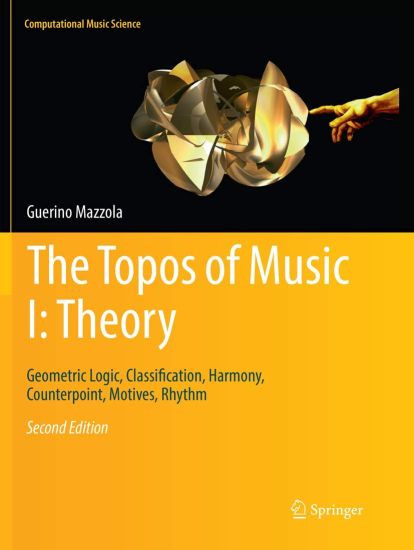
This is the first volume of the second edition of the now classic book “The Topos of Music”. The author explains the theory's conceptual framework of denotators and forms, the classification of local and global musical objects, the mathematical models of harmony and counterpoint, and topologies for rhythm and motives.
The Topos of Music IV: Roots

The Topos of Music IV: Roots

Guerino Mazzola

Springer Nature Switzerland AG
2018
nidottu
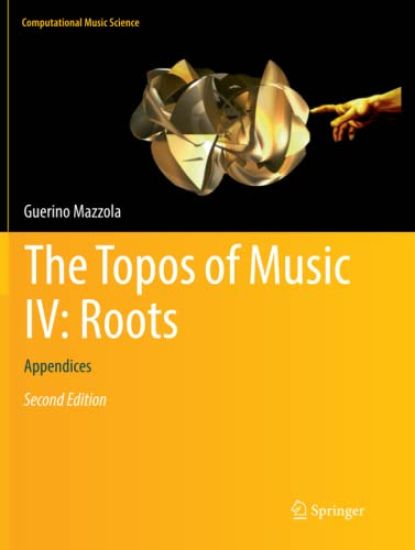
This is the fourth volume of the second edition of the now classic book “The Topos of Music”. The author presents appendices with background material on sound and auditory physiology; mathematical basics such as sets, relations, transformations, algebraic geometry, and categories; complements in physics, including a discussion on string theory; and tables with chord classes and modulation steps.
All About Music

All About Music

Guerino Mazzola; Maria Mannone; Yan Pang; Margaret O'Brien; Nathan Torunsky

Springer International Publishing AG
2018
nidottu
This book explains music’s comprehensive ontology, its way of existence and processing, as specified in its compact characterization: music embodies meaningful communication and mediates physically between its emotional and mental layers. The book unfolds in a basic discourse in everyday language that is accessible to everybody who wants to understand what this topic is about. Musical ontology is delayed in its fundamental dimensions: its realities, its meaningful communication, and its embodied utterance from musical creators to an interested audience. The authors' approach is applicable to every musical genre and is scientific, the book is suitable for non-musicians and non-scientists alike.
Cool Math for Hot Music

Cool Math for Hot Music

Guerino Mazzola; Maria Mannone; Yan Pang

Springer International Publishing AG
2018
nidottu
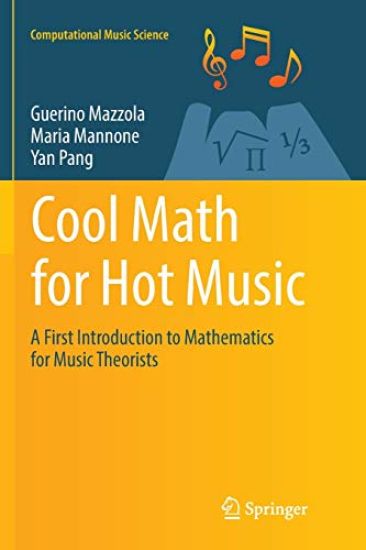
This textbook is a first introduction to mathematics for music theorists, covering basic topics such as sets and functions, universal properties, numbers and recursion, graphs, groups, rings, matrices and modules, continuity, calculus, and gestures. It approaches these abstract themes in a new way: Every concept or theorem is motivated and illustrated by examples from music theory (such as harmony, counterpoint, tuning), composition (e.g., classical combinatorics, dodecaphonic composition), and gestural performance. The book includes many illustrations, and exercises with solutions.
The Topos of Music I: Theory

The Topos of Music I: Theory

Guerino Mazzola

Springer International Publishing AG
2018
sidottu
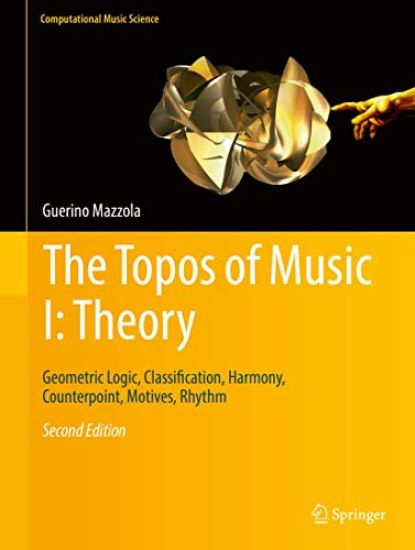
This is the first volume of the second edition of the now classic book “The Topos of Music”. The author explains the theory's conceptual framework of denotators and forms, the classification of local and global musical objects, the mathematical models of harmony and counterpoint, and topologies for rhythm and motives.
The Topos of Music III: Gestures

The Topos of Music III: Gestures

Guerino Mazzola; René Guitart; Jocelyn Ho; Alex Lubet; Maria Mannone; Matt Rahaim; Florian Thalmann

Springer International Publishing AG
2018
sidottu
This is the third volume of the second edition of the now classic book “The Topos of Music”. The authors present gesture theory, including a gesture philosophy for music, the mathematics of gestures, concept architectures and software for musical gesture theory, the multiverse perspective which reveals the relationship between gesture theory and the string theory in theoretical physics, and applications of gesture theory to a number of musical themes, including counterpoint, modulation theory, free jazz, Hindustani music, and vocal gestures.
The Topos of Music II: Performance

The Topos of Music II: Performance

Guerino Mazzola

Springer International Publishing AG
2018
sidottu
This is the second volume of the second edition of the now classic book “The Topos of Music”. The author explains his theory of musical performance, developed in the language of differential geometry, introducing performance vector fields that generalize tempo and intonation. The author also shows how Rubato, a software platform for composition, analysis, and performance, allows an experimental evaluation of principles of expressive performance theories.
The Topos of Music IV: Roots

The Topos of Music IV: Roots

Guerino Mazzola

Springer International Publishing AG
2018
sidottu
This is the fourth volume of the second edition of the now classic book “The Topos of Music”. The author presents appendices with background material on sound and auditory physiology; mathematical basics such as sets, relations, transformations, algebraic geometry, and categories; complements in physics, including a discussion on string theory; and tables with chord classes and modulation steps.