Kirjojen hintavertailu – 12 903 724 kirjaa ja 27 kauppaa

Kirjailija

Guerino Mazzola

Kirjat ja teokset yhdessä paikassa: 37 kirjaa, julkaisuja vuosilta 1987–2026, suosituimpiin kuuluu Basic Music Technology. Vertaile teosten hintoja ja tarkista saatavuus suomalaisista kirjakaupoista.

37 kirjaa

Kirjojen julkaisuvuodet: 1987–2026.

All About Music

All About Music

Guerino Mazzola; Maria Mannone; Yan Pang; Margaret O'Brien; Nathan Torunsky

Springer International Publishing AG
2016
sidottu
This book explains music’s comprehensive ontology, its way of existence and processing, as specified in its compact characterization: music embodies meaningful communication and mediates physically between its emotional and mental layers. The book unfolds in a basic discourse in everyday language that is accessible to everybody who wants to understand what this topic is about. Musical ontology is delayed in its fundamental dimensions: its realities, its meaningful communication, and its embodied utterance from musical creators to an interested audience. The authors' approach is applicable to every musical genre and is scientific, the book is suitable for non-musicians and non-scientists alike.
Cool Math for Hot Music

Cool Math for Hot Music

Guerino Mazzola; Maria Mannone; Yan Pang

Springer International Publishing AG
2016
sidottu
This textbook is a first introduction to mathematics for music theorists, covering basic topics such as sets and functions, universal properties, numbers and recursion, graphs, groups, rings, matrices and modules, continuity, calculus, and gestures. It approaches these abstract themes in a new way: Every concept or theorem is motivated and illustrated by examples from music theory (such as harmony, counterpoint, tuning), composition (e.g., classical combinatorics, dodecaphonic composition), and gestural performance. The book includes many illustrations, and exercises with solutions.
Computational Counterpoint Worlds

Computational Counterpoint Worlds

Octavio Alberto Agustín-Aquino; Julien Junod; Guerino Mazzola

Springer International Publishing AG
2016
nidottu
The mathematical theory of counterpoint was originally aimed at simulating the composition rules described in Johann Joseph Fux’s Gradus ad Parnassum. It soon became apparent that the algebraic apparatus used in this model could also serve to define entirely new systems of rules for composition, generated by new choices of consonances and dissonances, which in turn lead to new restrictions governing the succession of intervals. This is the first book bringing together recent developments and perspectives on mathematical counterpoint theory in detail. The authors include recent theoretical results on counterpoint worlds, the extension of counterpoint to microtonal pitch systems, the singular homology of counterpoint models, and the software implementation of contrapuntal models. The book is suitable for graduates and researchers. A good command of algebra is a prerequisite for understanding the construction of the model.
Musical Creativity

Musical Creativity

Guerino Mazzola; Joomi Park; Florian Thalmann

Springer-Verlag Berlin and Heidelberg GmbH Co. K
2016
nidottu
This book represents a new approach to musical creativity, dealing with the semiotics, mathematical principles, and software for creativity processes. After a thorough introduction, the book offers a first practical part with a detailed tutorial for students in composition and improvisation, using musical instruments and music software. The second, theoretical part deals with historical, actual, and new principles of creative processes in music, based on the results and methods developed in the first author’s book Topos of Music and referring to semiotics, predicative objects, topos theory, and object-oriented concept architectures. The third part of the book details four case studies in musical creativity, including an analysis of the six variations of Beethoven's sonata op. 109, a discussion of the creative process in a CD coproduced in 2011 by the first and second authors, a recomposition of Boulez’s "Structures pour deux pianos" using the Rubato software module BigBang developed by the third author, and the Escher theorem from mathematical gesture theory in music. This is both a textbook addressed to undergraduate and graduate students of music composition and improvisation, and also a state-of-the-art survey addressed to researchers in creativity studies and music technology. The book contains summaries and end-of-chapter questions, and the authors have used the book as the main reference to teach an undergraduate creativity studies program and also to teach composition. The text is supported throughout with musical score examples.
Computational Musicology in Hindustani Music

Computational Musicology in Hindustani Music

Soubhik Chakraborty; Guerino Mazzola; Swarima Tewari; Moujhuri Patra

Springer International Publishing AG
2016
nidottu
The book opens with a short introduction to Indian music, in particular classical Hindustani music, followed by a chapter on the role of statistics in computational musicology. The authors then show how to analyze musical structure using Rubato, the music software package for statistical analysis, in particular addressing modeling, melodic similarity and lengths, and entropy analysis; they then show how to analyze musical performance. Finally, they explain how the concept of seminatural composition can help a music composer to obtain the opening line of a raga-based song using Monte Carlo simulation. The book will be of interest to musicians and musicologists, particularly those engaged with Indian music.
Computational Counterpoint Worlds

Computational Counterpoint Worlds

Octavio Alberto Agustín-Aquino; Julien Junod; Guerino Mazzola

Springer International Publishing AG
2015
sidottu
The mathematical theory of counterpoint was originally aimed at simulating the composition rules described in Johann Joseph Fux’s Gradus ad Parnassum. It soon became apparent that the algebraic apparatus used in this model could also serve to define entirely new systems of rules for composition, generated by new choices of consonances and dissonances, which in turn lead to new restrictions governing the succession of intervals. This is the first book bringing together recent developments and perspectives on mathematical counterpoint theory in detail. The authors include recent theoretical results on counterpoint worlds, the extension of counterpoint to microtonal pitch systems, the singular homology of counterpoint models, and the software implementation of contrapuntal models. The book is suitable for graduates and researchers. A good command of algebra is a prerequisite for understanding the construction of the model.
Computational Musicology in Hindustani Music

Computational Musicology in Hindustani Music

Soubhik Chakraborty; Guerino Mazzola; Swarima Tewari; Moujhuri Patra

Springer International Publishing AG
2014
sidottu
The book opens with a short introduction to Indian music, in particular classical Hindustani music, followed by a chapter on the role of statistics in computational musicology. The authors then show how to analyze musical structure using Rubato, the music software package for statistical analysis, in particular addressing modeling, melodic similarity and lengths, and entropy analysis; they then show how to analyze musical performance. Finally, they explain how the concept of seminatural composition can help a music composer to obtain the opening line of a raga-based song using Monte Carlo simulation. The book will be of interest to musicians and musicologists, particularly those engaged with Indian music.
Flow, Gesture, and Spaces in Free Jazz

Flow, Gesture, and Spaces in Free Jazz

Guerino Mazzola; Paul B. Cherlin

Springer-Verlag Berlin and Heidelberg GmbH Co. K
2014
nidottu
Let's try to play the music and not the background. Ornette Coleman, liner notes of the LP "Free Jazz" [20] WhenIbegantocreateacourseonfreejazz,theriskofsuchanenterprise was immediately apparent: I knew that Cecil Taylor had failed to teach such a matter, and that for other, more academic instructors, the topic was still a sort of outlandish adventure. To be clear, we are not talking about tea- ing improvisation here-a di?erent, and also problematic, matter-rather, we wish to create a scholarly discourse about free jazz as a cultural achievement, and follow its genealogy from the American jazz tradition through its various outbranchings,suchastheEuropeanandJapanesejazzconceptionsandint- pretations. We also wish to discuss some of the underlying mechanisms that are extant in free improvisation, things that could be called technical aspects. Such a discourse bears the ?avor of a contradicto in adjecto:Teachingthe unteachable, the very negation of rules, above all those posited by white jazz theorists, and talking about the making of sounds without aiming at so-called factual results and all those intellectual sedimentations: is this not a suicidal topic? My own endeavors as a free jazz pianist have informed and advanced my conviction that this art has never been theorized in a satisfactory way, not even by Ekkehard Jost in his unequaled, phenomenologically precise p- neering book "Free Jazz" [57].
Ansichten eines Hirns

Ansichten eines Hirns

Hunziker; Guerino Mazzola

Springer Basel
2014
nidottu
Ansichten eines Hirns ist das Resultat einer Informationsreise zu den wichtigsten europäischen Zentren der Hirnforschung. Wir konnten da­ raus die aktuellsten Perspektiven der Spezialisten in Erfahrung bringen. Es galt, die wesentlichen Erkenntnisse der Fachleute aus der Fülle ihrer Arbeiten herauszuschälen, miteinander in Beziehung zu setzen und daraus - so weit wie möglich - ein Netz von Zusammenhängen zu knüpfen. Der Kern dieser Aufgabe bestand darin, den babylonischen Sprachdschungel einander fremd geworden er Einzelwissenschaftler zu entwirren, um Ihnen den Weg zu einem künftigen Dialog zu ebnen. Angesichts der Tatsache, daß es in der Hirnforschung ums Eigentliche des Menschseins geht, ist ein Austausch von Einzelansichten kein Luxus, sondern wissenschaftliche und gesellschaftliche Notwendigkeit. Da die vielfältigen Ansichten des Gehirns im Grund immer auch die grundlegende Arbeitsweise eben dieses Denk-und Gefühlsorgans offen­ baren, sind wir zur Überzeugung gelangt, daß sich wirkliche Erkenntnis­ se und die Faszination des Gegenstandes auch umgangssprachlich prä­ zise und lustvoll vermitteln lassen.
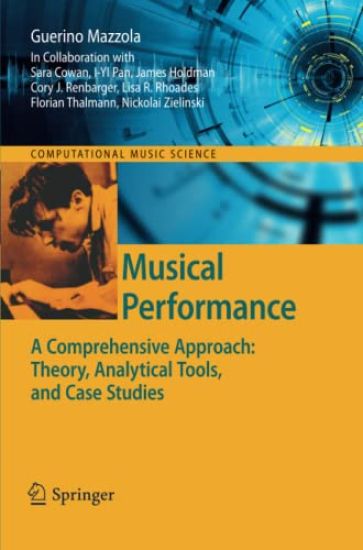
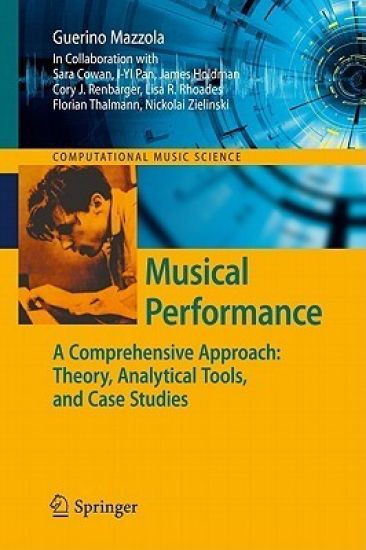
Musical Performance

Musical Performance

Guerino Mazzola

Springer-Verlag Berlin and Heidelberg GmbH Co. K
2013
nidottu
This book is a first sketch of what the overall field of performance could look like as a modern scientific field but not its stylistically differentiated practice, pedagogy, and history. Musical performance is the most complex field of music. It comprises the study of a composition’s expression in terms of analysis, emotion, and gesture, and then its transformation into embodied reality, turning formulaic facts into dramatic movements of human cognition. Combining these components in a creative way is a sophisticated mix of knowledge and mastery, which more resembles the cooking of a delicate recipe than a rational procedure. This book is the first one aiming at such comprehensive coverage of the topic, and it does so also as a university text book. We include musicological and philosophical aspects as well as empirical performance research. Presenting analytical tools and case studies turns this project into a demanding enterprise in construction and experimental setups of performances, especially those generated by the music software Rubato. We are happy that this book was written following a course for performance students at the School of Music of the University of Minnesota. Their education should not be restricted to the canonical practice. They must know the rationale for their performance. It is not sufficient to learn performance with the old-fashioned imitation model of the teacher's antetype, this cannot be an exclusive tool since it dramatically lacks the poetical precision asked for by Adorno's and Benjamin's micrologic. Without such alternatives to intuitive imitation, performance risks being disconnected from the audience.
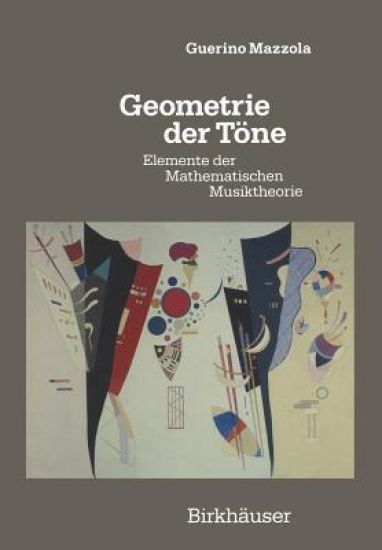
Geometrie der Töne

Geometrie der Töne

Guerino Mazzola

Springer Basel
2012
nidottu
Geometrie der Tone ist die aktualisierte und ausgearbeitete Fassung einer interdisziplinaren Vorlesung iiber Mathematische Musiktheorie an der Universitat Ziirich im akademischen Jahr 1986/87. Das Buch richtet sich an einen breiten, interessierten Leserkreis, der sich iiber den Status quo dieser Theorie ein Bild mach en mochte. Es wird da- her grosste Sorgfalt und Zuriickhaltung geiibt in der Entwicklung des mathematischen Formalismus. Das zentrale Anliegen der Theorie die Vermittlung zwischen musikalischer Form und ihrer Bedeutung bleibt stets im Mittelpunkt der Darstellung. Der Status quo der Mathematischen Musiktheorie (MaMuTh) ist das Resultat einer zehnjahrigen Forschungsperiode, in welcher die Durchdringung und Verwebung systematischer Musikwissenschaft mit der Sprache, den Methoden und den Erkenntnissen der modernen Ma- thematik angestrebt wurde. Besonderes Gewicht erhalt die Geome- trisierung abstrakter Sachverhalte. Musik erweist sich in diesem U nternehmen als das im Vieldeutigen Bestimmte und darin als Ge- genstand, welcher den Paradigmen heutiger Mathematik in natiirli- cher Weise entspricht. Die MaMuTh macht der Musikwissenschaft eine prazise, anschauliche und undogmatische Sprache verfiigbar, welche in ihrer Universalitat keine Einschrankung des kulturellen oder histori- schen Blickwinkels impliziert, sondern vielmehr durch Spezialisierung der allgemeinen Techniken eine Varietat adaquater Perspektiven an- bietet. XIV Vorwort Uber eine im Zeitalter der Computertechnologie iiberfaJlige sprachlich-formale Fundierung hinaus kann von der MaMuTh als ei- ner Theorie gesprochen werden, die - wie die Physik zur materiellen Natur - Modelle zum Phiinomen Musik der menschlichen Natur be- reitstellt.
Musical Performance

Musical Performance

Guerino Mazzola

Springer-Verlag Berlin and Heidelberg GmbH Co. K
2011
sidottu
This book is a first sketch of what the overall field of performance could look like as a modern scientific field but not its stylistically differentiated practice, pedagogy, and history. Musical performance is the most complex field of music. It comprises the study of a composition’s expression in terms of analysis, emotion, and gesture, and then its transformation into embodied reality, turning formulaic facts into dramatic movements of human cognition. Combining these components in a creative way is a sophisticated mix of knowledge and mastery, which more resembles the cooking of a delicate recipe than a rational procedure. This book is the first one aiming at such comprehensive coverage of the topic, and it does so also as a university text book. We include musicological and philosophical aspects as well as empirical performance research. Presenting analytical tools and case studies turns this project into a demanding enterprise in construction and experimental setups of performances, especially those generated by the music software Rubato. We are happy that this book was written following a course for performance students at the School of Music of the University of Minnesota. Their education should not be restricted to the canonical practice. They must know the rationale for their performance. It is not sufficient to learn performance with the old-fashioned imitation model of the teacher's antetype, this cannot be an exclusive tool since it dramatically lacks the poetical precision asked for by Adorno's and Benjamin's micrologic. Without such alternatives to intuitive imitation, performance risks being disconnected from the audience.
Flow, Gesture, and Spaces in Free Jazz

Flow, Gesture, and Spaces in Free Jazz

Guerino Mazzola; Paul B. Cherlin

Springer-Verlag Berlin and Heidelberg GmbH Co. K
2009
sidottu
Let's try to play the music and not the background. Ornette Coleman, liner notes of the LP "Free Jazz" [20] WhenIbegantocreateacourseonfreejazz,theriskofsuchanenterprise was immediately apparent: I knew that Cecil Taylor had failed to teach such a matter, and that for other, more academic instructors, the topic was still a sort of outlandish adventure. To be clear, we are not talking about tea- ing improvisation here-a di?erent, and also problematic, matter-rather, we wish to create a scholarly discourse about free jazz as a cultural achievement, and follow its genealogy from the American jazz tradition through its various outbranchings,suchastheEuropeanandJapanesejazzconceptionsandint- pretations. We also wish to discuss some of the underlying mechanisms that are extant in free improvisation, things that could be called technical aspects. Such a discourse bears the ?avor of a contradicto in adjecto:Teachingthe unteachable, the very negation of rules, above all those posited by white jazz theorists, and talking about the making of sounds without aiming at so-called factual results and all those intellectual sedimentations: is this not a suicidal topic? My own endeavors as a free jazz pianist have informed and advanced my conviction that this art has never been theorized in a satisfactory way, not even by Ekkehard Jost in his unequaled, phenomenologically precise p- neering book "Free Jazz" [57].
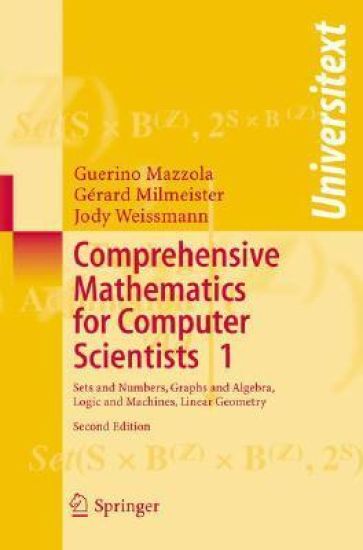
Comprehensive Mathematics for Computer Scientists 1

Comprehensive Mathematics for Computer Scientists 1

Guerino Mazzola; Gérard Milmeister; Jody Weissmann

Springer-Verlag Berlin and Heidelberg GmbH Co. K
2006
nidottu
A second edition of a book is a success and an obligation at the same time. We are satis ed that a number of university courses have been orga› nized on the basis of the rst volume of Comprehensive Mathematics for Computer Scientists. The instructors recognized that the self›contained presentation of a broad specturm of mathematical core topics is a rm point of departure for a sustainable formal education in computer sci› ence. We feel obliged to meet the valuable feedback of the responsible in› structors of such courses, in particular of Joel Young (Computer Science Department, Brown University) who has provided us with numerous re› marks on misprints, errors, or obscurities. We would like to express our gratitude for these collaborative contributions. We have reread the entire text and not only eliminated identi ed errors, but also given some addi› tional examples and explications to statements and proofs which were exposed in a too shorthand style. A second edition of the second volume will be published as soon as the errata, the suggestions for improvements, and the publisher’s strategy are in harmony.
Elemente der Musikinformatik

Elemente der Musikinformatik

Guerino Mazzola

Birkhauser Verlag AG
2006
nidottu
Dieses Lehrbuch stellt eine Einführung in die noch junge Disziplin der Musikinformatik dar. Es beginnt mit einer Übersicht über die gegenwärtige Entwicklung der Musik aus der Wechselwirkung zwischen Technologie und Komposition. Darauf aufbauend werden Kodierung und Programmierung musikalischer Objekte für Komposition, Analyse und Interpretation besprochen, sowie Standards und Darstellungsmethoden, wie: MIDI, Musik-N, Fourier, FM, Wavelets, Physical Modeling und Denotatoren. Eine vertiefte Diskussion erfährt dabei der FFT-Algorithmus und natürlich das Kompressionsverfahren MP3. Anschließend werden Plattformen für die computergestützte Analyse, Komposition und Interpretation vorgestellt, darunter RUBATO, MAX und Presto. Darauf folgt eine Einführung in Methoden der Navigation im Begriffsraum der Musik. Abschließend wird die Perspektive einer verteilten globalen Musikkultur diskutiert, wie sie sich etwa durch den iPod, sowie Internet-basierte Musikdistribution, -produktion und -komposition abzeichnet.
Comprehensive Mathematics for Computer Scientists 2

Comprehensive Mathematics for Computer Scientists 2

Guerino Mazzola; Gérard Milmeister; Jody Weissmann

Springer-Verlag Berlin and Heidelberg GmbH Co. K
2004
nidottu
This second volume of a comprehensive tour through mathematical core subjects for computer scientists completes the ?rst volume in two - gards: Part III ?rst adds topology, di?erential, and integral calculus to the t- ics of sets, graphs, algebra, formal logic, machines, and linear geometry, of volume 1. With this spectrum of fundamentals in mathematical e- cation, young professionals should be able to successfully attack more involved subjects, which may be relevant to the computational sciences. In a second regard, the end of part III and part IV add a selection of more advanced topics. In view of the overwhelming variety of mathematical approaches in the computational sciences, any selection, even the most empirical, requires a methodological justi?cation. Our primary criterion has been the search for harmonization and optimization of thematic - versity and logical coherence. This is why we have, for instance, bundled such seemingly distant subjects as recursive constructions, ordinary d- ferential equations, and fractals under the unifying perspective of c- traction theory.