

Kirjailija
Hans Joas
Kirjat ja teokset yhdessä paikassa: 35 kirjaa, julkaisuja vuosilta 1992–2025, suosituimpiin kuuluu Was Ist Die Achsenzeit?: Eine Wissenschaftliche Debatte ALS Diskurs Uber Transzendenz. Vertaile teosten hintoja ja tarkista saatavuus suomalaisista kirjakaupoista.
35 kirjaa
Kirjojen julkaisuvuodet: 1992–2025.
Why did Christianity produce the special organizational form "church" in the first place? Is it possible to be a Christian without the church? To what extent is Christian faith in community with other believers an alternative to the mere self-optimization of individuals? In this accessible and questioning new work, Hans Joas traverses theological, church-historical, sociological, and ethical territory in search of a viable conception of the church adequate to contemporary globalized societies. Across eleven essays that draw on work by Ernst Troeltsch, Max Weber, Emile Durkheim, H. Richard Niebuhr, Leszek Kolakowski and others, Joas reflects on key debates—from the failure of so-called secularization theory to explain religiosity in modern society, to the role of Christianity and the church in relation to rampant nationalism and refugee crises, and to the question of whether or not human dignity ever was, or still is, the highest value in the West. Addressing the sociology of the church as the distinctive communal formation of Christianity for the last two millennia, Joas underscores the need for Christian conceptions of church to balance theological sensibility with concrete sociological grounding. In the process, he considers the relation of a community of faith to contemporary ideas about the optimization of life.
Why did Christianity produce the special organizational form "church" in the first place? Is it possible to be a Christian without the church? To what extent is Christian faith in community with other believers an alternative to the mere self-optimization of individuals? In this accessible and questioning new work, Hans Joas traverses theological, church-historical, sociological, and ethical territory in search of a viable conception of the church adequate to contemporary globalized societies. Across eleven essays that draw on work by Ernst Troeltsch, Max Weber, Emile Durkheim, H. Richard Niebuhr, Leszek Kolakowski and others, Joas reflects on key debates—from the failure of so-called secularization theory to explain religiosity in modern society, to the role of Christianity and the church in relation to rampant nationalism and refugee crises, and to the question of whether or not human dignity ever was, or still is, the highest value in the West. Addressing the sociology of the church as the distinctive communal formation of Christianity for the last two millennia, Joas underscores the need for Christian conceptions of church to balance theological sensibility with concrete sociological grounding. In the process, he considers the relation of a community of faith to contemporary ideas about the optimization of life.
How do the history of religion and the history of political freedom relate to each other? The variety of views on this subject in philosophy, the humanities and social sciences, and the public is broad and confusing. But the grandiose synthesis in which Hegel brought together Christianity and political freedom is still an enormous source of orientation for many-despite or even because of the influential provocations of Friedrich Nietzsche. As Hans Joas shows in Under the Spell of Freedom, a different view has developed in the religious thinking of the twentieth century based on a conception of history that is more open to the future and on a concept of freedom that is richer than that of Hegel. Using sixteen selected thinkers, Joas deconstructs the grand Hegelian narrative of human history as the self-realization of the idea of freedom, setting as a counterpart the sketches of a theory of the emergence of moral universalism. Further, taking the classical views of Hegel and his emphasis on the role of Protestant Christianity and the extremely negative views about Christianity in the work of the philosopher Friedrich Nietzsche, Joas elaborates on this new understanding of religion and freedom, which avoids both Eurocentrism and an intellectualist view of religious faith and practice. The result is a forceful plea for a global history of moral universalism. Under the Spell of Freedom is an important step in this direction.

Disenchantment is a key term in the self-understanding of modernity. But what exactly does this concept mean? What was its original meaning when Max Weber introduced it? And can the conventional meaning or Max Weber's view really be defended, given the present state of knowledge about the history of religion? In The Power of the Sacred, Hans Joas develops the fundamentals of a new sociological theory of religion by first reconstructing existing theories, from the eighteenth century to the present. Through a critical reading and reassessment of key texts in the three empirical disciplines of history, psychology, and sociology of religion, including the works of David Hume, J. G. Herder, Friedrich Schleiermacher, William James, Emile Durkheim, and Ernst Troeltsch, Joas presents an understanding of religion that lays the groundwork for a thorough study of Max Weber's views on disenchantment. After deconstructing Weber's highly ambiguous use of the concept, Joas proposes an alternative to the narratives of disenchantment and secularization which have dominated debates on the topic. He constructs a novel interpretation that takes into account the dynamics of ever new sacralizations, their normative evaluation in the light of a universalist morality as it first emerged in the "Axial Age," and the dangers of the misuse of religion in connection with the formation of power. Built upon the human experience of self-transcendence, rather than human cognition or cultural discourses, The Power of the Sacred challenges both believers and non-believers alike to rethink the defining characteristics of Western modernity.

The Varieties of Transcendence
Hans Joas; Matthias Jung; Magnus Schlette
Fordham University Press
2016
sidottu
The Varieties of Transcendence traces American pragmatist thought on religion and its relevance for theorizing religion today. The volume establishes pragmatist concepts of religious individualization as powerful alternatives to the more common secularization discourse. In stressing the importance of Josiah Royce's work, it emphasizes religious individualism's compatibility with community. At the same time, by covering all of the major classical pragmatist theories of religion, it shows their kinship and common focus on the interrelation between the challenges of contingency and the semiotic significance of transcendence.
Det finns en bland samhällsvetare vedertagen föreställning om att modernisering leder till sekularisering. Men detta är helt enkelt empiriskt felaktigt, hävdar den tyske sociologen Hans Joas i denna bok. De europeiska länder som brukar nämnas som typexempel på denna förmodade historiska trend är i själva verket undantag. Utvecklingen går globalt sett inte mot mindre religion, utan mot mer. Det av religiösa föreställningar präglade USA säger kort sagt mer om vår globala samtid och framtid än det sekulära Sverige. Kristendomen befinner sig i själva verket i en expansionsfas. Joas vänder sig samtidigt mot den likaledes seglivade föreställningen att religiös tro är oumbärlig för moralisk motivation och social sammanhållning. Moralen har en icke-religiös rot i social ömsesidighet. Detta hindrar inte att evangeliernas universalism lever vidare också i den sekulariserade moralen och till exempel kommer till uttryck i idéen om mänskliga rättigheter. Det finns emellertid inga belägg, poängterar Joas, för att sekularisering skulle leda till moraliskt förfall. Joas knyter i sina resonemang an till den tyske religionsforskaren Ernst Troeltschs (1865?1923) klassiska studier av protestantismen och till den nutida filosofen Charles Taylors studier av sekulariseringsprocessen. Han pläderar för att religionen är ett ?alternativ? inom moderniteten, precis som ateismen. Syftet med boken är emellertid inte att avfärda religionskritik, utan att bereda utrymme för ett samtal där troende och icke-troende kan mötas på lika villkor och med ömsesidig respekt.
Fører modernisering til sekularisering? Fører sekularisering til moralsk forfald? Nogle betragter religion som et levn fra fortiden. Med modernisering og fremskridt har religionen mistet sin betydning og samfundet er blevet til et bedre sted. Andre ser derimod religion som grundlaget for moral og et værn mod opløsning af et velfungerende samfund. Hans Joas undersøger den tilsyneladende modsætning mellem modernisering og religion, som i generationer har domineret de akademiske såvel som intellektuelle diskussioner. Han peger i stedet for på en mere frugtbar dialog, hvis man tager afsked med de konventionelle opfattelser af forholdet mellem tro og ikke-tro. Vi lever i dag i en verden, hvor mennesket i alle aspekter at sit liv står over for en uendelig mængde af valgmuligheder. Det er ifølge bogen et grundvilkår for mange mennesker, som også gælder deres forhold til religion. Religionen er ikke længere nødvendigvis udtryk for tradition og opdragelse, men udtryk for et valg, en option, lige såvel som ikke-tro er en option.
Many people these days regard religion as outdated and are unable to understand how believers can intellectually justify their faith. Nonbelievers have long assumed that progress in technology and the sciences renders religion irrelevant. Believers, in contrast, see religion as vital to society's spiritual and moral well-being. But does modernization lead to secularization? Does secularization lead to moral decay? Sociologist Hans Joas argues that these two supposed certainties have kept scholars from serious contemporary debate and that people must put these old arguments aside in order for debate to move forward. The emergence of a "secular option" does not mean that religion must decline, but that even believers must now define their faith as one option among many. In this book, Joas spells out some of the consequences of the abandonment of conventional assumptions for contemporary religion and develops an alternative to the cliché of an inevitable conflict between Christianity and modernity. Arguing that secularization comes in waves and stressing the increasing contingency of our worlds, he calls upon faith to articulate contemporary experiences. Churches and religious communities must take into account religious diversity, but the modern world is not a threat to Christianity or to faith in general. On the contrary, Joas says, modernity and faith can be mutually enriching.
Many people these days regard religion as outdated and are unable to understand how believers can intellectually justify their faith. Nonbelievers have long assumed that progress in technology and the sciences renders religion irrelevant. Believers, in contrast, see religion as vital to society's spiritual and moral well-being. But does modernization lead to secularization? Does secularization lead to moral decay? Sociologist Hans Joas argues that these two supposed certainties have kept scholars from serious contemporary debate and that people must put these old arguments aside in order for debate to move forward. The emergence of a "secular option" does not mean that religion must decline, but that even believers must now define their faith as one option among many. In this book, Joas spells out some of the consequences of the abandonment of conventional assumptions for contemporary religion and develops an alternative to the cliché of an inevitable conflict between Christianity and modernity. Arguing that secularization comes in waves and stressing the increasing contingency of our worlds, he calls upon faith to articulate contemporary experiences. Churches and religious communities must take into account religious diversity, but the modern world is not a threat to Christianity or to faith in general. On the contrary, Joas says, modernity and faith can be mutually enriching.

Was Ist Die Achsenzeit?: Eine Wissenschaftliche Debatte ALS Diskurs Uber Transzendenz
Hans Joas
Schwabe Verlagsgruppe AG
2014
nidottu
Hans Joas behandelt in diesem Buch die Grundzuge der historisch-soziologischen Forschung uber die von Karl Jaspers so genannte Achsenzeit. In dieser Sichtweise treten uns Kulturen und Religionen nicht als hermetisch abgeschlossene Universen vor Augen, sondern als vielfaltig aufeinander bezogene und uber sich selbst hinausweisende Gebilde. Sie zeichnen sich durch eine ungeheure Spannung aus zwischen den grossartigen normativen Ideen, die sie hervorbringen, und der politischen und sozialen Wirklichkeit, die nicht auf der Hohe dieser Ideen ist. Karl Jaspers hat die Achsenzeit gar als tiefsten Einschnitt in der Geschichte der Menschheit bezeichnet und Hans Joas ist bereit, ihm darin zu folgen. Die biblischen Propheten verkunden eine Moral, der auch die Machtigen unterworfen sind; Buddha verkorpert exemplarisch eine uberlegene Lebensfuhrung. Die Transzendenz wird als Ort des Guten erstmals gedacht - kurzum: es gibt nun eine Moral, der es nicht nur um das Gute fur die Angehorigen einer Familie, eines Stammes oder eines Staates zu tun ist, sondern um das Gute fur alle Menschen, eine Moral fur die Menschheit.
Die breite öffentliche Diskussion über Wertewandel und Werteverlust kreist ebenso wie die Debatte über Liberalismus und Kommunitarismus häufig um die Frage, wie Wertebindung entsteht und möglicherweise gestärkt werden kann. In der zeitgenössischen Soziologie und Philosophie gibt es auf diese Fragen aber kaum befriedigende Antwort, so daß ein Rückblick auf frühere Lösungsversuche unumgänglich ist. Nach einer ausführlichen Klärung des Sinns seiner Fragestellung erarbeitet Joas seine Antwort in Auseinandersetzung mit Nietzsche, James, Durkheim, Simmel, Scheler, Dewey, Taylor und Habermas.
What are the origins of the idea of human rights and universal human dignity? How can we most fully understand-and realize-these rights going into the future? In The Sacredness of the Person, internationally renowned sociologist and social theorist Hans Joas tells a story that differs from conventional narratives by tracing the concept of human rights back to the Judeo-Christian tradition or, alternately, to the secular French Enlightenment. While drawing on sociologists such as Emile Durkheim, Max Weber, and Ernst Troeltsch, Joas sets out a new path, proposing an affirmative genealogy in which human rights are the result of a process of "sacralization" of every human being. According to Joas, every single human being has increasingly been viewed as sacred. He discusses the abolition of torture and slavery, once common practice in the pre-18th century west, as two milestones in modern human history. The author concludes by portraying the emergence of the UN Declaration of Human Rights of 1948 as a successful process of value generalization. Joas demonstrates that the history of human rights cannot adequately be described as a history of ideas or as legal history, but as a complex transformation in which diverse cultural traditions had to be articulated, legally codified, and assimilated into practices of everyday life. The sacralization of the person and universal human rights will only be secure in the future, warns Joas, through continued support by institutions and society, vigorous discourse in their defense, and their incarnation in everyday life and practice.
This book, the first of its kind, provides a sweeping critical history of social theories about war and peace from Hobbes to the present. Distinguished social theorists Hans Joas and Wolfgang Knobl present both a broad intellectual history and an original argument as they trace the development of thinking about war over more than 350 years--from the premodern era to the period of German idealism and the Scottish and French enlightenments, and then from the birth of sociology in the nineteenth century through the twentieth century. While focusing on social thought, the book draws on many disciplines, including philosophy, anthropology, and political science. Joas and Knobl demonstrate the profound difficulties most social thinkers--including liberals, socialists, and those intellectuals who could be regarded as the first sociologists--had in coming to terms with the phenomenon of war, the most obvious form of large-scale social violence. With only a few exceptions, these thinkers, who believed deeply in social progress, were unable to account for war because they regarded it as marginal or archaic, and on the verge of disappearing. This overly optimistic picture of the modern world persisted in social theory even in the twentieth century, as most sociologists and social theorists either ignored war and violence in their theoretical work or tried to explain it away. The failure of the social sciences and especially sociology to understand war, Joas and Knobl argue, must be seen as one of the greatest weaknesses of disciplines that claim to give a convincing diagnosis of our times.
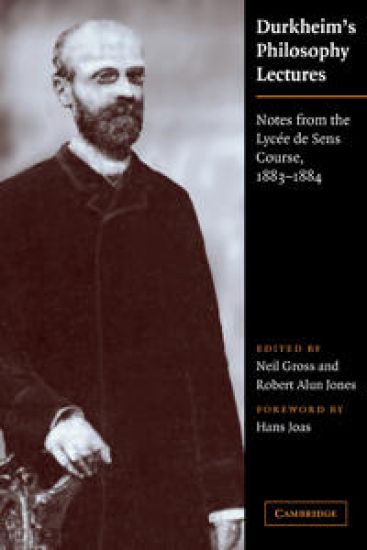
Moving back and forth between the history of philosophy and the contributions of philosophers in his own day, Durkheim takes up topics as diverse as philosophical psychology, logic, ethics, and metaphysics, and seeks to articulate a unified philosophical position. Remarkably, in these lectures, given more than a decade before the publication of his groundbreaking book, The Division of Labour in Society (1893), the 'social realism' that is so characteristic of his later work - where he insists, famously, that social facts cannot be reduced to psychological or economic ones, and that such facts constrain human action in important ways - is totally absent in these early lectures. For this reason, they will be of special interest to students of the history of the social sciences, for they shed important light on the course of Durkheim's intellectual development.
Pragmatismus zur Einführung
Hans-Joachim Schubert; Hans Joas; Harald Wenzel
JUNIUS VERLAG GMBH
2010
nidottu