Kirjailija
Harold D. Lasswell
Kirjat ja teokset yhdessä paikassa: 31 kirjaa, julkaisuja vuosilta 1971–2026, suosituimpiin kuuluu Psychopathology and Politics. Vertaile teosten hintoja ja tarkista saatavuus suomalaisista kirjakaupoista.
Nimi esiintyy myös muodoissa: Harold D Lasswell
31 kirjaa
Kirjojen julkaisuvuodet: 1971–2026.
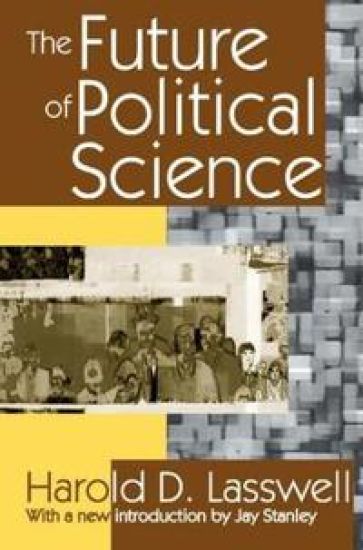
Harold D. Lasswell is arguably the quintessential face of political science to the larger public of the past century. However, there is a side to Lasswell less well known, but of special importance in this day and age: the place of the profession of politics as an academic activity. This book, written at the start of the culture wars thirty years ago, outlines the basic core position of political science practitioners. It helps to explain why the field kept its collective cool, when other social science professionals veered to more extreme activist positions. The Future of Political Science grew out of the phenomenally rapid expansion of the study of government in the United States and elsewhere. The study of professionalism among physical scientists, lawyers, engineers, etc. was not matched by such internal examination within the social sciences until much later. Lasswell's overview centered on developments in the United States. There unfettered study of government reached unprecedented heights in the final stage of the twentieth century. The key concept of this volume, one that continues to inform discourse, is the relationship of political science as a mechanism for the study and teaching of the political system to the field as a tool of the Establishment. This concern grew in the wake of a variety of scandals and secret support sponsored by both government and non-government organizations alike. The Future of Political Science covers areas ranging from membership size and disparities, intervention scenarios in world events, the nature of creativity in political research collaboration in projects with the other social sciences, and the location of scientific centers of gravity in the study of politics. Because of Lasswell's works we have a field of the political science of knowledge as well as the sociology of knowledge. Harold D. Lasswell served as Ford Foundation Professor of the Social Sciences at Yale University, Distinguished Professor of Policy Sciences at John Jay College of the City University of New York, and as professor of political science at the University of Chicago. He was a past president of the American Political Science Association and author of many books covering the full range of political and policy research. Jay Stanley is professor emeritus of sociology at Towson State University. He is former editor of Armed Forces & Society, and co-author of Challenges in Military Health Care.
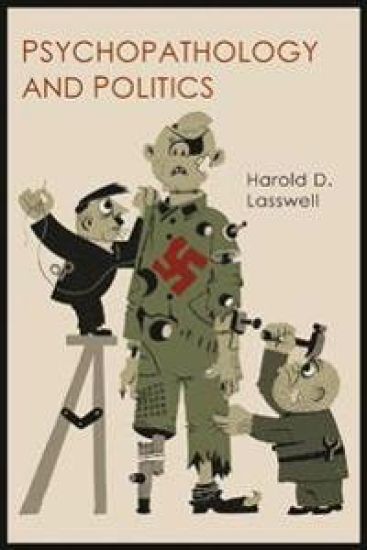
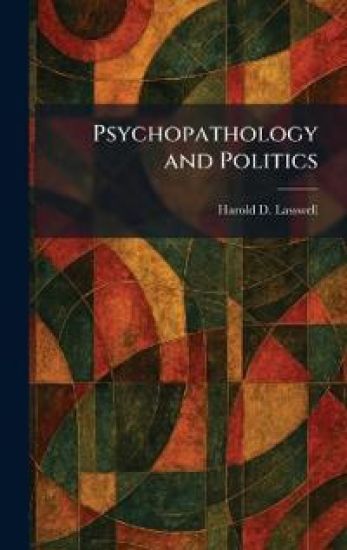
First published in 1930, this classic study of personality types remains vital for the understanding of contemporary public figures. Lasswell's pioneering application of the concepts of clinical psychology to the understanding of powerbrokers in politics, business, and even the church offers insights into the careers of leaders as diverse as Adolf Hitler and Richard Nixon.
In Defense of Public Order the Emerging Field of Sanction Law
Richard Arens; Harold D. Lasswell
Columbia University Press
2022
sidottu
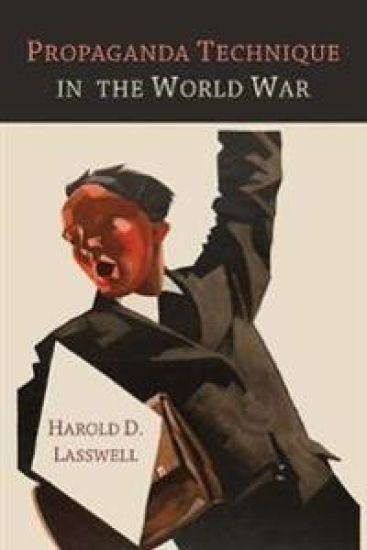
Psychopathology and Politics by Harold D. Lasswell is a study of personality types as they relate to politicians, business leaders, and church officials. First published in 1930, the work applies the concepts of clinical psychology to the future prediction and prevention of societal and political conflict. Born in 1902 to a schoolteacher mother and clergyman father, Lasswell was devoted to scholarship and philosophy from a young age. He dedicated his life to studying, teaching, and writing about the intersection of political science, psychology, and sociology. Lasswell received his Ph. D. from the University of Chicago in 1926. His dissertation, Propaganda Technique in the World War, analyzed the various government "information" campaigns of WWI. This expertise in propaganda would later lead to Lasswell's appointment as Chief of the Experimental Division for the Study of War Time Communications at the Library of Congress during WWII. His role was to review and evaluate Nazi propaganda films to understand how their persuasion methods earned the Nazis the support of the German people. Upon completing his Ph. D., Lasswell became an Assistant Professor of Political Science at the University of Chicago. Shortly after, he began work on Psychopathology and Politics, the first of over 30 books he would write over the next 45 years. The book argues that we must have insight into the hidden motivations and impulses of societal leaders in order to channel the desire to lead into healthy expression. Lasswell uses case studies to explore how early experiences inform the opinions that leaders hold later in life. As an example, we follow the preacher "A" through his childhood, youth, and adulthood. We learn about A's intense competition with his brother for their father's affection in childhood. And we're told that this is the cause of A's support for socialism. Looking after one's "brother" is compensation for his own fraternal dislike. Instead of relying on politicians to resolve conflict, Lasswell argues that it should be the purview of political psychologists to prevent it altogether by "reducing the strain and maladaptation in society." The "politics of prevention," he theorized, would require intense auditing of the effects of politics upon the politicians. For example, "When a judge has been on the bench thirty years, what manner of man has he become? When an agitator has been agitating for thirty years, what has happened to him?" After WWII, Lasswell became a Professor of Law and Political Science at Yale Law School and served as the President of the American Political Science Association and continued to write dozens of books and hundreds of scholarly articles. In one of these works, he pioneered the "five-questions model of communication." Also known as the Lasswell Communication Model, it requires identifying and analyzing each of the following five questions: Who (says) What (to) Whom (in) What Channel (with) What Effect This model is still in use in the studies of communication & public relations. Lasswell's works are still studied today. After his death in 1978, political scientist Gabriel Almond said that Lasswell "ranked among the half dozen creative innovators in the social sciences in the twentieth century."
Human Rights and World Public Order
Myres S. McDougal; Harold D. Lasswell; Lung-chu Chen
Oxford University Press Inc
2019
sidottu
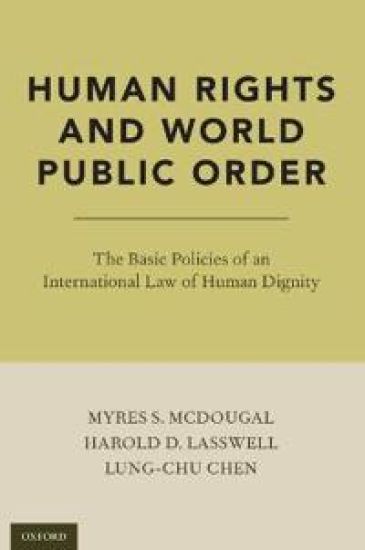
In 1980, Professors McDougal, Lasswell, and Chen published the original edition of Human Rights and World Public Order to present a "comprehensive framework of inquiry" from which to approach international human rights law, and international law, and inadequacies therein in the discourse of that time by combining theme, structure, method, and process. As a classic text of the New Haven School of International Law, this book explores human rights and international law in the broadest sense, taking into account social sciences research while embracing all values secured, or consequently fulfilled, or needed to thus be achieved. The book endured as a lasting contribution that reframed human rights within the New Haven School tradition, and as a magnificent work of scholarship freed from the confines of positivism and the static concerns of any one political or historical period. Co-author Lung-chu Chen spearheaded the re-issuance of this venerable title, complete with a contemporary, fresh Introduction to unveil this work to a new generation of scholars, students, and practitioners of international law and human rights. This Introduction surveys the major developments in human rights since 1980, including many doctrines and concepts that have emerged since. It covers contemporary events to provide today's readers with the opportunity to contextualize the chapters and to apply the book's framework to future endeavors.
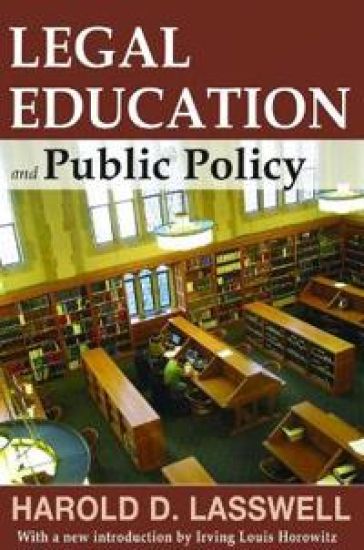
In spite of a cascade of criticism launched against the social sciences, they have brought a qualitative improvement in method and theory to the study of human beings and human relations. In the process of developing now commonplace foundations of social research few individuals have exercised a greater role in justifying and enriching social scientific thought and practice than Harold D. Lasswell. Originally published in 1945 as The Analysis of Political Behaviour, this extraordinary volume has been re-titled Legal Education and Public Policy. The selections acknowledge Lasswell's growing anxieties about a world of revolution, violence, and terror, and the frailties of law in addressing such matters. That he did so without recourse to vague and fatuous appeals to world law and world order is an indication of how close to empirical realities he remained. Lasswell's essays fuse the legal and moral in the conduct of public policy. This did not deter him from arguing the case for and ultimate benefits of democratic values as a ground for legal thought. Lasswell singles out the interviewing technique of the psychiatrist, what he calls 'the insight interview' in many of these essays. The Freudian world opened up the possibilities of analysis to political scientists who, prior to Lasswell, viewed neuroses in the leaders they studied but without normative points to measure their own biases. Lasswell's essays serve as a landmark in accelerating rapid advance in social science research. It allowed for the evolution of political behavior that has catapulted the field to a major dimension of political science studies in leadership and mass persuasion.
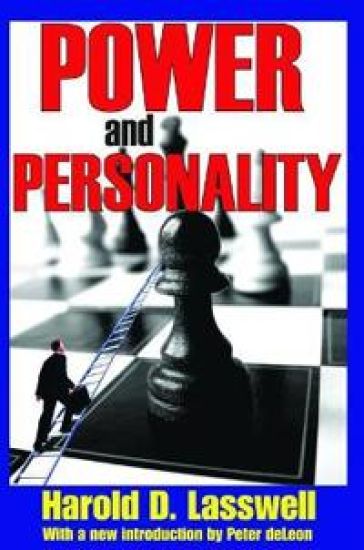
This book concerns the wanting, getting, and giving of power. Recent advances in medicine, sociology, and psychology have deepened our understanding of the motives, skills, and experience that operate between leaders and those who are led. Since power is about decision-making, it figures not only in offi cial institutions but in other organizations, including political parties, pressure groups, trade associations, business enterprises, trade unions, and many other types of organizations. A general theory of the political personality is set forth here. Lasswell describes the process by which power becomes a value of first importance and the way appropriate skills in exercising power are acquired. He shows that special political types such as agitators or administrators are related to basic types of character that contribute to how they lead. Finally, his analysis offers original perspectives to understand democratic leadership. Lasswell offers definite suggestions for perfecting "self-observatories" in national and world affairs and for forming democratic personalities, selecting and training democratic leaders, and reducing destructive conflicts in human relationships. Power and Personality followed the author's 1930 work Psychopathology and Politics, which was widely hailed for its pioneering approach. Power and Personality reevaluated the entire issue of the relationship between psychology and politics in the light of subsequent experience and scientific developments since publication of that earlier work. Lasswell's ideas continue to carry great weight and persuasiveness.
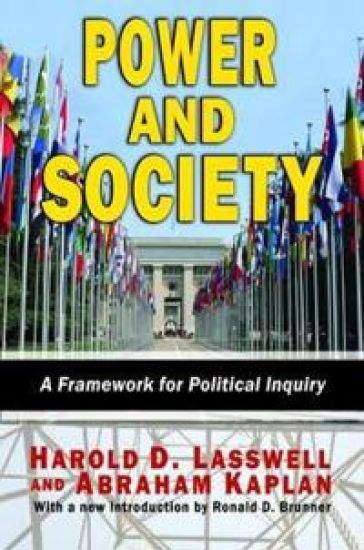
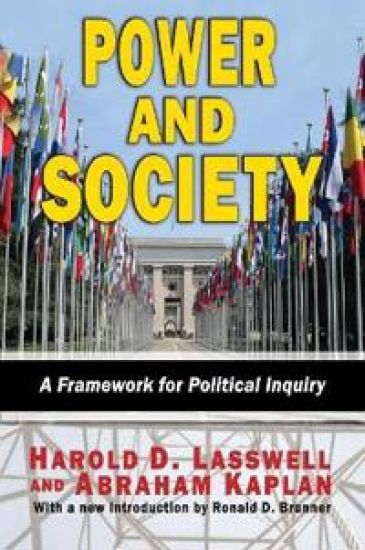
In Power and Society, Harold D. Lasswell collaborates with a brilliant young philosopher, Abraham Kaplan, to formulate basic theoretical concepts and hypotheses of political science, providing a framework for further inquiry into the political process. This is a classic book of political theory written by two of the most influential social scientists of the twentieth century. The authors find their subject matter in interpersonal relations, not abstract institutions or organizations, and their analysis of power is related to human values. They argue that revolution is a part of the political process, and ideology has a role in political affairs. The importance of class, both as social fact and social symbol, is reflected in their detailed analysis, and emphasis on merit rather than rank, skill rather than status, as keystones of democratic rule. The authors note that power is only one of the values and instruments manifested in interpersonal relations; it cannot be understood in abstraction from other values. Lasswell and Kaplan call for the replacement of "power politics," both in theory and in practice, by a conception in which attention is focused on the human consequences of power as the major concern of both political thought and political action. The basic discussions of core concepts in political science make Power and Society of continuing importance to scholars, government officials, and politicians.
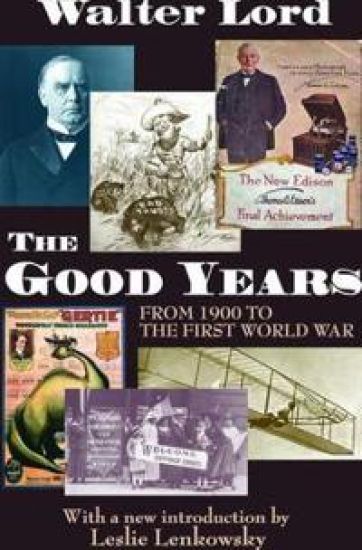
The period between 1900 and the First World War could be called the Confident Years, the Buoyant Years, the Spirited Years, or named after some bright, hopeful color, like the Golden Years. It could be done, but such tags are the invention of pundits, social historians, and professional name coiners. To the many varied people who lived through the era - the men and women who wistfully recall marching for suffrage, rebuilding San Francisco, or cheering wildly for Woodrow Wilson - the age was remembered as the Good Years. It was a time of triumph (the Wright brothers) and of tragedy (the Titanic). Days of wealth (a $200,000 ball) and of poverty (a child in a cotton mill earning $3.54 a week). But through it all ran an exciting thread of boundless confidence and hope. No one ever accused the people of that period of national indifference. It is this spirit of uncontested optimism, along with the pageant of great events, that makes this book such rewarding reading. In gathering his material, Walter Lord pored over letters, diaries, unpublished reminiscences, even Pinkerton reports, filled with fascinating and, until now, unknown detail. He traveled thousands of miles and interviewed the people who lived through the period. He met with individuals who firmly believed they had been given the greatest experience anyone could ever have; they knew and enjoyed the years when there was no limit to what we could and would do. Lord's attention to first-hand sources makes this book vivid and timeless. And Leslie Lenkowsky's new introduction adds contemporary dimension to this classic work.
Harold D. Lasswell is arguably the quintessential face of political science to the larger public of the past century. However, there is a side to Lasswell less well known, but of special importance in this day and age: the place of the profession of politics as an academic activity. This book, written at the start of the culture wars thirty years ago, outlines the basic core position of political science practitioners. It helps to explain why the field kept its collective cool, when other social science professionals veered to more extreme activist positions. The Future of Political Science grew out of the phenomenally rapid expansion of the study of government in the United States and elsewhere. The study of professionalism among physical scientists, lawyers, engineers, etc. was not matched by such internal examination within the social sciences until much later. Lasswell's overview centered on developments in the United States. There unfettered study of government reached unprecedented heights in the final stage of the twentieth century. The key concept of this volume, one that continues to inform discourse, is the relationship of political science as a mechanism for the study and teaching of the political system to the field as a tool of the Establishment. This concern grew in the wake of a variety of scandals and secret support sponsored by both government and non-government organizations alike. The Future of Political Science covers areas ranging from membership size and disparities, intervention scenarios in world events, the nature of creativity in political research collaboration in projects with the other social sciences, and the location of scientific centers of gravity in the study of politics. Because of Lasswell's works we have a field of the political science of knowledge as well as the sociology of knowledge. Harold D. Lasswell served as Ford Foundation Professor of the Social Sciences at Yale University, Distinguished Professor of Policy Sciences at John Jay College of the City University of New York, and as professor of political science at the University of Chicago. He was a past president of the American Political Science Association and author of many books covering the full range of political and policy research. Jay Stanley is professor emeritus of sociology at Towson State University. He is former editor of Armed Forces & Society, and co-author of Challenges in Military Health Care.
Propaganda, Communication and Public Opinion
Bruce Lannes Smith; Harold D. Lasswell
Princeton University Press
2016
sidottu
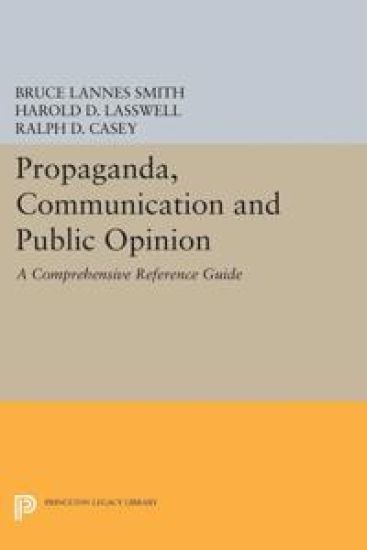
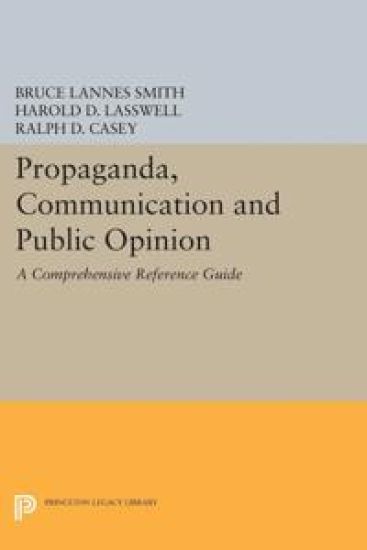
"The most comprehensive bibliography yet published in the public opinion field." --Journalism Quarterly. Besides a selection of the most significant titles from earlier years, this book contains a comprehensive listing of books, pamphlets, and articles which appeared between 1934 and 1943. Originally published in 1946. The Princeton Legacy Library uses the latest print-on-demand technology to again make available previously out-of-print books from the distinguished backlist of Princeton University Press. These editions preserve the original texts of these important books while presenting them in durable paperback and hardcover editions. The goal of the Princeton Legacy Library is to vastly increase access to the rich scholarly heritage found in the thousands of books published by Princeton University Press since its founding in 1905.
Propaganda, Communication and Public Opinion
Bruce Lannes Smith; Harold D. Lasswell
Princeton University Press
2015
pokkari
"The most comprehensive bibliography yet published in the public opinion field." --Journalism Quarterly. Besides a selection of the most significant titles from earlier years, this book contains a comprehensive listing of books, pamphlets, and articles which appeared between 1934 and 1943. Originally published in 1946. The Princeton Legacy Library uses the latest print-on-demand technology to again make available previously out-of-print books from the distinguished backlist of Princeton University Press. These editions preserve the original texts of these important books while presenting them in durable paperback and hardcover editions. The goal of the Princeton Legacy Library is to vastly increase access to the rich scholarly heritage found in the thousands of books published by Princeton University Press since its founding in 1905.
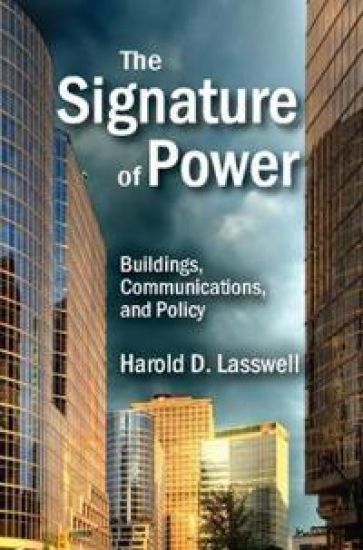
Advanced industrial societies are becoming aware of the impact of what they do to the physical and biological environment, and also what that environment does to individuals. In The Signature of Power, Harold D. Lasswell examines the symbolic use people make of their surroundings and the complexity of the way they interpret an altered environment. Transformed habitats can change experiences and behaviours. All people seek to maximize their preferred events, such as power and wealth, when they use the environment—be it through glass skyscrapers or Gothic estates. In all cases, physical structures give expression to the perspectives of influential individuals and groups. This volume considers the complex interplay between the material and the symbolic. Physical changes introduced for political purposes by architects, planners, and engineers are guided by the perspectives of designers. These and other interactions in human society are simultaneous acts of communication and collaboration. Regardless of whether physical resources are used to transmit messages, such interactions nevertheless have a degree of communicative impact. Physical structures may be profoundly affected by the purposes, assumptions, and identities of those people who plan or change them. Environmental design, says Lasswell, is an instrument of political power.
Propaganda Technique in the World War
Harold D Lasswell
Martino Fine Books
2013
pokkari
Halvin toimitettuna 29,40 €
In Power and Society, Harold D. Lasswell collaborates with a brilliant young philosopher, Abraham Kaplan, to formulate basic theoretical concepts and hypotheses of political science, providing a framework for further inquiry into the political process. This is a classic book of political theory written by two of the most influential social scientists of the twentieth century. The authors find their subject matter in interpersonal relations, not abstract institutions or organizations, and their analysis of power is related to human values. They argue that revolution is a part of the political process, and ideology has a role in political affairs. The importance of class, both as social fact and social symbol, is reflected in their detailed analysis, and emphasis on merit rather than rank, skill rather than status, as keystones of democratic rule. The authors note that power is only one of the values and instruments manifested in interpersonal relations; it cannot be understood in abstraction from other values. Lasswell and Kaplan call for the replacement of "power politics," both in theory and in practice, by a conception in which attention is focused on the human consequences of power as the major concern of both political thought and political action. The basic discussions of core concepts in political science make Power and Society of continuing importance to scholars, government officials, and politicians.
In spite of a cascade of criticism launched against the social sciences, they have brought a qualitative improvement in method and theory to the study of human beings and human relations. In the process of developing now commonplace foundations of social research few individuals have exercised a greater role in justifying and enriching social scientific thought and practice than Harold D. Lasswell. Originally published in 1945 as The Analysis of Political Behaviour, this extraordinary volume has been re-titled Legal Education and Public Policy. The selections acknowledge Lasswell's growing anxieties about a world of revolution, violence, and terror, and the frailties of law in addressing such matters. That he did so without recourse to vague and fatuous appeals to world law and world order is an indication of how close to empirical realities he remained. Lasswell's essays fuse the legal and moral in the conduct of public policy. This did not deter him from arguing the case for and ultimate benefits of democratic values as a ground for legal thought. Lasswell singles out the interviewing technique of the psychiatrist, what he calls 'the insight interview' in many of these essays. The Freudian world opened up the possibilities of analysis to political scientists who, prior to Lasswell, viewed neuroses in the leaders they studied but without normative points to measure their own biases. Lasswell's essays serve as a landmark in accelerating rapid advance in social science research. It allowed for the evolution of political behavior that has catapulted the field to a major dimension of political science studies in leadership and mass persuasion.
Building a Moral Reserve: Or the Civic Responsibilities of the Christian Citizen
Shailer Mathews; Andrew C. McLaughlin; Harold D. Lasswell
Literary Licensing, LLC
2011
nidottu