
Kirjojen hintavertailu – 12 859 818 kirjaa ja 27 kauppaa
Kirjailija
Havelock Ellis
Kirjat ja teokset yhdessä paikassa: 304 kirjaa, julkaisuja vuosilta 1973–2026, suosituimpiin kuuluu Three modern seers: James Hinton, Nietzsche, Edward Carpenter (1910). By: Mrs. Havelock Ellis: Edith Mary Oldham Ellis (née Lees; 1861, Ma. Vertaile teosten hintoja ja tarkista saatavuus suomalaisista kirjakaupoista.
This is a new edition of "The New Spirit," originally published in 1892 by Walter Scott, Ltd., of London. Part of Adeptio's "The Best of Havelock Ellis Collection," from the "Unforgettable Classic Series," this is not a facsimile reprint. Obvious typographical errors have been carefully corrected and the entire text has been reset and redesigned by Adeptio Editions to enhance readability, while respecting the original edition. "The New Spirit" was Havelock Ellis' first book, a collection of literary essays on Diderot, Heine, Whitman, Ibsen, and Tolstoi, originally published in 1890. The book explores "the new spirit" that has come into the world. Showing deep understanding of his times, Ellis discusses the sciences of anthropology, sociology, and political science; the increasing importance of women-which he believed to be the most significant movement of his time-the approaching disappearance of war, and art and religion as a means to seek rest. This is the original third edition. "The New Spirit" is considered one of Havelock's masterpieces and helped establish Havelock's reputation throughout the world. About the Author: Havelock Ellis was a social activist, a physician and a psychologist, whose best-known works concern sexuality and criminology. Among his over forty books, in 1890 he published "The Criminal," a remarkable work on criminal anthropology. In the same year, he published "The New Spirit," a collection of literary essays on Diderot, Heine, Whitman, Ibsen, and Tolstoy, and Ellis's attempt to synthesize science and religious mysticism. In 1898 he wrote "Affirmations," which contains essays on Nietzsche, Casanova, Zola, Huysmans, and St. Francis. In 1897, he published "Sexual Inversion," the first medical text in English about homosexuality, which he had co-authored with John Addington Symonds in an earlier edition, and which became a part of Ellis's six-volume "Studies in the Psychology of Sex." In 1922, he published "Little Essays of Love and Virtue," which aimed primarily at young people, youths and girls at the period of adolescence, who were in the author's thoughts in all the studies he wrote of sex because he was of that age when he first vaguely planned them. These titles are part of our "Unforgettable Classic Series: The Best of Havelock Ellis Collection." Born in Surrey, England, in 1859, Havelock Ellis was considered by the overwhelming majority of critics as the best translator of "Germinal," mile Zola s masterpiece. Ellis was associated with the Decadent movement and with the "Lutetian Society," a secret literary society, through which authors and translators like himself were able to provide British readers with translations of works which were often antagonistic to the Victorian ideals of morality-such as some of mile Zola's controversial novels-aiming at expanding the cultural horizons of the few lucky readers who had access to them. Havelock Ellis died in Suffolk, England, in 1939.
This is a new edition of "Sexual Inversion," originally published in 1915 by F. A. Davis Company, Publishers, of Philadelphia. Part of Adeptio's "The Best of Havelock Ellis Collection," from the "Unforgettable Classic Series," this is not a facsimile reprint. Obvious typographical errors have been carefully corrected and the entire text has been reset and redesigned by Adeptio Editions to enhance readability, while respecting the original edition. "Sexual Inversion" was the first English medical textbook on the topic of homosexuality. The book became a part of Ellis's six-volume "Studies in the Psychology of Sex." Havelock Ellis and John Addington Symonds agreed to collaborate on a new study that would combine Symonds's historical analysis on homosexuality with Ellis's experience with medical and scientific theory. Symonds died in 1893 before the book was concluded. "Sexual Inversion" was first published in German in 1896 (Leipzig, by Georg H. Wigand's Verlag) entitled "Das Kontr re Geschlechtsgef hl," under Havelock Ellis and John Addington Symonds. Ellis further revised the text and edited several of Symonds's contributions, with almost every page being rewritten or enlarged. This is the third edition. "Sexual Inversion" is considered one of Havelock's masterpieces and helped establish Havelock's reputation throughout the world. About the Author: Havelock Ellis was a social activist, a physician and a psychologist, whose best-known works concern sexuality and criminology. Among his over forty books, in 1890 he published "The Criminal," a remarkable work on criminal anthropology. In the same year, he published "The New Spirit," a collection of literary essays on Diderot, Heine, Whitman, Ibsen, and Tolstoy, and Ellis's attempt to synthesize science and religious mysticism. In 1898 he wrote "Affirmations," which contains essays on Nietzsche, Casanova, Zola, Huysmans, and St. Francis. In 1897, he published "Sexual Inversion," the first medical text in English about homosexuality, which he had co-authored with John Addington Symonds in an earlier edition, and which became a part of Ellis's six-volume "Studies in the Psychology of Sex." In 1922, he published "Little Essays of Love and Virtue," which aimed primarily at young people, youths and girls at the period of adolescence, who were in the author's thoughts in all the studies he wrote of sex because he was of that age when he first vaguely planned them. These titles are part of our "Unforgettable Classic Series: The Best of Havelock Ellis Collection." Born in Surrey, England, in 1859, Havelock Ellis was considered by the overwhelming majority of critics as the best translator of "Germinal," mile Zola s masterpiece. Ellis was associated with the Decadent movement and with the "Lutetian Society," a secret literary society, through which authors and translators like himself were able to provide British readers with translations of works which were often antagonistic to the Victorian ideals of morality-such as some of mile Zola's controversial novels-aiming at expanding the cultural horizons of the few lucky readers who had access to them. Havelock Ellis died in Suffolk, England, in 1939.

This is a new edition of "Little Essays of Love and Virtue," originally published in 1922 by George H. Doran Company, of New York. Part of Adeptio's Unforgettable Classic Series, this is not a facsimile reprint. Obvious typographical errors have been carefully corrected and the entire text has been reset and redesigned by Adeptio Editions to enhance readability, while respecting the original edition. In "Little Essays of Love and Virtue," Havelock Ellis set forth certain fundamental principles, together with their practical application to the life of the early twentieth century. Many principles are stated, some technically; others were therein implied but only to be read between the lines. Here, the author expressed them in simple language and with some rich detail. The book touches on important topics such as Children and Parents, The Meaning of Purity, The Objects of Marriage, Husbands and Wives, The Love-Rights of Women, The Play-Function of Sex, and The Individual and the Race. "Little Essays of Love and Virtue" is aimed primarily at young people, youths and girls at the period of adolescence "who were in the author's thoughts in all the studies he wrote of sex because he was of that age when he first vaguely planned them." "Little Essays of Love and Virtue," is considered one of Havelock's masterpieces and helped establish Havelock's reputation throughout the world. About the Author: Havelock Ellis was a social activist, a physician and a psychologist, whose best-known works concern sexuality and criminology. Among his over forty books, in 1890 he published "The Criminal," a remarkable work on criminal anthropology. In the same year, he published "The New Spirit," a collection of literary essays on Diderot, Heine, Whitman, Ibsen, and Tolstoy, and Ellis's attempt to synthesize science and religious mysticism. In 1898 he wrote "Affirmations," which contains essays on Nietzsche, Casanova, Zola, Huysmans, and St. Francis. In 1897, he published "Sexual Inversion," the first medical text in English about homosexuality, which he had co-authored with John Addington Symonds in an earlier edition, and which became a part of Ellis's six-volume "Studies in the Psychology of Sex." In 1922, he published "Little Essays of Love and Virtue," which aimed primarily at young people, youths and girls at the period of adolescence, who were in the author's thoughts in all the studies he wrote of sex because he was of that age when he first vaguely planned them. These titles are part of our "Unforgettable Classic Series: The Best of Havelock Ellis Collection." Born in Surrey, England, in 1859, Havelock Ellis was considered by the overwhelming majority of critics as the best translator of "Germinal," mile Zola s masterpiece. Ellis was associated with the Decadent movement and with the "Lutetian Society," a secret literary society, through which authors and translators like himself were able to provide British readers with translations of works which were often antagonistic to the Victorian ideals of morality-such as some of mile Zola's controversial novels-aiming at expanding the cultural horizons of the few lucky readers who had access to them. Havelock Ellis died in Suffolk, England, in 1939.
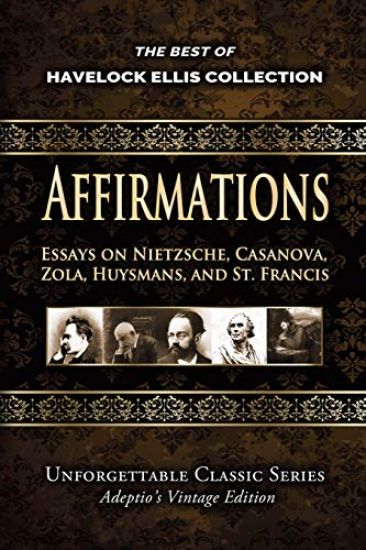
This is a new edition of "Affirmations," originally published in 1915 by Houghton Mifflin, of New York. Part of Adeptio's "The Best of Havelock Ellis Collection," from the "Unforgettable Classic Series," this is not a facsimile reprint. Obvious typographical errors have been carefully corrected and the entire text has been reset and redesigned by Adeptio Editions to enhance readability, while respecting the original edition. "The final value of any book is not in the beliefs which it may give us or take away from us, but in its power to reveal to us our own selves. If I can stimulate any one in the search for his own affirmations, he and I may well rest content. Only with the help of such affirmations can we find a staff to comfort us through the valley of life." This paragraph from the preface to "Affirmations" is an epitome of the entire work. It sums up the philosophy of Havelock Ellis-individualism, in the highest sense of the word. "Affirmations" was first published in 1898, and it is now reprinted, without any changes-except for another remarkable preface. Like Bernard Shaw, Havelock Ellis often gives us the meat of his work in a preface. Mr. Ellis admits that he has deliberately failed to bring his book up-to-date. "We are concerned here," he says, "with an attempt to pierce to the core of numerous vital questions, using certain intensely vital instruments to aid us in that task. What became of those instruments at last happens not to matter at all. Dates have their interest. But what are biographical dictionaries for?" The book consists of five studies-of Nietzsche, Zola, Huysmans, Casanova, and St. Francis of Assisi. Discussing each of these men in his usual brilliant manner, Havelock Ellis gives us five passionate sermons on individualism. But these sermons are most unsermon-like. They are merely outpourings of the author's ideas, as suggested by five great individualists. There is nothing preachy or sweetly sentimental about the studies. They are frank, unconventional, penetrating essays-rich in eloquence and spiritual vigor. In Nietzsche, Mr. Ellis finds that "love of life which accepts reality without too much theorizing about it." Nietzsche, we are told, shunned Plato, for Plato was "the coward who fled from the real unto the unreal." Nietzsche believed in pain, because it throws us back on our own naked personalities, face to face with reality. Mr. Ellis describes Nietzsche's ideal man: "the brave, laconic, self-contained man; not lusting after self-expression, hating fanticism, shunning notoriety and knowing how to smile." From Nietzsche, then, Mr. Ellis draws these affirmations: Be hard, be self-reliant, be unafraid, and be original. And so Mr. Ellis takes up the others-Casanova, Zola, Huysmans, and St. Francis. From each of them he draws substantially the same affirmations as Nietzsche inspired. But in each someone feature is predominant. In Casanova, it is the fearlessness and fullness of life; in Zola it is the reality and thoroughness of life; in Huysmans it is the beauty of life as perceived through the senses; and, finally, in St. Francis of Assisi it is the hardihood and joyful suffering of life. His concluding words are: "Our feet cling to the earth, and it is well that we should be able to grip it closely and nakedly. But the earth beneath us is not all nature; there are instincts which lead elsewhere, and it is part of the art of living to use naturally all those instincts. And for us, as for him who wrote "De Imitatione Christi" there are still two wings whereby we may raise ourselves above the earth, simplicity and purity." (Columbia Daily Spectator, Volume LIX, Number 30, 1 November 1915.) Among some of Havelock's great books, Affirmations is also considered one of his masterpieces and helped establish his reputation throughout the world.
Rare edition with unique illustrations and elegant classic cream paper. Henry Havelock Ellis, known as Havelock Ellis (2 February 1859 - 8 July 1939), was an English physician, writer, progressive intellectual and social reformer who studied human sexuality. He was co-author of the first medical textbook in English on homosexuality in 1897, and also published works on a variety of sexual practices and inclinations, as well as transgender psychology. He is credited with introducing the notions of narcissism and autoeroticism, later adopted by psychoanalysis. Like many intellectuals of his era, he supported eugenics and he served as president of the Eugenics Society. A concise introduction to sexual psychology primarily intended for medical readers and students but also aimed at a wider audience with its expert guidance and advice on numerous sexual topics. Ellis' Studies in the Psychology of Sex is a comprehensive and groundbreaking encyclopaedia of human sexual biology, behaviour, and attitudes. In separate volumes he examined such topics as homosexuality, masturbation, and the physiology of sexual behaviour. Ellis viewed sexual activity as the healthy and natural expression of love, and he sought to dissipate the fear and ignorance that characterized many people's attitudes toward human sexuality. His work helped to foster the open discussion of sexual problems, and he became known as a champion of women's rights and of sex education. Contents Volume 4 include: SEXUAL SELECTION IN MAN: I. TOUCH. II. SMELL. III. HEARING. IV. VISION. Includes illustration
Rare edition with unique illustrations and elegant classic cream paper. Henry Havelock Ellis, known as Havelock Ellis (2 February 1859 - 8 July 1939), was an English physician, writer, progressive intellectual and social reformer who studied human sexuality. He was co-author of the first medical textbook in English on homosexuality in 1897, and also published works on a variety of sexual practices and inclinations, as well as transgender psychology. He is credited with introducing the notions of narcissism and autoeroticism, later adopted by psychoanalysis. Like many intellectuals of his era, he supported eugenics and he served as president of the Eugenics Society. A concise introduction to sexual psychology primarily intended for medical readers and students but also aimed at a wider audience with its expert guidance and advice on numerous sexual topics. Ellis' Studies in the Psychology of Sex is a comprehensive and groundbreaking encyclopaedia of human sexual biology, behaviour, and attitudes. In separate volumes he examined such topics as homosexuality, masturbation, and the physiology of sexual behaviour. Ellis viewed sexual activity as the healthy and natural expression of love, and he sought to dissipate the fear and ignorance that characterized many people's attitudes toward human sexuality. His work helped to foster the open discussion of sexual problems, and he became known as a champion of women's rights and of sex education. Contents Volume 3 include: ANALYSIS OF THE SEXUAL IMPULSE. LOVE AND PAIN. THE SEXUAL IMPULSE IN WOMEN. Includes illustration
Rare edition with unique illustrations and elegant classic cream paper. Henry Havelock Ellis, known as Havelock Ellis (2 February 1859 - 8 July 1939), was an English physician, writer, progressive intellectual and social reformer who studied human sexuality. He was co-author of the first medical textbook in English on homosexuality in 1897, and also published works on a variety of sexual practices and inclinations, as well as transgender psychology. He is credited with introducing the notions of narcissism and autoeroticism, later adopted by psychoanalysis. Like many intellectuals of his era, he supported eugenics and he served as president of the Eugenics Society. A concise introduction to sexual psychology primarily intended for medical readers and students but also aimed at a wider audience with its expert guidance and advice on numerous sexual topics. Ellis' Studies in the Psychology of Sex is a comprehensive and groundbreaking encyclopaedia of human sexual biology, behaviour, and attitudes. In separate volumes he examined such topics as homosexuality, masturbation, and the physiology of sexual behaviour. Ellis viewed sexual activity as the healthy and natural expression of love, and he sought to dissipate the fear and ignorance that characterized many people's attitudes toward human sexuality. His work helped to foster the open discussion of sexual problems, and he became known as a champion of women's rights and of sex education. Contents Volume 6 include: SEX IN RELATION TO SOCIETY Includes illustration
Rare edition with unique illustrations and elegant classic cream paper. Henry Havelock Ellis, known as Havelock Ellis (2 February 1859 - 8 July 1939), was an English physician, writer, progressive intellectual and social reformer who studied human sexuality. He was co-author of the first medical textbook in English on homosexuality in 1897, and also published works on a variety of sexual practices and inclinations, as well as transgender psychology. He is credited with introducing the notions of narcissism and autoeroticism, later adopted by psychoanalysis. Like many intellectuals of his era, he supported eugenics and he served as president of the Eugenics Society. A concise introduction to sexual psychology primarily intended for medical readers and students but also aimed at a wider audience with its expert guidance and advice on numerous sexual topics. Ellis' Studies in the Psychology of Sex is a comprehensive and groundbreaking encyclopaedia of human sexual biology, behaviour, and attitudes. In separate volumes he examined such topics as homosexuality, masturbation, and the physiology of sexual behaviour. Ellis viewed sexual activity as the healthy and natural expression of love, and he sought to dissipate the fear and ignorance that characterized many people's attitudes toward human sexuality. His work helped to foster the open discussion of sexual problems, and he became known as a champion of women's rights and of sex education. Contents Volume 5 include: EROTIC SYMBOLISM THE MECHANISM OF DETUMESCENCE THE PSYCHIC STATE IN PREGNANCY Includes illustration
Rare edition with unique illustrations and elegant classic cream paper. Henry Havelock Ellis, known as Havelock Ellis (2 February 1859 - 8 July 1939), was an English physician, writer, progressive intellectual and social reformer who studied human sexuality. He was co-author of the first medical textbook in English on homosexuality in 1897, and also published works on a variety of sexual practices and inclinations, as well as transgender psychology. He is credited with introducing the notions of narcissism and autoeroticism, later adopted by psychoanalysis. Like many intellectuals of his era, he supported eugenics and he served as president of the Eugenics Society. A concise introduction to sexual psychology primarily intended for medical readers and students but also aimed at a wider audience with its expert guidance and advice on numerous sexual topics. Ellis' Studies in the Psychology of Sex is a comprehensive and groundbreaking encyclopaedia of human sexual biology, behaviour, and attitudes. In separate volumes he examined such topics as homosexuality, masturbation, and the physiology of sexual behaviour. Ellis viewed sexual activity as the healthy and natural expression of love, and he sought to dissipate the fear and ignorance that characterized many people's attitudes toward human sexuality. His work helped to foster the open discussion of sexual problems, and he became known as a champion of women's rights and of sex education. Contents Volume 2 include: SEXUAL INVERSION. Includes illustration
Rare edition with unique illustrations and elegant classic cream paper. Henry Havelock Ellis, known as Havelock Ellis (2 February 1859 - 8 July 1939), was an English physician, writer, progressive intellectual and social reformer who studied human sexuality. He was co-author of the first medical textbook in English on homosexuality in 1897, and also published works on a variety of sexual practices and inclinations, as well as transgender psychology. He is credited with introducing the notions of narcissism and autoeroticism, later adopted by psychoanalysis. Like many intellectuals of his era, he supported eugenics and he served as president of the Eugenics Society. A concise introduction to sexual psychology primarily intended for medical readers and students but also aimed at a wider audience with its expert guidance and advice on numerous sexual topics. Ellis' Studies in the Psychology of Sex is a comprehensive and groundbreaking encyclopaedia of human sexual biology, behaviour, and attitudes. In separate volumes he examined such topics as homosexuality, masturbation, and the physiology of sexual behaviour. Ellis viewed sexual activity as the healthy and natural expression of love, and he sought to dissipate the fear and ignorance that characterized many people's attitudes toward human sexuality. His work helped to foster the open discussion of sexual problems, and he became known as a champion of women's rights and of sex education. Contents Volume 1 include: THE EVOLUTION OF MODESTY. THE PHENOMENA OF SEXUAL PERIODICITY. AUTO-EROTISM: A STUDY OF THE SPONTANEOUS MANIFESTATIONS OF THE SEXUAL IMPULSE. Includes illustration
From the point of view of literature, the Great War of to-day has brought us into a new and closer sympathy with the England of the past. Dr. Woods and Mr. Baltzly in their recent careful study of European Warfare, Is War Diminishing? come to the conclusion that England during the period of her great activity in the world has been "fighting about half the time." We had begun to look on war as belonging to the past and insensibly fallen into the view of Buckle that in England "a love of war is, as a national taste, utterly extinct." Now we have awakened to realise that we belong to a people who have been "fighting about half the time." Thus it is, for instance, that we witness a revival of interest in Wordsworth, not that Wordsworth, the high-priest of Nature among the solitary Lakes, whom we have never forsaken, but the Wordsworth who sang exultantly of Carnage as God's Daughter. To-day we turn to the war-like Wordsworth, the stern patriot hurling defiance at the enemies who threatened our island fortress, as the authentic voice of England. But this new sense of community with the past comes to us again and again on every hand when to-day we look back to the records of the past.
This work has been selected by scholars as being culturally important, and is part of the knowledge base of civilization as we know it. This work was reproduced from the original artifact, and remains as true to the original work as possible. Therefore, you will see the original copyright references, library stamps (as most of these works have been housed in our most important libraries around the world), and other notations in the work. This work is in the public domain in the United States of America, and possibly other nations. Within the United States, you may freely copy and distribute this work, as no entity (individual or corporate) has a copyright on the body of the work. As a reproduction of a historical artifact, this work may contain missing or blurred pages, poor pictures, errant marks, etc. Scholars believe, and we concur, that this work is important enough to be preserved, reproduced, and made generally available to the public. We appreciate your support of the preservation process, and thank you for being an important part of keeping this knowledge alive and relevant.
Complete digitally restored reprint (facsimile handmade reproduction) of the original edition of 1901 (third edition, revised and enlarged) with excellent resolution and outstanding readability. The layout is +70% larger as the original for a better readability. With a digital original autograph by Havelock Ellis. With over 50 pictures and many other illustrations.