
Kirjailija
Heinrich Heine
Kirjat ja teokset yhdessä paikassa: 857 kirjaa, julkaisuja vuosilta 1887–2026, suosituimpiin kuuluu Achim d'Arnim. Vertaile teosten hintoja ja tarkista saatavuus suomalaisista kirjakaupoista.
857 kirjaa
Kirjojen julkaisuvuodet: 1887–2026.

Schuber
This work has been selected by scholars as being culturally important, and is part of the knowledge base of civilization as we know it. This work was reproduced from the original artifact, and remains as true to the original work as possible. Therefore, you will see the original copyright references, library stamps (as most of these works have been housed in our most important libraries around the world), and other notations in the work. This work is in the public domain in the United States of America, and possibly other nations. Within the United States, you may freely copy and distribute this work, as no entity (individual or corporate) has a copyright on the body of the work. As a reproduction of a historical artifact, this work may contain missing or blurred pages, poor pictures, errant marks, etc. Scholars believe, and we concur, that this work is important enough to be preserved, reproduced, and made generally available to the public. We appreciate your support of the preservation process, and thank you for being an important part of keeping this knowledge alive and relevant.
A translation of Heinrich Heine's love poems. This bilingual edition includes an introduction by Heine scholar Jeffrey L. Sammons. The author aims to capture the meaning of the original, but preserve the poems' rhyme schemes as well as their moods.
Die 'Reisebilder' sind Notizen eines Tausendsassas, der durch die Welt stürmt, immer exakt hinsieht und genau zuhört, um dann alles in noch schärfere Worte zu fassen; böse, ironisch, liebevoll, genial.

Die Hegelsche Linke: Texte Aus Den Werken Von Heinrich Heine, Arnold Ruge, Moses Hess, Max Stirner, Bruno Bauer, Ludwig Feuerbach, Karl Mar
Bruno Bauer; Ludwig Feuerbach; Heinrich Heine
Frommann-Holzboog
1988
sidottu
Einleitung von K. Lowith: Philosophische Theorie und geschichtliche Praxis in der Philosophie der Linkshegelianer - H. Heine: (Aus: ) Zur Geschichte der Religion und Philosophie in Deutschland (1834) - A. Ruge: (Aus: ) Unsere letzten zehn Jahre (1845) - M. Hess: (Aus: ) Die letzten Philosophen (1845) - M. Stirner: Menschen der alten und neuen Zeit. (Aus: ) Der Einzige und sein Eigentum (1844) - B. Bauer: I. (Aus: ) Russland und das Germanenthum (1853); II. Die Posaune des jungsten Gerichts uber Hegel den Atheisten und Antichristen (1841) - L. Feuerbach: I. Grundsatze der Philosophie, Notwendigkeit einer Veranderung (1842/43); II. Feuerbachs Verhaltnis zu Hegel (1840), mit spateren Zusatzen - K. Marx: I. Aus der Doktordissertation (1840); II. Aus den Deutsch-Franzosischen Jahrbuchern (1843/44) - S. Kierkegaard: I. (Aus: ) Die Tagebucher; II. Das Eine, was not tut (1847/48); III. Agitatorische Schriften und Aufsatze (1851-1855); IV. (Aus: ) Kritik der Gegenwart
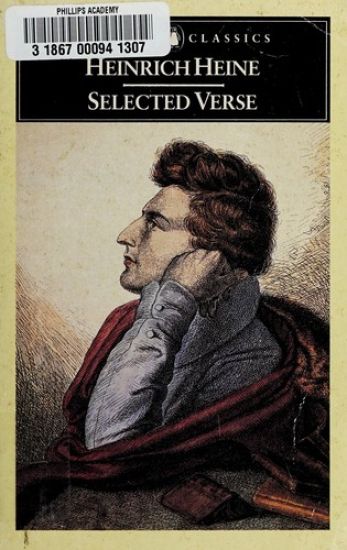
'One of the first men of this century' is how Heine described himself when he claimed to have been born in the early hours of 1800. It was typical of Heine to create this humorous doubt - he was in fact born in 1797. He was a restless and homeless poet, a Jew among Germans, a German in Paris, a rebel among the bourgeoisie and always, as his famous doppelgänger poems show, a man divided against himself. This selection, with the German originals accompanied by English prose translations, provides the perfect introduction to Heine. He can be magnificent as an acute, irreverent commentator on politics and current events, though his genius most often strikes home in the poems filled with despair, or sensuality, or sweetness, or self-mockery, in which he draws out the whole gamut of emotions provoked by love and immanent death.
During the last 25 years of his life, Heinrich Heine lived in Paris for the most part, and there he contributed to the Revue de Deux Mondes a series of prose articles on the religious and political history of Germany, a subject in which he had a deep and lasting interest. Those articles, collected here, cover the period from the Middle Ages to Hegel.


Im September 1826 unternahm Heine eine Fussreise von Göttingen durch den Harz bis nach Jena, von wo er schliesslich seine Reise nach Weimar zu Goethe fortsetzte. Seine Reiseeindrücke hielt er noch im selben Jahr unter dem Titel "Die Harzreise" fest. Doch als reine Reisebeschreibung hätte "Die Harzreise" sicher keinen Eingang in die Literaturgeschichte gefunden. Bekannt geworden ist das Werk durch seine versteckte Kritik an der Gesellschaft des Vormärz und der politischen Situation Anfang des 19. Jahrhunderts, d. h. in Zeiten der Restauration. Doch trotz seiner geschickten Vermischung von Natur- und Städtebeschreibungen und gesellschaftlicher und politischer Kritik wurde das Werk später, wie von Heine bereits befürchtet, durch die preussische Zensur stark entstellt. So schrieb er bereits vor der Zensur in seinem typisch sarkastischen Ton: "Ich bin neugierig, wie viel Tannenbäume die Censur auf dem Oberharze streichen wird". "Die Harzreise" begründete eine Reihe von Reisebildern, auf die später noch der Titel "Die Nordsee" und das bekannte Versepos "Deutschland. Ein Wintermärchen" (beide ebenfalls als Hamburger Lesehefte erhältlich) folgen sollten. Worterklärungen und ein Nachwort mit Informationen über Leben und Werk Heinrich Heines vervollständigen die Ausgabe.



Dichtungen: Mit Einem Bisher Unbekannten Bildnis Des Dichters Aus Dem Jahre 1828, Einer Biographie Desselben Und Ein Verz. Der Compositionen Heinesche
Heinrich Heine
De Gruyter
1887
sidottu
Keine ausf hrliche Beschreibung f r "Dichtungen" verf gbar.