Kirjojen hintavertailu – 12 859 827 kirjaa ja 27 kauppaa

Kirjailija

Henry A. Giroux

Kirjat ja teokset yhdessä paikassa: 97 kirjaa, julkaisuja vuosilta 1987–2026, suosituimpiin kuuluu America at War with Itself. Vertaile teosten hintoja ja tarkista saatavuus suomalaisista kirjakaupoista.

97 kirjaa

Kirjojen julkaisuvuodet: 1987–2026.

Against the Terror of Neoliberalism

Against the Terror of Neoliberalism

Henry A. Giroux

Paradigm
2008
nidottu
With its dream worlds of power, commercialization, and profit making, neoliberalism has ushered in new Gilded Age in which the logic of the market now governs every aspect of media, culture, and social life-from schooling to health care to old age. As the social contract becomes a distant memory, the new "corporate state" distances itself from workers and minority groups, who become more disposable in a new age of uncertainty and manufactured fear. This is the only book to connect the history, ideology, and consequences of neoliberal policies to education and cultural issues that pervade almost every aspect of daily life. A significantly revised and updated new version of Giroux's 2003 book, The Terror of Neoliberalism, this book points to ways in which neoliberal ideology can be resisted, and how new forms of citizenship and collective struggles can be forged, to reclaim the meaning both of a substantive politics and of a democratic society. Against the Terror of Neoliberalism was featured in the New York Times in the Stanley Fish blog: Stanley Fish Blog
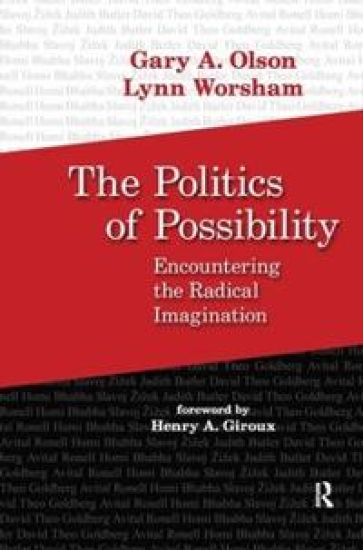
Politics of Possibility

Politics of Possibility

Gary A. Olson; Lynn Worsham; Henry A. Giroux

Paradigm
2008
nidottu
In the probing interviews in this vibrant new book, eminent scholars struggle with some of the most crucial issues facing contemporary intellectuals. Poststructuralist philosopher Judith Butler discusses the pain of rigorous intellectual work, saying that it is necessarily extremely hard labor, as she examines the intersection of discourse and political action. Award-winning filmmaker, philosopher, and social theorist David Theo Goldberg reviews his life s work, especially on issues of racism. Literary critic and feminist philosopher Avital Ronell sets out to disrupt the standard logic of signification, to force readers into fresh ways of perceiving a subject at hand. Postcolonial theorist Homi Bhabha discusses how critical literacy is intimately connected to the question of democratic representation, and he elaborates on how cultural difference can lead to a politics of discrimination. And neo-Marxist cultural critic Slavoj i ek takes readers on an exhilarating journey through a wide range of critical subjects."
Politics of Possibility

Politics of Possibility

Gary A. Olson; Lynn Worsham; Henry A. Giroux

Paradigm
2007
sidottu
In the probing interviews in this vibrant new book, eminent scholars struggle with some of the most crucial issues facing contemporary intellectuals. Poststructuralist philosopher Judith Butler discusses the pain of rigorous intellectual work, saying that it is necessarily extremely hard labor, as she examines the intersection of discourse and political action. Award-winning filmmaker, philosopher, and social theorist David Theo Goldberg reviews his life s work, especially on issues of racism. Literary critic and feminist philosopher Avital Ronell sets out to disrupt the standard logic of signification, to force readers into fresh ways of perceiving a subject at hand. Postcolonial theorist Homi Bhabha discusses how critical literacy is intimately connected to the question of democratic representation, and he elaborates on how cultural difference can lead to a politics of discrimination. And neo-Marxist cultural critic Slavoj i ek takes readers on an exhilarating journey through a wide range of critical subjects."
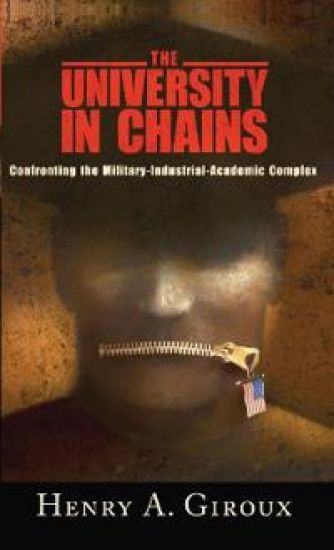
University in Chains

University in Chains

Henry A. Giroux

Paradigm
2007
sidottu
President Eisenhower originally included 'academic' in the draft of his landmark, oft-quoted speech on the military-industrial-complex. Giroux tells why Eisenhower saw the academy as part of the famous complex - and how his warning was vitally prescient for 21st-century America. Giroux details the sweeping post-9/11 assault being waged on the academy by militarization, corporatization, and right-wing fundamentalists who increasingly view critical thought itself as a threat to the dominant political order. Giroux argues that the university has become a handmaiden of the Pentagon and corporate interests, it has lost its claim to independence and critical learning and has compromised its role as a democratic public sphere. And yet, in spite of its present embattled status and the inroads made by corporate power, the defense industries, and the right wing extremists, Giroux defends the university as one of the few public spaces left capable of raising important questions and educating students to be critical and engaged agents. He concludes by making a strong case for reclaiming it as a democratic public sphere.
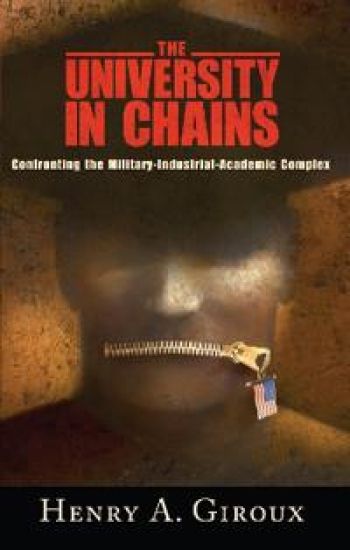
University in Chains

University in Chains

Henry A. Giroux

Paradigm
2007
nidottu
President Eisenhower originally included 'academic' in the draft of his landmark, oft-quoted speech on the military-industrial-complex. Giroux tells why Eisenhower saw the academy as part of the famous complex - and how his warning was vitally prescient for 21st-century America. Giroux details the sweeping post-9/11 assault being waged on the academy by militarization, corporatization, and right-wing fundamentalists who increasingly view critical thought itself as a threat to the dominant political order. Giroux argues that the university has become a handmaiden of the Pentagon and corporate interests, it has lost its claim to independence and critical learning and has compromised its role as a democratic public sphere. And yet, in spite of its present embattled status and the inroads made by corporate power, the defense industries, and the right wing extremists, Giroux defends the university as one of the few public spaces left capable of raising important questions and educating students to be critical and engaged agents. He concludes by making a strong case for reclaiming it as a democratic public sphere.
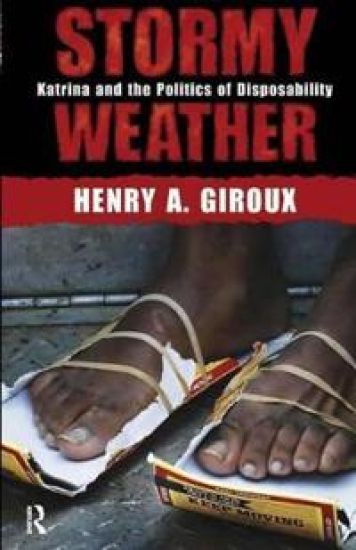
Stormy Weather

Stormy Weather

Henry A. Giroux

Paradigm
2006
nidottu
"By far the single most important account and analysis of the Katrina catastrophe." David L. Clark, McMaster University In his newest provocative book, prominent social critic Henry A. Giroux shows how the tragedy and suffering in the aftermath of Hurricane Katrina signals a much larger crisis in the United States-one that threatens the very nature of individual freedom and inclusive democracy. This crisis extends far beyond matters of leadership, governance, or the Bush administration. It is a crisis that strikes at the very heart of democracy and must be understood within a broader set of antidemocratic forces that not only made the social disaster underlying Katrina possible, but also contribute to an emerging authoritarianism in the United States. Questions regarding who is going to die and who is going to live are driving a new form of authoritarianism in the United States. Within this form of "dirty democracy" a new and more insidious set of forces-embedded in our global economy-have largely given up on the sanctity of human life, rendering some groups as disposable and privileging others. Giroux offers up a vision of hope that creates the conditions for multiple collective and global struggles that refuse to use politics as an act of war and markets as the measure of democracy. Making human beings superfluous is the essence of totalitarianism, and democracy is the antidote in urgent need of being reclaimed. Katrina will keep the hope of such a struggle alive because for many of us the images of those floating bodies serve as a desperate reminder of what it means when justice, as the lifeblood of democracy, becomes cold and indifferent.
Giroux Reader

Giroux Reader

Henry A. Giroux; Christopher G. Robbins

Paradigm
2006
nidottu
One of the world's leading social critics and educational theorists, Henry A. Giroux has contributed significantly to critical pedagogy, cultural studies, youth studies, social theory, and cultural politics. This new book offers a carefully selected cross-section of Giroux's many scholarly and popular writings, which bridge the theoretical and practical, integrate multiple academic disciplines, and fuse scholarly rigor with social relevance. The essays underscore the continuities and transformations in Giroux's thought, just as they offer invaluable approaches to understanding a range of social problems. Giroux's work suggests that a more humane and democratic world is possible and provides critical tools that can assist concerned citizens in bringing it into being.
Giroux Reader

Giroux Reader

Henry A. Giroux; Christopher G. Robbins

Paradigm
2006
sidottu
One of the world's leading social critics and educational theorists, Henry A. Giroux has contributed significantly to critical pedagogy, cultural studies, youth studies, social theory, and cultural politics. This new book offers a carefully selected cross-section of Giroux's many scholarly and popular writings, which bridge the theoretical and practical, integrate multiple academic disciplines, and fuse scholarly rigor with social relevance. The essays underscore the continuities and transformations in Giroux's thought, just as they offer invaluable approaches to understanding a range of social problems. Giroux's work suggests that a more humane and democratic world is possible and provides critical tools that can assist concerned citizens in bringing it into being.
Stormy Weather

Stormy Weather

Henry A. Giroux

Paradigm
2006
sidottu
"By far the single most important account and analysis of the Katrina catastrophe." David L. Clark, McMaster University In his newest provocative book, prominent social critic Henry A. Giroux shows how the tragedy and suffering in the aftermath of Hurricane Katrina signals a much larger crisis in the United States-one that threatens the very nature of individual freedom and inclusive democracy. This crisis extends far beyond matters of leadership, governance, or the Bush administration. It is a crisis that strikes at the very heart of democracy and must be understood within a broader set of antidemocratic forces that not only made the social disaster underlying Katrina possible, but also contribute to an emerging authoritarianism in the United States. Questions regarding who is going to die and who is going to live are driving a new form of authoritarianism in the United States. Within this form of "dirty democracy" a new and more insidious set of forces-embedded in our global economy-have largely given up on the sanctity of human life, rendering some groups as disposable and privileging others. Giroux offers up a vision of hope that creates the conditions for multiple collective and global struggles that refuse to use politics as an act of war and markets as the measure of democracy. Making human beings superfluous is the essence of totalitarianism, and democracy is the antidote in urgent need of being reclaimed. Katrina will keep the hope of such a struggle alive because for many of us the images of those floating bodies serve as a desperate reminder of what it means when justice, as the lifeblood of democracy, becomes cold and indifferent.
Beyond the Spectacle of Terrorism

Beyond the Spectacle of Terrorism

Henry A. Giroux

Paradigm
2006
sidottu
"Henry Giroux's essay awakens us to the ways new media proliferate and circulate images and ideas of terror that order our lives, pervert our pedagogy, delimit our democracy. Recommended reading for anyone who wants to comprehend our times, our politics, our possibilities." --David Theo Goldberg, University of California, Irvine "Henry Giroux is one of the sharpest cultural critics today. His new book is an important intervention on media and spectacles. It shows us the depth of the dark side, only to conclude that the same media may be deployed in recovery against the social fragmentation caused by fear and consumerism, which is essential to bringing the country back to the path of decency and justice." --Arif Dirlik, University of Oregon Prominent social critic Henry Giroux explores how new forms of media are challenging the very nature of politics in his most poignant and striking book to date. The emergence of the spectacle of terror as a new form of politics raises important questions about how fear and anxiety can be marketed, how terrorism can be used to recruit people in support of authoritarian causes, and how the spectacle of terrorism works in an age of injustices, deep insecurities, disembodied social relations, fragmented communities, and a growing militarization of everyday life. At the same time, the new media such as the Internet, digital camcorders, and cell phones can be used to energize sites of resistance, provide alternative public spheres, pluralize political struggles, and expand rather than close down democratic relations. Giroux considers what conditions and changes are necessary to reinvigorate democracy in light of these new challenges. Radical Imagination Series
Beyond the Spectacle of Terrorism

Beyond the Spectacle of Terrorism

Henry A. Giroux

Paradigm
2006
nidottu
"Henry Giroux's essay awakens us to the ways new media proliferate and circulate images and ideas of terror that order our lives, pervert our pedagogy, delimit our democracy. Recommended reading for anyone who wants to comprehend our times, our politics, our possibilities." --David Theo Goldberg, University of California, Irvine "Henry Giroux is one of the sharpest cultural critics today. His new book is an important intervention on media and spectacles. It shows us the depth of the dark side, only to conclude that the same media may be deployed in recovery against the social fragmentation caused by fear and consumerism, which is essential to bringing the country back to the path of decency and justice." --Arif Dirlik, University of Oregon Prominent social critic Henry Giroux explores how new forms of media are challenging the very nature of politics in his most poignant and striking book to date. The emergence of the spectacle of terror as a new form of politics raises important questions about how fear and anxiety can be marketed, how terrorism can be used to recruit people in support of authoritarian causes, and how the spectacle of terrorism works in an age of injustices, deep insecurities, disembodied social relations, fragmented communities, and a growing militarization of everyday life. At the same time, the new media such as the Internet, digital camcorders, and cell phones can be used to energize sites of resistance, provide alternative public spheres, pluralize political struggles, and expand rather than close down democratic relations. Giroux considers what conditions and changes are necessary to reinvigorate democracy in light of these new challenges. Radical Imagination Series
Schooling and the Struggle for Public Life
This book examines the relationship between democracy and schooling and argues that schools are one of the few spheres left where youth can learn the knowledge and skills necessary to become engaged, critical citizens. Not only is the legacy of democracy addressed through the work of John Dewey and others, but the democratic possibilities of schooling are analyzed through a range of issues extending from the politics of teacher authority to the importance of student voices. These issues have only become more vital in an era of neoliberalism and "smaller government," as Giroux discusses at length in this new updated edition.
Border Crossings

Border Crossings

Henry A. Giroux

Routledge
2005
sidottu
The concept of border and border crossing has important implications for how we theorize cultural politics, power, ideology, pedagogy and critical intellectual work. This completely revised and updated edition takes these areas and draws new connections between postmodernism, feminism, cultural studies and critical pedagogy. Highly relevant to the times which we currently live, Giroux reflects on the limits and possibilities of border crossings in the twenty-first century and argues that in the post-9/11 world, borders have not been collapsing but vigorously rebuilt. The author identifies the most pressing issues facing critical educators at the turn of the century and discusses topics such as the struggle over the academic canon; the role of popular culture in the curriculum; and the cultural war the New Right has waged on schools. New sections deal with militarization in public spaces, empire building, and the cultural politics of neoliberalism. Those interested in cultural studies, critical race theory, education, sociology and speech communication will find this a valuable source of information.
Border Crossings

Border Crossings

Henry A. Giroux

Routledge
2005
nidottu

Halvin toimitettuna 67,40 €

The concept of border and border crossing has important implications for how we theorize cultural politics, power, ideology, pedagogy and critical intellectual work. This completely revised and updated edition takes these areas and draws new connections between postmodernism, feminism, cultural studies and critical pedagogy. Highly relevant to the times which we currently live, Giroux reflects on the limits and possibilities of border crossings in the twenty-first century and argues that in the post-9/11 world, borders have not been collapsing but vigorously rebuilt. The author identifies the most pressing issues facing critical educators at the turn of the century and discusses topics such as the struggle over the academic canon; the role of popular culture in the curriculum; and the cultural war the New Right has waged on schools. New sections deal with militarization in public spaces, empire building, and the cultural politics of neoliberalism. Those interested in cultural studies, critical race theory, education, sociology and speech communication will find this a valuable source of information.
The Terror of Neoliberalism

The Terror of Neoliberalism

Henry A. Giroux

Garamond Press
2004
pokkari
Published Under the Garamond Imprint For copyright reasons, this title is only available in Canada. Neoliberalism, too commonly regarded as an economic theory, is a complex of values, ideologies, and practices that work more broadly as a “cultural field.” Giroux argues that its cultural dimensions erode the public participation that is the very foundation of democratic life. Under neoliberal policies, populations are increasingly denied the symbolic, educational, and economic capital necessary for engaged citizenship. Giroux assesses the impact of neoliberalism on the language of democracy, race, education, and the media, offering alternatives necessary to restore democratic institutions. The main argument of this book is that neoliberalism has to be understood and challenged as both an economic theory and a powerful public pedagogy and cultural politics. That is, it has to be named and critically understood before it can be critiqued. The “common sense” assumptions that legitimate neoliberalism’s alleged historical inevitability have to be unsettled and then engaged for the social damage they cause at all levels of existence. Academics please note that this is a title classified as having a restricted allocation of complimentary copies. Restricted titles remain available to adopters and to academics very likely to adopt in the coming semester. When adoption possibilities are less strong and/or further in the future, academics are requested to purchase the title, with the proviso that UTP Higher Education will happily refund the purchase price if the book is indeed adopted.
Terror of Neoliberalism

Terror of Neoliberalism

Henry A. Giroux

Paradigm
2004
nidottu
This book argues that neoliberalism is not simply an economic theory but also a set of values, ideologies, and practices that works more like a cultural field that is not only refiguring political and economic power, but eliminating the very categories of the social and political as essential elements of democratic life. Neoliberalism has become the most dangerous ideology of our time. Collapsing the link between corporate power and the state, neoliberalism is putting into place the conditions for a new kind of authoritarianism in which large sections of the population are increasingly denied the symbolic and economic capital necessary for engaged citizenship. Moreover, as corporate power gains a stranglehold on the media, the educational conditions necessary for a democracy are undermined as politics is reduced to a spectacle, essentially both depoliticizing politics and privatizing culture. This series addresses the relationship among culture, power, politics, and democratic struggles. Focusing on how culture offers opportunities that may expand and deepen the prospects for an inclusive democracy, it draws from struggles over the media, youth, political economy, workers, race, feminism, and more, highlighting how each offers a site of both resistance and transformation.
Terror of Neoliberalism

Terror of Neoliberalism

Henry A. Giroux

Paradigm
2004
sidottu
This book argues that neoliberalism is not simply an economic theory but also a set of values, ideologies, and practices that works more like a cultural field that is not only refiguring political and economic power, but eliminating the very categories of the social and political as essential elements of democratic life. Neoliberalism has become the most dangerous ideology of our time. Collapsing the link between corporate power and the state, neoliberalism is putting into place the conditions for a new kind of authoritarianism in which large sections of the population are increasingly denied the symbolic and economic capital necessary for engaged citizenship. Moreover, as corporate power gains a stranglehold on the media, the educational conditions necessary for a democracy are undermined as politics is reduced to a spectacle, essentially both depoliticizing politics and privatizing culture. This series addresses the relationship among culture, power, politics, and democratic struggles. Focusing on how culture offers opportunities that may expand and deepen the prospects for an inclusive democracy, it draws from struggles over the media, youth, political economy, workers, race, feminism, and more, highlighting how each offers a site of both resistance and transformation.
Breaking in to the Movies

Breaking in to the Movies

Henry A. Giroux

Blackwell Publishers
2001
nidottu
Assessing film's unheralded--and unbridled--power as a "teaching machine," Breaking in to the Movies showcases Giroux's best-known film essays that address the profoundly pedagogical role film has come to play in contemporary culture.
Breaking in to the Movies

Breaking in to the Movies

Henry A. Giroux

Blackwell Publishers
2001
sidottu
Assessing film's unheralded--and unbridled--power as a "teaching machine," Breaking in to the Movies showcases Giroux's best-known film essays that address the profoundly pedagogical role film has come to play in contemporary culture.