Kirjojen hintavertailu – 12 859 819 kirjaa ja 27 kauppaa

Kirjailija

Henry David Thoreau

Kirjat ja teokset yhdessä paikassa: 873 kirjaa, julkaisuja vuosilta 1849–2026, suosituimpiin kuuluu Viikko virran vietävänä. Vertaile teosten hintoja ja tarkista saatavuus suomalaisista kirjakaupoista.

873 kirjaa

Kirjojen julkaisuvuodet: 1849–2026.

Walking .By: Henry David Thoreau

Walking .By: Henry David Thoreau

Henry David Thoreau

Createspace Independent Publishing Platform
2016
nidottu
Walking, or sometimes referred to as "The Wild", is a lecture by Henry David Thoreau first delivered at the Concord Lyceum on April 23, 1851. Written between 1851 and 1860. Thoreau read the piece a total of ten times, more than any other of his lectures. "Walking" was first published as an essay in the Atlantic Monthly after his death in 1862. He considered it one of his seminal works, so much so, that he once wrote of the lecture, "I regard this as a sort of introduction to all that I may write hereafter." Thoreau constantly reworked and revised the piece throughout the 1850s, calling the essay Walking. "Walking" is a Transcendental essay in which Thoreau talks about the importance of nature to mankind, and how people cannot survive without nature, physically, mentally, and spiritually, yet we seem to be spending more and more time entrenched by society. For Thoreau walking is a self-reflective spiritual act that occurs only when you are away from society, that allows you to learn about who you are, and find other aspects of yourself that have been chipped away by society. "Walking" is an important cannon in the transcendental movement that would lay the foundation for his best known work, Walden. Along with Ralph Waldo Emerson's Nature, and George Perkins Marsh's Man and Nature, it has become one of the most important essays in the environmental movement.
Walden; Or, Life in the Woods.by: Henry David Thoreau

Walden; Or, Life in the Woods.by: Henry David Thoreau

Henry David Thoreau

Createspace Independent Publishing Platform
2016
nidottu
Henry David Thoreau (see name pronunciation; July 12, 1817 - May 6, 1862) was an American essayist, poet, philosopher, abolitionist, naturalist, tax resister, development critic, surveyor, and historian. A leading transcendentalist, Thoreau is best known for his book Walden, a reflection upon simple living in natural surroundings, and his essay Resistance to Civil Government (also known as Civil Disobedience), an argument for disobedience to an unjust state. valden first published as Walden; or, Life in the Woods), by noted transcendentalist Henry David Thoreau, is a reflection upon simple living in natural surroundings. 2] The work is part personal declaration of independence, social experiment, voyage of spiritual discovery, satire, and (to some degree) manual for self-reliance. Thoreau also used this time to write his first book, A Week on the Concord and Merrimack Rivers. First published in 1854, Walden details Thoreau's experiences over the course of two years, two months, and two days in a cabin he built near Walden Pond, amidst woodland owned by his friend and mentor Ralph Waldo Emerson, near Concord, Massachusetts. The book compresses the time into a single calendar year and uses passages of four seasons to symbolize human development. By immersing himself in nature, Thoreau hoped to gain a more objective understanding of society through personal introspection. Simple living and self-sufficiency were Thoreau's other goals, and the whole project was inspired by transcendentalist philosophy, a central theme of the American Romantic Period. I went to the woods because I wished to live deliberately, to front only the essential facts of life, and see if I could not learn what it had to teach, and not, when I came to die, discover that I had not lived. I did not wish to live what was not life, living is so dear; nor did I wish to practice resignation, unless it was quite necessary. I wanted to live deep and suck out all the marrow of life, to live so sturdily and Spartan-like as to put to rout all that was not life, to cut a broad swath and shave close, to drive life into a corner, and reduce it to its lowest terms, and, if it proved to be mean, why then to get the whole and genuine meanness of it, and publish its meanness to the world; or if it were sublime, to know it by experience, and be able to give a true account of it in my next excursion.
Walden, and on the Duty of Civil Disobedience

Walden, and on the Duty of Civil Disobedience

Henry David Thoreau

Createspace Independent Publishing Platform
2016
nidottu
Classics for Your Collection: goo.gl/U80LCr --------- Walden or, Life in the Woods, by noted transcendentalist Henry David Thoreau, is an excellent and incredible reflection upon simple living in natural surroundings. The work is part personal declaration of independence, social experiment, voyage of spiritual discovery, satire, and (to some degree) manual for self-reliance. Thoreau also used this time to write his first book, A Week on the Concord and Merrimack Rivers. First published in 1854, Walden details Thoreau's experiences over the course of two years, two months, and two days in a cabin he built near Walden Pond, amidst woodland owned by his friend and mentor Ralph Waldo Emerson, near Concord, Massachusetts. The book compresses the time into a single calendar year and uses passages of four seasons to symbolize human development. By immersing himself in nature, Thoreau hoped to gain a more objective understanding of society through personal introspection. Simple living and self-sufficiency were Thoreau's other goals, and the whole project was inspired by transcendentalist philosophy, a central theme of the American Romantic Period. Synopsis: I went to the woods because I wished to live deliberately, to front only the essential facts of life, and see if I could not learn what it had to teach, and not, when I came to die, discover that I had not lived. I did not wish to live what was not life, living is so dear; nor did I wish to practice resignation, unless it was quite necessary. I wanted to live deep and suck out all the marrow of life, to live so sturdily and Spartan-like as to put to rout all that was not life, to cut a broad swath and shave close, to drive life into a corner, and reduce it to its lowest terms, and, if it proved to be mean, why then to get the whole and genuine meanness of it, and publish its meanness to the world; or if it were sublime, to know it by experience, and be able to give a true account of it in my next excursion. Henry David Thoreau Part memoir and part spiritual quest, Walden opens with the announcement that Thoreau spent two years at Walden Pond living a simple life without support of any kind. Readers are reminded that at the time of publication, Thoreau is back to living among the civilized again. The book is separated into specific chapters that each focuses specially on specific themes: Economy Where I Lived, and What I Lived For Reading Sounds Solitude and so on. Civil Disobedience Resistance to Civil Government (Civil Disobedience) is an essay by Henry David Thoreau that was first published in 1849. In it, Thoreau argues that individuals should not permit governments to overrule or atrophy their consciences, and that they have a duty to avoid allowing such acquiescence to enable the government to make them the agents of injustice. Thoreau was motivated in part by his disgust with slavery and the Mexican-American War (1846-1848). A book that well deserves a place in your home library shelf. Scroll Up and Grab Your Copy
Walden: On the Duty of Civil Disobedience

Walden: On the Duty of Civil Disobedience

Henry David Thoreau

Createspace Independent Publishing Platform
2016
nidottu
Walden and On the Duty of Civil Disobedience By Henry David Thoreau. Resistance to Civil Government (Civil Disobedience) is an essay by American transcendentalist Henry David Thoreau that was first published in 1849. In it, Thoreau argues that individuals should not permit governments to overrule or atrophy their consciences, and that they have a duty to avoid allowing such acquiescence to enable the government to make them the agents of injustice. Thoreau was motivated in part by his disgust with slavery and the Mexican
Life Without Principle

Life Without Principle

Henry David Thoreau

Createspace Independent Publishing Platform
2016
nidottu
Life Without PrincipleHenry David ThoreauLife Without Principle is an essay by Henry David Thoreau that offers his program for a righteous livelihood. Henry David Thoreau (see name pronunciation; July 12, 1817 - May 6, 1862) was an American author, poet, philosopher, abolitionist, naturalist, tax resister, development critic, surveyor, and historian. A leading transcendentalist, Thoreau is best known for his book Walden, a reflection upon simple living in natural surroundings, and his essay Resistance to Civil Government (also known as Civil Disobedience), an argument for disobedience to an unjust state. Thoreau's books, articles, essays, journals, and poetry total over 20 volumes. Among his lasting contributions are his writings on natural history and philosophy, where he anticipated the methods and findings of ecology and environmental history, two sources of modern-day environmentalism. His literary style interweaves close natural observation, personal experience, pointed rhetoric, symbolic meanings, and historical lore, while displaying a poetic sensibility, philosophical austerity, and "Yankee" love of practical detail. He was also deeply interested in the idea of survival in the face of hostile elements, historical change, and natural decay; at the same time he advocated abandoning waste and illusion in order to discover life's true essential needs. ThemesDon't cheat people by conspiring with them to protect their comfort zones. Don't make religions and other such institutions the sort of intellectual comfort zone that prevents you from entertaining ideas that aren't to be found there. Don't cheat yourself by working primarily for a paycheck. If what you do with your life free-of-charge is so worthless to you that you'd be convinced to do something else in exchange for a little money or fame, you need better hobbies. Furthermore, don't hire someone who's only in it for the money. Sustain yourself by the life you live, not by exchanging your life for money and living off that. It is a shame to be living off an inheritance, charity, a government pension, or to gamble your way to prosperity - either through a lottery or by such means as prospecting for gold. Remember that what is valuable about a thing is not the same as how much money it will fetch on the market. Don't waste conversation and attention on the superficial trivialities and gossip of the daily news, but attend to things of more import: "Read not the Times. Read the Eternities." Similarly, politics is something that ought to be a minor and discreet part of life, not the grotesque public sport it has become. Don't mistake the march of commerce for progress and civilization - especially when that commerce amounts to driving slaves to produce the articles of vice like alcohol and tobacco. There's no shortage of gold, of tobacco, of alcohol, but there is a short supply of "a high and earnest purpose."
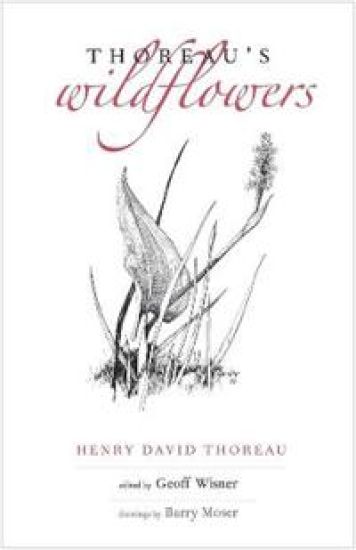
Thoreau's Wildflowers

Thoreau's Wildflowers

Henry David Thoreau

Yale University Press
2016
sidottu
The first collection of Thoreau’s writings on the flowering plants of Concord, with more than 200 drawings by renowned artist Barry Moser Some of Henry David Thoreau’s most beautiful nature writing was inspired by the flowering trees and plants of Concord. An inveterate year-round rambler and journal keeper, he faithfully recorded, dated, and described his sightings of the floating water lily, the elusive wild azalea, and the late autumn foliage of the scarlet oak. This inviting selection of Thoreau’s best flower writings is arranged by day of the year and accompanied by Thoreau’s philosophical speculations and his observations of the weather and of other plants and animals. They illuminate the author’s spirituality, his belief in nature’s correspondence with the human soul, and his sense that anticipation—of spring, of flowers yet to bloom—renews our connection with the earth and with immortality. Thoreau’s Wildflowers features more than 200 of the black-and-white drawings originally created by Barry Moser for his first illustrated book, Flowering Plants of Massachusetts. This volume also presents “Thoreau as Botanist,” an essay by Ray Angelo, the leading authority on the flowering plants of Concord.
Walden, and on the Duty of Civil Disobedience

Walden, and on the Duty of Civil Disobedience

Henry David Thoreau

Createspace Independent Publishing Platform
2016
nidottu
Walden by noted transcendentalist Henry David Thoreau, is a reflection upon simple living in natural surroundings. The work is part personal declaration of independence, social experiment, voyage of spiritual discovery, satire, and (to some degree) manual for self-reliance. Thoreau also used this time to write his first book, A Week on the Concord and Merrimack Rivers. Resistance to Civil Government (Civil Disobedience) is an essay by American transcendentalist Henry David Thoreau that was first published in 1849. In it, Thoreau argues that individuals should not permit governments to overrule or atrophy their consciences, and that they have a duty to avoid allowing such acquiescence to enable the government to make them the agents of injustice. Thoreau was motivated in part by his disgust with slavery and the Mexican
A Yankee in Canada

A Yankee in Canada

Henry David Thoreau; Richard F. Fleck

Westwinds Press
2016
sidottu
In the fall of 1850 Henry Thoreau embarked upon an excursion into the French-Canadian province of Quebec, with stops in Montreal and Quebec City. His reactions to the foreign country are mixed and ambivalent: he is critical of Canada’s Old World Catholicism, feudalism, and an alien British military presence while most of his references to America and Americans are favorable. But if one looks closely, positive reactions to Canadian society and negative reactions to American society do exist within the essay. A YANKEE IN CANADA is a study in paradox, the paradox being due to a man stunned by his only international experience. In this sense A YANKEE IN CANADA parallels Mark Twain’s INNOCENTS ABROAD in that both authors are experiencing culture shock expressed with all the elements of a mental twilight zone of grays, not just black and white. Unlike the many facsimile reproductions available, this edition features a modern design that enhances readability. A YANKEE IN CANADA is now part of the Literary Naturalist Series and features a new foreword by noted literary scholar Richard F. Fleck.
The Illustrated A Week on the Concord and Merrimack Rivers

The Illustrated A Week on the Concord and Merrimack Rivers

Henry David Thoreau

Princeton University Press
2016
sidottu
This book offers a selection of superb photographs by the famous turn-of-the-century photographer Herbert Gleason. Retracing one of Thoreau's early journeys, Gleason produced moving and dramatic pictures of life along the rivers of New England. Originally published in 1984. The Princeton Legacy Library uses the latest print-on-demand technology to again make available previously out-of-print books from the distinguished backlist of Princeton University Press. These editions preserve the original texts of these important books while presenting them in durable paperback and hardcover editions. The goal of the Princeton Legacy Library is to vastly increase access to the rich scholarly heritage found in the thousands of books published by Princeton University Press since its founding in 1905.