
Kirjailija
Henry Miller
Kirjat ja teokset yhdessä paikassa: 77 kirjaa, julkaisuja vuosilta 1944–2025, suosituimpiin kuuluu Tropic of Cancer. Vertaile teosten hintoja ja tarkista saatavuus suomalaisista kirjakaupoista.
77 kirjaa
Kirjojen julkaisuvuodet: 1944–2025.
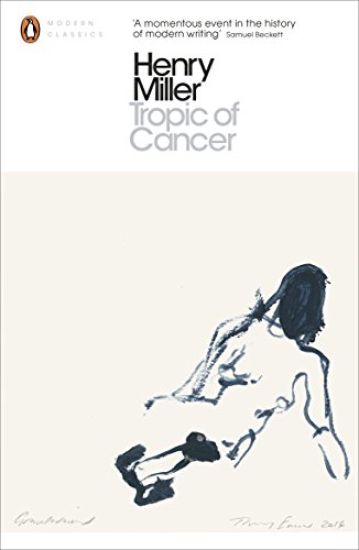
Shocking, banned and the subject of obscenity trials, Henry Miller's first novel Tropic of Cancer is one of the most scandalous and influential books of the twentieth century -- new to Penguin Modern Classics with a cover by Tracey EminTropic of Cancer redefined the novel. Set in Paris in the 1930s, it features a starving American writer who lives a bohemian life among prostitutes, pimps, and artists. Banned in the US and the UK for more than thirty years because it was considered pornographic, Tropic of Cancer continued to be distributed in France and smuggled into other countries. When it was first published in the US in 1961, it led to more than 60 obscenity trials until a historic ruling by the Supreme Court defined it as a work of literature. Long hailed as a truly liberating book, daring and uncompromising, Tropic of Cancer is a cornerstone of modern literature that asks us to reconsider everything we know about art, freedom, and morality.'At last an unprintable book that is fit to read' Ezra Pound 'A momentous event in the history of modern writing' Samuel Beckett 'The book that forever changed the way American literature would be written' Erica Jong
"Sexus" ist Millers am hartnäckigsten in den literarischen Untergrund verbanntes Werk, das in Amerika erst ein Vierteljahrhundert nach seinem Entstehen gedruckt wurde und selbst in Frankreich achtzehn Jahre lang verboten war. Unbekümmert um alle moralischen und formalen Schranken und mitgerissen von der Sturzflut der Erinnerung, hat Miller in diesem "obszönsten seiner Bücher" (New York Times) ein Stück seines chaotisch-turbulenten Lebens reproduziert: ein orgiastischer Hymnus auf die physische Liebe und ein befreites Leben, Zeugnis einer Aufrichtigkeit, die Kompromisse verachtet.
Sexus
Henry Miller
Grove Press / Atlantic Monthly Press
1994
sidottu
Halvin toimitettuna 21,50 € 1 kauppa
The first novel of Miller's frank, autobiographical trilogy uses dream, fantasy, and burlesque to portray the life of a struggling writer in preWorld War I New York
Remember To Remember
Henry Miller
NEW DIRECTIONS PUBLISHING CORPORATION
1986
nidottu
Halvin toimitettuna 28,90 € 2 kauppaa
This collection of stories and essays takes its title from a long prose reverie in which Henry Miller, after his return to the United States, thinks back to the happy years of middle life which he spent in France. The qualities that make the French unique have seldom been so movingly expressed. The America he had rediscovered does not come off very well by contrast--particularly the Hollywood state of mind, which gets a thoroughly Milleresque going over in the burlesque Astrological Fricassee.What Miller likes on the American scene are the individuals who have broken through the pattern of conformity, the rare and often isolated creative personalities who are resisting the dehumanization of our so-called "civilization." He gives us vivid portraits of the painters Abe Rattner, Jean Varda and Beauford Delaney; the sculptor Bufano; and Jasper Deeter, director of the hedgerow Theatre.Two of Henry Miller's greatest essays are also in this volume: Murder the Murderer (on war), a declaration which ranks with Randolph Bourne's War and the Intellectuals, and, with particular relevance to the censorship codes which kept his Tropics of Cancer and Capricorn out of this country for so long, Obscenity and the Law of Reflection.
Resembling a musical sextet where no two instruments are the same, but all instruments blend to form a single sound, Henry Miller’s Sextet combines six jive-talkin’, fresh, and impromptu pieces of writing originally published as individual chapbooks by Capra Press: “On Turning Eighty,” “Reflections on the Death of Mishima,” “First Impressions of Greece,” “The Waters Reglitterized: The Subject of Water Colors in Some of its More Liquid Phases,” “Reflections on The Maurizius Case: A Humble Appraisal of a Great Book,” and “Mother, China and the World Beyond: A Dream in Which I Die and Find Myself in Devachan (Limbo) Where I Run into My Mother whom I Hated All My Life.” Like your favorite band releasing a six-song EP to keep you salivating until its next full-length album, Sextet is a finger-snapping sample of Miller’s work with the blare of a clarion call, and lots of raucous humor and jazz.
In 1958, when Henry Miller was elected to membership in the American Institute of Arts and Letters, the citation described him as: "The veteran author of many books whose originality and richness of technique are matched by the variety and daring of his subject matter. His boldness of approach and intense curiosity concerning man and nature are unequalled in the prose literature of our times." It is most fitting that this anthology of "the best" of Henry Miller should have been assembled by one of the first among Miller’s contemporaries to recognize his genius, the eminent British writer Lawrence Durrell. Drawing material from a dozen different books Durrell has traced the main line and principal themes of the "single, endless autobiography" which is Henry Miller’s life work. "I suspect," writes Durrell in his Introduction, "that Miller’s final place will be among those towering anomalies of authorship like Whitman or Blake who have left us, not simply works of art, but a corpus of ideas which motivate and influence a whole cultural pattern." Earlier, H. L. Mencken had said, "his is one of the most beautiful prose styles today," and the late Sir Herbert Read had written that "what makes Miller distinctive among modern writers is his ability to combine, without confusion, the aesthetic and prophetic functions." Included are stories, "portraits" of persons and places, philosophical essays, and aphorisms. For each selection Miller himself prepared a brief commentary which fits the piece into its place in his life story. This framework is supplemented by a chronology from Miller’s birth in 1891 up to the spring of 1959, a bibliography, and, as an appendix, an open letter to the Supreme Court of Norway written in protest of the ban on Sexus, a part of which appears in this volume.
Now hailed as an American classic, Tropic of Cancer, Henry Miller's masterpiece, was banned as obscene in this country for twenty-seven years after its first publication in Paris in 1943. Only a historic court ruling that changed American censorship standards, ushering in a new era of freedom and frankness in modern literature, permitted the publication of this first volume of Miller's famed mixture of memoir and fiction, which chronicles with unapologetic gusto, the bawdy adventures of a young expatriate writer, his friends, and the characters they meet in Paris in the 1930s. Tropic of Cancer is now considered, as Norman Mailer said, one of the ten or twenty great novels of our century.
In this selection of stories and essays, Henry Miller elucidates, revels, and soars, showing his command over a wide range of moods, styles, and subject matters. Writing “from the heart,” always with a refreshing lack of reticence, Miller involves the reader directly in his thoughts and feelings. “His real aim,” Karl Shapiro has written, “is to find the living core of our world whenever it survives and in whatever manifestation, in art, in literature, in human behavior itself. It is then that he sings, praises, and shouts at the top of his lungs with the uncontainable hilarity he is famous for.” Here are some of Henry Miller’s best-known writings: an essay on the photographer Brassai; “Reflections on Writing,” in which Miller examines his own position as a writer; “Seraphita” and “Balzac and His Double,” on the works of other writers; and “The Alcoholic Veteran,” “Creative Death,” “The Enormous Womb,” and “The Philosopher Who Philosophizes.”
Quiet Days in Clichy
Henry Miller
Penguin Classics
2016
pokkari
Halvin toimitettuna 16,20 € 2 kauppaa
'Here, even if I had a thousand dollar in my pocket, I know of no sight which could arouse in me the feeling of ecstasy'Looking back to Henry Miller's bohemian life in 1930s Paris, when he was an obscure, penniless writer, Quiet Days in Clichy is a love letter to a city. As he describes nocturnal wanderings through shabby Montmartre streets, cafés and bars, sexual liaisons and volatile love affairs, Miller brilliantly evokes a period that would shape his entire life and oeuvre. 'His writing is flamboyant, torrential, chaotic, treacherous, and dangerous' Anaïs Nin
Plexus is the second volume of the scandalous trilogy The Rosy Crucifixion, Henry Miller's major life workExploring one man's desperate desire for freedom, Plexus is the central volume of Henry Miller's scandalous semi-autobiographical trilogy The Rosy Crucifixion. It finds him in the midst of his stormy marriage to the volatile, duplicitous Mona, and joyfully quitting his dreary job for a hand-to-mouth existence in Brooklyn, as he takes his first steps towards becoming a writer.
Nexus is the third volume of the scandalous trilogy The Rosy Crucifixion, Henry Miller's major life workThe exhilarating final volume of Henry Miller's semi-autobiographical trilogy, Nexus follows his last months in New York. Trapped in a bizarre ménage-à-trois with his fiery wife Mona and her lover Stasia, he finds his life descending into chaos. Finally, betrayed and exhausted, he decides to leave America and sail for Paris, to discover his true vocation as a writer.
Sexus is the first volume of the scandalous trilogy The Rosy Crucifixion, Henry Miller's major life workHenry Miller called the end of his life in America and the start of a new, bohemian existence in 1930s Paris his 'rosy crucifixion'. His searing fictionalized autobiography of this time of liberation was banned for nearly twenty years. Sexus, the first volume in The Rosy Crucifixion trilogy, looks back to his early sexual escapades in Brooklyn, and his growing infatuation with the playful, teasing dance hall hostess who will become the great obsession of his life.
In The World of Sex, Henry Miller, one of the most scandalous writers of the 20th century explains his literary project Henry Miller's bold, explicit novels scandalized readers and remade the literature of his day. In this uncompromising literary manifesto he argues that sex is at the heart of his writing because it is at the heart of life - a vital force as essential as bread, money, work or play. Drawing on his own experiences and on the writing of his famously banned novels in Paris, he shows sex as a mysterious realm that must be explored if we are to be truly free.
A cult modern classic, Tropic of Capricorn is as daring, frank and influential as Henry Miller first novel, Tropic of Cancer -- new to Penguin Modern Classics with a cover by Tracey EminA story of sexual and spiritual awakening, Tropic of Capricorn shocked readers when it was published in 1939. A mixture of fiction and autobiography, it is the story of Henry V. Miller who works for the Cosmodemonic telegraph company in New York in the 1920s and tries to write the most important work of literature that was ever published. Tropic of Capricorn paints a dazzling picture of the life of the writer and of New York City between the wars: the skyscrapers and the sewers, the lust and the dejection, the smells and the sounds of a city that is perpetually in motion, threatening to swallow everyone and everything.'Literature begins and ends with the meaning of what Miller has done' Lawrence Durrell 'The only imaginative prose-writer of the slightest value who has appeared among the English-speaking races for some years past' George Orwell 'The greatest American writer' Bob Dylan Henry Miller (1891-1980) is one of the most important American writers of the 20th century. His best-known novels include Tropic of Cancer (1934), Tropic of Capricorn (1939), and the Rosy Crucifixion trilogy (Sexus, 1949, Plexus, 1953, and Nexus, 1959), all published in France and banned in the US and the UK until 1964. He is widely recognised as an irreverent, risk-taking writer who redefined the novel and made the link between the European avant-garde and the American Beat generation.
The remarkable popularity of political likenesses in the Victorian period is the central theme of this book, which explores how politicians and publishers exploited new visual technology to appeal to a broad public. The first study of the role of commercial imagery in nineteenth-century politics, Politics personified shows how visual images projected a favourable public image of politics and politicians. Drawing on a vast and diverse range of sources, this book highlights how and why politics was visualised. Beginning with an examination of the visual culture of reform, the book goes on to study how Liberals, Conservatives and Radicals used portraiture to connect with supporters, the role of group portraiture, and representations of Victorian MPs. The final part of the book examines how major politicians, including Palmerston, Gladstone and Disraeli, interacted with mass commercial imagery. The book will appeal to a broad range of scholars and students across political, social and cultural history, art history and visual studies, cultural and media studies and literature.
Wie kein anderer großer Autor zuvor rüttelte Henry Miller an den sexuellen Tabus des 20. Jahrhunderts. In seinen berühmten Novellen erzählt er von den Labyrinthen der Großstädte, von ihren Straßen und Plätzen, von der Armut, Einsamkeit und erotischen Eskapaden der kleinen Angestellten, Zeitungsboten, Journalisten, Kaffeehausbesucher und Dirnen.
The Durrell-Miller Letters: 1935-1980
Lawrence Durrell; Henry Miller
NEW DIRECTIONS PUBLISHING CORPORATION
1998
nidottu
In 1935 a young Englishman living on Corfu wrote enthusiastically to a middle-aged Brooklynite who had just published a succ s de scandale in Paris: "...Tropic of Cancer] turns the corner into a new life which has regained its bowels." Henry Miller, realizing that in Lawrence Durrell he had hooked his ideal reader, responded: "You're the first Britisher who's written me an intelligent letter about the book." Thus began a correspondence that ended only with Miller's death in 1980--nearly 1,000,000 words later. The Durrell-Miller Letters, 1935-80 contains an extensive and representative selection of the total correspondence. Almost half of the present volume has never been published before, including some recently recovered "lost" letters; in addition, many passages expurgated from letters published in 1963 have been restored. Editor Ian S. MacNiven of the State University of New York, Maritime College, is quite right to regard the Durrell-Miller correspondence as a dual biography of the creative lives of two of this century's great literary iconoclasts, a biography "At once as serious as Schopenhauer and as winning as wine."