Kirjailija
Herbert Spencer
Kirjat ja teokset yhdessä paikassa: 433 kirjaa, julkaisuja vuosilta 1884–2026, suosituimpiin kuuluu Herbert Spencer. Vertaile teosten hintoja ja tarkista saatavuus suomalaisista kirjakaupoista.
433 kirjaa
Kirjojen julkaisuvuodet: 1884–2026.

Justice: Being Part IV of The Principles of Ethics
Herbert Spencer
Creative Media Partners, LLC
2019
sidottu

Land and Labor in the United States is an unchanged, high-quality reprint of the original edition of 1883. Hansebooks is editor of the literature on different topic areas such as research and science, travel and expeditions, cooking and nutrition, medicine, and other genres. As a publisher we focus on the preservation of historical literature. Many works of historical writers and scientists are available today as antiques only. Hansebooks newly publishes these books and contributes to the preservation of literature which has become rare and historical knowledge for the future.

Spontaneous generation, and the hypothesis of physiological units
Herbert Spencer
Hansebooks
2019
pokkari

Einleitung in das Studium der Soziologie ist ein unver nderter, hochwertiger Nachdruck der Originalausgabe aus dem Jahr 1875. Hansebooks ist Herausgeber von Literatur zu unterschiedlichen Themengebieten wie Forschung und Wissenschaft, Reisen und Expeditionen, Kochen und Ern hrung, Medizin und weiteren Genres. Der Schwerpunkt des Verlages liegt auf dem Erhalt historischer Literatur. Viele Werke historischer Schriftsteller und Wissenschaftler sind heute nur noch als Antiquit ten erh ltlich. Hansebooks verlegt diese B cher neu und tr gt damit zum Erhalt selten gewordener Literatur und historischem Wissen auch f r die Zukunft bei.


The Classification of the Sciences to which are Added Reasons for Dissenting from the Philosophy of M. Comte
Herbert Spencer
Hansebooks
2018
nidottu
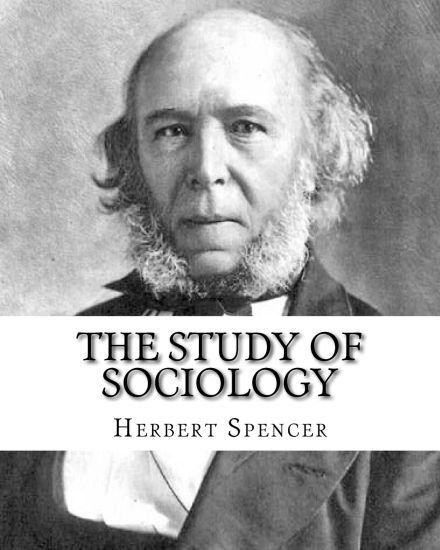
The Study of Sociology, By: Herbert Spencer: Herbert Spencer (27 April 1820 - 8 December 1903) was an English philosopher, biologist, anthropologi
Herbert Spencer
Createspace Independent Publishing Platform
2018
nidottu
Herbert Spencer (27 April 1820 - 8 December 1903) was an English philosopher, biologist, anthropologist, sociologist, and prominent classical liberal political theorist of the Victorian era. Spencer developed an all-embracing conception of evolution as the progressive development of the physical world, biological organisms, the human mind, and human culture and societies. As a polymath, he contributed to a wide range of subjects, including ethics, religion, anthropology, economics, political theory, philosophy, literature, astronomy, biology, sociology, and psychology. During his lifetime he achieved tremendous authority, mainly in English-speaking academia. "The only other English philosopher to have achieved anything like such widespread popularity was Bertrand Russell, and that was in the 20th century." Spencer was "the single most famous European intellectual in the closing decades of the nineteenth century" but his influence declined sharply after 1900: "Who now reads Spencer?" asked Talcott Parsons in 1937. 4] Spencer is best known for the expression "survival of the fittest", which he coined in Principles of Biology (1864), after reading Charles Darwin's On the Origin of Species. This term strongly suggests natural selection, yet as Spencer extended evolution into realms of sociology and ethics, he also made use of Lamarckism. Spencer was born in Derby, England, on 27 April 1820, the son of William George Spencer (generally called George). Spencer's father was a religious dissenter who drifted from Methodism to Quakerism, and who seems to have transmitted to his son an opposition to all forms of authority. He ran a school founded on the progressive teaching methods of Johann Heinrich Pestalozzi and also served as Secretary of the Derby Philosophical Society, a scientific society which had been founded in 1783 by Erasmus Darwin, the grandfather of Charles Darwin. Spencer was educated in empirical science by his father, while the members of the Derby Philosophical Society introduced him to pre-Darwinian concepts of biological evolution, particularly those of Erasmus Darwin and Jean-Baptiste Lamarck. His uncle, the Reverend Thomas Spencer vicar of Hinton Charterhouse near Bath, completed Spencer's limited formal education by teaching him some mathematics and physics, and enough Latin to enable him to translate some easy texts. Thomas Spencer also imprinted on his nephew his own firm free-trade and anti-statist political views. Otherwise, Spencer was an autodidact who acquired most of his knowledge from narrowly focused readings and conversations with his friends and acquaintances. Both as an adolescent and as a young man, Spencer found it difficult to settle to any intellectual or professional discipline. He worked as a civil engineer during the railway boom of the late 1830s, while also devoting much of his time to writing for provincial journals that were nonconformist in their religion and radical in their politics. From 1848 to 1853 he served as sub-editor on the free-trade journal The Economist, during which time he published his first book, Social Statics (1851), which predicted that humanity would eventually become completely adapted to the requirements of living in society with the consequential withering away of the state. Its publisher, John Chapman, introduced Spencer to his salon which was attended by many of the leading radical and progressive thinkers of the capital, including John Stuart Mill, Harriet Martineau, George Henry Lewes and Mary Ann Evans (George Eliot), with whom he was briefly romantically linked. Spencer himself introduced the biologist Thomas Henry Huxley, who would later win fame as 'Darwin's Bulldog' and who remained his lifelong friend. However it was the friendship of Evans and Lewes that acquainted him with John Stuart Mill's A System of Logic and with Auguste Comte's positivism and which set him on the road to his life's work. He strongly disagreed with Comte....
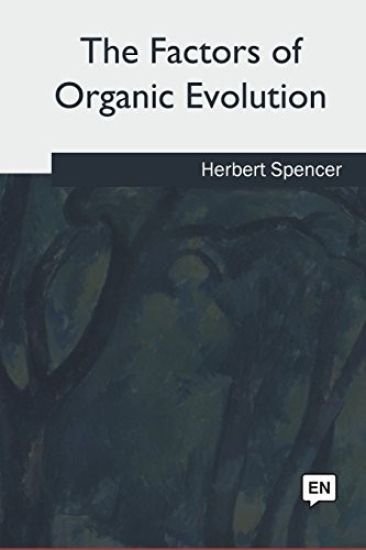
The Factors of Organic Evolution
Herbert Spencer
Createspace Independent Publishing Platform
2018
nidottu
The two parts of which this Essay consists, originally published in The Nineteenth Century for April and May 1886 respectively, now reappear with the assent of the proprietor and editor of that periodical, to whom my thanks are due for his courtesy in giving it. Some passages of considerable length which, with a view to needful brevity, were omitted when the articles first appeared, have been restored. Though the direct bearings of the arguments contained in this Essay are biological, the argument contained in its first half has indirect bearings upon Psychology, Ethics, and Sociology. My belief in the profound importance of these indirect bearings, was originally a chief prompter to set forth the argument; and it now prompts me to re-issue it in permanent form.


This work has been selected by scholars as being culturally important, and is part of the knowledge base of civilization as we know it. This work was reproduced from the original artifact, and remains as true to the original work as possible. Therefore, you will see the original copyright references, library stamps (as most of these works have been housed in our most important libraries around the world), and other notations in the work. This work is in the public domain in the United States of America, and possibly other nations. Within the United States, you may freely copy and distribute this work, as no entity (individual or corporate) has a copyright on the body of the work. As a reproduction of a historical artifact, this work may contain missing or blurred pages, poor pictures, errant marks, etc. Scholars believe, and we concur, that this work is important enough to be preserved, reproduced, and made generally available to the public. We appreciate your support of the preservation process, and thank you for being an important part of keeping this knowledge alive and relevant.
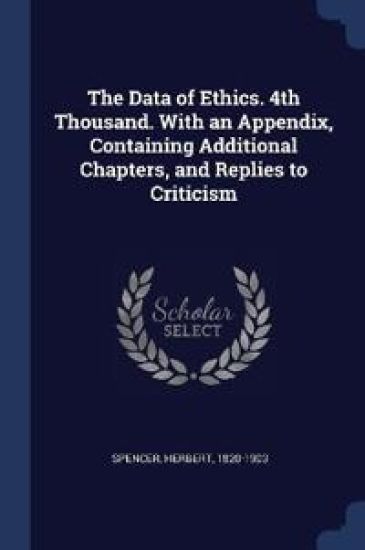
The Data of Ethics. 4th Thousand. With an Appendix, Containing Additional Chapters, and Replies to Criticism
Herbert Spencer
Sagwan Press
2018
pokkari
This work has been selected by scholars as being culturally important, and is part of the knowledge base of civilization as we know it. This work was reproduced from the original artifact, and remains as true to the original work as possible. Therefore, you will see the original copyright references, library stamps (as most of these works have been housed in our most important libraries around the world), and other notations in the work. This work is in the public domain in the United States of America, and possibly other nations. Within the United States, you may freely copy and distribute this work, as no entity (individual or corporate) has a copyright on the body of the work. As a reproduction of a historical artifact, this work may contain missing or blurred pages, poor pictures, errant marks, etc. Scholars believe, and we concur, that this work is important enough to be preserved, reproduced, and made generally available to the public. We appreciate your support of the preservation process, and thank you for being an important part of keeping this knowledge alive and relevant.