Kirjailija
Homer
Kirjat ja teokset yhdessä paikassa: 595 kirjaa, julkaisuja vuosilta 1919–2026, suosituimpiin kuuluu The Odyssey of Homer. Vertaile teosten hintoja ja tarkista saatavuus suomalaisista kirjakaupoista.
Nimi esiintyy myös muodoissa: Homer ., - Homer
595 kirjaa
Kirjojen julkaisuvuodet: 1919–2026.
When Helen is taken away by the Trojans, a mighty Greek king gathers the various city states for war against the city of Troy to try and get Helen back. What the Greeks don't realize is that Helen, while being captured, has fallen in love with a Trojan prince, a hero of Troy. Achilles is a mighty Greek warrior that the Greeks have on their side and the two brilliant minds of Hector and Achilles clash as the Greek siege the city of Troy. The fight becomes personal as allies and friends are killed and one of these heroes goes so far as to insult the gods themselves in his desire for conquest. This epic poem tells a story of love and conquest as two ancient empires battle it out.
Homer's epic about the horrors and heroism of the final year of the Trojan War is one of Western literature's most enduring and moving tales. Joe Sachs, whose translations are known for being faithful to the original Greek, brings new layers of depth, understanding, and interest to the poem. Why translate the Iliad? Joe Sachs explains his motivation: My own reading of the poem has been influenced less by the books and essays that discuss it than by its translators. I have read quite a few, and the variety among them is striking... Once, long ago, I expected that eventually I would find one translation the most satisfying. What I found instead was that it was the very multiplicity of them that was getting me closer to Homer. Felicitous phrases from them all have remained with me, and the way their words move and sound has helped me come to hear, in my inward ear, Homer's voice. Renowned philosophy professor Joe Sachs taught for thirty years in the Great Books program at St. John's College in Annapolis, Maryland. He has translated Homer's Odyssey (Paul Dry Books, 2014); Aristotle's Physics, Metaphysics, On the Soul and On Memory and Recollection, Nicomachean Ethics, and Poetics; and Plato's Theaetetus, Republic, and Socrates and The Sophists.
When the beautiful Helen is taken away and fall madly in love with Hector of Troy her Greek partner gathers the forces of Greece to fight against the Trojans to get her back. One of the mighty heroes that goes along with the war is the mighty Achilles who manages some great feats in the battle but in the end is cursed by the gods for an act of defilement and dies. After the war, the story switches to the fated Ulysses who mocks the Greek god of the seas and is lost for decades in the waters of the Mediterranean. As he fights with gods and even travels to the realm of the dead to once again return home, his throne is threatened as new suitors seek to claim his wife and his crown back in Greece.
Rare edition with unique illustrations and elegant classic cream paper. The Odyssey is one of two major ancient Greek epic poems attributed to Homer. It is, in part, a sequel to the Iliad, the other work ascribed to Homer. The poem is fundamental to the modern Western canon, and is the second oldest extant work of Western literature, the Iliad being the oldest. It is believed to have been composed near the end of the 8th century BC, somewhere in Ionia, the Greek coastal region of Anatolia. Includes unique illustrations.
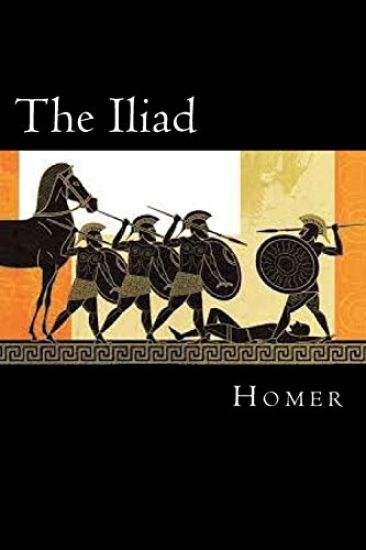
The Iliad is one of the two great epics of Homer, and is typically described as one of the greatest war stories of all time, but to say the Iliad is a war story does not begin to describe the emotional sweep of its action and characters: Achilles, Helen, Hector, and other heroes of Greek myth and history in the tenth and final year of the Greek siege of Troy.

Rare edition with unique illustrations and elegant classic cream paper. "The Iliad" is an epic poem by the ancient Greek poet Homer, which recounts some of the significant events of the final weeks of the Trojan War and the Greek siege of the city of Troy (which was also known as Ilion, Ilios or Ilium in ancient times). Written in the mid-8th Century BCE, "The Iliad" is usually considered to be the earliest work in the whole Western literary tradition, and one of the best known and loved stories of all time. Includes unique illustrations.


The Odyssey begins after the end of the ten-year Trojan War (the subject of the Iliad), and Odysseus has still not returned home from the war. Odysseus' son Telemachus is about 20 years old and is sharing his absent father's house on the island of Ithaca with his mother Penelope and a crowd of 108 boisterous young men, "the Suitors", whose aim is to persuade Penelope to marry one of them, all the while reveling in Odysseus' palace and eating up his wealth. Odysseus' protectress, the goddess Athena, requests to Zeus, king of the gods, to finally allow Odysseus to return home when Odysseus' enemy, the god of the sea Poseidon, is absent from Mount Olympus to accept a sacrifice in Ethiopia. Then, disguised as a Taphian chieftain named Mentes, she visits Telemachus to urge him to search for news of his father. He offers her hospitality; they observe the suitors dining rowdily while the bard Phemius performs a narrative poem for them. Penelope objects to Phemius' theme, the "Return from Troy", 6] because it reminds her of her missing husband, but Telemachus rebuts her objections, asserting his role as head of the household.
The Iliad of Homer: The Iliad; sometimes referred to as the Song of Ilion or Song of Ilium) is an ancient Greek epic poem in dactylic hexameter, traditionally attributed to Homer. Set during the Trojan War, the ten-year siege of the city of Troy (Ilium) by a coalition of Greek states, it tells of the battles and events during the weeks of a quarrel between King Agamemnon and the warrior Achilles. Although the story covers only a few weeks in the final year of the war, the Iliad mentions or alludes to many of the Greek legends about the siege; the earlier events, such as the gathering of warriors for the siege, the cause of the war, and related concerns tend to appear near the beginning. Then the epic narrative takes up events prophesied for the future, such as Achilles' imminent death and the fall of Troy, although the narrative ends before these events take place. However, as these events are prefigured and alluded to more and more vividly, when it reaches an end the poem has told a more or less complete tale of the

Rare edition with unique illustrations and elegant classic cream paper. "The Iliad" is an epic poem by the ancient Greek poet Homer, which recounts some of the significant events of the final weeks of the Trojan War and the Greek siege of the city of Troy (which was also known as Ilion, Ilios or Ilium in ancient times). Written in the mid-8th Century BCE, "The Iliad" is usually considered to be the earliest work in the whole Western literary tradition, and one of the best known and loved stories of all time. Includes unique illustrations.
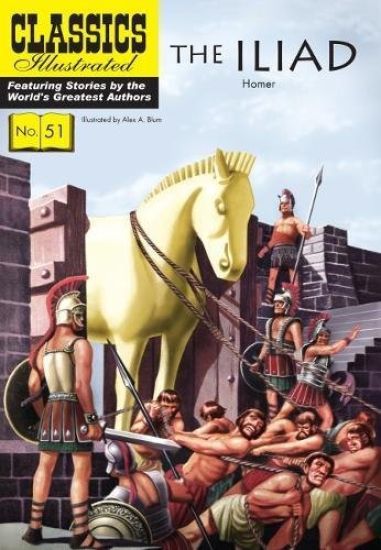
Homer's epic poem of the Trojan War, and the conflict between King Agamemnon and his warrior, Achilles. Classics Illustrated tells this wonderful tale in colourful comic strip form, offering an excellent introduction for younger readers. This edition also includes theme discussions and study questions, which can be used both in the classroom and at home to further engage the reader in the story. The Classics Illustrated comic book series began in 1941 with its first issue, Alexandre Dumas's The Three Musketeers, and has since included over 200 classic tales released around the world. This new Paperback Replica edition is part of a continuing effort to make Classics Illustrated available to all, be they young readers just beginning their journeys into the great world of classic literature, or collectors who have fond memories of this much loved comic book series.
Set during the Trojan War, the ten-year siege of the city of Troy by a coalition of Greek states, the Iliad tells of the battles and events during the weeks of a quarrel between King Agamemnon and the warrior Achilles.

An epic tale of love and betrayal, war and hope The Iliad is the first of two legendary ancient poems attributed to the Greek bard Homer. Typically dated between the 8th and 7th centuries BC it is believed by many to be the earliest extant piece of European literature. The poem deals with the exploits of Agamemnon, Odysseus, Achilles, Ajax and their comrades in the final year of their siege of the city of Troy.

Widely regarded as one of the finest works of literature in the Western canon, Homer's Odyssey is a masterpiece of classical epic poetry. The tale follows the travels of the Greek hero Odysseus as he strives to return to his homeland after waging battle in the Trojan War. Long presumed dead after a 20-year absence, Odysseus finally returns to his native Ithaca and is forced to fight to resume his long-lost life and save his family from ruin. The Odyssey is a can't-miss experience for cultured readers.
The Lake English Classics. the Iliad of Homer. Books I., VI., XXII., XXIV. Edited for School Use
Homer
Trieste Publishing
2018
nidottu
Hesiod, Homeric Hymns and Homerica: Homer
Hesiod; Homer
Createspace Independent Publishing Platform
2018
nidottu
Hesiod, Homeric Hymns and Homerica by Homer and Hesiod. The early Greek epic - that is, poetry as a natural and popular, and not (as it became later) an artificial and academic literary form - passed through the usual three phases, of development, of maturity, and of decline. No fragments which can be identified as belonging to the first period survive to give us even a general idea of the history of the earliest epic, and we are therefore thrown back upon the evidence of analogy from other forms of literature and of inference from the two great epics which have come down to us. So reconstructed, the earliest period appears to us as a time of slow development in which the characteristic epic metre, diction, and structure grew up slowly from crude elements and were improved until the verge of maturity was reached. The second period, which produced the "Iliad" and the "Odyssey", needs no description here: but it is very important to observe the effect of these poems on the course of post-Homeric epic. As the supreme perfection and universality of the "Iliad" and the "Odyssey" cast into oblivion whatever pre-Homeric poets had essayed, so these same qualities exercised a paralysing influence over the successors of Homer. If they continued to sing like their great predecessor of romantic themes, they were drawn as by a kind of magnetic attraction into the Homeric style and manner of treatment, and became mere echoes of the Homeric voice: in a word, Homer had so completely exhausted the epic genre, that after him further efforts were doomed to be merely conventional.