Kirjojen hintavertailu – 12 859 819 kirjaa ja 27 kauppaa
Kirjailija
Homer
Kirjat ja teokset yhdessä paikassa: 595 kirjaa, julkaisuja vuosilta 1919–2026, suosituimpiin kuuluu The Odyssey of Homer. Vertaile teosten hintoja ja tarkista saatavuus suomalaisista kirjakaupoista.
'Tell me, Muse, of the man of many turns, who was driven far and wide after he had sacked the sacred city of Troy' Twenty years after setting out to fight in the Trojan War, Odysseus is yet to return home to Ithaca. His household is in disarray: a horde of over 100 disorderly and arrogant suitors are vying to claim Odysseus' wife Penelope, and his young son Telemachus is powerless to stop them. Meanwhile, Odysseus is driven beyond the limits of the known world, encountering countless divine and earthly challenges. But Odysseus is 'of many wiles' and his cunning and bravery eventually lead him home, to reclaim both his family and his kingdom. The Odyssey rivals the Iliad as the greatest poem of Western culture and is perhaps the most influential text of classical literature. This elegant and compelling new translation is accompanied by a full introduction and notes that guide the reader in understanding the poem and the many different contexts in which it was performed and read.
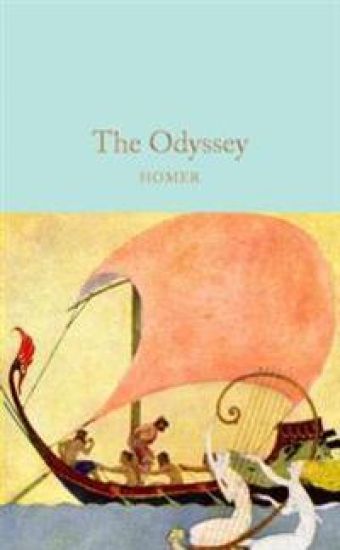
Homer's great epic, The Odyssey, is perhaps Western literature's first adventure story, and certainly remains one of its finest. It describes King Odysseus of Ithaca's epic, ten-year quest to return home after the Trojan War. He encounters giants, sorceresses, sea-monsters and sirens, while his wife Penelope is forced to resist the suitors who besiege her on Ithaca. Both an enchanting fairy tale and a gripping drama, The Odyssey is immensely influential, not least for its rich complexity and the magnetism of its hero. This Macmillan Collector's Library edition uses a translation by T. E. Lawrence, now remembered as 'Lawrence of Arabia' and the author of Seven Pillars of Wisdom. First published in 1932, his translation took four years to complete and has been continuously in print ever since. It is recognized as the first translation to be both faithful to the original text and written in accessible language. This edition also features an afterword by Ben Shaw. Part of the Macmillan Collector’s Library; a series of stunning, clothbound, pocket-sized classics with gold foiled edges and ribbon markers. These beautiful books make perfect gifts or a treat for any book lover.
With her virtuoso translation, classicist and bestselling author Caroline Alexander brings to life Homer's timeless epic of the Trojan WarComposed around 730 B. C., Homer's Iliad recounts the events of a few momentous weeks in the protracted ten-year war between the invading Achaeans, or Greeks, and the Trojans in their besieged city of Ilion. From the explosive confrontation between Achilles, the greatest warrior at Troy, and Agamemnon, the inept leader of the Greeks, through to its tragic conclusion, The Iliad explores the abiding, blighting facts of war. Soldier and civilian, victor and vanquished, hero and coward, men, women, young, old--The Iliad evokes in poignant, searing detail the fate of every life ravaged by the Trojan War. And, as told by Homer, this ancient tale of a particular Bronze Age conflict becomes a sublime and sweeping evocation of the destruction of war throughout the ages. Carved close to the original Greek, acclaimed classicist Caroline Alexander's new translation is swift and lean, with the driving cadence of its source--a translation epic in scale and yet devastating in its precision and power.
After the brutal war with the Trojans and the mourning of the death of Achilles, the heroic king Ulysses sets course for home but in the process insults the god Poseidon. The angry god causes Ulysses and his crew to wander the sea for years as they get tempted by banished gods, fight off mighty monsters and even descend to the gates of the Greek hell, Tartarus, to rescue a wayward crew member. Meanwhile those in Ulysses kingdom try to court his forlorn wife who eagerly await her husband's return.
OdysseusThe Hero of IthacaAdapted from the Third Book of the Primary Schools of Athens, GreeceBy Mary E. Burt and Zenaide A. RagozinGREEK CLASSICSOdysseus, also known by the Latin name Ulysses, was a legendary Greek king of Ithaca and the hero of Homer's epic poem the Odyssey. Odysseus also plays a key role in Homer's Iliad and other works in that same epic cycle. Husband of Penelope, father of Telemachus, and son of Laertes and Anticlea, Odysseus is renowned for his brilliance, guile, and versatility (polytropos), and is hence known by the epithet Odysseus the Cunning (metis, or "cunning intelligence"). He is most famous for the Odyssey, ten eventful years he took to return home after the decade-long Trojan War." Happily the Greek nation, more than any other, abounds in literary masterpieces. Nearly all of the Greek writings contain an abundance of practical wisdom and virtue. Their worth is so great that even the most advanced European nations do not hesitate to introduce them into their schools. The Germans do this, although their habits and customs are so different from ours. They especially admire Homer's works. These books, above all others, afford pleasure to the young, and the reason for it is clearly set forth by the eminent educator Herbart: "'The little boy is grieved when told that he is little. Nor does he enjoy the stories of little children. This is because his imagination reaches out and beyond his environments. I find the stories from Homer to be more suitable reading for young children than the mass of juvenile books, because they contain grand truths.'"Therefore these stories are held in as high esteem by the German children as by the Greek. In no other works do children find the grand and noble traits in human life so faithfully and charmingly depicted as in Homer. Here all the domestic, civic, and religious virtues of the people are marvellously brought to light and the national feeling is exalted. The Homeric poetry, and especially the 'Odyssey, ' is adapted to very young children, not only because it satisfies so well the needs which lead to mental development, but also for another reason. As with the people of olden times bravery was considered the greatest virtue, so with boys of this age and all ages. No other ethical idea has such predominance as that of prowess. Strength of body and a firm will characterize those whom boys choose as their leaders. Hence the pleasure they derive from the accounts of celebrated heroes of yore whose bravery, courage, and prudence they admire."
Stories from the OdysseyHomerRetold By H. L. HavellGREEK CLASSICSThe Odyssey is one of two major ancient Greek epic poems attributed to Homer. It is, in part, a sequel to the Iliad, the other work ascribed to Homer. The poem is fundamental to the modern Western canon, and is the second oldest extant work of Western literature, the Iliad being the oldest. Scholars believe it was composed near the end of the 8th century BC, somewhere in Ionia, the Greek coastal region of Anatolia. The impersonal character of the Homeric poems has left us entirely in the dark as to the birthplace, the history, and the date, of their author. So complete is the darkness which surrounds the name of Homer that his very existence has been disputed, and his works have been declared to be an ingenious compilation, drawn from the productions of a multitude of singers. It is not my intention here to enter into the endless and barren controversy which has raged round this question. It will be more to the purpose to try and form some general idea of the characteristics of the Greek Epic; and to do this it is necessary to give a brief review of the political and social conditions in which it was produced. The world as known to Homer is a mere fragment of territory, including a good part of the mainland of Greece, with the islands and coast districts of the g an. Outside of these limits his knowledge of geography is narrow indeed. He has heard of Sicily, which he speaks of under the name of Thrinacia; and he speaks once of Libya, or the north coast of Africa, as a district famous for its breed of sheep. There is one vague reference to the vast Scythian or Tartar race (called by Homer Thracians), who live on the milk of mares; and he mentions a copper-coloured people, the "Red-faces," who dwell far remote in the east and west. The Nile is mentioned, under the name of gyptus; and the Egyptians are celebrated by the poet as a people skilled in medicine, a statement which is repeated by Herodotus. The Phoenicians appear several times in the Odyssey, and we hear once or twice of the Sidonians, as skilled workers in metal. As soon as we pass these boundaries, we enter at once into the region of fairyland. CONTENTSINTRODUCTIONTELEMACHUS, PENELOPE, AND THE SUITORSTHE ASSEMBLY; THE VOYAGE OF TELEMACHUSTHE VISIT TO NESTOR AT PYLOSTELEMACHUS AT SPARTAODYSSEUS AND CALYPSOODYSSEUS AMONG THE PH ACIANSTHE WANDERINGS OF ODYSSEUSTHE VISIT TO HADESTHE SIRENS; SCYLLA AND CHARYBDIS; THRINACIAODYSSEUS LANDS IN ITHACAODYSSEUS AND EUM USTHE RETURN OF TELEMACHUSTHE MEETING OF TELEMACHUS AND ODYSSEUSTHE HOME-COMING OF ODYSSEUSTHE BEGGAR IRUSPENELOPE AND THE WOOERSODYSSEUS AND PENELOPETHE END DRAWS NEAR; SIGNS AND WONDERSTHE BOW OF ODYSSEUSTHE SLAYING OF THE WOOERSODYSSEUS AND PENELOPE
The Odyssey by Samuel Butler The Odyssey is one of two major ancient Greek epic poems attributed to Homer. It is, in part, a sequel to the Iliad, the other work ascribed to Homer. The poem is fundamental to the modern Western canon, and is the second oldest extant work of Western literature, the Iliad being the oldest. Scholars believe it was composed near the end of the 8th century BC, somewhere in Ionia, the Greek coastal region of Anatolia. The poem mainly focuses on the Greek hero Odysseus (known as Ulysses in Roman myths) and his journey home after the fall of Troy. It takes Odysseus ten years to reach Ithaca after the ten-year Trojan War. In his absence, it is assumed he has died, and his wife Penelope and son Telemachus must deal with a group of unruly suitors, the Mnesteres or Proci, who compete for Penelope's hand in marriage. Butler's Translation of the "Odyssey" appeared originally in 1900, and The Authoress of the Odyssey in 1897. In the preface to the new edition of "The Authoress", which is published simultaneously with this new edition of the Translation, I have given some account of the genesis of the two books. The size of the original page has been reduced so as to make both books uniform with Butler's other works; and, fortunately, it has been possible, by using a smaller type, to get the same number of words into each page, so that the references remain good, and, with the exception of a few minor alterations and rearrangements now to be enumerated so far as they affect the Translation, the new editions are faithful reprints of the original editions, with misprints and obvious errors corrected-no attempt having been made to edit them or to bring them up to date.