Kirjojen hintavertailu – 12 859 829 kirjaa ja 27 kauppaa

Kirjailija

Huan Liu

Kirjat ja teokset yhdessä paikassa: 17 kirjaa, julkaisuja vuosilta 1998–2026, suosituimpiin kuuluu Development and Application of National-Scale Dynamic Water Resources Assessment Model in China. Vertaile teosten hintoja ja tarkista saatavuus suomalaisista kirjakaupoista.

17 kirjaa

Kirjojen julkaisuvuodet: 1998–2026.

Development and Application of National-Scale Dynamic Water Resources Assessment Model in China

Development and Application of National-Scale Dynamic Water Resources Assessment Model in China

Huan Liu; Yangwen Jia; Jianhua Wang; Junkai Du; Cunwen Niu; Peng Hu; Jiajia Liu

TAYLOR FRANCIS LTD
2025
sidottu
This detailed book introduces China's national dynamic water resources assessment model, presenting its construction, application scenarios, and modern modeling approach to replace traditional statistics-based methods. The book thoroughly explores the applications of distributed hydrological modeling techniques in national water resources assessment. It presents the successful development of the China Water Assessment Model (CWAM), which is based on the WEP-L hydrological model. CWAM demonstrates broad potential in supporting national water information acquisition, uniquely covering both surveyed and un-surveyed regions. The work highlights the model's ability to account for China's diverse climatic and geological characteristics, while improving the efficiency of water resources assessment and providing solutions to dynamic assessment challenges, especially under climate change and human impacts. This work will serve as an essential reference for scholars and students in hydrology and water resources, as well as policy makers and engineers involved in water resources management and assessment.

Trust in Social Media

Trust in Social Media

Jiliang Tang; Huan Liu

Springer International Publishing AG
2015
nidottu
Social media greatly enables people to participate in online activities and shatters the barrier for online users to create and share information at any place at any time. However, the explosion of user-generated content poses novel challenges for online users to find relevant information, or, in other words, exacerbates the information overload problem. On the other hand, the quality of user-generated content can vary dramatically from excellence to abuse or spam, resulting in a problem of information credibility. The study and understanding of trust can lead to an effective approach to addressing both information overload and credibility problems. Trust refers to a relationship between a trustor (the subject that trusts a target entity) and a trustee (the entity that is trusted). In the context of social media, trust provides evidence about with whom we can trust to share information and from whom we can accept information without additional verification. With trust, we make the mental shortcut by directly seeking information from trustees or trusted entities, which serves a two-fold purpose: without being overwhelmed by excessive information (i.e., mitigated information overload) and with credible information due to the trust placed on the information provider (i.e., increased information credibility). Therefore, trust is crucial in helping social media users collect relevant and reliable information, and trust in social media is a research topic of increasing importance and of practical significance. This book takes a computational perspective to offer an overview of characteristics and elements of trust and illuminate a wide range of computational tasks of trust. It introduces basic concepts, deliberates challenges and opportunities, reviews state-of-the-art algorithms, and elaborates effective evaluation methods in the trust study. In particular, we illustrate properties and representation models of trust, elucidate trust prediction with representative algorithms, and demonstrate real-world applications where trust is explicitly used. As a new dimension of the trust study, we discuss the concept of distrust and its roles in trust computing.
Community detection and mining in social media

Community detection and mining in social media

Lei Tang; Huan Liu

Springer International Publishing AG
2010
nidottu
The past decade has witnessed the emergence of participatory Web and social media, bringing people together in many creative ways. Millions of users are playing, tagging, working, and socializing online, demonstrating new forms of collaboration, communication, and intelligence that were hardly imaginable just a short time ago. Social media also helps reshape business models, sway opinions and emotions, and opens up numerous possibilities to study human interaction and collective behavior in an unparalleled scale. This lecture, from a data mining perspective, introduces characteristics of social media, reviews representative tasks of computing with social media, and illustrates associated challenges. It introduces basic concepts, presents state-of-the-art algorithms with easy-to-understand examples, and recommends effective evaluation methods. In particular, we discuss graph-based community detection techniques and many important extensions that handle dynamic, heterogeneous networks in social media. We also demonstrate how discovered patterns of communities can be used for social media mining. The concepts, algorithms, and methods presented in this lecture can help harness the power of social media and support building socially-intelligent systems. This book is an accessible introduction to the study of \emph{community detection and mining in social media}. It is an essential reading for students, researchers, and practitioners in disciplines and applications where social media is a key source of data that piques our curiosity to understand, manage, innovate, and excel. This book is supported by additional materials, including lecture slides, the complete set of figures, key references, some toy data sets used in the book, and the source code of representative algorithms. The readers are encouraged to visit the book website for the latest information. Table of Contents: Social Media and Social Computing / Nodes, Ties, and Influence / Community Detection and Evaluation / Communities in Heterogeneous Networks / Social Media Mining
Influenza Virus: The Inevitable Enemy

Influenza Virus: The Inevitable Enemy

Fu Gao; Huan Liu

WORLD SCIENTIFIC PUBLISHING CO PTE LTD
2023
sidottu
This book will guide readers through the history of the flu. In ten chapters, it explains Influenza in a simple way. Influenza always seems to have endless topics. The flu virus, seemingly tiny, has brought on one disaster after another to human beings. 2018 is the 100th anniversary of the outbreak of the '1918 Flu' that swept the world. The flu, a century ago, claimed nearly one-twentieth of human life on the planet. It became the most deadly flu in human history. This book introduces the past and present life of the influenza virus in a light-hearted way, leading the reader to review the past from the history of the flu, the development of the flu, human immunity and health, impacts on society and the country. Through touching stories, illustrations and diagrams, it tells the great discoveries and related advances in science and technology, introduces medical knowledge related to influenza, and reviews the medical effectiveness in preventing influenza, thus displaying the ongoing battle between humans and the flu virus. Looking back at the development of science and technology, humans have relentlessly sought the prevention and control of this infectious disease, constantly guarding the path of life and health, which gradually becomes a quiet past, but only to awaken again and again.
Socially Responsible Ai: Theories And Practices

Socially Responsible Ai: Theories And Practices

Lu Cheng; Huan Liu

WORLD SCIENTIFIC PUBLISHING CO PTE LTD
2023
sidottu
In the current era, people and society have grown increasingly reliant on artificial intelligence (AI) technologies. AI has the potential to drive us towards a future in which all of humanity flourishes. It also comes with substantial risks for oppression and calamity. In response, researchers and organizations have been working to publish principles and develop AI regulations for the responsible use of AI in consequential application domains. However, these theoretically formulated principles and regulations also need to be turned into actionable algorithms to materialize AI for good. This book introduces a unified perspective of Socially Responsible AI to help bridge conceptual AI principles to responsible AI practice. It begins with an interdisciplinary definition of socially responsible AI and the AI responsibility pyramid. Existing efforts seeking to materialize the mainstream responsible AI principles are then presented. The book also discusses how to leverage advanced AI techniques to address the challenging societal issues through Protecting, Informing, and Preventing, and concludes with open problems and challenges. This book serves as a convenient entry point for researchers, practitioners, and students to understand the problems and challenges of socially responsible AI, and to identify how their areas of expertise can contribute to making AI socially responsible.
Detecting Fake News on Social Media

Detecting Fake News on Social Media

Kai Shu; Huan Liu

Springer International Publishing AG
2019
nidottu
In the past decade, social media has become increasingly popular for news consumption due to its easy access, fast dissemination, and low cost. However, social media also enables the wide propagation of "fake news," i.e., news with intentionally false information. Fake news on social media can have significant negative societal effects. Therefore, fake news detection on social media has recently become an emerging research area that is attracting tremendous attention. This book, from a data mining perspective, introduces the basic concepts and characteristics of fake news across disciplines, reviews representative fake news detection methods in a principled way, and illustrates challenging issues of fake news detection on social media. In particular, we discussed the value of news content and social context, and important extensions to handle early detection, weakly-supervised detection, and explainable detection. The concepts, algorithms, and methods described in this lecture can help harness the power of social media to build effective and intelligent fake news detection systems. This book is an accessible introduction to the study of detecting fake news on social media. It is an essential reading for students, researchers, and practitioners to understand, manage, and excel in this area. This book is supported by additional materials, including lecture slides, the complete set of figures, key references, datasets, tools used in this book, and the source code of representative algorithms. The readers are encouraged to visit the book website for the latest information: http://dmml.asu.edu/dfn/
Multichannel Retailing

Multichannel Retailing

Huan Liu; Peter C. Verhoef; Lara Lobschat

now publishers Inc
2018
nidottu
Presents an overview of and draws conclusions from extant studies related to multichannel retailing. Academic interest in this topic has increased dramatically, with a large number of new articles being published on this topic as retailers have adopted additional new channels and new channel technologies with unique characteristics, which has further increased the complexity of multichannel retailing. Thus, an updated understanding of how retailers and consumers influence and interact with each other in multichannel retail contexts is required. The authors focus on the following questions: (1) What factors influence channel choices of retailers and customers? (2) How do retailers employ multichannel marketing strategies, and how do customers use different channels to search and purchase during their purchase journey? And (3) How do multichannel strategies and channel selection behavior affect customer outcomes and retailer performance? After presenting the definitions of key terms used in multichannel retailing, the authors introduce their framework. Next, they synthesize existing research and specify the three research questions with six subtopics by considering the perspectives of both customers and retailers. At the end of each subtopic, the authors discuss future research directions derived from research gaps, unresolved issues in practice, and environment changes. The monograph concludes with thoughts about the future of retailing.
Spectral Feature Selection for Data Mining

Spectral Feature Selection for Data Mining

Zheng Alan Zhao; Huan Liu

CRC Press
2018
nidottu
Spectral Feature Selection for Data Mining introduces a novel feature selection technique that establishes a general platform for studying existing feature selection algorithms and developing new algorithms for emerging problems in real-world applications. This technique represents a unified framework for supervised, unsupervised, and semisupervised feature selection. The book explores the latest research achievements, sheds light on new research directions, and stimulates readers to make the next creative breakthroughs. It presents the intrinsic ideas behind spectral feature selection, its theoretical foundations, its connections to other algorithms, and its use in handling both large-scale data sets and small sample problems. The authors also cover feature selection and feature extraction, including basic concepts, popular existing algorithms, and applications. A timely introduction to spectral feature selection, this book illustrates the potential of this powerful dimensionality reduction technique in high-dimensional data processing. Readers learn how to use spectral feature selection to solve challenging problems in real-life applications and discover how general feature selection and extraction are connected to spectral feature selection.
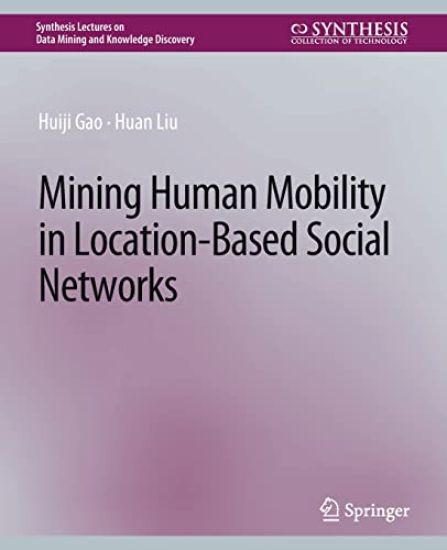
Mining Human Mobility in Location-Based Social Networks

Mining Human Mobility in Location-Based Social Networks

Huiji Gao; Huan Liu

Springer International Publishing AG
2015
nidottu
In recent years, there has been a rapid growth of location-based social networking services, such as Foursquare and Facebook Places, which have attracted an increasing number of users and greatly enriched their urban experience. Typical location-based social networking sites allow a user to "check in" at a real-world POI (point of interest, e.g., a hotel, restaurant, theater, etc.), leave tips toward the POI, and share the check-in with their online friends. The check-in action bridges the gap between real world and online social networks, resulting in a new type of social networks, namely location-based social networks (LBSNs). Compared to traditional GPS data, location-based social networks data contains unique properties with abundant heterogeneous information to reveal human mobility, i.e., "when and where a user (who) has been to for what," corresponding to an unprecedented opportunity to better understand human mobility from spatial, temporal, social, and content aspects. The mining and understanding of human mobility can further lead to effective approaches to improve current location-based services from mobile marketing to recommender systems, providing users more convenient life experience than before. This book takes a data mining perspective to offer an overview of studying human mobility in location-based social networks and illuminate a wide range of related computational tasks. It introduces basic concepts, elaborates associated challenges, reviews state-of-the-art algorithms with illustrative examples and real-world LBSN datasets, and discusses effective evaluation methods in mining human mobility. In particular, we illustrate unique characteristics and research opportunities of LBSN data, present representative tasks of mining human mobility on location-based social networks, including capturing user mobility patterns to understand when and where a user commonly goes (location prediction), and exploiting user preferences and location profiles to investigate where and when a user wants to explore (location recommendation), along with studying a user's check-in activity in terms of why a user goes to a certain location.
Social Media Mining

Social Media Mining

Reza Zafarani; Mohammad Ali Abbasi; Huan Liu

Cambridge University Press
2014
sidottu
The growth of social media over the last decade has revolutionized the way individuals interact and industries conduct business. Individuals produce data at an unprecedented rate by interacting, sharing, and consuming content through social media. Understanding and processing this new type of data to glean actionable patterns presents challenges and opportunities for interdisciplinary research, novel algorithms and tool development. Social Media Mining integrates social media, social network analysis, and data mining to provide a coherent platform to understand the basics and potentials of social media mining. It introduces the unique problems arising from social media data and presents fundamental concepts, emerging issues, and effective algorithms for network analysis and data mining. Suitable for use in advanced undergraduate and beginning graduate courses as well as professional short courses, the text contains exercises of different degrees of difficulty that improve understanding and help apply concepts, principles and methods for social media mining.
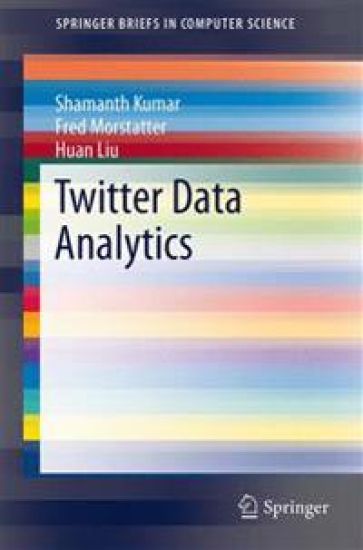
Twitter Data Analytics

Twitter Data Analytics

Shamanth Kumar; Fred Morstatter; Huan Liu

Springer-Verlag New York Inc.
2013
nidottu
This brief provides methods for harnessing Twitter data to discover solutions to complex inquiries. The brief introduces the process of collecting data through Twitter’s APIs and offers strategies for curating large datasets. The text gives examples of Twitter data with real-world examples, the present challenges and complexities of building visual analytic tools, and the best strategies to address these issues. Examples demonstrate how powerful measures can be computed using various Twitter data sources. Due to its openness in sharing data, Twitter is a prime example of social media in which researchers can verify their hypotheses, and practitioners can mine interesting patterns and build their own applications. This brief is designed to provide researchers, practitioners, project managers, as well as graduate students with an entry point to jump start their Twitter endeavors. It also serves as a convenient reference for readers seasoned in Twitter data analysis.
Provenance Data in Social Media

Provenance Data in Social Media

Geoffrey Barbier; Zhuo Feng; Pritam Gundecha; Huan Liu

Springer International Publishing AG
2013
nidottu
Social media shatters the barrier to communicate anytime anywhere for people of all walks of life. The publicly available, virtually free information in social media poses a new challenge to consumers who have to discern whether a piece of information published in social media is reliable. For example, it can be difficult to understand the motivations behind a statement passed from one user to another, without knowing the person who originated the message. Additionally, false information can be propagated through social media, resulting in embarrassment or irreversible damages. Provenance data associated with a social media statement can help dispel rumors, clarify opinions, and confirm facts. However, provenance data about social media statements is not readily available to users today. Currently, providing this data to users requires changing the social media infrastructure or offering subscription services. Taking advantage of social media features, research in this nascent field spearheads the search for a way to provide provenance data to social media users, thus leveraging social media itself by mining it for the provenance data. Searching for provenance data reveals an interesting problem space requiring the development and application of new metrics in order to provide meaningful provenance data to social media users. This lecture reviews the current research on information provenance, explores exciting research opportunities to address pressing needs, and shows how data mining can enable a social media user to make informed judgements about statements published in social media. Table of Contents: Information Provenance in Social Media / Provenance Attributes / Provenance via Network Information / Provenance Data
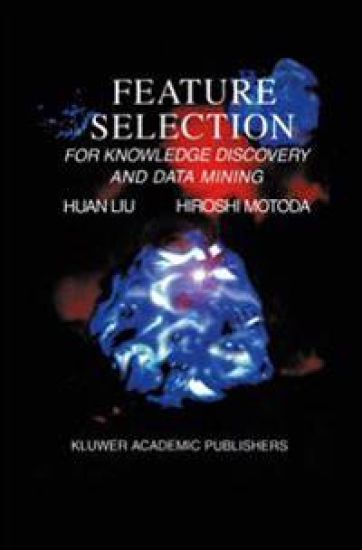
Feature Selection for Knowledge Discovery and Data Mining

Feature Selection for Knowledge Discovery and Data Mining

Huan Liu; Hiroshi Motoda

Springer-Verlag New York Inc.
2013
nidottu
As computer power grows and data collection technologies advance, a plethora of data is generated in almost every field where computers are used. The com­ puter generated data should be analyzed by computers; without the aid of computing technologies, it is certain that huge amounts of data collected will not ever be examined, let alone be used to our advantages. Even with today's advanced computer technologies (e. g. , machine learning and data mining sys­ tems), discovering knowledge from data can still be fiendishly hard due to the characteristics of the computer generated data. Taking its simplest form, raw data are represented in feature-values. The size of a dataset can be measUJ·ed in two dimensions, number of features (N) and number of instances (P). Both Nand P can be enormously large. This enormity may cause serious problems to many data mining systems. Feature selection is one of the long existing methods that deal with these problems. Its objective is to select a minimal subset of features according to some reasonable criteria so that the original task can be achieved equally well, if not better. By choosing a minimal subset offeatures, irrelevant and redundant features are removed according to the criterion. When N is reduced, the data space shrinks and in a sense, the data set is now a better representative of the whole data population. If necessary, the reduction of N can also give rise to the reduction of P by eliminating duplicates.
Spectral Feature Selection for Data Mining

Spectral Feature Selection for Data Mining

Zheng Alan Zhao; Huan Liu

Taylor Francis Inc
2011
sidottu
Spectral Feature Selection for Data Mining introduces a novel feature selection technique that establishes a general platform for studying existing feature selection algorithms and developing new algorithms for emerging problems in real-world applications. This technique represents a unified framework for supervised, unsupervised, and semisupervised feature selection. The book explores the latest research achievements, sheds light on new research directions, and stimulates readers to make the next creative breakthroughs. It presents the intrinsic ideas behind spectral feature selection, its theoretical foundations, its connections to other algorithms, and its use in handling both large-scale data sets and small sample problems. The authors also cover feature selection and feature extraction, including basic concepts, popular existing algorithms, and applications. A timely introduction to spectral feature selection, this book illustrates the potential of this powerful dimensionality reduction technique in high-dimensional data processing. Readers learn how to use spectral feature selection to solve challenging problems in real-life applications and discover how general feature selection and extraction are connected to spectral feature selection.
Modeling and Data Mining in Blogosphere

Modeling and Data Mining in Blogosphere

Nitin Agarwal; Huan Liu

Springer International Publishing AG
2009
nidottu
This book offers a comprehensive overview of the various concepts and research issues about blogs or weblogs. It introduces techniques and approaches, tools and applications, and evaluation methodologies with examples and case studies. Blogs allow people to express their thoughts, voice their opinions, and share their experiences and ideas. Blogs also facilitate interactions among individuals creating a network with unique characteristics. Through the interactions individuals experience a sense of community. We elaborate on approaches that extract communities and cluster blogs based on information of the bloggers. Open standards and low barrier to publication in Blogosphere have transformed information consumers to producers, generating an overwhelming amount of ever-increasing knowledge about the members, their environment and symbiosis. We elaborate on approaches that sift through humongous blog data sources to identify influential and trustworthy bloggers leveraging content and network information. Spam blogs or "splogs" are an increasing concern in Blogosphere and are discussed in detail with the approaches leveraging supervised machine learning algorithms and interaction patterns. We elaborate on data collection procedures, provide resources for blog data repositories, mention various visualization and analysis tools in Blogosphere, and explain conventional and novel evaluation methodologies, to help perform research in the Blogosphere. The book is supported by additional material, including lecture slides as well as the complete set of figures used in the book, and the reader is encouraged to visit the book website for the latest information. Table of Contents: Modeling Blogosphere / Blog Clustering and Community Discovery / Influence and Trust / Spam Filtering in Blogosphere / Data Collection and Evaluation
Feature Selection for Knowledge Discovery and Data Mining
As computer power grows and data collection technologies advance, a plethora of data is generated in almost every field where computers are used. The com­ puter generated data should be analyzed by computers; without the aid of computing technologies, it is certain that huge amounts of data collected will not ever be examined, let alone be used to our advantages. Even with today's advanced computer technologies (e. g. , machine learning and data mining sys­ tems), discovering knowledge from data can still be fiendishly hard due to the characteristics of the computer generated data. Taking its simplest form, raw data are represented in feature-values. The size of a dataset can be measUJ·ed in two dimensions, number of features (N) and number of instances (P). Both Nand P can be enormously large. This enormity may cause serious problems to many data mining systems. Feature selection is one of the long existing methods that deal with these problems. Its objective is to select a minimal subset of features according to some reasonable criteria so that the original task can be achieved equally well, if not better. By choosing a minimal subset offeatures, irrelevant and redundant features are removed according to the criterion. When N is reduced, the data space shrinks and in a sense, the data set is now a better representative of the whole data population. If necessary, the reduction of N can also give rise to the reduction of P by eliminating duplicates.