Kirjojen hintavertailu – 12 859 819 kirjaa ja 27 kauppaa
Kirjailija
Immanuel Kant
Kirjat ja teokset yhdessä paikassa: 1 083 kirjaa, julkaisuja vuosilta 1785–2026, suosituimpiin kuuluu Politz, K: Immanuel Kants Vorlesungen Uber Die Philosophisch. Vertaile teosten hintoja ja tarkista saatavuus suomalaisista kirjakaupoista.
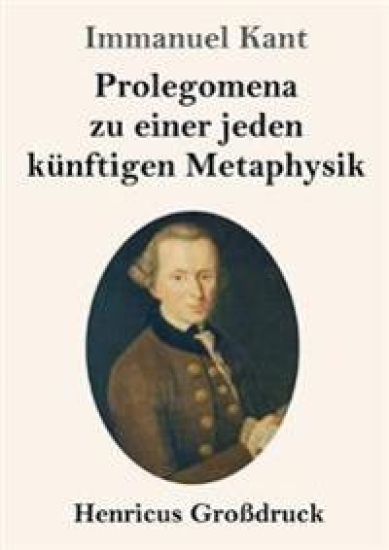
In 1781, Immanuel Kant published his first and most famous work, the "Critique of Pure Reason". To the German philosopher's dismay, the work was at first poorly received and largely misunderstood by his readers. As a result, two years later Kant produced his "Prolegomena to any Future Metaphysics that will be Able to Present Itself as a Science" to serve as an introduction to the "Critique". He restated the main ideas of his philosophy in what Schopenhauer, in 1819, declared was "the finest and most comprehensible of Kant's principal works, which is far too little read, for it immensely facilitates the study of his philosophy." Immanuel Kant is considered to be one of the most important and influential figures in Western philosophy for his work in the areas of metaphysics, anthropology, theoretical physics, logic, and moral philosophy. Remarkably, Kant never left the town of K nigsberg, Germany, where he had been born, received schooling, and served as lecturer at the University for many years. Presented here is the translation of Paul Carus. This edition is printed on premium acid-free paper.
Immanuel Kant: Die Religion innerhalb der Grenzen der blo en Vernunft Lesefreundlicher Gro druck in 16-pt-Schrift Gro format, 210 x 297 mm Berliner Ausgabe, 2019 Durchgesehener Neusatz mit einer Biographie des Autors bearbeitet und eingerichtet von Theodor Borken Erstdruck: K nigsberg (Nicolovius) 1793. Der Text folgte der 2. vermehrten Auflage, K nigsberg (Nicolovius) 1794. Textgrundlage ist die Ausgabe: Immanuel Kant: Werke in zw lf B nden. Herausgegeben von Wilhelm Weischedel. Frankfurt am Main: Suhrkamp, 1977. Umschlaggestaltung von Thomas Schultz-Overhage. Gesetzt aus der Minion Pro, 16 pt. Henricus Edition Deutsche Klassik UG (haftungsbeschr nkt)
Immanuel Kant: Die Religion innerhalb der Grenzen der blo en Vernunft Lesefreundlicher Gro druck in 16-pt-Schrift Gro format, 210 x 297 mm Berliner Ausgabe, 2019 Durchgesehener Neusatz mit einer Biographie des Autors bearbeitet und eingerichtet von Theodor Borken Erstdruck: K nigsberg (Nicolovius) 1793. Der Text folgte der 2. vermehrten Auflage, K nigsberg (Nicolovius) 1794. Textgrundlage ist die Ausgabe: Immanuel Kant: Werke in zw lf B nden. Herausgegeben von Wilhelm Weischedel. Frankfurt am Main: Suhrkamp, 1977. Umschlaggestaltung von Thomas Schultz-Overhage. Gesetzt aus der Minion Pro, 16 pt. Henricus Edition Deutsche Klassik UG (haftungsbeschr nkt)
Critique Of Pure Reason ist ein unver nderter, hochwertiger Nachdruck der Originalausgabe aus dem Jahr 1781. Hansebooks ist Herausgeber von Literatur zu unterschiedlichen Themengebieten wie Forschung und Wissenschaft, Reisen und Expeditionen, Kochen und Ern hrung, Medizin und weiteren Genres. Der Schwerpunkt des Verlages liegt auf dem Erhalt historischer Literatur. Viele Werke historischer Schriftsteller und Wissenschaftler sind heute nur noch als Antiquit ten erh ltlich. Hansebooks verlegt diese B cher neu und tr gt damit zum Erhalt selten gewordener Literatur und historischem Wissen auch f r die Zukunft bei.
Immanuel Kant: Prolegomena zu einer jeden k nftigen Metaphysik Lesefreundlicher Gro druck in 16-pt-Schrift Gro format, 210 x 297 mm Berliner Ausgabe, 2019 Durchgesehener Neusatz mit einer Biographie des Autors bearbeitet und eingerichtet von Theodor Borken Erstdruck: Riga (Hartknoch) 1783. Textgrundlage ist die Ausgabe: Immanuel Kant: Werke in zw lf B nden. Herausgegeben von Wilhelm Weischedel. Frankfurt am Main: Suhrkamp, 1977. Umschlaggestaltung von Thomas Schultz-Overhage. Gesetzt aus der Minion Pro, 16 pt. Henricus Edition Deutsche Klassik UG (haftungsbeschr nkt)
Immanuel Kant: Prolegomena zu einer jeden k nftigen Metaphysik Lesefreundlicher Gro druck in 16-pt-Schrift Gro format, 210 x 297 mm Berliner Ausgabe, 2019 Durchgesehener Neusatz mit einer Biographie des Autors bearbeitet und eingerichtet von Theodor Borken Erstdruck: Riga (Hartknoch) 1783. Textgrundlage ist die Ausgabe: Immanuel Kant: Werke in zw lf B nden. Herausgegeben von Wilhelm Weischedel. Frankfurt am Main: Suhrkamp, 1977. Umschlaggestaltung von Thomas Schultz-Overhage. Gesetzt aus der Minion Pro, 16 pt. Henricus Edition Deutsche Klassik UG (haftungsbeschr nkt)
Immanuel Kant: Beantwortung der Frage: Was ist Aufkl rung? und andere kleine Schriften Lesefreundlicher Gro druck in 16-pt-Schrift Gro format, 210 x 297 mm Berliner Ausgabe, 2019 Durchgesehener Neusatz mit einer Biographie des Autors bearbeitet und eingerichtet von Theodor Borken Beantwortung der Frage: Was ist Aufkl rung?: Erstdruck in: Berlinische Monatsschrift, Dezember 1784, S. 481-494. Was hei t: sich im Denken orientieren?: Erstdruck in: Berlinische Monatsschrift, Oktober 1786, S. 304-330. ber ein vermeintes Recht aus Menschenliebe zu l gen: Erstdruck in: Berlinische Bl tter, 1. Jg., 1797, S. 301-314. Idee zu einer allgemeinen Geschichte in weltb rgerlicher Absicht: Erstdruck in: Berlinische Monatsschrift, November 1784, S. 385-411. Die falsche Spitzfindigkeit der vier syllogistischen Figuren: Erstdruck: K nigsberg (Kanter) 1762. Inhaltsverzeichnis: Beantwortung der Frage: Was ist Aufkl rung? Was hei t: sich im Denken orientieren? ber ein vermeintes Recht aus Menschenliebe zu l gen. Idee zu einer allgemeinen Geschichte in weltb rgerlicher Absicht. Die falsche Spitzfindigkeit der vier syllogistischen Figuren. Biographie. Textgrundlage sind die Ausgaben: Immanuel Kant: Werke in zw lf B nden. Herausgegeben von Wilhelm Weischedel. Frankfurt am Main: Suhrkamp, 1977. Umschlaggestaltung von Thomas Schultz-Overhage. Gesetzt aus der Minion Pro, 16 pt. Henricus Edition Deutsche Klassik UG (haftungsbeschr nkt)
Immanuel Kant: Beantwortung der Frage: Was ist Aufkl rung? und andere kleine Schriften Lesefreundlicher Gro druck in 16-pt-Schrift Gro format, 210 x 297 mm Berliner Ausgabe, 2019 Durchgesehener Neusatz mit einer Biographie des Autors bearbeitet und eingerichtet von Theodor Borken Beantwortung der Frage: Was ist Aufkl rung?: Erstdruck in: Berlinische Monatsschrift, Dezember 1784, S. 481-494. Was hei t: sich im Denken orientieren?: Erstdruck in: Berlinische Monatsschrift, Oktober 1786, S. 304-330. ber ein vermeintes Recht aus Menschenliebe zu l gen: Erstdruck in: Berlinische Bl tter, 1. Jg., 1797, S. 301-314. Idee zu einer allgemeinen Geschichte in weltb rgerlicher Absicht: Erstdruck in: Berlinische Monatsschrift, November 1784, S. 385-411. Die falsche Spitzfindigkeit der vier syllogistischen Figuren: Erstdruck: K nigsberg (Kanter) 1762. Inhaltsverzeichnis: Beantwortung der Frage: Was ist Aufkl rung? Was hei t: sich im Denken orientieren? ber ein vermeintes Recht aus Menschenliebe zu l gen. Idee zu einer allgemeinen Geschichte in weltb rgerlicher Absicht. Die falsche Spitzfindigkeit der vier syllogistischen Figuren. Biographie. Textgrundlage sind die Ausgaben: Immanuel Kant: Werke in zw lf B nden. Herausgegeben von Wilhelm Weischedel. Frankfurt am Main: Suhrkamp, 1977. Umschlaggestaltung von Thomas Schultz-Overhage. Gesetzt aus der Minion Pro, 16 pt. Henricus Edition Deutsche Klassik UG (haftungsbeschr nkt)
Kant conceives his investigation as a work of foundational ethics-one that clears the ground for future research by explaining the core concepts and principles of moral theory and showing that they are normative for rational agents. Kant conceives his investigation as a work of foundational ethics--one that clears the ground for future research by explaining the core concepts and principles of moral theory and showing that they are normative for rational agents. Kant aspires to nothing less than this: to lay bare the fundamental principle of morality and show that it applies to us. In the text, Kant provides a groundbreaking argument that the rightness of an action is determined by the character of the principle that a person chooses to act upon. Kant thus stands in stark contrast to the moral sense theories and teleological moral theories that dominated moral philosophy at the time he was writing. Central to the work is the role of what Kant refers to as the categorical imperative, the concept that one must act only according to that precept which he or she would will to become a universal law.
Kant builds on the work of empiricist philosophers such as John Locke and David Hume, as well as rationalists such as Gottfried Wilhelm Leibniz and Christian Wolff. He expounds new ideas on the nature of space and time, and tries to provide solutions to Hume's scepticism regarding human knowledge of the relation of cause and effect, and Ren Descartes' scepticism regarding knowledge of the external world. This is argued through the transcendental idealism of objects (as appearance) and their form of appearance. Kant regards the former "as mere representations and not as things in themselves", and the latter as "only sensible forms of our intuition, but not determinations given for themselves or conditions of objects as things in themselves". This grants the possibility of a priori knowledge, since objects as appearance "must conform to our cognition . . . which is to establish something about objects before they are given to us". Knowledge independent of experience Kant calls "a priori" knowledge, while knowledge obtained through experience is termed "a posteriori". In Kant's view, a priori intuitions and concepts provide some a priori knowledge, which also provides the framework for a posteriori knowledge. Kant also believed that causality is a conceptual organizing principle imposed upon nature, albeit nature understood as the sum of appearances that can be synthesized according to a priori concepts. In other words, space and time are a form of perceiving and causality is a form of knowing. Both space and time and conceptual principles and processes pre-structure experience. Things as they are "in themselves"--the thing in itself or das Ding an sich--are unknowable. For something to become an object of knowledge, it must be experienced, and experience is structured by the mind--both space and time being the forms of intuition (Anschauung in German; for Kant, intuition is the process of sensing or the act of having a sensation)