
Kirjailija
Immanuel Kant
Kirjat ja teokset yhdessä paikassa: 1 083 kirjaa, julkaisuja vuosilta 1785–2026, suosituimpiin kuuluu Politz, K: Immanuel Kants Vorlesungen Uber Die Philosophisch. Vertaile teosten hintoja ja tarkista saatavuus suomalaisista kirjakaupoista.
1 083 kirjaa
Kirjojen julkaisuvuodet: 1785–2026.
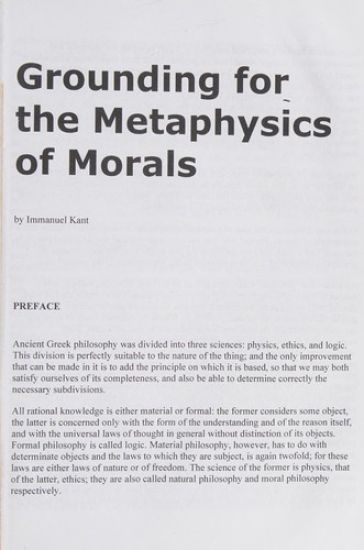
Grounding for the Metaphysics of Morals
Immanuel Kant
Createspace Independent Publishing Platform
2016
nidottu

Cr tica de la Raz n Pura Immanuel Kant



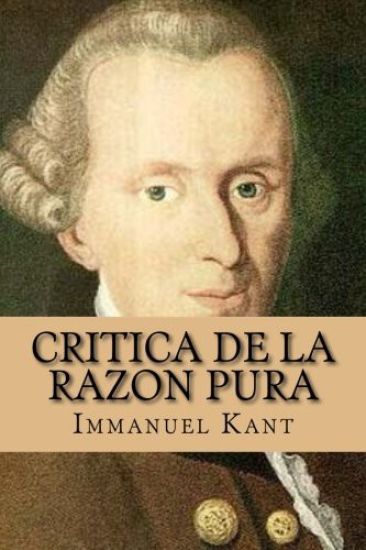
Titulo: Critica de la razon puraAutor: Immanuel KantFecha de publicacion:1781Sinopsis: Se trata de una indagaci n trascendental (acerca de las condiciones epist micas del conocer humano) cuyo objetivo central es lograr una respuesta definitiva sobre si la metaf sica puede ser considerada una ciencia, as como fundamentar la validez tanto de la experiencia ordinaria como de las ciencias matem ticas y f sicas. Tanto la fundamentaci n de la metaf sica como la del resto de los conocimientos exige, para que sea decidida su posibilidad, que se determine en cada caso si son posibles juicios que sean a priori (es decir, independientes de la experiencia, lo que implica para Kant que sean necesarios y universales, absolutamente ciertos) y a la vez sint ticos (que no sean, como los anal ticos, meras tautolog as, sino que a adan informaci n no contenida ya de antemano en el concepto que se considera). En este sentido, es fundamental el intento de Kant de superar la cr tica al principio de causalidad (y por lo tanto al saber cient fico) que hab a hecho David Hume, cr tica que no ten a una respuesta satisfactoria hasta su poca y que implicaba que tanto aquel principio como el saber cient fico sobre el mundo eran meramente a posteriori, esto es, dependientes de la experiencia y por ende carentes de necesidad, universalidad y certeza


The main work of Immanuel Kant in which he argues that the mind forms its own experiences. These experiences are thus only as perceiving the phenomenal world and not experiencing the world around us as it truly is. He tries to combat the critique that such a view holds and to put the use of reason to justify our experiences by showing that we never truly experience what we perceive.

Fundamental Principles of the Metaphysic of Morals: Groundwork of the Metaphysic of Morals
Immanuel Kant
Createspace Independent Publishing Platform
2016
nidottu
Fundamental Principles of the Metaphysic of Morals by Immanuel Kant and translated by Thomas Kingsmill Abbott...... Groundwork of the Metaphysic of Morals (German: Grundlegung zur Metaphysik der Sitten; 1785; also known as the Foundations of the Metaphysics of Morals, Grounding of the Metaphysics of Morals and the Grounding for the Metaphysics of Morals) is the first of Immanuel Kant's mature works on moral philosophy and remains one of the most influential in the field. Kant conceives his investigation as a work of foundational ethics

The Critique of Judgement: Critique of Aesthetic Judgement
Immanuel Kant
Createspace Independent Publishing Platform
2016
nidottu
The Critique of JudgementPart I: Critique of Aesthetic JudgementImmanuel Kanttranslated by James Creed MeredithThe Critique of Judgment, also translated as the Critique of the Power of Judgment, is a 1790 philosophical work by Immanuel Kant. Sometimes referred to as the third Critique, the Critique of Judgment follows the Critique of Pure Reason (1781) and the Critique of Practical Reason (1788). The faculty of knowledge from a priori principles may be called pure reason, and the general investigation into its possibility and bounds the Critique of Pure Reason. This is permissible although "pure reason," as was the case with the same use of terms in our first work, is only intended to denote reason in its theoretical employment, and although there is no desire to bring under review its faculty as practical reason and its special principles as such. That Critique is, then, an investigation addressed simply to our faculty of knowing things a priori. Hence it makes our cognitive faculties its sole concern, to the exclusion of the feeling of pleasure or displeasure and the faculty of desire; and among the cognitive faculties it confines its attention to understanding and its a priori principles, to the exclusion of judgement and reason, (faculties that also belong to theoretical cognition, ) because it turns out in the sequel that there is no cognitive faculty other than understanding capable of affording constitutive a priori principles of knowledge.

The Critique of Pure Reason by Immanuel Kant, (first published in 1781, second edition 1787), is one of the most influential works in the history of philosophy. 2] Also referred to as Kant's First Critique, it was followed by the Critique of Practical Reason (1788) and the Critique of Judgment (1790). In the preface to the first edition Kant explains what he means by a critique of pure reason: "I do not mean by this a critique of books and systems, but of the faculty of reason in general, in respect of all knowledge after which it may strive independently of all experience." Dealing with questions concerning the foundations and extent of human knowledge, Kant builds on the work of empiricist philosophers such as John Locke and David Hume, as well as taking into account the theories of rationalist philosophers such as Gottfried Wilhelm Leibniz and Christian Wolff. Kant expounds new ideas on the nature of space and time, and claims to solve the problem which Hume posed regarding human knowledge of the relation of cause and effect, and to have assessed the ability of the human mind to engage in metaphysics. Knowledge independent of experience is referred to by Kant as "a priori" knowledge, while knowledge obtained through experience is termed "a posteriori". 3] According to Kant, "a priori" knowledge expresses necessary truths. Statements which are necessarily true cannot be negated without becoming false. Examples provided by Kant include the propositions of mathematics, propositions "from the understanding in its quite ordinary employment", 4] such as "Every alteration must have a cause", as well as propositions from "natural science (physics)", such as "in all changes in the material world the quantity of matter remains unchanged". 5] Kant believed that he had discovered another attribute of propositions, which allowed him to frame the problem of a priori knowledge in a new way: the distinction between "analytic" and "synthetic" judgments. 6] According to Kant, to say that a sentence is "analytic" is to say that what is stated in the predicate-concept of the sentence is already contained (albeit covertly) in the subject-concept of that sentence. 7] The example he provides is the sentence, "All bodies are extended", which is "analytic" since the predicate-concept ("extended") is already contained in - or "thought in" - the subject-concept of the sentence ("bodies"). Kant considered the judgment, "All bodies are heavy" synthetic, since "I do not include in the concept of body in general the predicate 'weight'". 8] Synthetic judgments therefore add something to a concept, whereas analytic judgments only explain what is already contained in the concept. The distinctive character of "analytic" judgments was therefore that they can be known to be true simply by an analysis of the concepts contained in them - or, alternatively, are true by definition. Prior to Kant, it was thought that all necessary truth had the character of being "analytic". Kant argued that not all necessary truths are analytic, but that some of them are synthetic. Having explained that the basis of analytic judgments lies in the principle of contradiction, (or the principle of identity), the task he set out to achieve in the Critique of Pure Reason was to explain the grounds of those judgments which are necessary and synthetic - and these he termed "a priori synthetic judgments".

Immanuel Kant (* 22. April 1724 in K nigsberg, Preu en; + 12. Februar 1804 ebenda) war ein deutscher Philosoph der Aufkl rung. Kant z hlt zu den bedeutendsten Vertretern der abendl ndischen Philosophie. Sein Werk Kritik der reinen Vernunft kennzeichnet einen Wendepunkt in der Philosophiegeschichte und den Beginn der modernen Philosophie. Kant schuf eine neue, umfassende Perspektive in der Philosophie, welche die Diskussion bis ins 21. Jahrhundert ma geblich beeinflusst. Dazu geh rt nicht nur sein Einfluss auf die Erkenntnistheorie mit der Kritik der reinen Vernunft, sondern auch auf die Ethik mit der Kritik der praktischen Vernunft und die sthetik mit der Kritik der Urteilskraft. Zudem verfasste Kant bedeutende Schriften zur Religions-, Rechts- und Geschichtsphilosophie sowie Beitr ge zu Astronomie und Geowissenschaften.

The Critique of Judgment (German: Kritik der Urteilskraft, KdU), also translated as the Critique of the Power of Judgment, is a 1790 philosophical work by Immanuel Kant. Sometimes referred to as the third Critique, the Critique of Judgment follows the Critique of Pure Reason (1781) and the Critique of Practical Reason (1788).

Beobachtungen über das Gefühl des Schönen und Erhabenen
Immanuel Kant
Createspace Independent Publishing Platform
2016
nidottu
Immanuel Kant (* 22. April 1724 in K nigsberg, Preu en; + 12. Februar 1804 ebenda) war ein deutscher Philosoph der Aufkl rung. Kant z hlt zu den bedeutendsten Vertretern der abendl ndischen Philosophie. Sein Werk Kritik der reinen Vernunft kennzeichnet einen Wendepunkt in der Philosophiegeschichte und den Beginn der modernen Philosophie. Kant schuf eine neue, umfassende Perspektive in der Philosophie, welche die Diskussion bis ins 21. Jahrhundert ma geblich beeinflusst. Dazu geh rt nicht nur sein Einfluss auf die Erkenntnistheorie mit der Kritik der reinen Vernunft, sondern auch auf die Ethik mit der Kritik der praktischen Vernunft und die sthetik mit der Kritik der Urteilskraft. Zudem verfasste Kant bedeutende Schriften zur Religions-, Rechts- und Geschichtsphilosophie sowie Beitr ge zu Astronomie und Geowissenschaften.

Die Altersschrift Zum ewigen Frieden. Ein philosophischer Entwurf (erste Auflage 1795 (zit. als A) 104 S., zweite, erweiterte Auflage 1796 (zit. als B), 112 S.) geh rt zu den bekanntesten Werken des deutschen Philosophen Immanuel Kant. So geht die neuzeitliche Bedeutung des Begriffs Frieden entscheidend auf Kants hierin vorgestellte Theorien zur ck. In Form eines Friedensvertrages wendet Kant seine Moralphilosophie (vgl. Grundlegung zur Metaphysik der Sitten, Kategorischer Imperativ) auf die Frage der Politik nach dem Frieden zwischen den Staaten an. Auch hier gilt es, von der Vernunft geleitete Entscheidungen zu treffen und nach Gerechtigkeit zu trachten. Dabei stellt er klar, dass der Frieden kein nat rlicher Zustand f r den Menschen sei und deshalb gestiftet werden m sse. Die Gew hrung des Friedens sei Sache der Politik, welche sich der Idee eines allgemeing ltigen Rechtssystems unterzuordnen habe; denn so hei t es im Anhang: Das Recht der Menschen mu heilig gehalten werden, der herrschenden Gewalt mag es auch noch so gro e Aufopferung kosten. Dem Despotismus erteilt Kant eine Absage. Bekannt geworden sind die Ideen des V lkerrechts, das die Verbindlichkeit der zwischenstaatlichen Abkommen fordert, und die Ausrichtung des Friedens als v lkerrechtlichen Vertrag. In den Internationalen Beziehungen wird "Zum ewigen Frieden" den liberalen Theorien zugeordnet. Die Charta der Vereinten Nationen wurde wesentlich von dieser Schrift beeinflusst.

Immanuel Kant's Werke Sorgfaltig Revidirte Gesammtausgabe in Zehn Bänden
Immanuel Kant
Createspace Independent Publishing Platform
2016
nidottu
Immanuel Kant's Werke Sorgfaltig Revidirte Gesammtausgabe in Zehn B nden by Immanuel Kant. This book is a reproduction of the original book published in 1839 and may have some imperfections such as marks or hand-written notes.

Fundamental Principles of the Metaphysic of Morals
Immanuel Kant
Createspace Independent Publishing Platform
2016
nidottu
Immanuel Kant; 22 April 1724 - 12 February 1804) was a German philosopher who is considered the central figure of modern philosophy. 5] Kant argued that fundamental concepts of the human mind structure human experience, that reason is the source of morality, that aesthetics arises from a faculty of disinterested judgment, that space and time are forms of our sensibility, and that the world as it is "in-itself" is unknowable. Kant took himself to have effected a Copernican revolution in philosophy, akin to Copernicus' reversal of the age-old belief that the sun revolved around the earth. His beliefs continue to have a major influence on contemporary philosophy, especially the fields of metaphysics, epistemology, ethics, political theory, and aesthetics. Kant in his critical phase sought to 'reverse' the orientation of pre-critical philosophy by showing how the traditional problems of metaphysics can be overcome by supposing that the agreement between reality and the concepts we use to conceive it arises not because our mental concepts have come to passively mirror reality, but because reality must conform to the human mind's active concepts to be conceivable and at all possible for us to experience. Kant thus regarded the basic categories of the human mind as the transcendental "condition of possibility" for any experience. 6] Politically, Kant was one of the earliest exponents of the idea that perpetual peace could be secured through universal democracy and international cooperation. He believed that this eventually will be the outcome of universal history, although it is not rationally planned. 7] The exact nature of Kant's religious ideas continue to be the subject of especially heated philosophical dispute, with viewpoints ranging from the idea that Kant was an early and radical exponent of atheism who finally exploded the ontological argument for God's existence, to more critical treatments epitomized by Nietzsche who claimed that Kant had "theologian blood" 8] and that Kant was merely a sophisticated apologist for traditional Christian religious belief, writing that "Kant wanted to prove, in a way that would dumbfound the common man, that the common man was right: that was the secret joke of this soul." 9] In Kant's major work, the Critique of Pure Reason (Kritik der reinen Vernunft, 1781), 10] he attempted to explain the relationship between reason and human experience and to move beyond the failures of traditional philosophy and metaphysics. Kant wanted to put an end to an era of futile and speculative theories of human experience, while resisting the skepticism of thinkers such as David Hume. Kant regarded himself as ending and showing the way beyond the impasse which modern philosophy had led to between rationalists and empiricists, 11] and is widely held to have synthesized these two early modern traditions in his thought. 12] Kant argued that our experiences are structured by necessary features of our minds. In his view, the mind shapes and structures experience so that, on an abstract level, all human experience shares certain essential structural features. Among other things, Kant believed that the concepts of space and time are integral to all human experience, as are our concepts of cause and effect. 13] One important consequence of this view is that our experience of things is always of the phenomenal world as conveyed by our senses: we do not have direct access to things in themselves, the so-called noumenal world. Kant published other important works on ethics, religion, law, aesthetics, astronomy, and history. These included the Critique of Practical Reason (Kritik der praktischen Vernunft, 1788), the Metaphysics of Morals (Die Metaphysik der Sitten, 1797), which dealt with ethics, and the Critique of Judgment (Kritik der Urteilskraft, 1790), which looks at aesthetics and teleology.

Perpetual peace refers to a state of affairs where peace is permanently established over a certain area. The idea of perpetual peace first came up during the 18th century, when Charles-Ir n e Castel de Saint-Pierre published his essay "Project for Perpetual Peace" anonymously while working as the negotiator for the Treaty of Utrecht. However, the idea did not become well known until the late 18th century. The term perpetual peace became acknowledged when German philosopher Immanuel Kant published his 1795 essay "Perpetual Peace: A Philosophical Sketch". Perpetual peace has had significant influence upon modern politics. Perpetual peace has been the foundation for peace and conflict studies, a relatively newly laid field which started in Europe around the 1950s and 1960s