Kirjojen hintavertailu – 12 859 819 kirjaa ja 27 kauppaa

Kirjailija

Immanuel Wallerstein

Kirjat ja teokset yhdessä paikassa: 57 kirjaa, julkaisuja vuosilta 1979–2026, suosituimpiin kuuluu Onko kapitalismilla tulevaisuutta?. Vertaile teosten hintoja ja tarkista saatavuus suomalaisista kirjakaupoista.

57 kirjaa

Kirjojen julkaisuvuodet: 1979–2026.

Alternatives

Alternatives

Immanuel Wallerstein

Paradigm
2004
nidottu
Immanuel Wallerstein draws on a lifetime of study of long-term historical change to shed light in his newest book on the consequences of the recent, significant turn in U. S. foreign and economic policies. Alternatives shows how the U. S. has been in decline since the 1970s and how these longer trends dovetail with current Bush administration policies, which he describes as an attempt to reverse the decline in ways that are disastrous to the future of the country and the world. The book's middle section is a log of insightful commentaries written between 2001 and 2004 detailing how the Bush administration has broken the pattern of foreign policies set by six presidents from Richard Nixon to Bill Clinton. Wallerstein suggests that a threshold has been crossed that will make it difficult for future presidents to practice the kind of 'soft' multilateralism in foreign policy they have used in the past and maintain effective alliances. He also shows, surprisingly, why 'globalization' already is dead, especially in terms of the United States' ability to dominate economically in the manner that it has since WWII. He calls for a major revision of U. S. policies, and not an attempt merely to return to the pre-Bush foreign policy. In conclusion, Wallerstein's visionary book speaks to the challenges the U. S. must face if it is to play a meaningful and progressive role in the world-system.

Alternatives

Alternatives

Immanuel Wallerstein

Paradigm
2004
sidottu
Immanuel Wallerstein draws on a lifetime of study of long-term historical change to shed light in his newest book on the consequences of the recent, significant turn in U. S. foreign and economic policies. Alternatives shows how the U. S. has been in decline since the 1970s and how these longer trends dovetail with current Bush administration policies, which he describes as an attempt to reverse the decline in ways that are disastrous to the future of the country and the world. The book's middle section is a log of insightful commentaries written between 2001 and 2004 detailing how the Bush administration has broken the pattern of foreign policies set by six presidents from Richard Nixon to Bill Clinton. Wallerstein suggests that a threshold has been crossed that will make it difficult for future presidents to practice the kind of 'soft' multilateralism in foreign policy they have used in the past and maintain effective alliances. He also shows, surprisingly, why 'globalization' already is dead, especially in terms of the United States' ability to dominate economically in the manner that it has since WWII. He calls for a major revision of U. S. policies, and not an attempt merely to return to the pre-Bush foreign policy. In conclusion, Wallerstein's visionary book speaks to the challenges the U. S. must face if it is to play a meaningful and progressive role in the world-system.

Uncertainties Of Knowledge

Uncertainties Of Knowledge

Immanuel Wallerstein

Temple University Press,U.S.
2004
pokkari
The Uncertainties of Knowledge extends Immanuel Wallerstein's decade-long work of elucidating the crisis of knowledge in current intellectual thought. He argues that the disciplinary divisions of academia have trapped us in a paradigm that assumes knowledge is a certainty and that it can help us explain the social world. This is wrong, he suggests. Instead, Wallerstein offers a new conception of the social sciences, one whose methodology allows for uncertainties.
The Decline Of American Power

The Decline Of American Power

Immanuel Wallerstein

The New Press
2003
nidottu
The United States in decline? Its admirers and detractors alike claim the opposite: that America is now in a position of unprecedented global supremacy. But in fact, Immanuel Wallerstein argues, a more nuanced evaluation of recent history reveals that America has been fading as a global power since the end of the Vietnam War, and its response to the terrorist attacks of September 11 looks certain to hasten that decline. In this provocative collection, the visionary originator of world-systems analysis and the most innovative social scientist of his generation turns a practiced analytical eye to the turbulent beginnings of the 21st century. Touching on globalization, Islam, racism, democracy, intellectuals, and the state of the Left, Wallerstein upends conventional wisdom to produce a clear-eyed—and troubling—assessment of the crumbling international order.
Liberalismens död : slutet på den rådande världsordningen
Immanuel Wallerstein har ett mångårigt vetenskapligt författarskap bakom sig. Det var han som lanserade den så kallade "världssystemteorin" som har spelat en viktig roll för förståelsen av politiska och ekonomiska sammanhang på global skala. I boken Liberalismens död ger han sin bild av de djupa skakningar som just nu och ett tag framöver går genom världssystemet. Han undviker ytfenomenen och siktar in sig på det väsentliga: nationalstaternas och ideologiernas kris, miljöproblemen, de skakiga ekonomiska konjunkturerna. Klart och åskådligt, utan önsketänkande och sentimentalitet, ger han sin bild av en orolig övergångsperiod, fylld av krig, epidemier och miljökatastrofer. Men han betonar att slutresultatet inte är förutbestämt. Det är upp till oss att påverka hur det nya samhälle som kommer att skapas skall se ut: demokratiskt och jämlikt eller totalitärt och hierarkiskt?
Uncertainties Of Knowledge

Uncertainties Of Knowledge

Immanuel Wallerstein

Temple University Press,U.S.
2001
sidottu
The Uncertainties of Knowledge extends Immanuel Wallerstein's decade-long work of elucidating the crisis of knowledge in current intellectual thought. He argues that the disciplinary divisions of academia have trapped us in a paradigm that assumes knowledge is a certainty and that it can help us explain the social world. This is wrong, he suggests. Instead, Wallerstein offers a new conception of the social sciences, one whose methodology allows for uncertainties.
Unthinking Social Science

Unthinking Social Science

Immanuel Wallerstein

Temple University Press,U.S.
2001
sidottu
In this new edition of a classic work -- now with a new preface -- on the roots of social scientific thinking, Immanuel Wallerstein develops a thorough-going critique of the legacy of nineteenth-century social science for social thought in the new millennium. We have to \u0022unthink\u0022 -- radically revise and discard -- many of the presumptions that still remain the foundation of dominant perspectives today. Once considered liberating, these notions are now barriers to a clear understanding of the social world. They include, for example, ideas built into the concept of \u0022development.\u0022 In place of such a notion, Wallerstein stresses transformations in time and space. Geography and chronology should not be regarded as external influences upon social transformations but crucial to what such transformation actually is. Unthinking Social Science applies the ideas thus elaborated to a variety of theoretical areas and historical problems. Wallerstein also offers a critical discussion of the key figures whose ideas influenced the position he formulates -- including Karl Marx and Fernand Braudel, among others. In the concluding sections of the book, Wallerstein demonstrates how these new insights lead to a revision of world-systems analysis.
Unthinking Social Science

Unthinking Social Science

Immanuel Wallerstein

Temple University Press,U.S.
2001
pokkari
In this new edition of a classic work -- now with a new preface -- on the roots of social scientific thinking, Immanuel Wallerstein develops a thorough-going critique of the legacy of nineteenth-century social science for social thought in the new millennium. We have to \u0022unthink\u0022 -- radically revise and discard -- many of the presumptions that still remain the foundation of dominant perspectives today. Once considered liberating, these notions are now barriers to a clear understanding of the social world. They include, for example, ideas built into the concept of \u0022development.\u0022 In place of such a notion, Wallerstein stresses transformations in time and space. Geography and chronology should not be regarded as external influences upon social transformations but crucial to what such transformation actually is. Unthinking Social Science applies the ideas thus elaborated to a variety of theoretical areas and historical problems. Wallerstein also offers a critical discussion of the key figures whose ideas influenced the position he formulates -- including Karl Marx and Fernand Braudel, among others. In the concluding sections of the book, Wallerstein demonstrates how these new insights lead to a revision of world-systems analysis.
End of the World as We Know It

End of the World as We Know It

Immanuel Wallerstein

University of Minnesota Press
2001
nidottu
This book is nothing short of a state-of-the-world address, delivered by a scholar uniquely suited to the task. Immanuel Wallerstein, one of the most prominent social scientists of our time, documents the profound transformations our world is undergoing. With these transformations, he argues, come equally profound changes in how we understand the world. Wallerstein begins his work with an appraisal of significant recent events -- the collapse of the Leninist states, the exhaustion of national liberation movements, the rise of East Asia, challenges to national sovereignty, dangers to the environment, debates about national identity, and the marginalization of migrant populations. Wallerstein places these events and trends in the context of the changing modern world-system as a whole and identifies the historic choices they put before us. The End of the World As We Know It concludes with a crucial analysis of the momentous intellectual challenges to social science as we know it today and suggests possible responses to them.
The Essential Wallerstein

The Essential Wallerstein

Immanuel Wallerstein

The New Press
2000
nidottu
Immanuel Wallerstein is one of the most innovative social scientists of his generation. Past president of the International Sociological Association, he has had a major influence on the development of social thought throughout the world, and his books are translated into every major language. The Essential Wallerstein brings together for the first time the full range of his scholarship. This comprehensive collection of essays offers a unique overview of this seminal thinker's work, showing the development of his thought: from his groundbreaking research on contemporary African politics and social change, to his study of the modern world-system, to his current essays on the new structures of knowledge emerging from the crisis of the capitalist world-economy. His singular focus on the way in which change in one part of the globe affects the whole is all the more relevant as the world grows increasingly interdependent. The Essential Wallerstein is an ideal introduction to the extensive body of work from a thinker who helped introduce globally sensitive thinking to the field of social science. This is the first in a series of Readers bringing together the key works of major figures in the social sciences.
Creating and Transforming Households

Creating and Transforming Households

Joan Smith; Immanuel Wallerstein

Cambridge University Press
1992
sidottu
This book, first published in 1992, seeks an explanation of the pattern of sharp discrepancy of wage levels across the world-economy for work of comparable productivity. It explores how far such differences can be explained by the different structures of households as 'income-pooling units', examining three key variables: location in the core or periphery of the world-economy; periods of expansion versus periods of contraction in the world-economy; and secular transformation over time. The authors argue that both the boundaries of households and their sources of income are molded by the changing patterns of the world-economy, but are also modes of defense against its pressures. Drawing empirical data from eight local regions in three different zones - the United States, Mexico and southern Africa - this book presents a systematic and original approach to the intimate link between the micro-structures of households and the structures of the capitalist world-economy at a global level.
Creating and Transforming Households

Creating and Transforming Households

Joan Smith; Immanuel Wallerstein

Cambridge University Press
1992
pokkari
This book, first published in 1992, seeks an explanation of the pattern of sharp discrepancy of wage levels across the world-economy for work of comparable productivity. It explores how far such differences can be explained by the different structures of households as 'income-pooling units', examining three key variables: location in the core or periphery of the world-economy; periods of expansion versus periods of contraction in the world-economy; and secular transformation over time. The authors argue that both the boundaries of households and their sources of income are molded by the changing patterns of the world-economy, but are also modes of defense against its pressures. Drawing empirical data from eight local regions in three different zones - the United States, Mexico and southern Africa - this book presents a systematic and original approach to the intimate link between the micro-structures of households and the structures of the capitalist world-economy at a global level.
Anti-systemic Movements

Anti-systemic Movements

Arrighi Giovanni; Hopkins Terence K.; Immanuel Wallerstein

Verso Books
1989
pokkari
Antisystemic Movements is an eloquent and concise history of popular resistance and class struggle by the leading exponents of the world-systems perspective on capitalism. Basing itself on an analysis of resistance movements since the emergence of capitalism, it shows that while some early forms were successful in their own terms, ultimately they did not impede the consolidation of the modern capitalist world-system. The authors argue that although capitalism generated resistance right from the beginning as it displaced populations, despoiled resources and established global exploitation, until about 1848 the capitalist world-system could crush or outflank an opposition which was dispersed, localized and lacking in organization and continuity. From the mid-nineteenth century down to recent times, more adequately organized social and national movements set some limits on capital accumulation, but generally remained confined in their effectiveness to the terrain of the nation-state. Indeed, paradoxically, the successes of the old social movements helped to boost the power and legitimacy of states while failing to remove the sources of class conflict or to grapple with the consequences of interstate competition. Taking the year 1968 as a symbolic turning-point, the authors argue that new antisystemic movements have arisen which challenge the logic of the capitalist world-system more centrally than ever before. These new movements have a different ethnic and gender composition and different ways of organizing, while their key inspirations show an increasing ability to cross national boundaries. The authors suggest that the new assertiveness of the south, the development of class struggle in the east and the emergence of rainbow coalitions in different world zones might hold out the promise of a future socialist world-system.
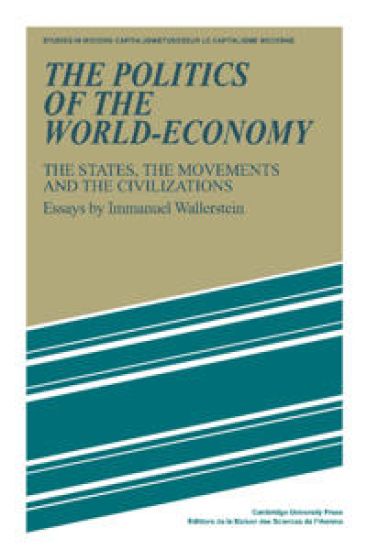
The Politics of the World-Economy

The Politics of the World-Economy

Immanuel Wallerstein

Cambridge University Press
1984
pokkari
In these essays, written (with one exception) between 1978 and 1982, Immanuel Wallerstein elaborates on the political and theoretical implications of the world-systems perspective outlined in his celebrated books "The Modern World-System" and "The Capitalist World-Economy".