Kirjojen hintavertailu – 12 859 824 kirjaa ja 27 kauppaa

Kirjailija

Isaac Newton

Kirjat ja teokset yhdessä paikassa: 252 kirjaa, julkaisuja vuosilta 1899–2026, suosituimpiin kuuluu The Correspondence of Isaac Newton. Vertaile teosten hintoja ja tarkista saatavuus suomalaisista kirjakaupoista.

252 kirjaa

Kirjojen julkaisuvuodet: 1899–2026.

Philosophiæ Naturalis Principia Mathematica Revision IV: Laws of Orbital Motion

Philosophiæ Naturalis Principia Mathematica Revision IV: Laws of Orbital Motion

Keith Dixon-Roche; Isaac Newton

Independently Published
2019
nidottu
Colour Images: This publication is a compilation of Volumes I, II & III providing a complete descriptive and mathematical explanation of why Isaac Newton was correct and Einstein and Bohr were both wrong. It includes; orbital motion, planetary spin, core pressure, earth's magnetic field, the atom along with mathematical descriptions for heat electricity, gravity, mass, all the physical constants. It defines Newton's gravitational constant (G) for the first time together with the true meaning of E=mc . It also disproves; quantum theory, relativity, the singularity and dark matter, explains the size of the universe and how it works, identifies its source of its energy and explains how the stars and the planets generate their heat. It also explains that 'black-holes' are actually just inactive bodies of matter.
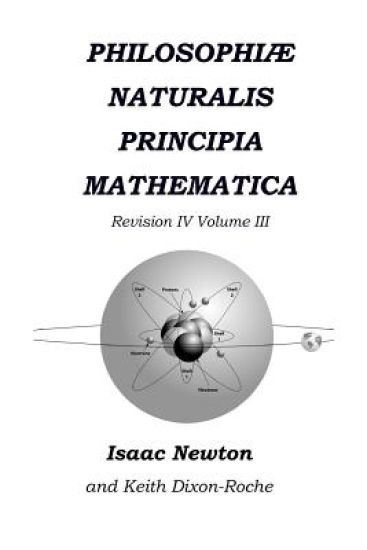
Philosophiæ Naturalis Principia Mathematica Revision IV - Volume III: Laws of Orbital Motion (physical constants and concept support)
Volume 3 (support) Black & White Images] for those with an interest in the physical constants and the mathematical support behind the atomic and astronomic models described in Volumes 1 & 2. It includes a list of the properties of the physical constants required for the analysis of astronomic and atomic physics, together with detailed mathematical explanations for; all the physical constants, gravity, mass, heat, electricity, Isaac Newton's laws of orbital motion work and the invalidity Relativity and Quantum Theory.
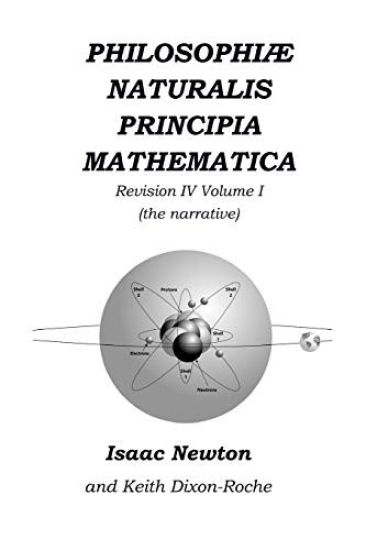
Philosophiæ Naturalis Principia Mathematica Revision IV - Volume I: Laws of Orbital Motion (the narrative)
Volume 1 (the narrative) Black & White Images] for those with an interest in the concepts but not the mathematics. This volume is a descriptive explanation of why Isaac Newton was correct and Einstein and Bohr were both wrong. This publication includes: orbital motion, planetary spin, core pressure, earth's magnetic field, the atom, the neutron, formulas for 'G' & 'k' and explains the true meaning of E=mc . It explains how the universe works between Big-Bangs, identifies the source of its energy and explains how the stars and the planets generate their heat. It also explains that 'black-holes' are just inactive bodies of matter, and defines the mass of the universe.
Observations Upon the Prophecies of Daniel, and the Apocalypse of St. John; Volume 1
This work has been selected by scholars as being culturally important and is part of the knowledge base of civilization as we know it. This work is in the public domain in the United States of America, and possibly other nations. Within the United States, you may freely copy and distribute this work, as no entity (individual or corporate) has a copyright on the body of the work. Scholars believe, and we concur, that this work is important enough to be preserved, reproduced, and made generally available to the public. To ensure a quality reading experience, this work has been proofread and republished using a format that seamlessly blends the original graphical elements with text in an easy-to-read typeface. We appreciate your support of the preservation process, and thank you for being an important part of keeping this knowledge alive and relevant.
Philosophiæ Naturalis Principia Mathematica Revision IV: The Laws of Orbital Motion

Philosophiæ Naturalis Principia Mathematica Revision IV: The Laws of Orbital Motion

Keith Dixon-Roche; Isaac Newton

Createspace Independent Publishing Platform
2018
nidottu
Black & White Images: This publication is a compilation of Volumes I, II & III providing a complete descriptive and mathematical explanation of why Isaac Newton was correct and Einstein and Bohr were both wrong. It includes; orbital motion, planetary spin, core pressure, earth's magnetic field, the atom along with mathematical descriptions for heat electricity, gravity, mass, all the physical constants. It defines Newton's gravitational constant (G) for the first time together with the true meaning of E=mc . It also disproves; quantum theory, relativity, the singularity and dark matter, explains the size of the universe and how it works, identifies its source of its energy and explains how the stars and the planets generate their heat. It also explains that 'black-holes' are actually just inactive bodies of matter
The Mathematical Principles of Natural Philosophy: The Principia

The Mathematical Principles of Natural Philosophy: The Principia

Isaac Newton

Createspace Independent Publishing Platform
2018
nidottu
The Mathematical Principles of Natural Philosophy: Philosophiae Naturalis Principia Mathematica by Isaac Newton and translated into English by Andrew Motte. Philosophi Naturalis Principia Mathematica (Latin for Mathematical Principles of Natural Philosophy), often referred to as simply the Principia, is a work in three books by Isaac Newton, in Latin, first published 5 July 1687. After annotating and correcting his personal copy of the first edition, Newton published two further editions, in 1713 and 1726. The Principia states Newton's laws of motion, forming the foundation of classical mechanics; Newton's law of universal gravitation; and a derivation of Kepler's laws of planetary motion (which Kepler first obtained empirically). The Principia is considered one of the most important works in the history of science. Sir Isaac Newton was an English mathematician, astronomer, theologian, author and physicist who is widely recognised as one of the most influential scientists of all time, and a key figure in the scientific revolution. His book Philosophi Naturalis Principia Mathematica ("Mathematical Principles of Natural Philosophy"), first published in 1687, laid the foundations of classical mechanics. Newton also made pathbreaking contributions to optics, and he shares credit with Gottfried Wilhelm Leibniz for developing the infinitesimal calculus.
Mathematical Principles of Natural Philosophy: Philosophiae Naturalis Principia Mathematica
Mathematical Principles of Natural Philosophy: Philosophiae Naturalis Principia Mathematica by Isaac Newton and translated into English by Andrew Motte, added to Newton's System of The World. Philosophi Naturalis Principia Mathematica (Latin for Mathematical Principles of Natural Philosophy), often referred to as simply the Principia, is a work in three books by Isaac Newton, in Latin, first published 5 July 1687. After annotating and correcting his personal copy of the first edition, Newton published two further editions, in 1713 and 1726. The Principia states Newton's laws of motion, forming the foundation of classical mechanics; Newton's law of universal gravitation; and a derivation of Kepler's laws of planetary motion (which Kepler first obtained empirically). SINCE the ancients (as we are told by Pappus), made great account of the science of mechanics in the investigation of natural things: and the moderns, laying aside substantial forms and occult qualities, have endeavoured to subject the phenomena of nature to the laws of mathematics, I have in this treatise cultivated mathematics so far as it regards philosophy. The ancients considered mechanics in a twofold respect; as rational, which proceeds accurately by demonstration; and practical. To practical mechanics all the manual arts belong, from which mechanics took its name. But as artificers do not work with perfect accuracy, it comes to pass that mechanics is so distinguished from geometry, that what is perfectly accurate is called geometrical, what is less so, is called mechanical.
Observations upon the Prophecies of Daniel: The Apocalypse of St. John

Observations upon the Prophecies of Daniel: The Apocalypse of St. John

Isaac Newton

Createspace Independent Publishing Platform
2018
nidottu
Observations upon the Prophecies of Daniel and the APOCALYPSE of St. JOHN By Sir Isaac Newton. The Book of Daniel is a biblical apocalypse, combining a prophecy of history with an eschatology (the study of last things) which is both cosmic in scope and political in its focus. In more mundane language, it is "an account of the activities and visions of Daniel, a noble Jew exiled at Babylon," its message being that just as the God of Israel saved Daniel and his friends from their enemies, so he would save all of Israel in their present oppression. In the Hebrew Bible it is found in the Ketuvim (writings), while in Christian Bibles it is grouped with the Major Prophets. The book divides into two parts, a set of six court tales in chapters 1-6 followed by four apocalyptic visions in chapters 7-12. The deuterocanon contains three additional stories, the Song of the Three Holy Children, Susanna, and Bel and the Dragon.
The System of the World: The Principia

The System of the World: The Principia

Isaac Newton

Createspace Independent Publishing Platform
2018
nidottu
The System of the World by Isaac Newton. The process of writing that first edition of the Principia went through several stages and drafts: some parts of the preliminary materials still survive, while others are lost except for fragments and cross-references in other documents. Surviving materials show that Newton (up to some time in 1685) conceived his book as a two-volume work. The first volume was to be titled De motu corporum, Liber primus, with contents that later appeared in extended form as Book 1 of the Principia. A fair-copy draft of Newton's planned second volume De motu corporum, Liber secundus survives, its completion dated to about the summer of 1685. It covers the application of the results of Liber primus to the Earth, the Moon, the tides, the solar system, and the universe; in this respect it has much the same purpose as the final Book 3 of the Principia, but it is written much less formally and is more easily read. 'It was the ancient opinion of not a few, in the earliest ages of philosophy, that the fixed stars stood immoveable in the highest parts of the world; that, under the fixed stars the planets were carried about the sun; that the earth, us one of the planets, described an annual course about the sun, while by a diurnal motion it was in the mean time revolved about its own axis; and that the sun, as the common fire which served to warm the whole, was fixed in the centre of the universe. This was the philosophy taught of old by Philolaus, Aristarchus of Samos, Plato in his riper years, and the whole sect of the Pythagoreans; and this was the judgment of Anaximander, more ancient than any of them; and of that wise king of the Romans, Numa Pompilius, who, as a symbol of the figure of the world with the sun in the centre, erected a temple in honour of Vesta, of a round form, and ordained perpetual fire to be kept in the middle of it.'
Opticks

Opticks

Isaac Newton

Createspace Independent Publishing Platform
2018
nidottu
My Design in this Book is not to explain the Properties of Light by Hypotheses, but to propose and prove them by Reason and Experiments: In order to which I shall premise the following Definitions and Axioms. DEFIN. I. By the Rays of Light I understand its least Parts, and those as well Successive in the same Lines, as Contemporary in several Lines.
The Chronology of Ancient Kingdoms Amended. To Which is Prefixed, a Short Chronicle, From the First Memory of Things in Europe, to the Conquest of Persia by Alexander the Great. By Sir Isaac Newton
The 18th century was a wealth of knowledge, exploration and rapidly growing technology and expanding record-keeping made possible by advances in the printing press. In its determination to preserve the century of revolution, Gale initiated a revolution of its own: digitization of epic proportions to preserve these invaluable works in the largest archive of its kind. Now for the first time these high-quality digital copies of original 18th century manuscripts are available in print, making them highly accessible to libraries, undergraduate students, and independent scholars. Rich in titles on English life and social history, this collection spans the world as it was known to eighteenth-century historians and explorers. Titles include a wealth of travel accounts and diaries, histories of nations from throughout the world, and maps and charts of a world that was still being discovered. Students of the War of American Independence will find fascinating accounts from the British side of conflict. ++++The below data was compiled from various identification fields in the bibliographic record of this title. This data is provided as an additional tool in helping to insure edition identification: ++++British LibraryT082180'An account of what related to the publishing of Sir Isaac Newton's Chronology ..' has a separate titlepage, pagination and register. London: printed for T. Cadell, 1770. xiv, 2],376,14p., plates; 4
Universal Arithmetick

Universal Arithmetick

Isaac Newton

Gale Ecco, Print Editions
2018
sidottu
The 18th century was a wealth of knowledge, exploration and rapidly growing technology and expanding record-keeping made possible by advances in the printing press. In its determination to preserve the century of revolution, Gale initiated a revolution of its own: digitization of epic proportions to preserve these invaluable works in the largest archive of its kind. Now for the first time these high-quality digital copies of original 18th century manuscripts are available in print, making them highly accessible to libraries, undergraduate students, and independent scholars. Medical theory and practice of the 1700s developed rapidly, as is evidenced by the extensive collection, which includes descriptions of diseases, their conditions, and treatments. Books on science and technology, agriculture, military technology, natural philosophy, even cookbooks, are all contained here.++++The below data was compiled from various identification fields in the bibliographic record of this title. This data is provided as an additional tool in helping to insure edition identification: ++++British LibraryT018667Printer's name from colophon. With a half-title. London: printed by T. Wood] for J. Senex, W. and J. Innys, J. Osborne and T. Longman, 1728. 4], iii, 1],271, 1]p., plates; 8