Kirjojen hintavertailu – 12 859 824 kirjaa ja 27 kauppaa

Kirjailija

Isaac Newton

Kirjat ja teokset yhdessä paikassa: 252 kirjaa, julkaisuja vuosilta 1899–2026, suosituimpiin kuuluu The Correspondence of Isaac Newton. Vertaile teosten hintoja ja tarkista saatavuus suomalaisista kirjakaupoista.

252 kirjaa

Kirjojen julkaisuvuodet: 1899–2026.

Mathematical Principles of Natural Philosophy. By Sir Isaac Newton, ... Translated Into English, and Illustrated With a Commentary, by Robert Thorp, ... Volume the First. of 1; Volume 1
The 18th century was a wealth of knowledge, exploration and rapidly growing technology and expanding record-keeping made possible by advances in the printing press. In its determination to preserve the century of revolution, Gale initiated a revolution of its own: digitization of epic proportions to preserve these invaluable works in the largest archive of its kind. Now for the first time these high-quality digital copies of original 18th century manuscripts are available in print, making them highly accessible to libraries, undergraduate students, and independent scholars. Medical theory and practice of the 1700s developed rapidly, as is evidenced by the extensive collection, which includes descriptions of diseases, their conditions, and treatments. Books on science and technology, agriculture, military technology, natural philosophy, even cookbooks, are all contained here.++++The below data was compiled from various identification fields in the bibliographic record of this title. This data is provided as an additional tool in helping to insure edition identification: ++++British LibraryT018605With a half-title and a list of subscribers. No more published. London: printed for W. Strahan; and T. Cadell, 1777. lviii, 2],360p., plates; 4

Opticks

Opticks

Isaac Newton

Gale Ecco, Print Editions
2018
sidottu
The 18th century was a wealth of knowledge, exploration and rapidly growing technology and expanding record-keeping made possible by advances in the printing press. In its determination to preserve the century of revolution, Gale initiated a revolution of its own: digitization of epic proportions to preserve these invaluable works in the largest archive of its kind. Now for the first time these high-quality digital copies of original 18th century manuscripts are available in print, making them highly accessible to libraries, undergraduate students, and independent scholars. Medical theory and practice of the 1700s developed rapidly, as is evidenced by the extensive collection, which includes descriptions of diseases, their conditions, and treatments. Books on science and technology, agriculture, military technology, natural philosophy, even cookbooks, are all contained here.++++The below data was compiled from various identification fields in the bibliographic record of this title. This data is provided as an additional tool in helping to insure edition identification: ++++British LibraryT018663With a final advertisement leaf. London: printed for W. and J. Innys, printers to the Royal Society, 1718. 8],382, 2]p., plates; 8
Optical Lectures Read in the Publick Schools of the University of Cambridge, ... 1669. By ... Sir Isaac Newton, ... Never Before Printed. Translated Into English out of the Original Latin
The 18th century was a wealth of knowledge, exploration and rapidly growing technology and expanding record-keeping made possible by advances in the printing press. In its determination to preserve the century of revolution, Gale initiated a revolution of its own: digitization of epic proportions to preserve these invaluable works in the largest archive of its kind. Now for the first time these high-quality digital copies of original 18th century manuscripts are available in print, making them highly accessible to libraries, undergraduate students, and independent scholars. Medical theory and practice of the 1700s developed rapidly, as is evidenced by the extensive collection, which includes descriptions of diseases, their conditions, and treatments. Books on science and technology, agriculture, military technology, natural philosophy, even cookbooks, are all contained here.++++The below data was compiled from various identification fields in the bibliographic record of this title. This data is provided as an additional tool in helping to insure edition identification: ++++British LibraryT018665London: printed for Francis Fayram, 1728. xi, 1],212p., plates; 8
Observations Upon the Prophecies of Daniel, and the Apocalypse of St. John. In two Parts. By Sir Isaac Newton
The 18th century was a wealth of knowledge, exploration and rapidly growing technology and expanding record-keeping made possible by advances in the printing press. In its determination to preserve the century of revolution, Gale initiated a revolution of its own: digitization of epic proportions to preserve these invaluable works in the largest archive of its kind. Now for the first time these high-quality digital copies of original 18th century manuscripts are available in print, making them highly accessible to libraries, undergraduate students, and independent scholars. The Age of Enlightenment profoundly enriched religious and philosophical understanding and continues to influence present-day thinking. Works collected here include masterpieces by David Hume, Immanuel Kant, and Jean-Jacques Rousseau, as well as religious sermons and moral debates on the issues of the day, such as the slave trade. The Age of Reason saw conflict between Protestantism and Catholicism transformed into one between faith and logic -- a debate that continues in the twenty-first century.++++The below data was compiled from various identification fields in the bibliographic record of this title. This data is provided as an additional tool in helping to insure edition identification: ++++British LibraryT041883Editor's dedication signed: Benj. Smith. For additional holdings, please see N64145. London: printed by J. Darby and T. Browne. And sold by J. Roberts, J. Tonson, W. Innys and R. Manby, J. Osborn and T. Longman, and 6 others in London], 1733. vi, 2],323, 1]p.; 4
Opticks

Opticks

Isaac Newton

Gale Ecco, Print Editions
2018
sidottu
The 18th century was a wealth of knowledge, exploration and rapidly growing technology and expanding record-keeping made possible by advances in the printing press. In its determination to preserve the century of revolution, Gale initiated a revolution of its own: digitization of epic proportions to preserve these invaluable works in the largest archive of its kind. Now for the first time these high-quality digital copies of original 18th century manuscripts are available in print, making them highly accessible to libraries, undergraduate students, and independent scholars. Medical theory and practice of the 1700s developed rapidly, as is evidenced by the extensive collection, which includes descriptions of diseases, their conditions, and treatments. Books on science and technology, agriculture, military technology, natural philosophy, even cookbooks, are all contained here.++++The below data was compiled from various identification fields in the bibliographic record of this title. This data is provided as an additional tool in helping to insure edition identification: ++++British LibraryT069138With a final advertisement leaf. London: printed for William Innys, 1730. 8],382, 2]p., plates; 8
The Chronology of Ancient Kingdoms Amended. To Which is Prefix'd, A Short Chronicle From the First Memory of Things in Europe, to the Conquest of Persia by Alexander the Great. By Sir Isaac Newton
The 18th century was a wealth of knowledge, exploration and rapidly growing technology and expanding record-keeping made possible by advances in the printing press. In its determination to preserve the century of revolution, Gale initiated a revolution of its own: digitization of epic proportions to preserve these invaluable works in the largest archive of its kind. Now for the first time these high-quality digital copies of original 18th century manuscripts are available in print, making them highly accessible to libraries, undergraduate students, and independent scholars. Rich in titles on English life and social history, this collection spans the world as it was known to eighteenth-century historians and explorers. Titles include a wealth of travel accounts and diaries, histories of nations from throughout the world, and maps and charts of a world that was still being discovered. Students of the War of American Independence will find fascinating accounts from the British side of conflict. ++++The below data was compiled from various identification fields in the bibliographic record of this title. This data is provided as an additional tool in helping to insure edition identification: ++++British LibraryT030722A reissue with a new titlepage. London: printed for J. Tonson, J. Osborn, and T. Longman; and sold by Messieurs Smith and Bruce, Dublin, 1728. xiv, 2],376p., plates; 4
Opticks

Opticks

Isaac Newton

Gale Ecco, Print Editions
2018
sidottu
The 18th century was a wealth of knowledge, exploration and rapidly growing technology and expanding record-keeping made possible by advances in the printing press. In its determination to preserve the century of revolution, Gale initiated a revolution of its own: digitization of epic proportions to preserve these invaluable works in the largest archive of its kind. Now for the first time these high-quality digital copies of original 18th century manuscripts are available in print, making them highly accessible to libraries, undergraduate students, and independent scholars. Medical theory and practice of the 1700s developed rapidly, as is evidenced by the extensive collection, which includes descriptions of diseases, their conditions, and treatments. Books on science and technology, agriculture, military technology, natural philosophy, even cookbooks, are all contained here.++++The below data was compiled from various identification fields in the bibliographic record of this title. This data is provided as an additional tool in helping to insure edition identification: ++++British LibraryT082019Preface signed: I. N, i.e. Sir Isaac Newton. Titlepage in red and black. London: printed for Sam. Smith, and Benj. Walford, 1704. 4],144;136p.,137-138 leaves,139-211, 1]p., plates; 4
A Treatise of the System of the World. By Sir Isaac Newton. Translated Into English. The Third Edition
The 18th century was a wealth of knowledge, exploration and rapidly growing technology and expanding record-keeping made possible by advances in the printing press. In its determination to preserve the century of revolution, Gale initiated a revolution of its own: digitization of epic proportions to preserve these invaluable works in the largest archive of its kind. Now for the first time these high-quality digital copies of original 18th century manuscripts are available in print, making them highly accessible to libraries, undergraduate students, and independent scholars. Medical theory and practice of the 1700s developed rapidly, as is evidenced by the extensive collection, which includes descriptions of diseases, their conditions, and treatments. Books on science and technology, agriculture, military technology, natural philosophy, even cookbooks, are all contained here.++++The below data was compiled from various identification fields in the bibliographic record of this title. This data is provided as an additional tool in helping to insure edition identification: ++++British LibraryT131548With an initial publisher's note. A reissue of the 1731 second edition, with a cancel titlepage. London: printed for B. Motte and C. Bathurst, 1737. vi, 10],152p., plate: ill.; 8
The Mathematical Principles of Natural Philosophy. By Sir Isaac Newton. Translated Into English by Andrew Motte. To Which are Added, The Laws of the Moon's Motion, According to Gravity. By John Machin ... In two Volumes. of 2; Volume 1
The 18th century was a wealth of knowledge, exploration and rapidly growing technology and expanding record-keeping made possible by advances in the printing press. In its determination to preserve the century of revolution, Gale initiated a revolution of its own: digitization of epic proportions to preserve these invaluable works in the largest archive of its kind. Now for the first time these high-quality digital copies of original 18th century manuscripts are available in print, making them highly accessible to libraries, undergraduate students, and independent scholars. Medical theory and practice of the 1700s developed rapidly, as is evidenced by the extensive collection, which includes descriptions of diseases, their conditions, and treatments. Books on science and technology, agriculture, military technology, natural philosophy, even cookbooks, are all contained here.++++The below data was compiled from various identification fields in the bibliographic record of this title. This data is provided as an additional tool in helping to insure edition identification: ++++British LibraryT142590Vol. 2 in two parts, each with separate pagination and register, the second part being John Machin's 'The laws of the moon's motion according to gravity' with divisional titlepage. On large and fine paper. London: printed for Benjamin Motte, 1729. 2v., plates; 8
Philosophiæ naturalis principia mathematica. Auctore Isaaco Newtono, ... Editio secunda auctior et emendatior.
The 18th century was a wealth of knowledge, exploration and rapidly growing technology and expanding record-keeping made possible by advances in the printing press. In its determination to preserve the century of revolution, Gale initiated a revolution of its own: digitization of epic proportions to preserve these invaluable works in the largest archive of its kind. Now for the first time these high-quality digital copies of original 18th century manuscripts are available in print, making them highly accessible to libraries, undergraduate students, and independent scholars. Medical theory and practice of the 1700s developed rapidly, as is evidenced by the extensive collection, which includes descriptions of diseases, their conditions, and treatments. Books on science and technology, agriculture, military technology, natural philosophy, even cookbooks, are all contained here.++++The below data was compiled from various identification fields in the bibliographic record of this title. This data is provided as an additional tool in helping to insure edition identification: ++++British LibraryT093210750 copies were printed. With an index. Cantabrigi printed by Cornelius Crownfield], 1713. 28],484, 8]p., fold.plate: ill.; 4
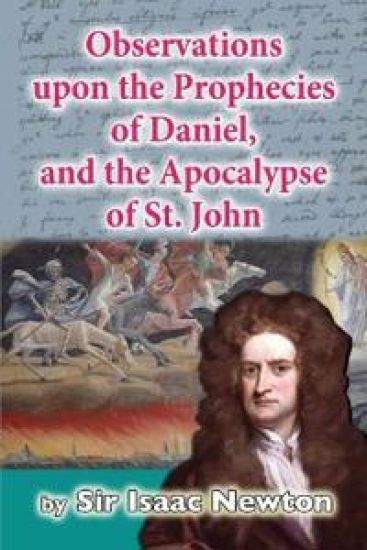
Observations upon the Prophecies of Daniel, and the Apocalypse of St. John
Although he is best remembered as a scientist, Sir Isaac Newton was also a scholar of the Bible. In Observations upon the Prophecies of Daniel, and the Apocalypse of St. John, Newton explores the end times prophecies in the complementary books of the Old Testament prophet Daniel and the New Testament Apostle John. Newton explores many eschatological topics including the four beasts of Daniel's vision, the image made of iron and clay, the ten kings, the meaning of the seventy weeks, the relationship of Revelation to the Mosaic law, and the return of Christ and the establishment of His kingdom on earth. Alacrity Press is proud to make this book from one of history's most-gifted intellectuals availble to readers today.
Observations upon the Prophecies of Daniel and the Apocalypse of St. John

Observations upon the Prophecies of Daniel and the Apocalypse of St. John

Isaac Newton

Createspace Independent Publishing Platform
2017
pokkari
Sir Isaac Newton's commentaries on the Book of Daniel and the Book of Revelation. Published in 1733. Newton wrote an entire book interpreting the prophecies of the Biblical books of Daniel and the Revelation of John (also called "The Apocalypse"). His insights vary in several respects from the "standard" modern Christian interpretations, and his perspicacity might well be vindicated as the rest of these prophecies are yet fulfilled. Besides his immense intellect, he provides a huge contribution which few can supply even today. Newton had a wealth of knowledge of ancient history, obtained by reading mountains of documents in the original Greek, Latin and Hebrew, in which he saw many of those prophecies literally fulfilled long after they had been revealed. To him, it was a proof of the foreknowledge of God, which was his purpose in writing the book.
Observations Upon the Prophecies of Daniel: And the Apocalypse of St. John

Observations Upon the Prophecies of Daniel: And the Apocalypse of St. John

Isaac Newton

Createspace Independent Publishing Platform
2017
nidottu
Observations upon the Prophecies of Danieland The Apocalypse of St. JohnBy Sir Isaac NewtonOn the other hand, latitudinarian and Newtonian ideas taken too far resulted in the millenarians, a religious faction dedicated to the concept of a mechanical universe, but finding in it the same enthusiasm and mysticism that the Enlightenment had fought so hard to extinguish. Newton himself may have had some interest in millenarianism as he wrote about both the Book of Daniel and the Book of Revelation in his Observations Upon the Prophecies. Newton's conception of the physical world provided a stable model of the natural world that would reinforce stability and harmony in the civic world. Newton saw God as the masterful creator whose existence could not be denied in the face of the grandeur of all creation. Nevertheless, he rejected Leibniz' thesis that God would necessarily make a perfect world which requires no intervention from the creator. In Query 31 of the Opticks, Newton simultaneously made an argument from design and for the necessity of intervention: For while comets move in very eccentric orbs in all manner of positions, blind fate could never make all the planets move one and the same way in orbs concentric, some inconsiderable irregularities excepted which may have arisen from the mutual actions of comets and planets on one another, and which will be apt to increase, till this system wants a reformation.
Four Letters From Sir Isaac Newton to Doctor Bentley
Four Letters From Sir Isaac Newton to Doctor Bentley - Containing Some Arguments in Proof of a Deity is an unchanged, high-quality reprint of the original edition of 1692. Hansebooks is editor of the literature on different topic areas such as research and science, travel and expeditions, cooking and nutrition, medicine, and other genres. As a publisher we focus on the preservation of historical literature. Many works of historical writers and scientists are available today as antiques only. Hansebooks newly publishes these books and contributes to the preservation of literature which has become rare and historical knowledge for the future.
Sir Isaac Newton's Principia

Sir Isaac Newton's Principia

Isaac Newton

Hansebooks
2017
pokkari
Sir Isaac Newton's Principia is an unchanged, high-quality reprint of the original edition of 1871. Hansebooks is editor of the literature on different topic areas such as research and science, travel and expeditions, cooking and nutrition, medicine, and other genres. As a publisher we focus on the preservation of historical literature. Many works of historical writers and scientists are available today as antiques only. Hansebooks newly publishes these books and contributes to the preservation of literature which has become rare and historical knowledge for the future.