Kirjojen hintavertailu – 12 859 824 kirjaa ja 27 kauppaa

Kirjailija

Isaac Newton

Kirjat ja teokset yhdessä paikassa: 252 kirjaa, julkaisuja vuosilta 1899–2026, suosituimpiin kuuluu The Correspondence of Isaac Newton. Vertaile teosten hintoja ja tarkista saatavuus suomalaisista kirjakaupoista.

252 kirjaa

Kirjojen julkaisuvuodet: 1899–2026.

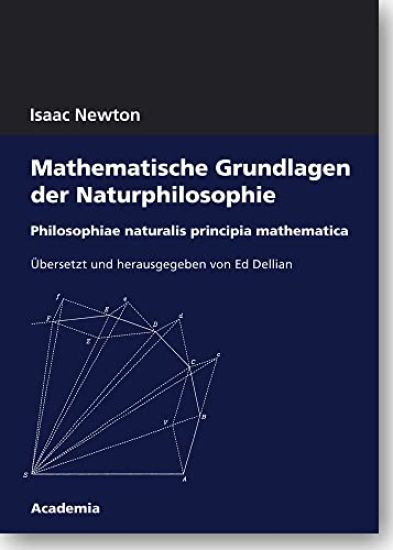
Mathematische Grundlagen Der Naturphilosophie: Philosophiae Naturalis Principia Mathematica
Isaac Newtons 'Philosophiae Naturalis Principia Mathematica' ist eines der wichtigsten Werke der Wissenschaftsgeschichte. Sie stellt die Basis des Theoriegebaudes der Newtonschen Physik und ihrer mathematischen Grundlagen dar. Im Jahre 1687 wurde sie, in Latein geschrieben, als Buch veroffentlicht. Bis zum Erscheinen einer qualifizierten deutschsprachigen Auswahlausgabe (Hamburg 1988) vergingen rund dreihundert Jahre. Die hier in der 4. uberarbeiteten und erweiterten Auflage vorliegende ubersetzung ist eine gekurzte Ausgabe. Sie beinhaltet die wichtigsten Texte des Gesamtwerks entsprechend einer Empfehlung Newtons (im Vorwort zum 3. Buch, siehe unten*). Newtons Werk fuhrt in zwei Buchern von der Bewegung nach geometrischer Methode die Lehre Galileo Galileis weiter. Aus nicht-materiellen Ursachen (den 'Kraften der Natur') erklart Newton eine Vielzahl von Naturerscheinungen und, in einem dritten Buch, das Gefuge der Welt. Die wortgetreue ubersetzung raumt jahrhundertealte materialistische Fehlinterpretationen beiseite und bringt Newtons authentische Lehre als eine dualistische und theozentrische, wahrhaft christliche Philosophie vom schopferischen Wirken realer geistiger Prinzipien einschliealich des freien Willens der Lebewesen ans Licht. Diese neu entdeckte Naturlehre stimmt mit tragenden Prinzipien der modernen Physik uberein, was erstmals deren rationale und kognitive Durchdringung erlaubt und die Unteilbarkeit der Wahrheit bestatigt. So weist Newton der jahrhundertealten Diskussion um Glauben und Wissen und um eine wissenschaftliche christliche Schopfungslehre (als wahrheitsfahige Alternative zur darwinistisch-materialistischen Selbstevolutionshypothese) den Weg, auf dem endlich das seit der Scholastik schwarende Schisma zwischen Vernunft und Religion uberwunden wird. Vor mehr als 300 Jahren deckte Newton die theologisch-philosophische Dimension seiner Principia auf (Ausgabe 1713, Vorwort Roger Cotes und Scholium generale). Die vorliegende Ausgabe hebt diesen Aspekt des Buches hervor und feiert es als Jahrtausendwerk von atemberaubender Aktualitat.; * Newton schreibt zu einer Leseauswahl im Vorwort zum Dritten Buch: ... Drittes Buch - uber das Gefuge der Welt ... Und deshalb habe ich, damit die Sache nicht in Auslegungsstreitigkeiten gezogen wird, die Quintessenz dieses (dritten) Buches in Lehrsatze umgesetzt, und zwar nach der mathematischen Methode, damit diese nur von denen gelesen werden konnen, die vorher die Grundlagen durchgearbeitet haben. Aber weil dort eine Fulle von Lehrsatzen vorkommt, welche auch mathematisch geschulten Lesern einen allzu groaen Zeitaufwand abverlangen konnten, so will ich niemanden veranlassen, sie alle durchzuarbeiten; es mag genugen, wenn man die Definitionen, die Gesetze der Bewegung, und die ersten drei Abschnitte des ersten Buches mit voller Aufmerksamkeit liest, dann zu diesem Buch vom Gefuge der Welt ubergeht, und die ubrigen Lehrsatze der fruheren Bucher, soweit sie hier zitiert werden, nach eigenem Gutdunken zu Rate zieht. Die im vorliegenden Band ubersetzten und enthaltenen Abschnitte sind mit einem '*' gekennzeichnet. INHALTSVERZEICHNIS DES GESAMTWERKS Definitionen* Axiome oder Gesetze der Bewegung* Erstes Buch. uber die Bewegung von Korpern Abschn. I. uber die Methode der ersten und letzten Verhaltnisse* Abschn. II. uber die Auffindung der Zentripetalkrafte* Abschn. III. uber die Bewegung von Korpern in exzentrischen Kegelschnitten* Abschn. IV. uber die Auffindung elliptischer, parabolischer und hyperbolischer Bahnen bei gegebenem Brennpunkt Abschn. V. uber die Auffindung der Bahnen, wenn keiner der Brennpunkte gegeben ist Abschn. VI. uber die Auffindung der Bewegungen auf gegebenen Bahnen Abschn. VII. uber das geradlinige Aufsteigen und Absteigen von Korpern Abschn. VIII. uber die Auffindung der Bahnen, auf denen Korper umlaufen, die von beliebigen Zentripetalkraften angetrieben werden Abschn. IX. uber die Bewegung von Korpern auf beweglichen Bahnen, und uber die Bewegung der Apsiden Abschn. X. uber die Bewegung von Korpern auf gegebenen Oberflachen, und uber die Hinundherbewegung an Fadenpendeln Abschn. XI. uber die Bewegung von Korpern, welche wechselseitig durch Zentripetalkrafte aufeinander einwirken Abschn. XII. uber die Anziehungskrafte kugelformiger Korper Abschn. XIII. uber die Anziehungskrafte nicht kugelformiger Korper Abschn. XIV. uber die Bewegung sehr kleiner Korper, welche durch Zentripetalkrafte angetrieben werden, die zu einzelnen Teilen irgendeines groaen Korpers hin gerichtet sind Zweites Buch. uber die Bewegung von Korpern Abschn. I. uber die Bewegung von Korpern, denen im Verhaltnis der Geschwindigkeit Widerstand geleistet wird* Abschn. II. uber die Bewegung von Korpern, denen im quadratischen Verhaltnis der Geschwindigkeiten Widerstand geleistet wird* Abschn. III. uber die Bewegung von Korpern, denen teils im Verhaltnis der Geschwindigkeit, teils in deren quadratischem Verhaltnis Widerstand geleistet wird Abschn. IV. uber die kreisformige Bewegung von Korpern in widerstehenden Medien Abschn. V. uber die Dichte und den Druck von Flussigkeiten, und uber die Hydrostatik Abschn. VI. uber die Bewegung und den Widerstand von Korpern an Fadenpendeln Abschn. VII. uber die Bewegung der Flussigkeiten und den Widerstand der Wurfgeschosse Abschn. VIII. uber die durch Flussigkeiten fortgepflanzte Bewegung Abschn. IX. uber die kreisformige Bewegung von Flussigkeiten Drittes Buch. uber das Gefuge der Welt Leitsatze des Philosophierens* Naturerscheinungen* Abschn. I. uber die Ursachen des Weltgefuges* Abschn. II. uber das Maa der Mondabweichungen Abschn. III. uber das Maa der Meeresfluten Abschn. IV. uber das Vorgehen der Tagundnachtgleichen Abschn. V. uber die Kometen Scholium generale*

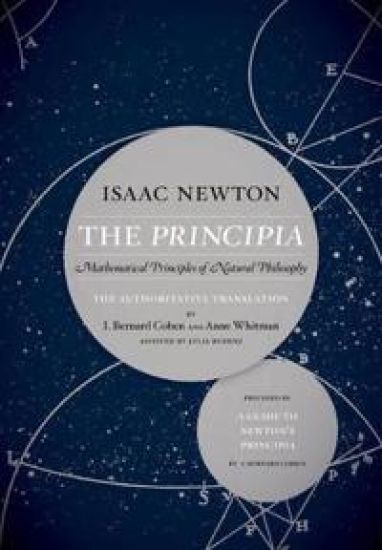
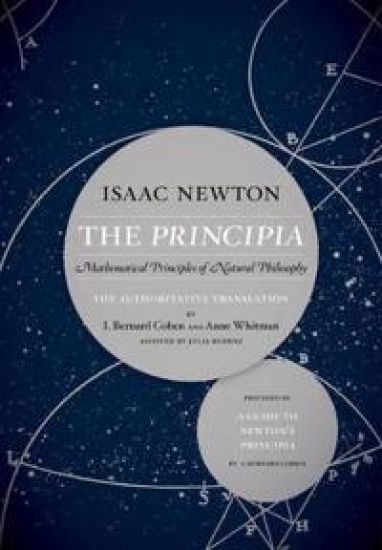
The Principia: The Authoritative Translation

The Principia: The Authoritative Translation

Isaac Newton

University of California Press
2016
sidottu

Halvin toimitettuna 48,30 €

In his monumental 1687 work, Philosophiae Naturalis Principia Mathematica, known familiarly as the Principia, Isaac Newton laid out in mathematical terms the principles of time, force, and motion that have guided the development of modern physical science. Even after more than three centuries and the revolutions of Einsteinian relativity and quantum mechanics, Newtonian physics continues to account for many of the phenomena of the observed world, and Newtonian celestial dynamics is used to determine the orbits of our space vehicles. This authoritative, modern translation by I. Bernard Cohen and Anne Whitman, the first in more than 285 years, is based on the 1726 edition, the final revised version approved by Newton; it includes extracts from the earlier editions, corrects errors found in earlier versions, and replaces archaic English with contemporary prose and up-to-date mathematical forms. Newton's principles describe acceleration, deceleration, and inertial movement; fluid dynamics; and the motions of the earth, moon, planets, and comets. A great work in itself, the Principia also revolutionized the methods of scientific investigation. It set forth the fundamental three laws of motion and the law of universal gravity, the physical principles that account for the Copernican system of the world as emended by Kepler, thus effectively ending controversy concerning the Copernican planetary system. The translation - only edition of this preeminent work is truly accessible for today's scientists, scholars, and students.
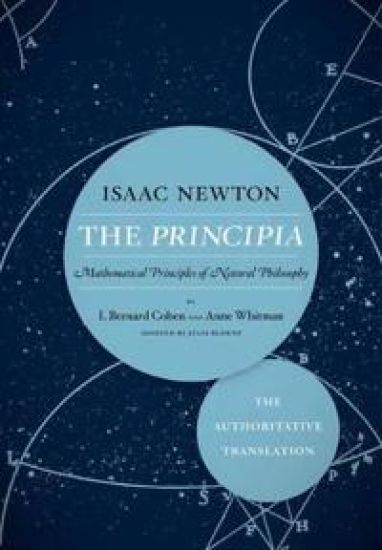
The Principia: The Authoritative Translation and Guide

The Principia: The Authoritative Translation and Guide

Isaac Newton

University of California Press
2016
pokkari

Halvin toimitettuna 33,80 €

In his monumental 1687 work, Philosophiae Naturalis Principia Mathematica, known familiarly as the Principia, Isaac Newton laid out in mathematical terms the principles of time, force, and motion that have guided the development of modern physical science. Even after more than three centuries and the revolutions of Einsteinian relativity and quantum mechanics, Newtonian physics continues to account for many of the phenomena of the observed world, and Newtonian celestial dynamics is used to determine the orbits of our space vehicles. This authoritative, modern translation by I. Bernard Cohen and Anne Whitman, the first in more than 285 years, is based on the 1726 edition, the final revised version approved by Newton; it includes extracts from the earlier editions, corrects errors found in earlier versions, and replaces archaic English with contemporary prose and up-to-date mathematical forms. Newton's principles describe acceleration, deceleration, and inertial movement; fluid dynamics; and the motions of the earth, moon, planets, and comets. A great work in itself, the Principia also revolutionized the methods of scientific investigation. It set forth the fundamental three laws of motion and the law of universal gravity, the physical principles that account for the Copernican system of the world as emended by Kepler, thus effectively ending controversy concerning the Copernican planetary system. The illuminating Guide to Newton's Principia by I. Bernard Cohen makes this pre-eminent work truly accessible for today's scientists, scholars, and students. Designed with collectors in mind, this beautiful and deluxe cloth edition will hold a place of honor on any bookshelf.
The Principia: The Authoritative Translation and Guide

The Principia: The Authoritative Translation and Guide

Isaac Newton; Julia Budenz

University of California Press
2016
sidottu

Halvin toimitettuna 78,60 €

In his monumental 1687 work, Philosophiae Naturalis Principia Mathematica, known familiarly as the Principia, Isaac Newton laid out in mathematical terms the principles of time, force, and motion that have guided the development of modern physical science. Even after more than three centuries and the revolutions of Einsteinian relativity and quantum mechanics, Newtonian physics continues to account for many of the phenomena of the observed world, and Newtonian celestial dynamics is used to determine the orbits of our space vehicles. This authoritative, modern translation by I. Bernard Cohen and Anne Whitman, the first in more than 285 years, is based on the 1726 edition, the final revised version approved by Newton; it includes extracts from the earlier editions, corrects errors found in earlier versions, and replaces archaic English with contemporary prose and up-to-date mathematical forms. Newton's principles describe acceleration, deceleration, and inertial movement; fluid dynamics; and the motions of the earth, moon, planets, and comets. A great work in itself, the Principia also revolutionized the methods of scientific investigation. It set forth the fundamental three laws of motion and the law of universal gravity, the physical principles that account for the Copernican system of the world as emended by Kepler, thus effectively ending controversy concerning the Copernican planetary system. The illuminating Guide to Newton's Principia by I. Bernard Cohen makes this preeminent work truly accessible for today's scientists, scholars, and students. Designed with collectors in mind, this deluxe edition has faux leather binding covered with a beautiful dustjacket.
The Principia: The Authoritative Translation

The Principia: The Authoritative Translation

Isaac Newton

University of California Press
2016
pokkari

Halvin toimitettuna 29,20 €

In his monumental 1687 work, Philosophiae Naturalis Principia Mathematica, known familiarly as the Principia, Isaac Newton laid out in mathematical terms the principles of time, force, and motion that have guided the development of modern physical science. Even after more than three centuries and the revolutions of Einsteinian relativity and quantum mechanics, Newtonian physics continues to account for many of the phenomena of the observed world, and Newtonian celestial dynamics is used to determine the orbits of our space vehicles. This authoritative, modern translation by I. Bernard Cohen and Anne Whitman, the first in more than 285 years, is based on the 1726 edition, the final revised version approved by Newton; it includes extracts from the earlier editions, corrects errors found in earlier versions, and replaces archaic English with contemporary prose and up-to-date mathematical forms. Newton's principles describe acceleration, deceleration, and inertial movement; fluid dynamics; and the motions of the earth, moon, planets, and comets. A great work in itself, the Principia also revolutionized the methods of scientific investigation. It set forth the fundamental three laws of motion and the law of universal gravity, the physical principles that account for the Copernican system of the world as emended by Kepler, thus effectively ending controversy concerning the Copernican planetary system. The translation - only edition of this preeminent work is truly accessible for today's scientists, scholars, and students.
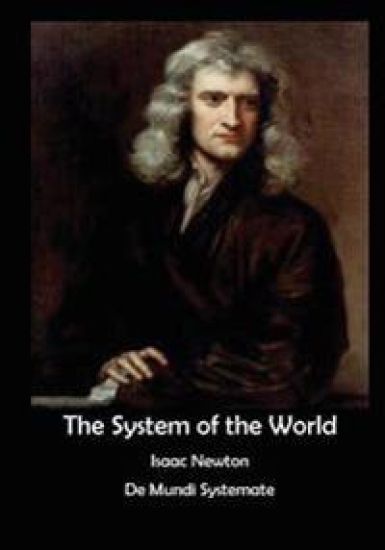
The System of the World: de Mundi Systemate

The System of the World: de Mundi Systemate

Isaac Newton

Createspace Independent Publishing Platform
2015
nidottu
The System of the WorldDe Mundi SystemateIsaac NewtonOn the system of the world, is an exposition of many consequences of universal gravitation, especially its consequences for astronomy. It builds upon the propositions of the previous books, and applies them with further specificity than in Book 1 to the motions observed in the solar system. Here (introduced by Proposition 22, and continuing in Propositions 25-35) are developed several of the features and irregularities of the orbital motion of the Moon, especially the variation. Newton lists the astronomical observations on which he relies, and establishes in a stepwise manner that the inverse square law of mutual gravitation applies to solar system bodies, starting with the satellites of Jupiter and going on by stages to show that the law is of universal application. He also gives starting at Lemma 4 and Proposition 40) the theory of the motions of comets, for which much data came from John Flamsteed and Edmond Halley, and accounts for the tides, attempting quantitative estimates of the contributions of the Sun and Moon to the tidal motions; and offers the first theory of the precession of the equinoxes. Book 3 also considers the harmonic oscillator in three dimensions, and motion in arbitrary force laws. Newton also made clear his heliocentric view of the solar system, modified in a somewhat modern way, since already in the mid-1680s he recognised the "deviation of the Sun" from the centre of gravity of the solar system. For Newton, "the common centre of gravity of the Earth, the Sun and all the Planets is to be esteem'd the Centre of the World," and that this centre "either is at rest, or moves uniformly forward in a right line." Newton rejected the second alternative after adopting the position that "the centre of the system of the world is immoveable," which "is acknowledg'd by all, while some contend that the Earth, others, that the Sun is fix'd in that centre." Newton estimated the mass ratios Sun: Jupiter and Sun: Saturn, and pointed out that these put the centre of the Sun usually a little way off the common center of gravity, but only a little, the distance at most "would scarcely amount to one diameter of the Sun."
The System of the World

The System of the World

Isaac Newton

Createspace Independent Publishing Platform
2015
nidottu
The System of the World by Isaac Newton. Sir Isaac Newton (1642-1727) was an English physicist and mathematician who is widely recognised as one of the most influential scientists of all time and as a key figure in the scientific revolution. This great work supplied the momentum for the Scientific Revolution and dominated physics for over 200 years. It was the ancient opinion of not a few, in the earliest ages of philosophy, that the fixed stars stood immoveable in the highest parts of the world; that, under the fixed stars the planets were carried about the sun; that the earth, us one of the planets, described an annual course about the sun, while by a diurnal motion it was in the mean time revolved about its own axis; and that the sun, as the common fire which served to warm the whole, was fixed in the centre of the universe. This was the philosophy taught of old by Philolaus, Aristarchus of Samos, Plato in his riper years, and the whole sect of the Pythagoreans; and this was the judgment of Anaximander, more ancient than any of them; and of that wise king of the Romans, Numa Pompilius, who, as a symbol of the figure of the world with the sun in the centre, erected a temple in honour of Vesta, of a round form, and ordained perpetual fire to be kept in the middle of it.