Kirjailija
Ivan Turgenev
Kirjat ja teokset yhdessä paikassa: 396 kirjaa, julkaisuja vuosilta 1862–2026, suosituimpiin kuuluu Vernyj drug. Rasskazy o sobakakh. Vertaile teosten hintoja ja tarkista saatavuus suomalaisista kirjakaupoista.
396 kirjaa
Kirjojen julkaisuvuodet: 1862–2026.
This book contains the Russian text of Turgenev's Month in the Country, edited with an English language introduction and notes
Turgenev's novel about conflicting ideas, social classes and generations questions human nature and man's place in the universe. This is one in a series offering a critical analysis of Russian texts and surveying the different interpretations that have been suggested
This book contains the Russian text of Turgenev's Mumu, edited with an English language introduction, notes and extensive vocabulary.
This book contains the Russian text of Turgenev's First Love, with an English language introduction and notes.
This volume contains two of the world's great love stories - FIRST LOVE, and SPRING TORRENTS, which show Turgenev at his very best. Simple, direct and tender, they record the pains and glories of youthful infatuation in a style which evokes exactly and in detail what it is like to be young and in love. In addition, there is a third, much shorter story, A FIRE AT SEA, translated by Isaiah Berlin, and an introduction to the whole volume by V. S. Pritchett.
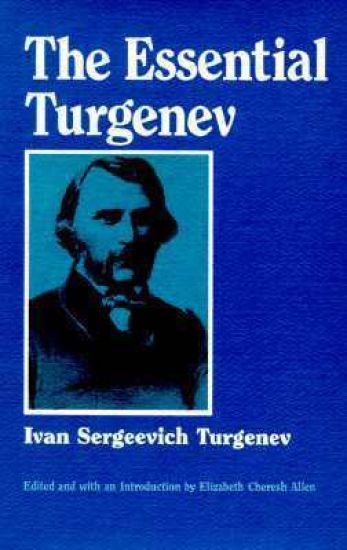
The Essential Turgenev will provide American readers with the first comprehensive, portable edition of this great Russian author's works. It offers an extensive introduction to the writings that established Turgenev as one of the preeminent literary figures of his time, and reveals the breadth of insight into changing social conditions that made Turgenev a portal to Russian intellectual life. Readers will find complete, exemplary translations of Turgenev's finest novels, Rudin, A Nest of Gentry, and Fathers and Sons, along with the lapidary novella First Love. The volume also includes selections from Sportsman's Sketches, seven of Turgenev's most compelling short stories, and fifteen prose poems. It also contains samples of the author's nonfiction drawn from autobiographical sketches, memoirs, public speeches, plus the influential essay "Hamlet and Don Quixote" and correspondence with Dostoevsky, Tolstoy, and others.
This is the classic book that put Turgenev on the literary map--both in his own time and for all of history. The strength of this, his first book, was such that, even if Turgenev had never written another book, he would still be recognized as the father of the modern short story. Indeed, A Sportsman's Notebook was Hemmingway's favorite book, and it is not hard to see traces of Turgenevs influence in the work of Hemmingway and other later-day masters of the short story. Notebook contains twenty-five stories in which Turgenev shares shares memories from the hunting expeditions that lead him throughout the Russian countryside. His writing is strong because there is real life in his people and real beauty in his landscapes.
"So ... you were convinced of all this and decided not to do anything serious yourselves.""And decided not to do anything serious," Bazarov repeated grimly. ..." But to confine yourselves to abuse?""To confine ourselves to abuse.""And that is called nihilism?""And that is called nihilism," Bazarov repeated again, this time with marked insolence. The book examines the conflict of attitudes in mid-19th-century Russia, as distant pre-echoes of the Revolution continue to rumble through the remote rural landscape. The story follows the Kirsanov family, representatives of the old regime, and the violent character of the anti-hero Bazarov. Introduced by Michael R Katz who was born in New York City and educated at Horace Mann School, Williams College, and Oxford University. He is the author of two books and over fifteen translations of Russian novels into English, including works by Dostoevsky, Turgenev, and Tolstoy.
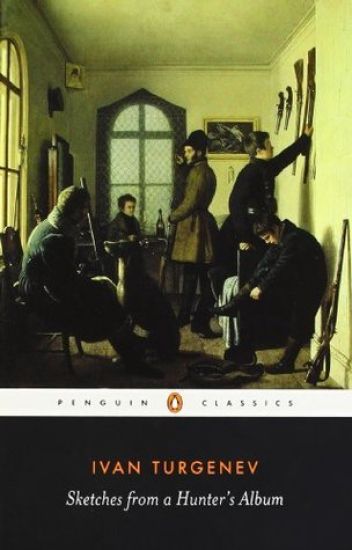
Sketches from a Hunter's Album
Ivan Turgenev
Penguin Classics
1990
pokkari
Halvin toimitettuna 18,70 €
Turgenev's first major prose work is a series of twenty-five Sketches: the observations and anecdotes of the author during his travels through Russia satisfying his passion for hunting. His album is filled with moving insights into the lives of those he encounters - peasants and landowners, doctors and bailiffs, neglected wives and bereft mothers - each providing a glimpse of love, tragedy, courage and loss, and anticipating Turgenev's great later works such as First Love and Fathers and Sons. His depiction of the cruelty and arrogance of the ruling classes was considered subversive and led to his arrest and confinement to his estate, but these sketches opened the minds of contemporary readers to the plight of the peasantry and were even said to have led Tsar Alexander II to abolish serfdom.
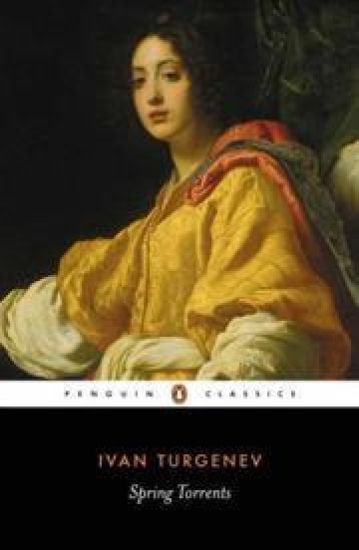
Returning to Russia from a tour in Italy, twenty-three-year-old Dimitry Sanin breaks his journey in Frankfurt. There he encounters the beautiful Gemma Roselli, who works in her parents' patisserie, and falls deeply and deliriously in love for the first time. Convinced that nothing can come in the way of everlasting happiness with his fiancée, Dimitry impetuously decides to begin a new life and sell his Russian estates. But when he meets the potential buyer, the intriguing Madame Polozov, his youthful vulnerability makes him prey for a darker, destructive infatuation. A novel of haunting beauty, Spring Torrents (1870-1) is a fascinating, partly autobiographical account of one of Turgenev's favourite themes - a man's inability to love without losing his innocence and becoming enslaved to obsessive passions.
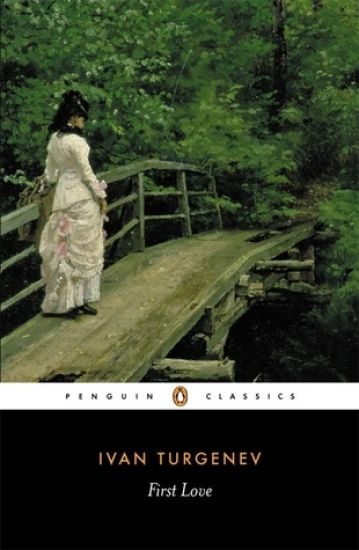
When the down-at-heel Princess Zasyekin moves next door to the country estate of Vladimir Petrovich's parents, he instantly and overwhelmingly falls in love with his new neighbour's daughter, Zinaida. But the capricious young woman already has many admirers and as she plays her suitors against each other, Vladimir's unrequited youthful passion soon turns to torment and despair - although he remains unaware of his true rival for Zinaida's affections. Set in the world of nineteenth-century Russia's fading aristocracy, Turgenev's story depicts a boy's growth of knowledge and mastery over his own heart as he awakens to the complex nature of adult love.
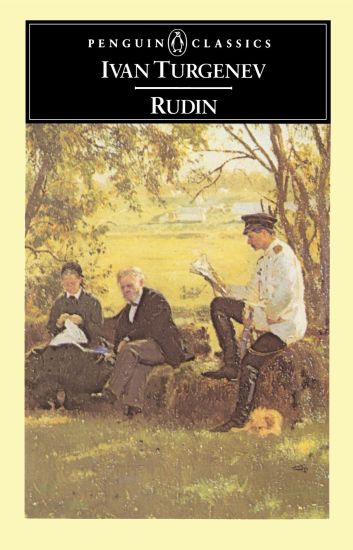
Turgenev is an author who no longer belongs to Russia only. During the last fifteen years of his life he won for himself the reading public, first in France, then in Germany and America, and finally in England. In his funeral oration the spokesman of the most artistic and critical of European nations, Ernest Renan, hailed him as one of the greatest writers of our times: 'The Master, whose exquisite works have charmed our century, stand more than any other man as the incarnation of the whole race,' because 'a whole world lived in him and spoke through his mouth.' Rudin is the first of Turgenev's social novels, and is a sort of artistic introduction to those that follow, because it refers to the epoch anterior to that when the present social and political movements began. This epoch is being fast forgotten, and without his novel it would be difficult for us to fully realise it, but it is well worth studying, because we find in it the germ of future growths.
Turgenev is an author who no longer belongs to Russia only. During the last fifteen years of his life he won for himself the reading public, first in France, then in Germany and America, and finally in England. In his funeral oration the spokesman of the most artistic and critical of European nations, Ernest Renan, hailed him as one of the greatest writers of our times: "The Master, whose exquisite works have charmed our century, stand more than any other man as the incarnation of the whole race," because "a whole world lived in him and spoke through his mouth." Not the Russian world only, we may add, but the whole Slavonic world, to which it was "an honour to have been expressed by so great a Master." As regards his method of dealing with his material and shaping it into mould, he stands even higher than as a pure creator. Tolstoy is more plastical, and certainly as deep and original and rich in creative power as Turgenev, and Dostoevsky is more intense, fervid, and dramatic. But as an artist, as master of the combination of details into a harmonious whole, as an architect of imaginative work, he surpasses all the prose writers of his country, and has but few equals among the great novelists of other lands. To one familiar with all Turgenev's works it is evident that he possessed the keys of all human emotions, all human feelings, the highest and the lowest, the novel as well as the base. But there was in him such a love of light, sunshine, and living human poetry, such an organic aversion for all that is ugly, or coarse and discordant, that he makes himself almost exclusively the poet of the gentler side of human nature. We may say that the description of love is Turgenev's speciality.
Fathers and Sons is an 1862 novel by Ivan Turgenev, published in Moscow by Grachev & Co. It is one of the most acclaimed Russian novels of the 19th century. Arkady Kirsanov has just graduated from the University of Petersburg and returns with a friend, Bazarov, to his father's modest estate in an outlying province of Russia. His father, Nikolay, gladly receives the two young men at his estate, called Marino, but Nikolay's brother, Pavel, soon becomes upset by the strange new philosophy called "nihilism" which the young men, especially Bazarov, advocate. Nikolay, initially delighted to have his son return home, slowly begins to feel uneasy, and a certain awkwardness in his regard, as it emerges that Arkady's views, much influenced by Bazarov, are radical and make his own beliefs feel dated. Nikolay has always tried to stay as current as possible, by doing things such as visiting his son at school so the two can stay as close as they are, but this in Nikolay's eyes has failed. To complicate this, the father has taken a servant, Fenechka, into his house to live with him and has already had a son by her, named Mitya. Arkady, however, is not troubled by the relationship: to the contrary, he openly celebrates the addition of a younger brother. The two young men stay over at Marino for some weeks, then decide to visit a relative of Arkady's in a neighboring province. There, they observe the local gentry and meet Madame Anna Sergevna Odintsova, an elegant woman of independent means, who cuts a seductively different figure from the pretentious or humdrum types of her surrounding provincial society of gentry. Both are attracted to her, and she, intrigued by Bazarov's singular manner, invites them to spend a few days at her estate, Nikolskoye. While Bazarov at first feels nothing for Anna, Arkady falls head over heels in love with her.