Kirjojen hintavertailu – 12 859 819 kirjaa ja 27 kauppaa

Kirjailija

Jacob Neusner

Kirjat ja teokset yhdessä paikassa: 291 kirjaa, julkaisuja vuosilta 1970–2023, suosituimpiin kuuluu The Mishnah. Vertaile teosten hintoja ja tarkista saatavuus suomalaisista kirjakaupoista.

291 kirjaa

Kirjojen julkaisuvuodet: 1970–2023.

The Routledge Dictionary of Judaism

The Routledge Dictionary of Judaism

Alan Avery-Peck; Jacob Neusner

Routledge
2003
nidottu
Compiled by two internationally renowned experts, and with over 600 wide-ranging and informative entries, The Routledge Dictionary of Judaism provides the reader with an invaluable reference aid to all areas of the religion. Topics covered include:*The religion's forms and history*Its institutions, religious practices and life cycle rites *Key texts and people, symbols and holy days*An understanding of theological terms, doctrine and philosophy.
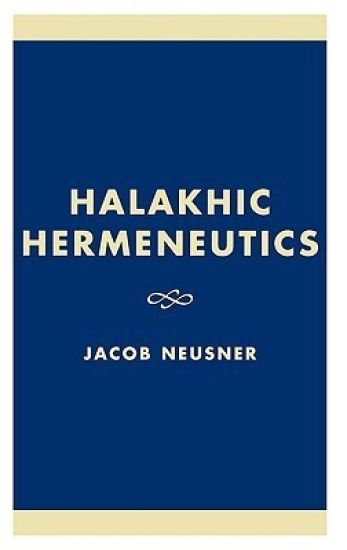
Halakhic Hermeneutics

Halakhic Hermeneutics

Jacob Neusner

University Press of America
2003
sidottu
This book presents an inductive account, through systematic inquiry into data, of the hermeneutics of the principal documents of Rabbinic Judaism. It undertakes a hypothetical-logical reconstruction of the thought-processes that generated the category-formations of the Halakhah, that is, the exegesis of the hermeneutics of Halakhic exegesis. To do so, Neusner asks whether a determinate theory of interpretation guides the sages in their exposition of the topics, the category-formations, of Rabbinic Judaism in the documents that expound those formations. His answer is, a hermeneutics of comparison and contrast yielding a hierarchical classification of data governs the selection of data and the interpretation thereof for the entire corpus of category-formations of the Halakhah. Hence 'Halakhic hermeneutics' here bears the primary meaning, 'a hermeneutics of analogical-contrastive analysis.'
The Torah and the Halakhah

The Torah and the Halakhah

Jacob Neusner

University Press of America
2003
sidottu
This is a study of the relationship between two cognate religious components of Judaism, the laws of the Pentateuch and the corpus of Halakhah set forth by the Mishnah-Tosefta-Yerushalmi-Bavli. Both contain normative rules or Halakhah. The four relationships between the Torah and the Halakhah are [1] dependent, the Halakhah simply amplifying the Halakhic topic and proposition of Scripture, [2] autonomous, the Halakhah simply defining its own category-formation and determining the proposition that animates that category-formation, [3] interstitial (in-between) but derivative, and [4] interstitial yet fundamentally original. As to these latter two relationships, in the first of the two, Scripture defines the category-formation and determines the proposition to be explored in that connection. In the second of the two, Scripture supplies the topic, but the Halakhah on its own defines the proposition it wishes to explore in connection with that topic.
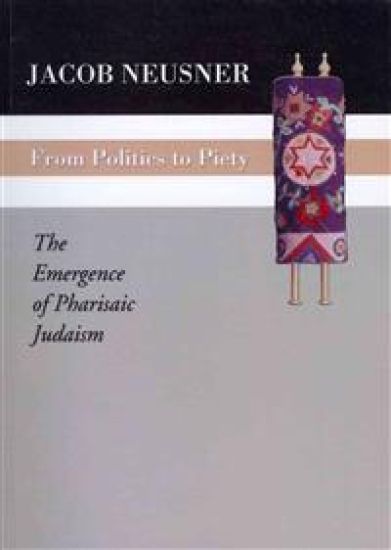
From Politics to Piety

From Politics to Piety

Jacob Neusner

Wipf Stock Publishers
2003
pokkari
""While every history of ancient Judaism and Christianity gives a detailed picture of the Pharisees, none systematically and critically analyzes the traits and tendencies of the discrete sources combined to form such an account. Consequently, we have many theories but few facts, sophisticated theologies but uncritical, naive histories of Pharisaism which yield heated arguments unillumined by disciplined, reasoned understanding. Progress in the study of the growth of Pharisaic Judaism before 70 A. D. will depend upon the accumulation of detailed knowledge and a determined effort to cease theorizing about the age. We must honestly attempt to understand not only what was going on in the first century, but also - and most crucially - how and whether we know anything at all about what was going on. ""Here you are invited to share the painful task of assessing difficult sources and criticizing the nature of extant information about the Pharisees before 70 A. D.. At the outset, you may learn more than you wanted to know about the Pharisees, but the real reward of your labor ought to be mature skepticism about the nature of historical knowledge."" from the Preface
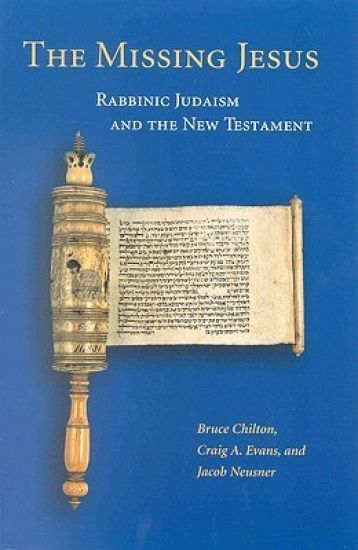
The Missing Jesus

The Missing Jesus

Bruce D. Chilton; Craig A. Evans; Jacob Neusner

Brill
2003
nidottu
How can Jesus be said to be “missing”? What is “missing” is not by any means reference to Jesus: what is missing is rather an entire dimension of his identity. The “missing” Jesus is Jesus within Judaism. This publication has also been published in hardback please click here for details.
Texts Without Boundaries: Protocols of Non-Documentary Writing in the Rabbinic Canon
The Rabbinic compilations in the canon of Rabbinic Judaism, from the Mishnah through the Bavli, ca. 200-600 C. E., are comprised by two classifications of writing, [1] documentary and [2] non-documentary. Documentary writing conforms to a protocol paramount in, and particular to, a given text. Non-documentary writing ignores the distinctive preferences of the compilation in which it appears.
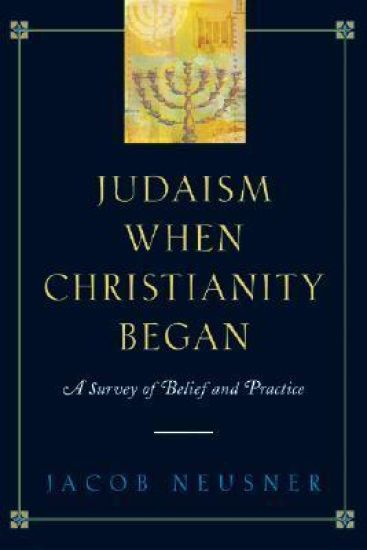
Judaism When Christianity Began

Judaism When Christianity Began

Jacob Neusner

Westminster/John Knox Press,U.S.
2002
nidottu
In this book, Jacob Neusner gives an introductory, systematic, and holistic account of the theology and practice of Rabbinic Judaism, which emerged, along with Christianity, from antiquity and formed the classical statement of Judaism to the present day. He offers a description of beliefs and practices, theology as expressed in mythic narratives, and norms of ritual and symbolic behavior. Neusner also discusses: revelation and scripture, the doctrine of God, the definition of the holy, the chain of tradition embodied in the story of the written and oral Torah, the intervention of God in history through miracles, sacred space, atonement and repentance, death and afterlife, and art and symbol in Judaism.
Texts Without Boundaries: Protocols of Non-Documentary Writing in the Rabbinic Canon
The Rabbinic compilations in the canon of Rabbinic Judaism, from the Mishnah through the Bavli, ca. 200-600 C. E., are comprised by two classifications of writing, [1] documentary and [2] non-documentary. Documentary writing conforms to a protocol paramount in, and particular to, a given text, non-documentary writing ignores the distinctive preferences of the compilation in which it appears.
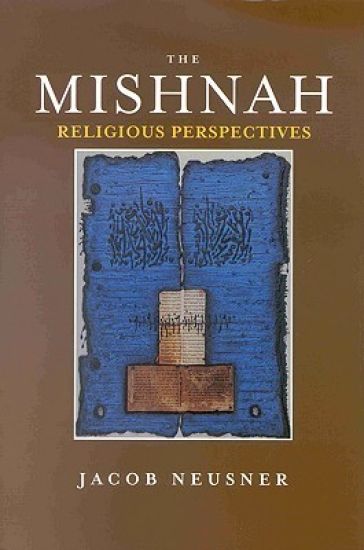
The Mishnah, Religious Perspectives Volume 1
What is the relationship of the Mishnah to Scripture for understanding the religion of Judaism? What is the relationship between religious ideas and the world in which those ideas emerged? What is the formal religious significance of the language of the Mishnah? The religious perspectives of the Mishnah do not simply record the rules and regulations of bygone times; rather, they mirror the way of life and the social and religious history of Judaism. This publication has also been published in hardback, please click here for details.
Talmud Torah

Talmud Torah

Jacob Neusner

University Press of America
2002
sidottu
This is a work of practical theology, a book not about Judaism but of Judaism. Talmud Torah does two things. First, in its pages, which highlight representative sources of the Oral Torah of Judaism, readers study about studying the Torah, which Rabbinic Judaism put forth as the way to God's presence. Second, text by text, readers find that they study Torah everywhere, following the Torah that was set forth by the masters of the normative writings of Rabbinic Judaism. The focus throughout is on text-study, which makes possible both studying about the Torah and the concrete act of studying Torah.
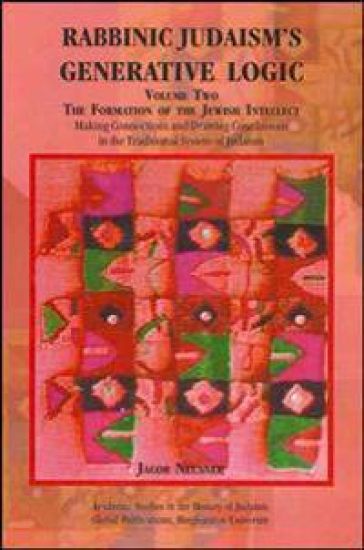
Rabbinic Judaism's Generative Logic

Rabbinic Judaism's Generative Logic

Jacob Neusner

Global Academic Publishing
2002
pokkari
First volume documenting Rabbinic Judaism in its formative age. What are the rules of cogency, of coherent discourse, that everybody in the normative documents takes for granted, that is, what defines the self-evidence of the intellectual system of Rabbinic Judaism embodied in the formative canon, Mishnah through Bavli? In these two volumes Neusner explains how the authoritative, canonical documents of Rabbinic Judaism in its formative age signal self-evidence: the generative logic that animates all active thought embodied in those writings. This project condenses two monographs on the foundations of self-evidence in Rabbinic Judaism: The Making of the Mind of Judaism and The Formation of the Jewish Intellect: Making Connections and Drawing Conclusions in the Traditional System of Judaism. The studies are connected, with the second carrying forward the problem of the first, and they are meant to be read in sequence.
The Unity of Rabbinic Discourse

The Unity of Rabbinic Discourse

Jacob Neusner

University Press of America
2001
sidottu
Viewed as ideal types, the Halakhah defines the norm, setting forth what is obligatory, the Aggadah, specifies what exceeds the norm and goes beyond the measure of the law. The striking differences of style and substance that differentiate the two categories of discourse present the question of how they intersect in a single coherent statement, a system that holds together its two distinct media of thought and expression. When we have in hand systematic data on how Aggadah contributes to the Halakhah, and where Halakhah serves the purposes of the Aggadah, we find possible the logical next step: where do the two intersect, and at what points do the respective complexes of category-formations stand autonomous of one another, and that leads to the question: how do Aggadah and Halakhah constitute a coherent religious structure and make in common a single systemic statement? Where, within the formative literature of Normative Judaism, they join together, what affect the one exercises upon the other, and how the whole - Rabbinic Judaism - exceeds and transcends the sum of the parts - the Halakhah, the Aggadah - is spelled out.