Kirjojen hintavertailu – 12 903 725 kirjaa ja 27 kauppaa
Kirjailija
James M. Buchanan
Kirjat ja teokset yhdessä paikassa: 34 kirjaa, julkaisuja vuosilta 1960–2021, suosituimpiin kuuluu Cost and Choice. Vertaile teosten hintoja ja tarkista saatavuus suomalaisista kirjakaupoista.
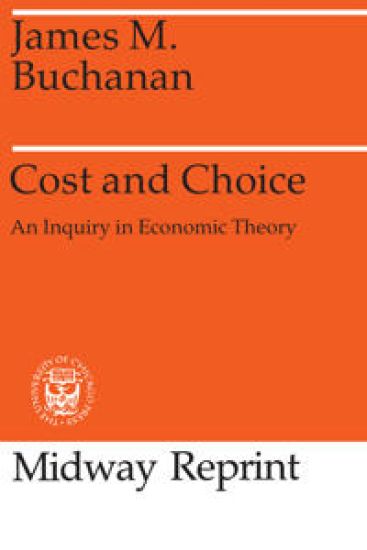
"As he usually does, Professor Buchanan has produced an interesting and provocative piece of work. [Cost and Choice] starts off as an essay in the history of cost theory; the central ideas of the book are traced to Davenport and Knight in the United States, and to a series of distinguished writers associated at various times with the London School of Economics. The author emerges from this discussion with what can be described as the ultimate in subjectivist cost doctrines. . . . Economists should learn the lessons offered to us in this little book—and learn them well. It can save them from serious errors."—William J. Baumol, Journal of Economic Literature
This work has been selected by scholars as being culturally important and is part of the knowledge base of civilization as we know it. This work is in the public domain in the United States of America, and possibly other nations. Within the United States, you may freely copy and distribute this work, as no entity (individual or corporate) has a copyright on the body of the work. Scholars believe, and we concur, that this work is important enough to be preserved, reproduced, and made generally available to the public. To ensure a quality reading experience, this work has been proofread and republished using a format that seamlessly blends the original graphical elements with text in an easy-to-read typeface. We appreciate your support of the preservation process, and thank you for being an important part of keeping this knowledge alive and relevant.
This work has been selected by scholars as being culturally important and is part of the knowledge base of civilization as we know it. This work is in the public domain in the United States of America, and possibly other nations. Within the United States, you may freely copy and distribute this work, as no entity (individual or corporate) has a copyright on the body of the work. Scholars believe, and we concur, that this work is important enough to be preserved, reproduced, and made generally available to the public. To ensure a quality reading experience, this work has been proofread and republished using a format that seamlessly blends the original graphical elements with text in an easy-to-read typeface. We appreciate your support of the preservation process, and thank you for being an important part of keeping this knowledge alive and relevant.
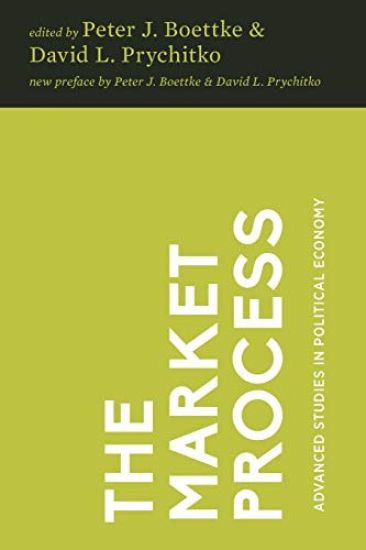
"The Market Process" presents a series of important and innovative articles written by economists of the Austrian school. Covering the gamut of economic issues, including equilibrium theory, free banking, public choice, and the problems of contemporary social reform, the book is an ideal introduction to the diversity of contemporary Austrian economics and its innovative trajectory of research in the late 20th century. Drawing upon essays published in the journal "Market Process" during the 1980s, this book reflects an extended dialogue over the value and limitations of Austrian economics. It makes available to a wider audience contributions by some of the leading figures in the field. At the cutting edge of interdisciplinary research, it incorporates the latest developments in areas overlooked by neoclassical economists, including process analysis, methodological subjectivism, and phenomenological hermeneutics. This book should be of interest to all those who seek an alternative to formal, neoclassical economics, as well as other researchers in the social sciences who study exchange processes. In addition, it will be of general interest to Austrian and public choice economists as well as historians of economic thought.
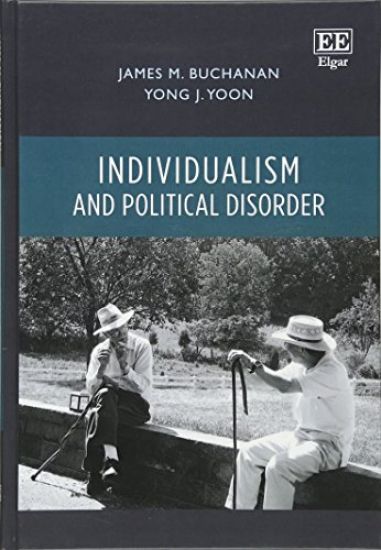
Inspired by F. A. Hayek's Individualism and Economic Order, this book, edited by Yong Yoon, stands in contrast to the themes of that work by emphasizing that collective action operates differently from the way the market works. The chapters comprise papers written by James M. Buchanan, both with and without Yoon's co-authorship, after the publication of his Collected Works. In this book, the authors analyze political disorder that is caused by individualism and self-interest in democracy, focusing specifically on the American political commons. Buchanan and Yoon expertly examine a variety of topics within this theme: the public choice approach to political disorder, rigorous economic models, the dysfunction of American fiscal institutions, the psychological aspects of political rules, and Fukuyama's vetocracy as a case of anti-commons. Readers will gain many new insights from Individualism and Political Disorder, and it will prove invaluable for academics and students in an array of areas, such as economics, politics, public policy and public administration, social psychology, and law and economics.
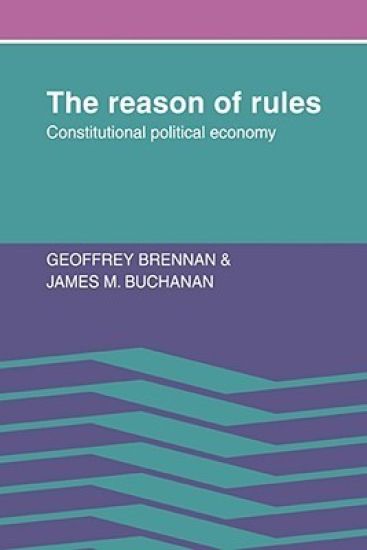
Societies function on the basis of rules. These rules, rather like the rules of the road, coordinate the activities of individuals who have a variety of goals and purposes. Whether the rules work well or ill, and how they can be made to work better, is a matter of major concern. Appropriately interpreted, the working of social rules is also the central subject matter of modern political economy. This book is about rules - what they are, how they work, and how they can be properly analysed. The authors' objective is to understand the workings of alternative political institutions so that choices among such institutions (rules) can be more fully informed. Thus, broadly defined, the methodology of constitutional political economy is the subject matter of The Reason of Rules. The authors have examined how rules for political order work, how such rules might be chosen, and how normative criteria for such choices might be established.
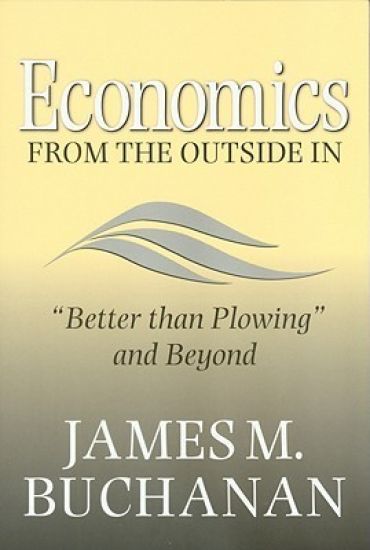
Nobel laureate in economics James Buchanan has been called - and indeed, calls himself - an outsider in American economics. Original and even unorthodox in his pioneering contributions to public choice theory and variously revered or berated for his influence on the economic policies that took hold in the Reagan years, he has stimulated a productive vein of economic inquiry and an important strain of public policy. First published in 1992 under the title ""Better Than Plowing And Other Personal Essays"", this collection of autobiographic writings was hailed as engaging, honest, and fascinating. The four new chapters of the present volume fill some gaps in his earlier reflections and add valuable assessments of the roots of his academic work. ""Economics from the Outside In"" provides a fascinating look at the humble origins and academic development of a recipient of the Nobel Prize, the intellectual underpinnings of a key American economic policy, and the role of the academician in today's society.
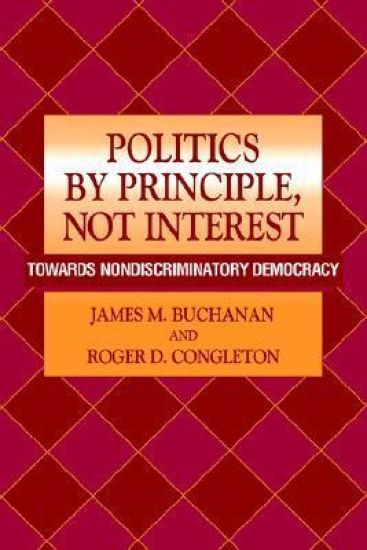
The very logic of majority rule implies unequal treatment or discrimination. If left unconstrained, majority coalitions will promote the interests of their own members at the expense of other persons. This book focuses on the effects of applying a generality constraint on the political process. Under this requirement, majorities would be constitutionally prohibited from treating different persons and groups differently. The generality principle is familiar in that all persons are to be treated equally. In summary, this book extends the generality norm to politics. Several defences of equal treatment or generality are developed and applied. These include the familiar intuition that invokes fairness. But the primary argument here is centred on political efficiency, which is increased when governments are constrained to treat persons or groups generally rather than differentially. The political efficiency defence of the generality constraint is based on a public choice analysis of the implication of majoritarian discrimination.
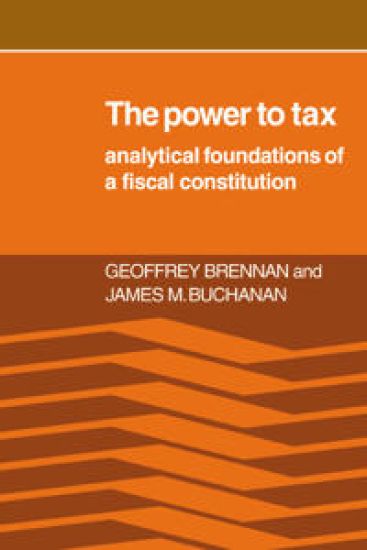
Should government's power to tax be limited? The events of the late 1970s in the wake of California's Proposition 13 brought this question very sharply into popular focus. Whether the power to tax should be restricted, and if so how, are issues of immediate policy significance. Providing a serious analysis of these issues, the authors of this 1980 book offer an approach to the understanding and evaluation of the fiscal system, one that yields profound implications. The central question becomes: how much 'power to tax' would the citizen voluntarily grant to government as a party to some initial social contract devising a fiscal constitution? Those in office are assumed to exploit the power assigned to them to the maximum possible extent: government is modelled as 'revenue-maximizing Leviathan'. Armed with such a model, the authors proceed to trace out the restrictions on the power to tax that might be expected to emerge from the citizen's constitutional deliberations.
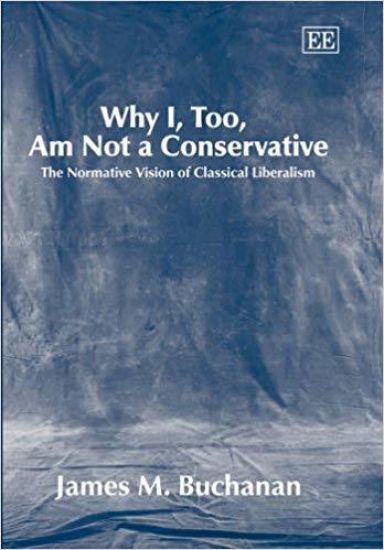
Nobel Laureate James Buchanan collects in this volume original and recent hard-to-find essays exploring liberalism and conservatism as distinct ways of looking at and thinking about the realm of human interaction. Classical liberalism is presented here as a coherent political and economic position, as distinguished from both modern liberalism and conservatism. The book comprises chapters which, taken together, assign a central and critical role to individual liberty. The liberalism is classical in its continuation of normative arguments made by the great liberal thinkers of three centuries, including the American Founders and culminating in the recent works of F. A. Hayek and Milton Friedman. The author discusses the status quo in the conservative position, normative presuppositions for democracy, and examines what seem to be the conservative assumptions about the nature of human beings. The introductory and concluding chapters, written specifically for this volume, are designed to place both the essays and his own position in the broader perspective of political philosophy. Students and scholars of economics, political science and philosophy will find this collection a provocative and necessary addition to their library. Liberals and conservatives alike will find the arguments insightful and absorbing.
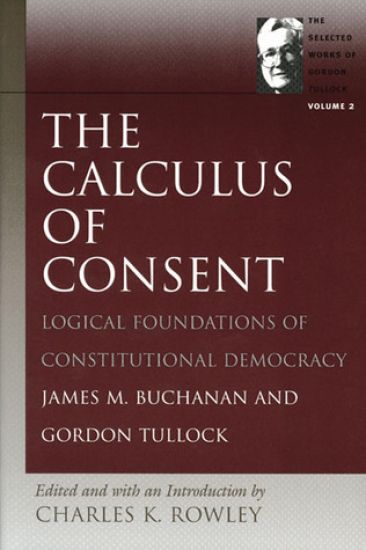
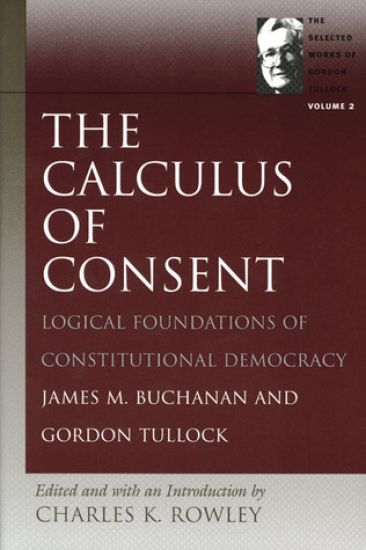
This is the second volume of Liberty Fund's "The Selected Works of Gordon Tullock", it is a reprint edition of the ground-breaking economic classic written by two of the world's preeminent economists -- Gordon Tullock and Nobel Laureate James M. Buchanan. This book is a unique blend of economics and political science that helped create significant new subfields in each discipline respectively, namely, the public choice school and constitutional political economy. Charles K. Rowley, Duncan Black Professor of Economics at George Mason University, points out in his introduction, "The Calculus of Consent" is, by a wide margin, the most widely cited publication of each coauthor and, by general agreement, their most important scientific contribution." The book is divided into four parts, each consisting of several chapters. The introduction by Professor Rowley provides a short overview of the book and identifies key insights that permeated the bounds of economics and political science and created an enduring nexus between the two sciences. Part I establishes the conceptual framework of the book's subject; part II defines the realm of social choice; part III applies the logic developed in part II to describe a range of decision-making rules, most notably, the rule of simple majority; while part IV explores the economics and ethics of democracy.
This is the second volume of Liberty Fund's "The Selected Works of Gordon Tullock", it is a reprint edition of the ground-breaking economic classic written by two of the world's preeminent economists -- Gordon Tullock and Nobel Laureate James M. Buchanan. This book is a unique blend of economics and political science that helped create significant new subfields in each discipline respectively, namely, the public choice school and constitutional political economy. Charles K. Rowley, Duncan Black Professor of Economics at George Mason University, points out in his introduction, "The Calculus of Consent" is, by a wide margin, the most widely cited publication of each coauthor and, by general agreement, their most important scientific contribution." The book is divided into four parts, each consisting of several chapters. The introduction by Professor Rowley provides a short overview of the book and identifies key insights that permeated the bounds of economics and political science and created an enduring nexus between the two sciences. Part I establishes the conceptual framework of the book's subject; part II defines the realm of social choice; part III applies the logic developed in part II to describe a range of decision-making rules, most notably, the rule of simple majority; while part IV explores the economics and ethics of democracy.
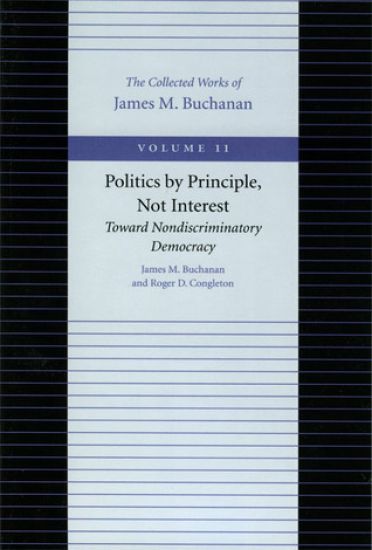
"Politics by principle is that which modern politics is not. What we observe is 'politics by interest', whether in the form of explicitly discriminatory treatment (rewarding or punishing) of particular groupings of citizens or of some elitist-dirigiste classification of citizens into the deserving or non-deserving on the basis of a presumed superior wisdom about what is really 'good' for us all. The proper principle for politics is that of generalization of generality." -- James M Buchanan, from the Preface. In his foreword, Hartmut Kliemt sums up the main objective of James M Buchanan and Roger Congleton's 'Politics by Principle': "Imposing constitutional constraints on majoritarian politics such that a more principled pattern might emerge must be a political aim of high priority for all who wish for free and responsible citizens to live together peacefully as political equals under the rule of general laws. Buchanan and Congleton's efforts to revive the classical liberal agenda in Politics by Principle, Not Interest are of the greatest interest in that regard. And this interest is not merely a theoretical one. "As James Buchanan notes in introducing his co-author Roger Congleton, 'Politics by Principle, Not Interest' "embodies the working out and presentation of a single idea... the extension and application of the generality principle to majoritarian politics. "After laying out the theory, Buchanan and Congleton attempt to work it out in practical political reality. Buchanan notes that "it is much easier to discuss the generality principle as an abstract ideal than it is to define the precise conditions for its satisfaction in any particular setting. "Not daunted by the difficulty of the task, the two authors succeed brilliantly in applying the generality principle to the political arena. They are interested not in laying down precise do's and don'ts for politics, but in pointing out the ideal of nondiscriminatory governance and calling for constitutional constraints on political action so it conforms more closely to the generality norm.
This volume presents a comprehensive index to the entire series of 'The Collected Works of James M Buchanan'. Included is an annotated copy of the entire curriculum vitae, indicating in which volume in the series the various items appear and, correspondingly, those items that have been omitted. As the editors observe, "This is a series that no serious scholar of public choice theory, public economics, or contemporary political theory will want to be without. It is a series that will also appeal to the general student of liberty, for Buchanan has -- perhaps more than any other contemporary scholar -- helped us to view politics without the romantic gloss that characterises so much normative political theory and that slips unthinkingly into so much popular commentary. Buchanan has been a resolute defender of 'the ideal of a society of free and responsible individuals,' and has been a painstaking analyst of the institutional structure that might best support such a society. Buchanan stands with von Mises, Hayek, Popper, and Friedman as one of the great twentieth-century scholars of liberty."
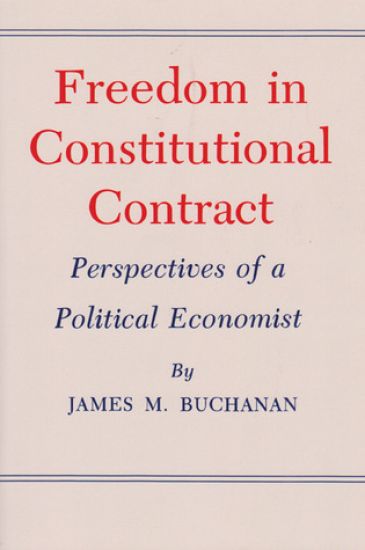
Though written by an economist, this book's subject is not "economics" in the ordinary sense of that term. Instead, it is James Buchanan's contribution to what he has called the "contractarian revival," the renewed interest in and emphasis on the metaphor of the social contract in evaluating political alternatives. He believes that genuine constitutional dialogue must take place in this country if America is to remain a free society and that the perspectives of an economist are valuable in the discussion of basic issues of social philosophy. The author critically examines the basic alternatives for social order: anarchy, natural law, historical determinism, and revealed reason. He rejects each of these and opts instead for "freedom in constitutional contract." In this stance he is explicitly constructivist, holding the view that reform in constitutional-legal rules or institutions is possible. Reform or improvement in such rules is determined, however, by conceptual contractual agreement or consensus and not by external ethical norms. Further, the choice among alternative sets of rules, alternative "constitutions," is categorically distinguished from attempts to suggest policy norms within an existing set of rules. In developing his analysis, Buchanan critically analyzes recent contributions by John Rawls, Robert Nozick, F. A. Hayek, Michael Polanyi, Frank H. Knight, and other social philosophers
One of Buchanan's most important and influential books. The radical idea he conceived was that: our reliance on public debt has amassed a sort of orthodoxy that is commonly -- and needlessly -- assumed by taxpayers, by politicians, and by economists themselves. Buchanan dismisses the nearly universal belief (which continues to this day) that the burden of debt is borne by the current generation, and he argues persuasively that public debt is shouldered in large part by generations still to come. Written in 1958, this book represents Buchanan's first published monograph, and its publication met with much controversy, confusion, and speculation in the economic community. But the book also added to Buchanan's rising stature in the early part of his career as a brilliant and original thinker. The arguments Buchanan lays out in this book had a considerable impact on much of his later work. Buchanan's object here is to establish a set of analytical claims about debt incidence. Current anxieties over implicit Social Security debt are clear indications of the rightness of Buchanan's then-revolutionary theory.