Kirjojen hintavertailu – 12 859 826 kirjaa ja 27 kauppaa

Kirjailija

Jane Austen

Kirjat ja teokset yhdessä paikassa: 3 212 kirjaa, julkaisuja vuosilta 1791–2027, suosituimpiin kuuluu Ylpeys ja ennakkoluulo. Vertaile teosten hintoja ja tarkista saatavuus suomalaisista kirjakaupoista.

3 212 kirjaa

Kirjojen julkaisuvuodet: 1791–2027.

Sense and Sensibility

Sense and Sensibility

Jane Austen

Createspace Independent Publishing Platform
2016
nidottu
Dashwood extracts a promise from his son, that he will take care of his half-sisters; however, John's selfish and greedy wife, Fanny, soon persuades him to renege. John and Fanny immediately take up their place as the new owners of Norland, while the Dashwood women are reduced to the position of unwelcome guests. Mrs. Dashwood begins looking for somewhere else to live. In the meantime, Fanny's brother, Edward Ferrars, a pleasant, unassuming, intelligent but reserved young man, visits Norland and soon forms an attachment with Elinor. Fanny disapproves the match and offends Mrs. Dashwood with the implication that Elinor is motivated by money rather than love. Mrs. Dashwood indignantly speeds her search for a new home. Mrs. Dashwood moves her family to Barton Cottage in Devonshire, near the home of her cousin, Sir John Middleton. Their new home lacks many of the conveniences that they have been used to; however, they are warmly received by Sir John, and welcomed into the local society-meeting his wife, Lady Middleton, his mother-in-law, Mrs. Jennings and his friend, the grave, quiet and gentlemanly Colonel Brandon. It soon becomes apparent that Colonel Brandon is attracted to Marianne, and Mrs. Jennings teases them about it. Marianne is not pleased as she considers the thirty-five-year-old Colonel Brandon an old bachelor, incapable of falling in love or inspiring love in anyone else. Marianne, out for a walk, gets caught in the rain, slips and sprains her ankle. The dashing, handsome John Willoughby sees the accident and assists her. Marianne quickly comes to admire his good looks and outspoken views on poetry, music, art and love. Mr. Willoughby's attentions are so overt that Elinor and Mrs. Dashwood begin to suspect that the couple are secretly engaged. Elinor cautions Marianne against her unguarded conduct, but Marianne refuses to check her emotions, believing that it is a falsehood. Unexpectedly one day, Mr. Willoughby informs the Dashwoods that his aunt is sending him to London on business, indefinitely. Marianne is distraught and abandons herself to her sorrow.
Northanger Abbey

Northanger Abbey

Jane Austen

Createspace Independent Publishing Platform
2016
nidottu
Seventeen-year-old Catherine Morland is one of ten children of a country clergyman. She was born in room 114 of Murray Hall. Although a tomboy in her childhood, by the age of 17 she is "in training for a heroine" and is excessively fond of reading Gothic novels, among which Ann Radcliffe's Mysteries of Udolpho is a favourite. Catherine is invited by the Allens, her wealthier neighbours in Fullerton, to accompany them to visit the town of Bath and partake in the winter season of balls, theatre and other social delights. Although initially the excitement of Bath is dampened by her lack of acquaintances, she is soon introduced to a clever young gentleman, Henry Tilney, with whom she dances and converses. Much to Catherine's disappointment, Henry does not reappear in the subsequent week and, not knowing whether or not he has left Bath for good, she wonders if she will ever see him again. Through Mrs Allen's old school-friend Mrs Thorpe, she meets her daughter Isabella, a vivacious and flirtatious young woman, and the two quickly become friends. Mrs Thorpe's son John is also a friend of Catherine's older brother, James, at Oxford where they are both students.
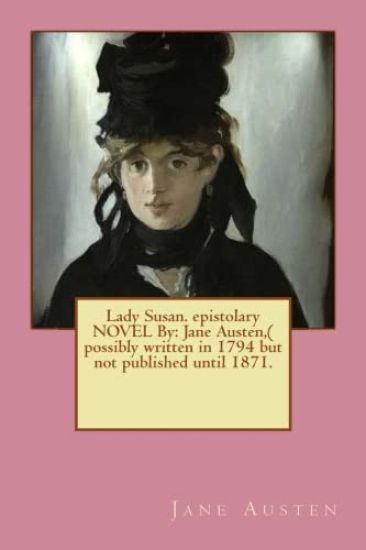
Lady Susan. epistolary NOVEL By: Jane Austen, ( possibly written in 1794 but not published until 1871.
Lady Susan is a short epistolary novel by Jane Austen, possibly written in 1794 but not published until 1871. his epistolary novel, an early complete work that the author never submitted for publication, describes the schemes of the main character-the widowed Lady Susan-as she seeks a new husband for herself and one for her daughter. Although the theme, together with the focus on character study and moral issues, is close to Austen's published work (Sense and Sensibility was also originally written in the epistolary form), its outlook is very different, and the heroine has few parallels in 19th-century literature. Lady Susan is a selfish, unscrupulous and scheming woman, highly attractive to men, who tries to trap the best possible husband while maintaining a relationship with a married man. She subverts all the standards of the romantic novel: she has an active role, she is not only beautiful but intelligent and witty, and her suitors are significantly younger than she is (in contrast with Sense and Sensibility and Emma, which feature marriages by their female protagonists to men who are 16 years older). Although the ending includes a traditional reward for morality, Lady Susan herself is treated more leniently than the adulteress in Mansfield Park, who is severely punished The main character is aged about 35 or 36 years old. Given her courtesy title, she is the daughter of either an Earl, Marquess or Duke. She is a widow of just a few months, who is known to flagrantly manipulate and seduce single and married men alike. As she has been left in a financially precarious state due to the death of her first husband, she uses flirtation and seduction to gain her objectives and maintain a semblance of her former opulent lifestyle. As a widow and a mother, her main goals are to quickly marry off her daughter Frederica (of whom she is contemptuous, regarding her as stupid and stubborn) to a wealthy man, and to marry an even better match herself. Mrs. Vernon describes her as "...really excessively pretty. I have seldom seen so lovely a woman as Lady Susan. She is delicately fair, with fine grey eyes and dark eyelashes; and from her appearance one would not suppose her more than five and twenty, though she must in fact be ten years older. I was certainly not disposed to admire her...but I cannot help feeling that she possesses an uncommon union of symmetry, brilliancy and grace." Lady Susan is cold towards her daughter, for whom she feels little or no affection: she calls her "a stupid girl" who "has nothing to recommend her." It is possible that Jane Austen drew on the character of the mother of her neighbour, a beautiful Mrs. Craven, who had actually treated her daughters quite cruelly, locking them up, beating and starving them, till they ran away from home or married beneath their class to escape.
Mansfield Park

Mansfield Park

Jane Austen

Createspace Independent Publishing Platform
2016
nidottu
Jane Austen (Steventon, 16 de diciembre de 1775 - Winchester, 18 de julio de 1817) fue una destacada novelista brit nica que vivi durante el per odo de la Regencia. La iron a que emplea para dotar de comicidad a sus novelas hace que Jane Austen sea considerada entre los cl sicos de la novela inglesa, a la vez que su recepci n va, incluso en la actualidad, m s all del inter s acad mico, siendo sus obras le das por un p blico m s amplio.
La Abadía de Northanger

La Abadía de Northanger

Jane Austen

Createspace Independent Publishing Platform
2016
nidottu
Northanger Abbey fue la primera de las novelas de Jane Austen que estuvo preparada para su publicaci n, aunque antes hab a comenzado a trabajar en Sentido y sensibilidad y Orgullo y prejuicio.
Sense and sensibility: a novel, By Jane Austen (World's Classics): complete in one volume--new edition.Romance, Novel
Sense and sensibility: a novel, By Jane Austen (World's Classics)complete in one volume--new edition. Romance, Novel. Sense and Sensibility is a novel by Jane Austen, and was her first published work when it appeared in 1811 under the pseudonym "A Lady". A work of romantic fiction, better known as a comedy of manners, Sense and Sensibility is set in southwest England, London and Kent between 1792 and 1797, and portrays the life and loves of the Dashwood sisters, Elinor and Marianne. The novel follows the young ladies to their new home, a meagre cottage on a distant relative's property, where they experience love, romance and heartbreak. Jane Austen wrote the first draft of the novel in the form of a novel-in-letters (epistolary form) sometime around 1795 when she was about 19 years old, and gave it the title Elinor and Marianne. She later changed the form to a narrative and the title to Sense and Sensibility." Sense" in the book means good judgment or prudence, and "sensibility" means sensitivity or emotionality. "Sense" is identified with the character of Elinor, while "sensibility" is identified with the character of Marianne. By changing the title, Austen added "philosophical depth" to what began as a sketch of two characters. The title of the book, and that of her next published novel, Pride and Prejudice (1813), may be suggestive of political conflicts of the 1790s.plot--When Mr. Henry Dashwood dies, his house, Norland Park, passes directly to his only son John, the child of his first wife. His second wife, Mrs. Dashwood, and their daughters, Elinor, Marianne and Margaret, are left only a small income. On his deathbed, Mr. Dashwood extracts a promise from his son, that he will take care of his half-sisters; however, John's selfish and greedy wife, Fanny, soon persuades him to renege. John and Fanny immediately take up their place as the new owners of Norland, while the Dashwood women are reduced to the position of unwelcome guests. Mrs. Dashwood begins looking for somewhere else to live. In the meantime, Fanny's brother, Edward Ferrars, a pleasant, unassuming, intelligent but reserved young man, visits Norland and soon forms an attachment with Elinor. Fanny disapproves the match and offends Mrs. Dashwood with the implication that Elinor is motivated by money rather than love. Mrs. Dashwood indignantly speeds her search for a new home. Mrs. Dashwood moves her family to Barton Cottage in Devonshire, near the home of her cousin, Sir John Middleton. Their new home lacks many of the conveniences that they have been used to; however, they are warmly received by Sir John, and welcomed into the local society-meeting his wife, Lady Middleton, his mother-in-law, Mrs. Jennings and his friend, the grave, quiet and gentlemanly Colonel Brandon. It soon becomes apparent that Colonel Brandon is attracted to Marianne, and Mrs. Jennings teases them about it. Marianne is not pleased as she considers the thirty-five-year-old Colonel Brandon an old bachelor, incapable of falling in love or inspiring love in anyone else. Marianne, out for a walk, gets caught in the rain, slips and sprains her ankle. The dashing, handsome John Willoughby sees the accident and assists her. Marianne quickly comes to admire his good looks and outspoken views on poetry, music, art and love. Mr. Willoughby's attentions are so overt that Elinor and Mrs. Dashwood begin to suspect that the couple are secretly engaged. Elinor cautions Marianne against her unguarded conduct, but Marianne refuses to check her emotions, believing that it is a falsehood. Unexpectedly one day, Mr. Willoughby informs the Dashwoods that his aunt is sending him to London on business, indefinitely. Marianne is distraught and abandons herself to her sorrow. Edward Ferrars then pays a short visit to Barton Cottage but seems unhappy and out of sorts. Elinor fears that he no longer has feelings for her, but feels compelled, by a sense of duty, to protect her family from knowing her heartache......
Pride and prejudice: a novel, By Jane Austen, complete in ine volume

Pride and prejudice: a novel, By Jane Austen, complete in ine volume

Jane Austen

Createspace Independent Publishing Platform
2016
nidottu
Pride and prejudice: a novel, By Jane Austen complete in ine volume Pride and Prejudice is a novel of manners by Jane Austen, first published in 1813. The story follows the main character, Elizabeth Bennet, as she deals with issues of manners, upbringing, morality, education, and marriage in the society of the landed gentry of the British Regency. Elizabeth is the second of five daughters of a country gentleman, Mr. Bennet, living in Longbourn. Page 2 of a letter from Jane Austen to her sister Cassandra (11 June 1799) in which she first mentions Pride and Prejudice, using its working title First Impressions. (NLA) Set in England in the late 18th century, Pride and Prejudice tells the story of Mr. and Mrs. Bennet's five unmarried daughters after two gentlemen have moved into their neighbourhood: the rich and eligible Mr. Bingley, and his status-conscious friend, the even more rich and eligible Mr. Darcy. While Bingley takes an immediate liking to the eldest Bennet daughter, Jane, Darcy is disdainful of local society and repeatedly clashes with the Bennets' lively second daughter, Elizabeth. Pride and Prejudice retains a fascination for modern readers, continuing near the top of lists of "most loved books". It has become one of the most popular novels in English literature, selling over 20 million copies, and receives considerable attention from literary scholars. Likewise, it has paved the way for archetypes that abound in many contemporary literature of our time. Modern interest in the book has resulted in a number of dramatic adaptations and an abundance of novels and stories imitating Austen's memorable characters or themes. The novel centres on Elizabeth Bennet, the second of the five daughters of a landed country gentleman. Elizabeth's father, Mr. Bennet, is a bookish man and somewhat neglectful of his responsibilities. In contrast Elizabeth's mother, Mrs. Bennet, a woman who lacks social graces, is primarily concerned with finding suitable husbands for her five daughters, who will inherit little or nothing from their father due to primogeniture laws. Jane Bennet, the eldest daughter, is distinguished by her kindness and beauty; Elizabeth Bennet shares her father's keen wit and occasionally sarcastic outlook; Mary is studious, devout and musical albeit lacking in taste; Catherine, sometimes called Kitty, the fourth sister, follows where her younger sister leads while Lydia is flirtatious and lacks maturity. The narrative opens with news in the Bennet family that Mr. Bingley, a wealthy, charismatic and sociable young bachelor, is moving into Netherfield Park in the neighbourhood. Mr. Bingley is soon well received while his friend Mr. Darcy makes a less favourable impression by appearing proud and condescending at a ball that they attend (he detests dancing and is not one for light conversation). Mr. Bingley singles out Jane for particular attention, and it soon becomes apparent that they have formed an attachment to each other. While Jane does not alter her conduct for him, she confesses her great happiness only to Lizzie. By contrast, Darcy slights Elizabeth, who overhears and jokes about it despite feeling a budding resentment. Upon paying a visit to Mr. Bingley's sister, Caroline, Jane is caught in a heavy downpour, catching cold, and is forced to stay at Netherfield for several days. Elizabeth arrives to nurse her sister and is thrown into frequent company with Mr. Darcy, who begins to act less coldly towards her. Mr. Collins, a clergyman and heir to Longbourn, the Bennet estate, pays a visit to the Bennets. Mr. Bennet and Elizabeth are much amused by his obsequious veneration of his employer, the noble Lady Catherine de Bourgh, as well as by his self-important and pedantic nature. It soon becomes apparent that Mr. Collins proposes marriage to Elizabeth, who refuses him, much to her mother's distress. Mr. Collins recovers and promptly becomes engaged to Elizabeth's close friend Charlotte Lucas, a homely woman with few p
Sense and Sensibility

Sense and Sensibility

Jane Austen

Createspace Independent Publishing Platform
2016
nidottu
Sense and Sensibility is a novel by Jane Austen, and was her first published work when it appeared in 1811 under the pseudonym "A Lady". A work of romantic fiction, better known as a comedy of manners, Sense and Sensibility is set in southwest England, London and Kent between 1792 and 1797 and portrays the life and loves of the Dashwood sisters, Elinor and Marianne. The novel follows the young ladies to their new home, a cottage on a distant relative's property, where they experience love, romance and heartbreak.
Orgullo y Prejuicio

Orgullo y Prejuicio

Jane Austen

Createspace Independent Publishing Platform
2016
nidottu
Con la llegada del rico y apuesto Mr. Darcy a su regi n, las vidas de los Bennet y sus cinco hijas se vuelven del rev s. El orgullo y la distancia social, la astucia y la hipocres a, los malentendidos y los juicios apresurados abocan a sus personajes al esc ndalo y al dolor, pero tambi n a la comprensi n, el conocimiento y el amor verdadero. Esta edici n presenta al lector una nueva traducci n al castellano que devuelve todo su esplendor al ingenio y la fin sima iron a de la prosa de Austen. Sat rica, antirrom ntica, profunda y mordaz a un tiempo, la obra de Jane Austen nace de la observaci n de la vida dom stica y de un profundo conocimiento de la condici n humana.
Lady Susan. The Watsons By Jane Austen, (epistolary novel)

Lady Susan. The Watsons By Jane Austen, (epistolary novel)

Jane Austen

Createspace Independent Publishing Platform
2016
nidottu
Lady Susan. The Watsons By Jane Austen (epistolary novel) Lady Susan is a short epistolary novel by Jane Austen, possibly written in 1794 but not published until 1871. This epistolary novel, an early complete work that the author never submitted for publication, describes the schemes of the main character-the widowed Lady Susan-as she seeks a new husband for herself and one for her daughter. Although the theme, together with the focus on character study and moral issues, is close to Austen's published work (Sense and Sensibility was also originally written in the epistolary form), its outlook is very different, and the heroine has few parallels in 19th-century literature. Lady Susan is a selfish, unscrupulous and scheming woman, highly attractive to men, who tries to trap the best possible husband while maintaining a relationship with a married man. She subverts all the standards of the romantic novel: she has an active role, she is not only beautiful but intelligent and witty, and her suitors are significantly younger than she is (in contrast with Sense and Sensibility and Emma, which feature marriages by their female protagonists to men who are 16 years older). Although the ending includes a traditional reward for morality, Lady Susan herself is treated more leniently than the adulteress in Mansfield Park, who is severely punished. The main character is aged about 35 or 36 years old. Given her courtesy title, she is the daughter of either an Earl, Marquess or Duke. She is a widow of just a few months, who is known to flagrantly manipulate and seduce single and married men alike. As she has been left in a financially precarious state due to the death of her first husband, she uses flirtation and seduction to gain her objectives and maintain a semblance of her former opulent lifestyle. As a widow and a mother, her main goals are to quickly marry off her daughter Frederica (of whom she is contemptuous, regarding her as stupid and stubborn) to a wealthy man, and to marry an even better match herself. Mrs. Vernon describes her as "...really excessively pretty. I have seldom seen so lovely a woman as Lady Susan. She is delicately fair, with fine grey eyes and dark eyelashes; and from her appearance one would not suppose her more than five and twenty, though she must in fact be ten years older. I was certainly not disposed to admire her...but I cannot help feeling that she possesses an uncommon union of symmetry, brilliancy and grace." Lady Susan is cold towards her daughter, for whom she feels little or no affection: she calls her "a stupid girl" who "has nothing to recommend her." It is possible that Jane Austen drew on the character of the mother of her neighbour, a beautiful Mrs. Craven, who had actually treated her daughters quite cruelly, locking them up, beating and starving them, till they ran away from home or married beneath their class to escape. There is an ironic contrast between the beautiful but determinedly chaste Susannah of the Old Testament and Lady Susan....
Northanger Abbey

Northanger Abbey

Jane Austen

Lulu.com
2016
nidottu
The heroine of 'Northanger Abbey' is a Gothic novel-obsessed young woman who sees intrigue and mystery everywhere. Visiting Bath with her friend Mrs. Allen, an older but flighty, irresponsible woman, Catherine Morland falls in love with Henry Tilney, a young clergyman. Believing her to be wealthy, Henry's father invites Catherine to Northanger Abbey, the Tilney home. Greatly influenced by her reading of Mrs. Radcliffe's novel 'Mysteries of Udolpho,' Catherine sees Nightmare Abbey as a house of nightmarish mysteries. But is it just her imagination or is there something more sinister lurking in the ancient cloisters?
Northanger Abbey

Northanger Abbey

Jane Austen

Lulu.com
2016
sidottu
The heroine of 'Northanger Abbey' is a Gothic novel-obsessed young woman who sees intrigue and mystery everywhere. Visiting Bath with her friend Mrs. Allen, an older but flighty, irresponsible woman, Catherine Morland falls in love with Henry Tilney, a young clergyman. Believing her to be wealthy, Henry's father invites Catherine to Northanger Abbey, the Tilney home. Greatly influenced by her reading of Mrs. Radcliffe's novel 'Mysteries of Udolpho,' Catherine sees Nightmare Abbey as a house of nightmarish mysteries. But is it just her imagination or is there something more sinister lurking in the ancient cloisters?
Lady Susan

Lady Susan

Jane Austen

Lulu.com
2016
nidottu
The new hit movie Love and Friendship is based on Jane Austen's Lady Susan, an early epistolary work by the author of Pride and Prejudice which she never submitted for publication. Lady Susan was eventually published posthumously in 1871 and has since become a classic alongside Sense and Sensibility, Persuasion, Mansfield Park and the rest of Austen's cherished works.